


On January 7, 2026, a 37-year-old woman named Renee Nicole Good was shot and killed by a federal immigration agent in Minneapolis. She was behind the wheel of her car, just blocks from her home. She was not a suspect, nor was she wanted for arrest. There is no indication she had committed any crime.
And yet, she died at the hands of the state.
The federal reaction was immediate. Within hours, the Department of Homeland Security released a statement justifying the shooting. Kristi Noem held a press conference. The President echoed the justification online. Officials said the agent had been injured, said the woman was violent, and said the operation was lawful and necessary. Her name was not mentioned. Her death was not mourned.
The events surrounding Renee Good’s death did not represent a singular breakdown. What happened on that Minneapolis street was the result of multiple, compounding failures in planning, restraint, policy, ethics, and basic human decency.
Each one must be examined in full.
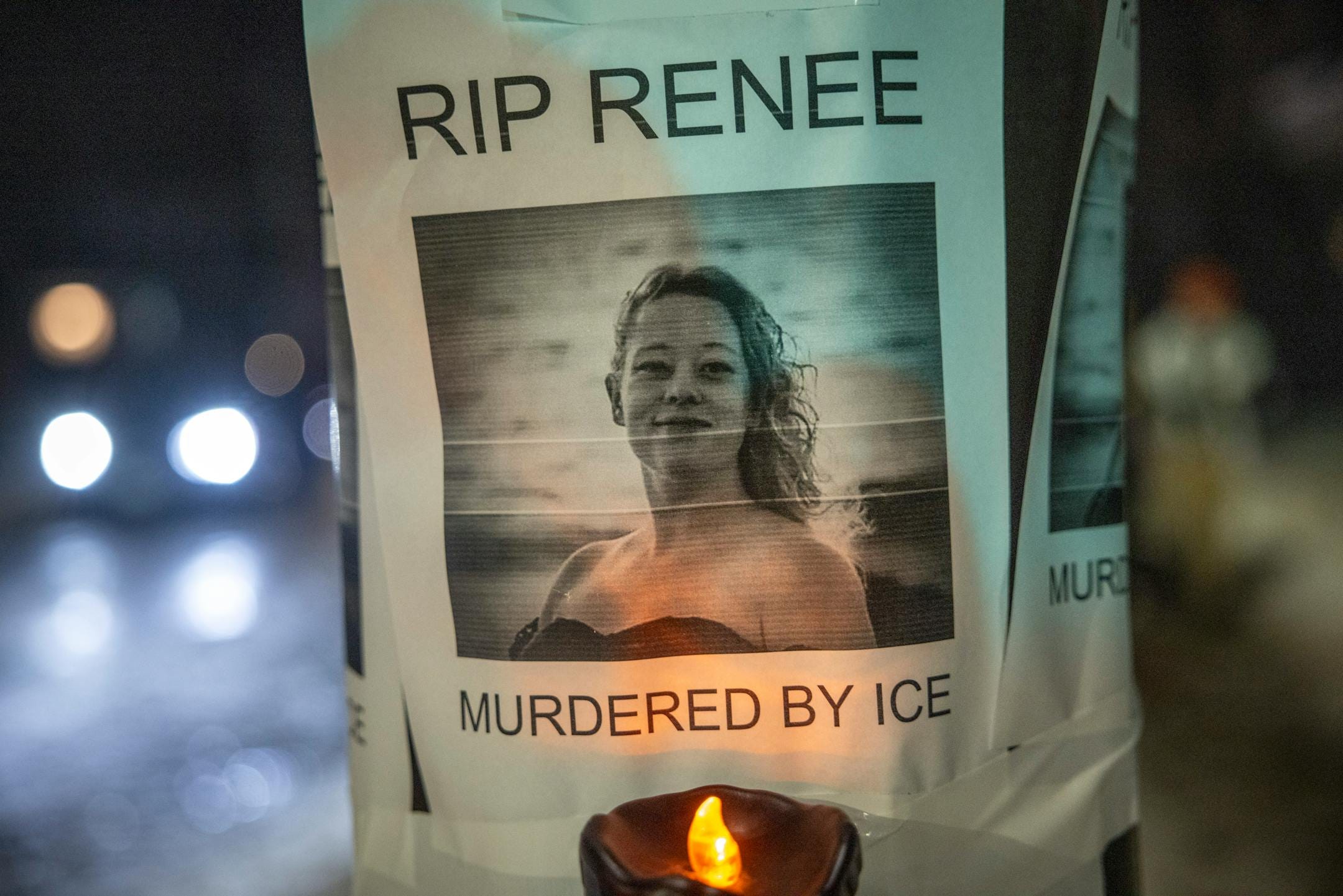
(David Guttenfelder/The New York Times)
Want to Know Your Rights?
Download a free digital copy of the U.S. Constitution, the same document Trump is trying to bulldoze. Learn exactly what he’s breaking, and how to fight back.
100,000+ strong — and counting.
This winter, become a paid subscriber for just $1 a week and help us keep the truth alive.
Join The Coffman Chronicle — $1/Week
A Failure of Discretion
Minneapolis is a city that still lives in the shadow of state violence. In 2020, George Floyd was killed on camera by a police officer, Derek Chauvin. His death triggered national protests and a reckoning around policing in America. In Minneapolis, the response was not just protest but lasting trauma burned into the memory of the city, its institutions, and its people.
George Floyd’s killing was not an aberration. It was the moment the world finally saw, in full and unbroken view, a pattern that Minneapolis residents had been naming for years. Long before 2020, the city carried a documented history of aggressive policing, racially disproportionate use of force, and controversial killings. The deaths of civilians at the hands of law enforcement, repeated findings of misconduct, and longstanding community complaints made clear that Floyd was not a deviation from the norm but an exposure of it.
That history was well known by 2025, when federal enforcement activity in the Twin Cities began to escalate. In June, armed agents from DHS and the FBI were seen at a popular Minneapolis restaurant. Their presence sparked confusion and fear. Photos of tactical gear and rifles circulated online, leading to public protest and growing anxiety about federal activity in civilian spaces. On December 6, ICE agents were filmed confronting a student in a parking lot at Augsburg University. Witnesses said agents pointed weapons at the student and bystanders. The university condemned the incident. Local lawmakers raised alarms about the risks of an unchecked federal presence operating with little transparency or coordination.
See our reporting here:

Just days earlier, on December 1, DHS had formally launched Operation Metro Surge, describing it as a targeted immigration enforcement campaign focused on Minneapolis and Saint Paul. That changed on December 26, when a partisan commentator and YouTuber, Nick Shirley, released a viral video accusing Somali-run day care centers in Minneapolis of defrauding federal childcare programs. The administration quickly seized on the video’s narrative. In the days that followed, officials began reframing the already active surge as a combined immigration and anti-fraud effort.
Then, on January 6, 2026, DHS announced it was deploying 2,000 additional agents to the Twin Cities, now calling the operation the largest immigration enforcement effort in American history.
Less than twenty-four hours later, Renee Nicole Good was dead.
In a city where law enforcement violence had ignited sustained global protest less than six years earlier, DHS and ICE proceeded with a highly militarized surge, inserting masked, armed federal agents into neighborhoods and residential streets. There was no visible de-escalation planning. There was no public briefing with local officials. There was no public-facing plan to prevent the very kind of tragedy that followed. The discretionary judgment that should have stopped such an aggressive posture — in that city, at that scale, after that history — was either ignored or never asked for in the first place.
A Failure of Proportionality
The use of deadly force demands more than fear. It demands justification, not just under policy, but under basic common sense.
A person pulling away in a car does not automatically pose a lethal threat, especially when the car is moving slowly, when the road is blocked, and when no weapon is visible. Video of Renee Good’s final moments shows another vehicle ahead of hers turning around, presumably redirected by agents. Good appears to be doing the same.
As she begins to turn, an agent approaches her locked door, tries to open it, then pulls a weapon. As the vehicle turns, he fires into the vehicle, with one bullet striking the lower corner of the windshield on the driver’s side. The agent appears to fire twice more through the driver’s side window as the vehicle continues to turn away from the agents. Seconds later, the vehicle strikes a pole. The agent is later seen walking nearby, apparently uninjured.
Whatever the facts may be, the force used cannot be explained as proportionate. Fleeing a checkpoint, even if that’s what occurred, is not grounds for a bullet. It’s a basis for pursuit, potentially, but not execution. Agents could have taken down the license plate number or followed the vehicle.
There has been no reporting suggesting that the agents spotted a drawn weapon or any other indicator of risk beyond the vehicle turning away.
Proportionality asks one core question: Did the action taken match the actual danger posed? Here, the answer is no.
A Failure of Policy
The Department of Homeland Security updated its use-of-force policy in 2022. It states clearly that agents may use deadly force only when there is a reasonable belief that the subject poses an imminent threat of death or serious physical injury to the officer or another person. ICE’s internal guidance further reinforces these restrictions and discourages the use of firearms against moving vehicles unless the vehicle itself poses an immediate threat, specifically due to the risk of crossfire harming bystanders, like those filming the incident.
None of these standards appears to have been met in the shooting of Good.
Moreover, standard federal policy and best practice across law enforcement require that when an agent uses lethal force, they are removed from the scene, their weapon is taken for evidence, and a review process begins immediately. In this case, the agent involved remained on the scene. Witnesses report seeing him walking freely in the vicinity after the shooting. DHS has not stated whether his weapon was recovered. No timeline has been shared for internal review. No formal investigation has been confirmed by DHS. Local authorities, however, have indicated that an investigation will be conducted in partnership with the FBI. This was later confirmed by DHS Secretary Kristi Noem.
Policy exists to constrain state power and to protect civilians from arbitrary violence. In this case, it appears that those policies were either ignored or selectively enforced. That is not a technical oversight. It is a systemic failure.
A Failure to Render Aid
When someone is shot by law enforcement, the immediate obligation is to provide medical assistance. Federal policy requires it, and basic human ethics demand it.
After Good was shot, witnesses say agents on the scene did not attempt to provide first aid. A doctor reportedly identified themselves and attempted to approach the vehicle. They were denied access. Emergency medical personnel faced obstacles reaching the scene because ICE vehicles were blocking the road. They had to approach the car on foot, having left the emergency vehicle several houses down.
By the time EMS reached her, Renee Nicole Good had already suffered a likely fatal head wound. However, that does not absolve responsibility. Unless death is clearly irreversible, the obligation is to begin life-saving measures until they are taken over by EMS or a medical examiner announces death. No help came from the agents who fired the shots. None appeared to try.
This is more than a policy breach. It is a violation of what should be an inviolable expectation — that a government agent who uses lethal force will attempt to save the life they just endangered. That expectation was not met.
A Failure of Transparency
Federal transparency demands clarity, restraint, and patience, especially in the aftermath of a use-of-force death. Rather than begin with caution or investigation, DHS began with messaging.
Within hours of the incident, the Department of Homeland Security held a press conference to justify the shooting. Secretary Kristi Noem described Good as a “domestic terrorist,” asserted that she had “run over an agent,” and claimed that the agent was hospitalized. No evidence or details were provided.
President Trump soon repeated the claims on social media, escalating the narrative and dismissing critics as crisis actors and provocateurs.
The administration has yet to release the name of the agent involved. No footage from body-worn cameras or vehicle-mounted systems has been provided. No hospital has confirmed treatment of the alleged injured officer. The only video available to the public — recorded by bystanders — tells a different story. At no point is an agent struck. At no point does Good appear armed. The only action captured on video is a federal officer pulling on a locked door and firing a fatal shot.
Meanwhile, local leaders, including the mayor of Minneapolis and the governor of Minnesota, have demanded answers. The community has demanded transparency. The federal government has remained quiet, except for the language it used to justify the killing.
Transparency does not mean releasing conclusions. It means releasing facts. It means acknowledging uncertainty and opening the door to review. What has happened instead is narrative control. That is not transparency. That is manipulation.
A Failure of Empathy
Renee Nicole Good was a daughter, a citizen, and a valued member of her Minneapolis community. She was unarmed and was not wanted for any crime.
No one from DHS has expressed public regret for her death. No one from ICE has addressed her family. No one from the administration has acknowledged the pain her death has caused or the fear it has triggered in a city still traumatized by the legacy of George Floyd and generations of law enforcement violence.
The government moved faster to justify her death than to acknowledge that she had lived. That is a moral failure, not just a communications failure, and it compounds every failure that came before.
What Comes Next
This is not an isolated case.
On September 12th, Silverio Villegas González, an immigrant, was shot and killed in another vehicle-related ICE encounter, also in Franklin Park. DHS said he used his vehicle to strike or drag an agent. Eyewitnesses and video evidence challenged this, showing González may have been trying to drive away slowly.
Weeks later, on October 4, 2025, Marimar Martinez, also a citizen, was shot eight times by ICE agents in Franklin Park, Illinois, near Chicago. She was critically wounded but survived. Officials claimed she had rammed their vehicle. Bystander video cast doubt on that account. Though she was initially charged, those charges were quietly dropped in November.
In both of these cases, body-camera footage, when released, directly contradicted initial claims about threats, injuries, and agent conduct. Often, those videos were released only after legal pressure or public outcry.
Now, in January 2026, it has happened again.
There is a pattern here. Someone in a car is encountered. A shot is fired as they attempt to leave. A story is told, and the facts — the real facts — emerge slowly, if at all.
Unlike the killing of Renee Good, the shootings of Marimar Martinez and Silverio Villegas González — both by ICE agents under similar circumstances — did not generate the same national outrage or protest. Whether that reflects timing, location, identity, media attention, or fatigue, the difference is hard to ignore. It raises questions about which stories we elevate, which faces we remember, and what it takes to force public reckoning with state violence.
What happened is not just a tragedy. It is the latest viral warning that the systems meant to protect us can turn violent, that law enforcement meant to limit harm can be ignored, and that the truth, when inconvenient, can be buried. As ICE activity and law enforcement use-of-force increases, as tensions rise, as fear builds, how many will pull away out of terror, only to be gunned down?
Unless every failure that led to this and similar moments is named, confronted, and repaired, this will happen again.
Sources:
Woman in Minnesota fatally shot by ICE agent during raid, video shows (The Guardian) — Jan. 7, 2026
Thousands gather in Minneapolis to mourn woman killed by ICE agent (NPR) — Jan. 7, 2026
Officials Dispute Federal Account of Fatal ICE Encounter in Minnesota (The New York Times) — Jan. 7, 2026
ICE agent fatally shoots woman during immigration operation in Minneapolis (WBEZ/Chicago) — Jan. 7, 2026
Live updates: Local officials dispute Noem’s claims after shooting (Washington Post) — Jan. 8, 2026
Minnesota governor says he is preparing National Guard amid furor over fatal ICE shooting (ABC News) — Jan. 7, 2026
Minnesota ICE shooting: Eyewitnesses say Renee Good posed ‘no threat’ (MPR News) — Jan. 7, 2026
Driver shot in Minneapolis is the fifth death linked to immigration crackdown (AP News via MSN) — Jan. 7, 2026
Killing of Silverio Villegas González (Wikipedia) — Sep. 12, 2025
Federal judge dismisses case against Chicago woman shot by Border Patrol (Washington Post) — Nov. 20, 2025
Attorney: Federal agents taunted Chicago woman before shooting her (Guardian) — Oct. 7, 2025
Bodycam footage contradicts government account of Martinez shooting (Reuters) — Oct. 8, 2025
The killing of a US citizen was a test to see how far the Lyin' King and his goon squads can really go. Wouldn't be surprised to see a lot more of this type of thing.
John Kennedy you do not deserve the name. She was not obstructing, she was moving away. The agent was not in danger of being hit by the car. By shooting her the agents obstructed their own operation and by not allowing medical attention immediately when offered compounded the situation. Yes it is a crime to obey a lawful order but when the person is trying to leave and is not endangering the officer as shown by many videos, lethal force is not an option. Taking a picture of the license plate and issuing a ticket or summons is. This was murder.