


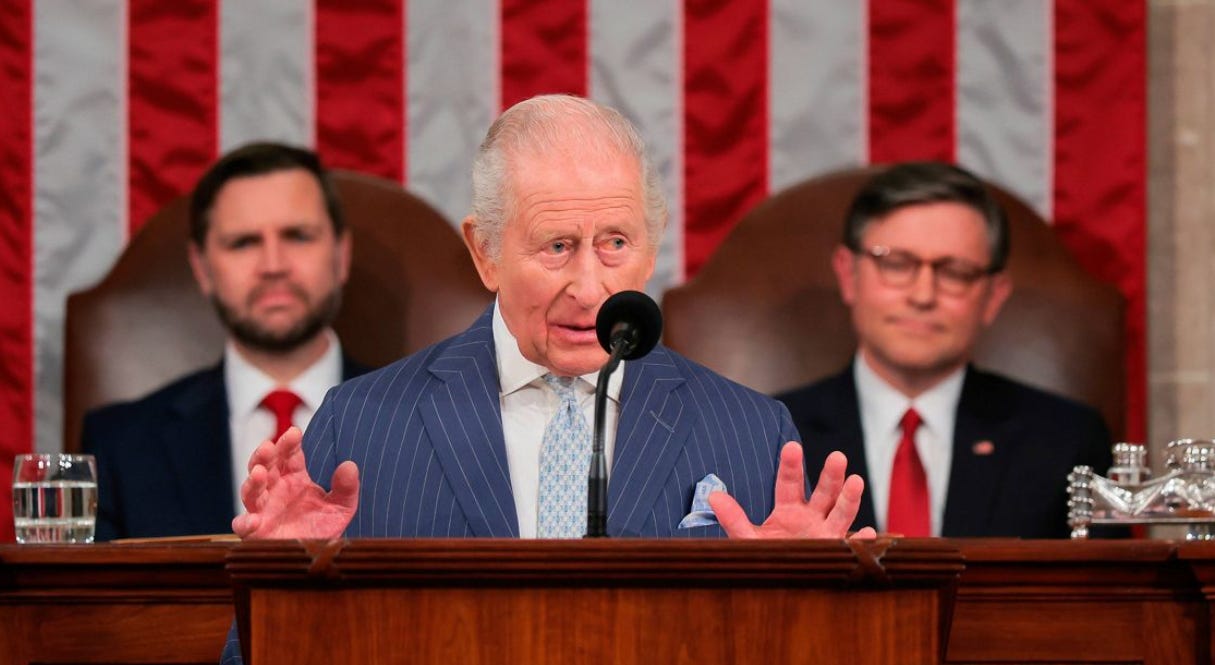
There was an irony sitting in the chamber before King Charles III said a word. A hereditary monarch had come to address the legislature of a republic born in rebellion against hereditary power. The room itself carried the contradiction: a king standing beneath the symbols of American self-government, speaking to the branch the founders placed first for a reason.
Yet the sharper irony was not that a king spoke to Congress. It was what the king chose to remind Congress about.
He spoke in the polished language of diplomacy, ceremony, and shared history. He praised the long bond between Britain and the United States. He honored sacrifice. He nodded toward anniversaries, alliances, and democratic traditions that usually fill speeches like this. Yet beneath the pageantry was something more revealing.
At a time when American politics is increasingly tempted by one-man rule, a constitutional monarch stood before Congress and spoke about limits on executive power. At a time when alliances are treated by some as burdens or bargaining chips, he reminded lawmakers that America once needed those alliances when it was bleeding.
The speech was not scolding. That would have been too easy to dismiss. It was quieter than that. It was a mirror.
And what made the moment so uncomfortable was not that King Charles seemed foreign to the American experiment. It was that, in that chamber, he sounded like he remembered parts of it that too many American leaders now treat as optional.
This Community Is Powered by You
What started as a small circle has grown into something much bigger, and it’s all because of readers like you.
Every time you forward this email, post it on socials, or bring someone new into the fold, you’re helping build one of the most passionate, independent political communities out there.
Want to keep the momentum going?
Share this newsletter with someone who should be part of this conversation.
Thank you for being here. It means everything.
A Ceremony With a Warning Inside It
On paper, the speech was exactly what a royal address to Congress is supposed to be. King Charles III thanked the American people. He honored the 250th anniversary of the Declaration of Independence. He praised the long, complicated, and eventually durable bond between Britain and the United States. He spoke of shared history, shared sacrifice, shared values, and the kind of polished language of friendship that fills diplomatic ceremonies precisely because it is designed not to provoke.
Ceremony, however, does not mean emptiness. Sometimes, the ceremony is where the most careful warnings are hidden. A visiting monarch does not walk into Congress and name names. He does not point across the chamber and accuse a republic of drifting from itself. He does not need to. The setting, the timing, and the chosen themes can say enough.
That is what made this address worth paying attention to.
Charles spoke at a moment when the United States is celebrating its founding while arguing, again, over the basic architecture of that founding. What is Congress for? What limits should bind executive power? What does the rule of law mean when powerful people want exceptions? What are alliances worth when they become inconvenient to the politics of resentment? Those questions were not shouted from the podium. They were threaded through the speech.
The King stood in the House chamber and praised Congress as a place of representation, debate, and deliberation. He reached back to the Magna Carta, English common law, the Bill of Rights, and the shared legal roots that helped shape American constitutional government. He pointed to the idea that liberty depends not on one person’s will, but on institutions strong enough to restrain power.
Then he turned outward. He reminded lawmakers that America’s alliances are not abstract arrangements on a map. They are commitments written in history, sacrifice, and memory. When he spoke of 9/11 and NATO’s invocation of Article 5, he was not simply honoring the past. He was reminding Congress that the United States once depended on the very collective-defense promise some American politicians now treat as disposable.
None of this was delivered like a partisan attack. Its force came from restraint.
Charles wrapped the message in gratitude, history, and friendship. He spoke softly enough that anyone determined not to hear it could pretend it was only pageantry. But the meaning was there all the same: republics do not survive on symbols alone. They survive when power is limited, laws are deliberated, institutions are respected, and allies remember that promises made in peace may be needed in crisis.
That is why the speech mattered, not because a king came to Congress, but because he used the occasion to praise the very habits a republic loses when it begins forgetting why it was built.
Executive Power Is Supposed to Have Limits
The most revealing part of the speech was not the flattery. It was the history lesson.
Charles reached back past the Revolution, past the Declaration, past even the founding of the United States, to the older legal inheritance that shaped both countries: English common law, the Bill of Rights of 1689, and the Magna Carta. In another moment, that might have sounded like ceremonial filler. Not now, not when the United States is openly arguing over whether presidents should be bound by Congress, restrained by courts, limited by law, or empowered to rule by command whenever the machinery of democracy feels too slow.
That is what made the Magna Carta reference land differently.
Charles connected that inheritance to the principle that executive power is subject to checks and balances. Then he turned directly to Congress itself, describing the promise of American liberty as something carried out not by the will of one, but by the deliberation of many.
That is not just a tribute to history. It is a description of how a republic is supposed to function.
The American Constitution does not begin with the presidency. It begins with Congress. Article I precedes Article II because lawmaking was not meant to be an accessory to executive ambition. It was supposed to be the first line of democratic legitimacy: the place where power is argued over, divided, slowed down, amended, exposed, and turned into law by representatives answerable to the people.
That design is not a technicality. It is the guardrail.
A president can move quickly. Congress is supposed to move deliberately. A president can speak in one voice. Congress is supposed to contain many voices. A president can promise certainty. Congress is supposed to force conflict into the open, where citizens can see who is asking for power, who is surrendering it, and who will pay the price.
That is why unilateral executive power is dangerous, no matter which party holds it. It offers the illusion of strength while hollowing out the habits that make self-government possible. It lets lawmakers avoid hard votes. It lets presidents govern by emergency, memo, waiver, order, threat, and spectacle. It teaches the public to look to one person for action, while treating the branch closest to the people as an obstacle rather than a constitutional necessity.
And once that habit takes hold, it does not stay confined to one administration. Every president inherits the tools the last president normalized. Every party that cheers executive overreach when its own side holds power helps build the machinery the other side will eventually use. What looks convenient in the moment becomes precedent. What looks like efficiency becomes dependency. What looks like leadership becomes a transfer of power away from the people’s representatives and toward the person sitting behind the Resolute Desk.
That was the constitutional pressure point beneath the ceremony. A constitutional monarch stood in the chamber of a republic and praised the principle that executive power must be checked. That should not have sounded unusual. It should not have felt pointed. It should not have needed repeating.
Yet it did, because the danger facing the American system is not only that a president might try to seize too much power. It is that Congress might keep giving it away, piece by piece, until the public forgets that the republic was never supposed to run on the will of one.
Congress Exists for Deliberation, Not Decoration
Congress is not supposed to be scenery. It is not supposed to be the backdrop for presidential announcements, the applause track for executive ambition, or the constitutional furniture behind whoever currently occupies the White House. It is supposed to be the place where power slows down long enough to be seen.
That is the point of deliberation.
A republic does not ask one person to decide what the country needs and then demand that everyone else adjust. It forces arguments into public view. It requires coalitions. It invites amendments. It exposes tradeoffs. It makes representatives put their names on the record before laws are passed, money is spent, wars are authorized, agencies are reshaped, or rights are restricted.
That process is frustrating by design. It is supposed to be harder to pass a law than to issue a command. It is supposed to be harder to build democratic consent than to perform strength from a podium. Congress has often used process as an excuse for cowardice, delay, or dysfunction, but the answer to a weak legislature is not to surrender the republic to executive shortcut. It is to make the legislature do its job.
When Congress avoids hard votes, presidents fill the vacuum. When lawmakers fear accountability, they let executive agencies, courts, emergency declarations, and presidential orders carry the political weight. Then both parties pretend to be shocked when the presidency grows more powerful, more theatrical, and more central to national life than the founders intended.
That changes how citizens understand power. People stop asking what Congress will pass and start asking what one leader will do. They stop judging representatives by the laws they write and start judging them by how loudly they perform loyalty or outrage. They begin to see compromise as weakness, deliberation as betrayal, and constitutional restraint as obstruction.
That is how a republic becomes emotionally prepared for one-man rule before it formally arrives.
The warning is not that Congress lacks power. The warning is that Congress keeps acting as though its power is optional.
It has the power to legislate, to appropriate, and to investigate. It has the power to check the executive branch, to force public accountability when presidents claim authority that belongs to the people’s representatives. But power unused becomes power surrendered.
And when Congress becomes decoration, the presidency becomes the government. The question shifts from “What does the law allow?” to “What can the president get away with?” That is a dangerous question for any democracy to normalize, because it does not ask whether power is legitimate. It asks only whether power is effective.
A republic cannot survive on that standard. The president may lead, but Congress is supposed to decide what becomes law. When that distinction collapses, the country does not become stronger. It becomes easier to rule and harder to govern.
That is why the King’s reminder mattered— not because Congress needed a monarchy lesson, but because Congress needed to hear, in its own chamber, that deliberation is not weakness. It is the mechanism that keeps a free people from being governed by command.
The Alliance America Needed When It Was Bleeding
Then Charles turned from the architecture of power at home to the architecture of security abroad. The two questions are connected. A country tempted by one-man rule at home is often tempted by one-country-alone politics abroad. It begins to treat limits as weakness, deliberation as delay, alliances as burdens, and history as something to be edited whenever it becomes inconvenient.
That is why the King’s reference to 9/11 and NATO’s Article 5 carried so much weight.
This year marks the 25th anniversary of the September 11 attacks. Charles called 9/11 a defining moment for America and said the pain and shock were felt around the world. Then he reminded Congress what happened next: NATO invoked Article 5 for the first time, and the United Nations Security Council united in the face of terror. Britain stood with America then, he said, and stands with America now.
That was not just a memorial line. It was a correction.
In American politics, NATO is too often reduced to a bill, a complaint, or a campaign applause line. We hear about who pays enough, who owes what, who is taking advantage, and whether the United States is getting a good deal. Those arguments are not always irrelevant. Burden-sharing is a real issue. Allies should carry their share of the load.
However, that is not the whole story. The whole story includes the morning America was attacked and did not stand alone.
Article 5 is NATO’s collective-defense promise: an armed attack against one member is treated as an attack against all. NATO says it has been invoked only once in the alliance’s history — after the September 11 attacks against the United States.
That history reverses the usual political script.
The alliance some American politicians now sneer at as a burden once treated America’s wound as its own. NATO did not invoke Article 5 because London had been attacked. It did not invoke Article 5 because Paris, Berlin, Rome, Warsaw, or Ottawa had been struck. It invoked Article 5 because New York and Washington had been struck.
After 9/11, America was not abandoned. It was answered.
That does not mean every decision that followed was wise. It does not erase the catastrophic mistakes of the wars that came after, the lives lost, the money spent, the civil liberties damaged, or the foreign-policy failures that still echo. None of that changes the basic fact Charles put back before Congress: when the United States needed the alliance, the alliance showed up.
That is the memory being lost in the current debate. If NATO is discussed only as a transaction, then the public is trained to forget that collective defense is not a subscription service. It is a promise built for the worst day, not the easiest one. You do not judge a fire department only by the dues paid in calm weather. You judge it when the alarm sounds.
For America, the alarm sounded on September 11, and the alliance answered.
When Charles spoke about NATO, Ukraine, shared security, and the danger of becoming more inward-looking, he was not just praising old institutions for the sake of diplomacy. He was reminding Congress that the United States has already lived through the reason those institutions exist.
The same politics that favors a president unconstrained at home often favors America unconstrained abroad. No Congress in the way. No courts in the way. No allies in the way. No memory in the way. Just power, freed from obligation.
But democracies are not made safer by forgetting their restraints, and nations are not made stronger by forgetting who stood beside them when they were bleeding.
What America Is Being Asked to Forget
The danger is not only what American politics is becoming. It is what American politics is being taught to forget.
Forget that Congress is not a prop. Forget that courts are not an inconvenience. Forget that executive power was supposed to be limited because concentrated power was the very thing the republic was built to resist. Forget that alliances are not favors America does for weaker nations, but commitments that once came back to America when the country was attacked.
Forgetting is not accidental in authoritarian politics. It is part of the project.
A public with a long memory is harder to manipulate. It remembers why restraints exist. It remembers why no president, party, faction, or movement is supposed to hold all the levers at once. It remembers that institutions are not supposed to serve one leader’s appetite for power. They are supposed to protect the public from it.
That is why memory itself becomes a battlefield. If people can be convinced that Congress is useless, they will cheer when presidents bypass it. If they can be convinced that courts are illegitimate whenever they rule against their side, they will applaud efforts to intimidate or ignore them. If they can be convinced that allies are parasites, they will forget the moment those allies treated America’s grief as their own.
The result is a politics stripped of obligation. Power becomes something to seize, not something to limit. Law becomes something to bend, not something to obey. Alliances become something to threaten, not something to honor. History becomes something to brand, not something to learn from.
That is the connective tissue between the domestic and foreign-policy parts of the speech. At home, the temptation is to let one person act where the constitutional system demands deliberation. Abroad, the temptation is to let one country act as though no promise, treaty, or shared sacrifice should bind it. In both cases, the appeal is the same: freedom from restraint, freedom from process, freedom from accountability.
However, that kind of freedom is not democracy. It is power without memory.
The United States does not need to romanticize Britain to understand the point. It does not need to treat King Charles as a prophet, a scold, or a moral authority over the American system. The principles he praised were not foreign imports. They were America’s own claims about itself.
Limited executive power. Legislative deliberation. Rule of law. Collective defense. Shared sacrifice. Democratic restraint.
Those are not royal ideas. They are republican ones.
That is why the speech stung, not because Charles said something America had never heard before, but because he said things America used to say about itself with more confidence. He spoke as if checks and balances were still understood as a strength. He spoke as if Congress still knew deliberation was its purpose. He spoke as if alliances still carried moral and historical weight.
The uncomfortable question hanging over the chamber was whether America still believes all of that, or whether those phrases have become ceremonial language too.
Republics do not usually lose themselves all at once. They lose themselves through repetition, through exception after exception, emergency after emergency, through one more executive shortcut, one more surrendered vote, one more attack on an independent court, one more alliance treated like a bad deal, one more historical fact reduced to an inconvenient footnote.
Eventually, the public is asked to accept a smaller version of self-government and call it strength.
That is what America is being asked to forget: that the republic was built on suspicion of unchecked power, and it survives only if that suspicion is kept alive.
The Point Was Not the King
This is not an argument for monarchy.
That needs to be said plainly, because the irony of the moment can be easy to misread. The lesson of King Charles’s speech is not that hereditary power has some wisdom democracy lacks. It does not. The American Revolution was right to reject the idea that birth should confer political authority. No republic should need a crown to explain liberty to it.
Instead, that is what made the moment so revealing.
A man whose title exists because of inheritance stood before the elected legislature of a country founded against the inherited rule of his nation and spoke about limits, law, deliberation, and obligation. He did not sound radical. He did not sound subversive. He sounded like someone reciting the basic operating instructions of a constitutional democracy.
That was the mirror.
The discomfort was not that Charles brought foreign ideas into Congress. The discomfort was that he reflected America’s own ideas back to it at a time when many of its leaders are treating those ideas as optional.
A republic is not supposed to be embarrassed by a speech about checks and balances. Congress is not supposed to need reminding that its job is to deliberate, legislate, and restrain power. A country that once watched NATO invoke Article 5 on its behalf should not need to be reminded that alliances are more than invoices.
And yet here we are.
The speech exposed the gap between the language America still uses and the habits American politics now rewards. Everyone still praises the Constitution. Everyone still invokes freedom. Everyone still claims to respect the rule of law. Everyone still says they believe in democracy, at least when democracy gives them the outcome they want.
The test is not whether leaders can repeat the words. The test is whether they accept the limits those words require.
Checks and balances mean accepting that a president does not get everything he wants. Legislative deliberation means accepting that the public’s business cannot be reduced to executive command. Rule of law means accepting that power must answer to something outside itself. Alliances mean accepting that strength includes obligation, not just dominance.
That is where the contradiction lives.
America still wraps itself in the symbols of a republic, but too much of its politics now rewards monarchical habits: loyalty to one leader, contempt for institutional restraint, impatience with lawmaking, suspicion of courts, and the belief that power is legitimate if it wins.
Charles did not have to say any of that directly. The chamber said it for him.
A king stood inside the legislative heart of the American republic and praised the habits that keep one-person rule at bay. In a healthier political moment, that would have sounded like civic background music.
In this one, it sounded like a warning.
The Warning Was Polite, But It Was Still a Warning
King Charles did not come to Congress as an enemy of the American experiment. He came wrapped in ceremony, alliance, friendship, and history. He praised the United States. He honored its founding. He spoke of shared sacrifice and common purpose. He used the soft language of diplomacy because that is what the moment required.
But soft language can still carry a hard truth.
The hard truth is that America is living through a moment when the basic architecture of the republic is under strain. Congress is too often treated as an obstacle instead of the first branch of government. Executive power is too often treated as a substitute for lawmaking. Courts are too often respected only when they deliver the preferred outcome. Alliances are too often judged only by what they cost, not by what they have meant when history turned dark.
That is why the speech landed— not because a king knows more about democracy than Americans do, but because a king stood in Congress and reminded Americans of things the republic is supposed to know by heart.
Power needs limits. Law needs deliberation. Congress needs courage. Alliances need memory. Democracies need institutions strong enough to restrain leaders who confuse themselves with the nation.
None of that should be controversial, and yet, in this moment, it sounded almost radical.
That is the measure of the danger. A republic does not lose itself only when someone tears up the Constitution on live television. It loses itself when the public becomes accustomed to shortcuts, when lawmakers grow comfortable surrendering their own power, when voters are trained to see restraint as weakness, and when allies become props, courts become enemies, and history becomes disposable.
The United States was born by rejecting kings, but the lesson of this speech is not that America should listen to a king. It is that America should listen to itself, to the constitutional memory, democratic suspicion of concentrated power, and alliance obligations that have been part of its own story all along.
Charles did not need to scold Congress. The contrast did the work.
A king came to the chamber of a republic and praised the habits that keep republics alive. The question now is not whether Congress applauded.
The question is whether Congress still remembers why those habits exist.
Support Independent Media
If this piece speaks to you, consider becoming a paid subscriber to The Coffman Chronicle.
We are living through a moment when too many powerful people want the public to forget what democracy is supposed to mean: that power must be limited, Congress must do more than applaud, courts must remain independent, and alliances built through sacrifice should not be treated like disposable political props.
That is why independent journalism matters.
Our job is not to flatter power. It is to follow it, question it, and remind people what is being taken from them in real time, sometimes loudly, sometimes quietly, and often under the cover of ceremony.
If you can afford it, becoming a paid subscriber helps keep this work going. It helps us keep digging, keep connecting the dots, and keep telling the truth about who is trying to concentrate power, who is surrendering it, and who pays the price when the public is asked to forget.
The republic does not defend itself.
People do.
Sources:
“Full Transcript of King Charles III’s Speech to Congress.” AP News. April 29, 2026.
“King Charles Promotes US-UK Unity in Speech to Congress Amid Iran Tensions.” Reuters. April 28, 2026.
National Archives. “The Constitution of the United States: A Transcription.”
National September 11 Memorial & Museum. “International Community Responds.”
NATO. “Collective Defence and Article 5.”
“King Charles Praises Nato and Urges Defence of Ukraine in Key Speech During Trump Visit.” The Guardian. April 28, 2026.
U.S. Capitol Visitor Center. “About Congress.”
Library of Congress. “U.S. Constitution: Article II.” Constitution Annotated.
I figured it would go right over Trumps head. Seems it did, too bad he learned nothing.
This congress remembers, and does, nothing.