


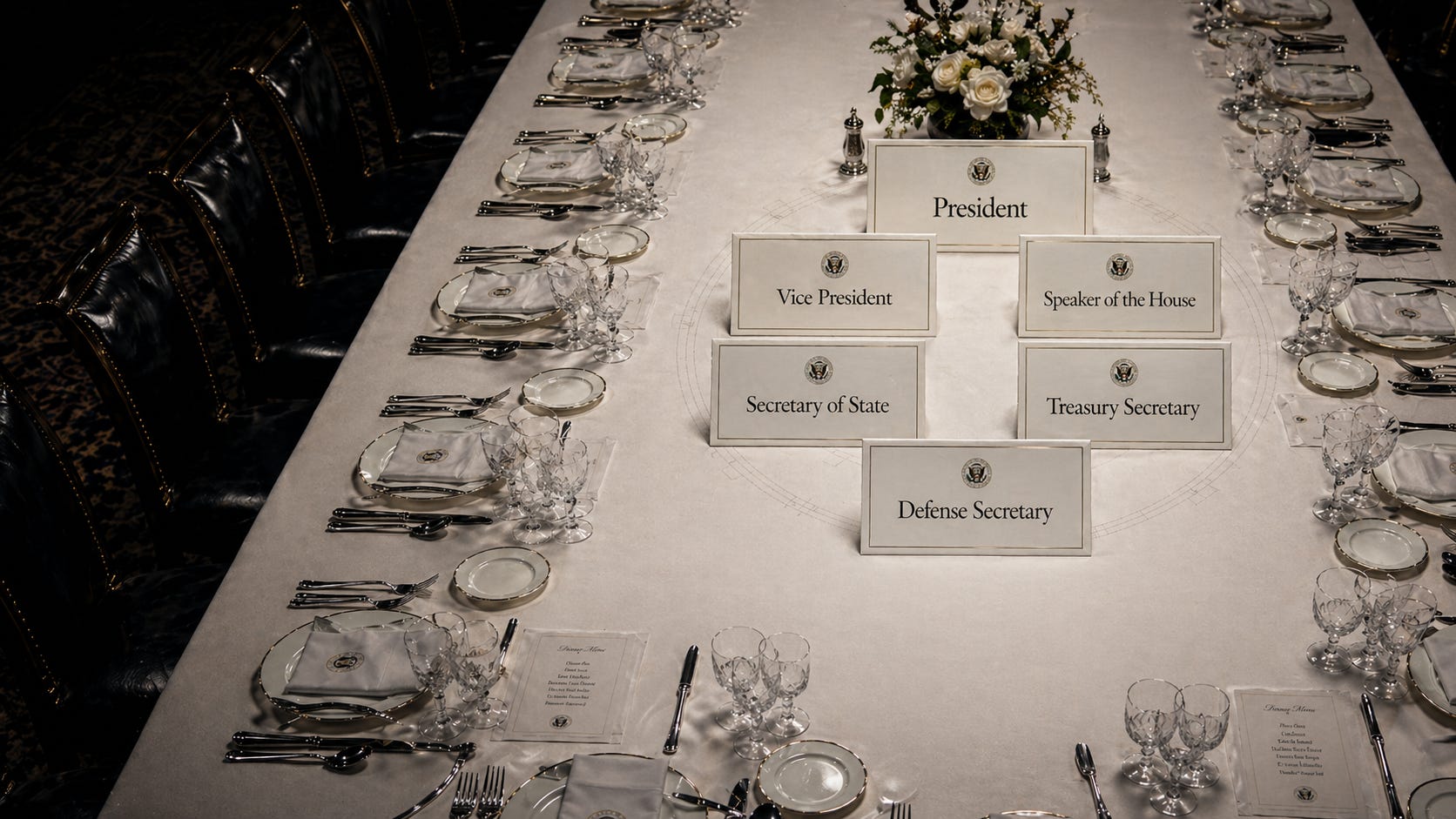
The bulletproof vest did its job. That is the part of the story everyone can understand.
A Secret Service officer stood between an armed man and a ballroom full of some of the most powerful people in the United States government. President Donald Trump was unharmed. The suspect, Cole Tomas Allen, was taken into custody and charged with attempting to assassinate the president after authorities said he tried to breach security at the White House Correspondents’ Dinner at the Washington Hilton while armed with a shotgun and pistol. The Washington Post, citing an FBI affidavit, reported that Allen charged a security checkpoint with a long gun before being stopped. The Associated Press reported that a Secret Service officer was hit in a ballistic vest during the incident and survived. Authorities are still reviewing the exact ballistics, including who fired the shot that struck the officer.
That is the immediate security story. It is not the whole story.
The larger question is not only how close one armed man allegedly got to the president. The larger question is why so much of the government’s emergency backup plan was gathered inside one building in the first place.
Reuters reported that Trump, Vice President JD Vance, House Speaker Mike Johnson, Secretary of State Marco Rubio, Treasury Secretary Scott Bessent, and Defense Secretary Pete Hegseth were all present at the dinner. Senate President Pro Tempore Chuck Grassley was not. This isn’t a random list. Presidential succession is not symbolic. Under federal law, if there is neither a president nor vice president able to serve, the speaker of the House is next, followed by the Senate president pro tempore, then Cabinet officers beginning with the secretary of state, the secretary of the treasury, and the secretary of defense.
So this was not just a room full of officials. It was a room containing the president, the vice president, the speaker of the House, and several Cabinet officers, near the top of the line the country would rely on in the event of a catastrophe.
That changes the question.
The debate after the attack has already drifted toward venue security. Would a White House ballroom have been safer than a hotel ballroom? Probably. A hardened federal venue would likely offer tighter perimeter control, fewer unknown hotel guests, fewer outside staff, and more centralized Secret Service command. The Washington Hilton said it had been operating under Secret Service protocols coordinated with D.C. police and hotel security, which means this was not an unguarded event. However, coordination across a hotel is still not the same as control inside a hardened federal site.
That is the strongest argument for a White House ballroom, but it is not the strongest lesson from what happened. A locked room is still one room.
A better-protected ballroom might reduce the risk of an outside breach. It would not eliminate the danger of concentrating the country’s constitutional backup system in a single physical space. It would not prevent every shared-location risk— Not contamination, not food poisoning, not fire, not structural failure, not an insider threat, not a catastrophic accident, and not the basic fact that if too many successors are gathered together, the room itself becomes a national vulnerability.
The officer’s vest may have stopped a round. The country still needs to ask why so much of its continuity plan was sitting behind the same security perimeter.
This Community Is Powered by You
What started as a small circle has grown into something much bigger, and it’s all because of readers like you.
Every time you forward this email, post it on socials, or bring someone new into the fold, you’re helping build one of the most passionate, independent political communities out there.
Want to keep the momentum going?
Share this newsletter with someone who should be part of this conversation.
Thank you for being here. It means everything.
The Room Was the Real Risk
The danger that night was not measured only by how close the suspect allegedly got to the president. It was also measured by who else was inside the building.
Not everyone in the presidential line of succession was there, but enough of the top of it was.
The country had the president, vice president, speaker of the House, secretary of state, treasury secretary, and defense secretary gathered at the same event, behind the same security perimeter, vulnerable to the same disruption. Those are not just impressive titles. They are part of the emergency chain of succession that the country would rely on if the president and vice president were unable to serve.
The room itself became the risk.
That is the part Washington should not rush past. A security team can stop an attacker. A bulletproof vest can save an officer’s life. A motorcade can move the president out of danger. All of that matters, but none of it answers the deeper question of why the country allowed so much of its emergency replacement structure to be physically concentrated in one place.
Continuity of government is not only about what happens after a disaster strikes. It is supposed to be about reducing the likelihood that a single disaster could take out too many essential officials at once.
That is why the ballroom debate is too narrow. Yes, the Washington Hilton raises obvious security questions. Yes, a White House ballroom would likely be easier to secure than a hotel. However, the most important vulnerability was not the carpet, the walls, or the address.
The most important vulnerability was the guest list.
Security Success Is Not the Same as Continuity Success
It is possible for the Secret Service to perform bravely in the moment and still leave the country with hard questions about the plan that put everyone in that room.
The attacker did not reach the ballroom. A catastrophe was prevented. Those are not small facts. They are the difference between a terrifying night and a national trauma of almost unimaginable scale.
However, that is the tactical story. The strategic story is harder to defend.
A security operation can stop the person at the door and still expose a planning failure behind the door. It can prevent the worst-case outcome and still reveal that the worst-case outcome was allowed to get too close. That is why the question cannot stop at whether the suspect was intercepted. The deeper question is why one event held so many people who would be needed if the president, vice president, or other senior officials were suddenly unable to serve.
That is the difference between protecting a person and protecting continuity.
Protecting a person means body armor, checkpoints, motorcades, evacuation routes, counterassault teams, and rapid response. Protecting continuity means asking in advance whether too many essential officials are exposed to the same danger simultaneously.
Those are related, but they are not the same mission.
A brave officer can save a life. A strong security perimeter can slow or stop an attacker. Neither one changes the basic risk created when the president, vice president, speaker of the House, and several Cabinet officials are placed under the same roof during a period of rising political violence.
That is why the night should not be remembered only as proof that security worked. It should also be remembered as proof that Washington got lucky.
The problem was not only that danger came too close to the room. The problem was that the room mattered too much.
The Designated Survivor Question
The most revealing answer from the White House is not that continuity planning was ignored completely. It is that officials appear to have treated informal absence as good enough.
Reuters reported that White House press secretary Karoline Leavitt said discussions about a designated survivor took place before the dinner, but that no formal designated survivor was named because some Cabinet members in the line of succession were already absent for personal reasons. She said that designating one survivor was unnecessary because several members were not already there.
That answer may sound reasonable at first. If several successors are not in the room, then technically, the government has not placed everyone in the same place. However, that should not satisfy anyone who understands what continuity planning is supposed to do.
Continuity planning should not depend on who happened to have another obligation that night.
A designated survivor is not merely a person who missed the party. It is a deliberate decision. It is a named official kept away from a high-risk gathering so there is no confusion about who remains available if catastrophe strikes. The point is not just physical separation. The point is clarity, planning, and a chain of command.
That is why “some Cabinet members were already absent” is a weak answer. Absence is not the same as assignment. An official may be home, traveling, sick, delayed, or simply not invited. That does not mean the government has made a clear continuity decision. It does not tell the public who was selected, whether that person was briefed, whether they had secure communications, or whether agencies were operating under a defined emergency plan.
The Correspondents’ Dinner is not the State of the Union. It is not a constitutional ceremony. It is not required by law. Yet once the president, vice president, House speaker, and several Cabinet successors attended the same event, the risk profile began to look less like a dinner and more like a continuity problem.
That is the standard planners should have applied.
The issue is not whether the law required a formal designated survivor for the Correspondents’ Dinner. The issue is whether the risk demanded one. Government continuity cannot be reduced to the bare minimum required by the law.
A country does not protect itself by asking only, “What are we required to do?” It protects itself by asking, “What would happen if this room became the failure point?”
The weakest point in the plan may not have been the building. It may have been the assumption that absence and preparation are the same thing.
The Lesson Is Not “Build a Better Ballroom”
Washington is very good at visible security. It knows how to close streets, set up barricades, deploy armed officers, screen guests, harden entrances, and move protected officials through controlled spaces. After an attack or attempted attack, the public often sees the same response: more fencing, more agents, more checkpoints, more perimeter.
Some of that is necessary. No serious person should pretend otherwise.
However, visible security is not the same as risk management. Those protections matter, and in this case, they may have prevented a national tragedy. However, they do not answer the deeper planning question: why was so much of the succession chain exposed to the same single point of failure?
That is where Washington keeps getting the lesson wrong. It often responds to danger by asking how to make the room safer. Sometimes, the more important question is whether the room should contain that much risk in the first place.
The Correspondents’ Dinner was not just another gala once the president, vice president, speaker of the House, and multiple Cabinet officials walked into the same building. It became a concentrated-risk event. That does not mean it had to be canceled. It does not mean public officials should live underground or avoid every shared space. It does mean the security plan should have been built around more than keeping an attacker out.
It should have been built around what happens if something goes wrong inside.
That is the kitchen-table version of this story. Every family understands redundancy. You do not keep the only copy of every important document in one box if the house can burn. You do not put all your emergency contacts on a single phone if that phone can die. You do not store every spare key in the same drawer and call the plan secure because the front door has a deadbolt.
Government continuity works the same way. The line of succession is supposed to be the country’s redundancy system. It is the backup plan for the backup plan. However, redundancy only works if the backups are not all exposed to the same failure.
Political violence is now part of the environment in which public events are planned. That does not mean officials should disappear from public life. A democracy cannot function if its leaders are permanently hidden from the public, the press, or one another. However, it cannot function if planners continue to treat high-profile political gatherings as if the old assumptions still apply.
The country needs clearer rules for events where multiple people in the line of succession are expected to attend. It needs a serious threshold for when a gathering stops being a social event and becomes a continuity-of-government risk. It needs a formal process for deciding when the vice president should not attend with the president, when the speaker should remain elsewhere, when a Cabinet official should be deliberately separated, and when a designated survivor should be named even if the law does not require one.
The legal minimum is not always the responsible maximum.
That is the real lesson. Not that public officials should vanish from civic life. Not that every event must become a fortress. Not that the Correspondents’ Dinner should never happen again. The lesson is that the government cannot keep treating the concentration of power as a scheduling inconvenience rather than a national vulnerability.
The country should not confuse survival with proof that the plan was sound.
A democracy cannot depend on luck, reflexes, and body armor as its continuity strategy. It cannot keep putting too much of its constitutional backup system in one room and then calling the event secure because the room is guarded. Security is supposed to protect the people inside. Continuity is supposed to protect the country if something happens to them.
Those are not the same thing.
The question after the Correspondents’ Dinner should not be limited to whether Washington needs a safer ballroom. The question should be whether Washington has become too comfortable placing the presidency, the vice presidency, congressional leadership, and Cabinet succession under the same roof and trusting the perimeter to hold.
Because a locked room is still one room, and no room should carry that much of the republic.
Support Independent Media
The Coffman Chronicle exists to ask the questions power would rather skip.
If this kind of independent, accountability-focused journalism matters to you, consider becoming a paid subscriber. Your support helps keep this work going, keeps it reader-funded, and keeps us focused on the questions that too often get buried under spectacle, spin, and official reassurance.
Because democracy does not protect itself. People have to.
Sources:
“Man Charged with Attempted Assassination of Trump in White House Correspondents’ Dinner Shooting.” AP News, April 27, 2026.
“Designated Survivor Discussions Took Place Prior to Press Dinner, White House Says.” Reuters. April 27, 2026.
Cornell Law School, Legal Information Institute. “3 U.S. Code § 19 — Vacancy in Offices of Both President and Vice President; Officers Eligible to Act.” Accessed April 27, 2026.
National Constitution Center. “Why Is There a Designated Survivor for the State of the Union?” February 5, 2019.
“Washington Hilton Says It Was Using Secret Service Protocols on Night of Attack.” Reuters, April 27, 2026.
“Explainer: Who Takes Charge If the U.S. President Is Incapacitated?” Reuters, April 27, 2026.
U.S. Department of Justice. “Suspect in White House Correspondents’ Dinner Shooting Charged with Attempt to Assassinate the President.” Press release, April 27, 2026.
U.S. Senate. “Presidential Succession Act.” Senate Historical Office. Accessed April 27, 2026.
It seems to me we're missing something. It's certainly true that in theory, it was breathtakingly careless and thoughtless to have the whole government leadership in one room, mostly at one table. The exception was the president pro tempore of the senate, who wasn't there.
But to me, the larger question is why this keeps happening. I'm aware of Butler, PA, and two days ago, but I hear various clown sycophants talk about "three" attempts. So I looked it up. According to a site that calls itself "Factually," but cautions that it's not always right (so not reliably factual), there have been six attempts, starting as far back as June, 2016.
My daughter likes to quote her grandfather (my late father), who said that when you think everyone else is the problem, then you're the problem. Matt Damon's character in "Rounders" put it a different way: if you can't spot the sucker in your first half hour of poker, then you're the sucker.
So our princess, the clown, can't for an instant stop talking about her White House ballroom as a method of security, which she says we've needed for 150 years (so why hasn't anyone built one, especially during Truman's term, when extensive White House renovation was done?). But the more important question is why no one ever tried three times, or six times, to assassinate the president. Is the problem DC/government security, or is it the president, who is now the princess?
One, cabinet had no need to be there, 2 not government function, won't ever be held in ballroom
3 it's not something anyone wants
4 now tax dollars to keep president safe when he's the cause of all problems
5 he will be gone anyway so no vanity for a destroyed administration.