


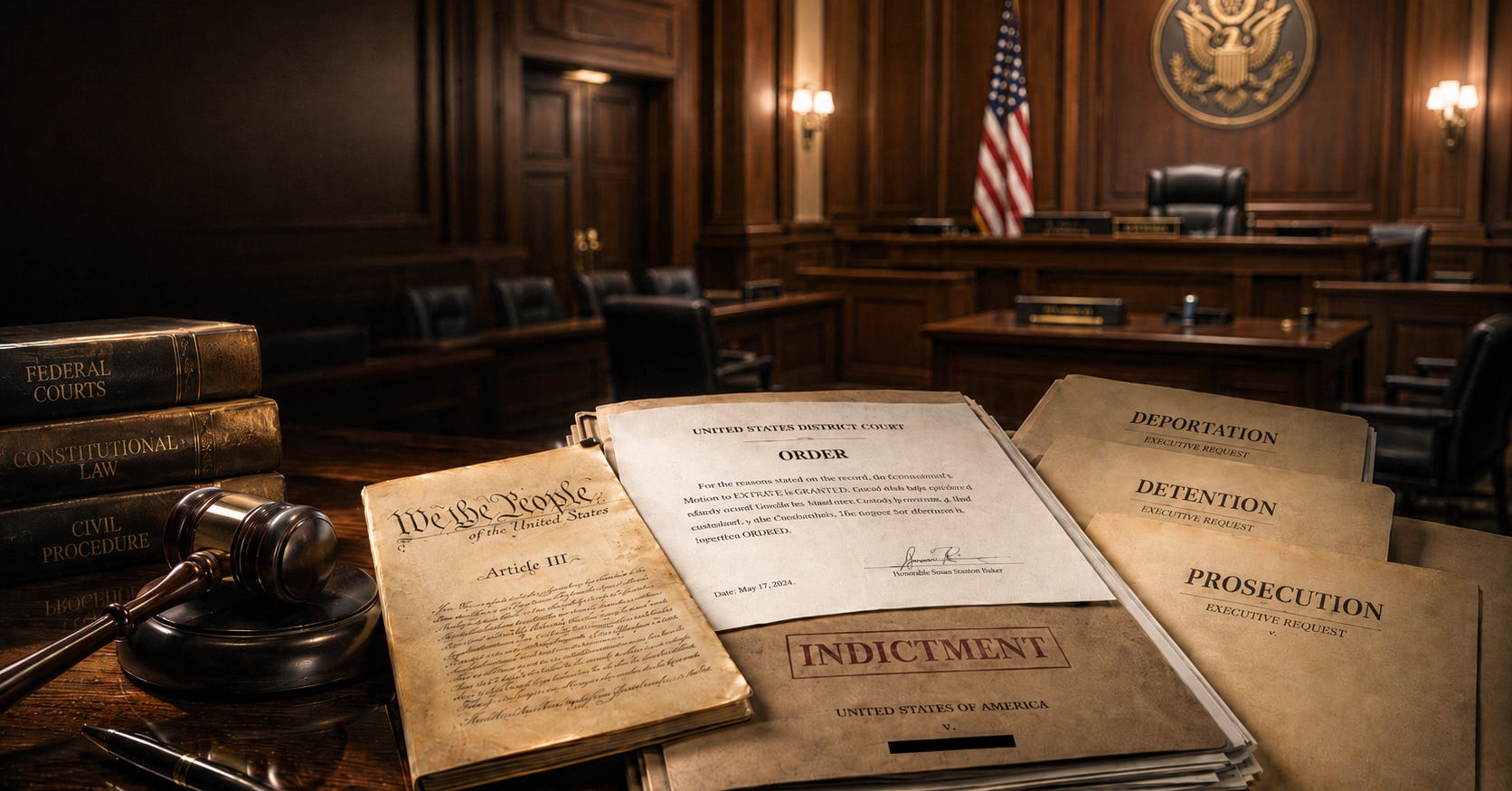
The government had the machine.
It had the immigration system, detention power, and prosecutors. It had the ability to remove a man from the country, accuse him of a federal crime, and tell the public that every step was justified because the government said so.
However, inside an Article III courtroom, the machine ran into a question it could not simply overpower: was this prosecution law enforcement or retaliation?
That is the constitutional heart of the Kilmar Abrego Garcia case. The story is not just that federal charges were dismissed, nor that a judge rejected the government’s argument. The deeper story is that concentrated executive power was forced to answer for itself in a court that still had the authority to say no.
This is what the Constitution looks like when it works under pressure, not when the government behaves perfectly, when abuse is prevented before it begins, or when powerful officials suddenly decide to police themselves. The Constitution works when one branch overreaches, and another branch has the independence, authority, and backbone to stop it.
In this case, Article II had the machinery, including immigration enforcement, detention authority, prosecution, public messaging, and the power to shape the public narrative. Article III supplied the guardrail.
Concentrated power does not always manifest as a single dramatic constitutional crisis. Sometimes it arrives as a deportation order, a reopened investigation, a charging decision, a press conference, and a government lawyer insisting that the public should trust the same branch that made the mistake to control the consequences as well.
The Abrego Garcia case is not only an immigration story. It is a warning about what happens when the same government that wrongfully uses power then tries to decide whether its own conduct should be excused, defended, or buried.
Moreover, it is a reminder of something too often lost in our political noise. The Constitution did not work here because the abuse never happened. It worked because the abuse was challenged, examined, and stopped by a court with the power to say no.
Support independent media that follows the power.
The Coffman Chronicle is built to track who holds power, who abuses it, who profits from it, and who pays the price.
Paid supporters get full Tony Michaels Podcast episodes, deeper transcript analysis, paid columns, archives, and the reporting framework behind the show.
If you believe independent media has to survive outside billionaire platforms, corporate media, and party-approved gatekeepers, become a paid supporter today.
This Was Not Just a Dropped Case
The easy way to tell this story is to say the federal charges were dismissed. While that is true, it is not enough.
The deeper issue is why they were dismissed, what the judge found, and what that tells us about power when it starts protecting itself. Abrego Garcia was not simply a defendant who beat a case. He was a man who had already been wrongfully deported to El Salvador despite a prior order barring his removal there. After that mistake became a national legal fight, the government revisited an old 2022 traffic stop and built a criminal case around allegations that had not led to charges at the time.
U.S. District Judge Waverly Crenshaw dismissed the indictment after finding that the government had not overcome the presumption that the prosecution was vindictive. That is a careful legal distinction, and it matters. The court did not have to prove every official’s private motive. It had to examine the sequence, the timing, the government’s explanations, and whether the prosecution appeared to punish Abrego Garcia for successfully challenging the government’s earlier misconduct.
That sequence is the story.
When the government makes a mistake, the constitutional answer is supposed to be accountability. What cannot be allowed is something darker: the government gets caught, loses ground in court, and then reaches for another lever of power against the person who forced the mistake into public view.
That is what made the dismissal so important. The court was not merely saying prosecutors filed a weak case. It was saying the case carried the stain of retaliation. The courtroom was no longer just examining the defendant. It was examining the government.
That is exactly how the Constitution is supposed to work.
In a healthy republic, the state does not get to use a criminal indictment as a public-relations cleanup, nor convert embarrassment into a prosecution. It does not get to say, in effect, “You made us look bad by proving we violated the law, so now we are going to make an example out of you.”
That line is the difference between law enforcement and punishment by process.
Punishment by process is one of the most dangerous tools concentrated power can use, because the damage begins long before a conviction. The arrest, the indictment, the headlines, the detention fight, the legal bills, the public accusations, the fear, the uncertainty — all of it can become punishment even if the government ultimately loses.
That is why this story cannot be treated as just another legal development. The dropped charges are the headline, but the constitutional issue is the pattern underneath. One branch of government exercised power after power until an independent court finally forced it to stop.
The Machine Protects the Mistake
Concentrated power does not always show up wearing a uniform. It does not always announce itself with tanks in the street, emergency speeches, or one dramatic moment where everyone can point and say, “There. That is the crisis.”
Sometimes it looks much more ordinary: a deportation order, a detention decision, a press statement, a reopened investigation, a federal indictment, and a prosecutor telling the court that everything was done by the book.
That is what makes it dangerous. The most powerful abuses are often hidden inside the normal language of government. They come wrapped in legal forms, agency procedures, charging documents, and official explanations. They sound clean, routine. They sound like the system simply doing its job.
However, the constitutional question is not whether the paperwork looks official. The question is whether the power behind it was used lawfully.
The executive branch already holds enormous power in this area. It controls immigration enforcement, federal detention decisions, criminal prosecution, and the agencies that investigate. It often controls the first public version of the story, and when those powers all move in the same direction against the same person, the imbalance is overwhelming.
A single person cannot match the federal government’s machinery. Most families cannot match it either. They do not have an army of lawyers, agents, prosecutors, spokespeople, and political officials. They do not get to shape the first headline before the evidence is tested.
The government does, so when the government stacks those powers together, the risk is not just that one agency makes one bad decision. The risk is that the entire machine begins protecting the first mistake.
That is how concentrated power works. It rarely stops with the original act. It looks for reinforcement, justification, and another lever. A wrongful action becomes a legal argument. A legal defeat becomes a political grievance. A political grievance becomes a new investigation. A new investigation becomes a prosecution. Then the prosecution becomes the proof that the government wanted the public to see all along.
That is not accountability. That is power laundering its own misconduct through another part of the state.
This is why the Constitution divides power in the first place. The founders were not naive about government. They understood that power tends to defend itself. They understood that the same branch should not be allowed to accuse, punish, justify, and judge all at once.
The issue is not whether the government can enforce immigration law. It can. The issue is not whether prosecutors can bring serious charges. They can. The issue is whether those powers can be used as a response to embarrassment, defeat, or public accountability.
Once prosecution becomes a tool for retaliation, the law itself becomes a threat.
Article III Is the Guardrail
Article III is where concentrated power has to bring receipts.
The executive branch can enforce the law, investigate, and detain. It can deport and prosecute. Those are real powers, and no serious constitutional argument pretends otherwise.
However, those powers are not supposed to be self-justifying.
The government does not get to say, “We did it, therefore it was lawful.” It does not get to say, “We charged him, therefore the charge was legitimate.” It does not get to say, “We control the machinery, therefore the machinery cannot be questioned.”
That is exactly why Article III exists.
The courts are not supposed to run the executive branch or write immigration policy. They are not supposed to decide every enforcement priority. However, they are supposed to decide whether the government stayed within the law when it used its power.
Without an independent court, the executive branch becomes something far more dangerous than an enforcement branch. It becomes the investigator, jailer, prosecutor, narrator, and judge rolled into one. It controls the accusation, the custody, and the public framing. If no court can meaningfully intervene, it controls the outcome before the law ever has a chance to catch up.
That is not a republic. That is a machine.
An Article III courtroom changes that arrangement. It forces the government to step outside its own chain of command and answer to a branch it does not control. It forces prosecutors to explain the timing, agencies to justify the sequence, and official power to meet a standard beyond political convenience.
That is what the Constitution looks like when it works. It worked because the executive branch did not have the final say on whether it had abused its own power.
Article I writes the laws. Article II enforces the laws. Article III decides whether the government stayed within the law. That is not a technical arrangement. It is the architecture of a republic.
In the Abrego Garcia case, that architecture was essential. The court did not erase the harm, but it did something nearly or as important. It reminded the executive branch that there is still a difference between enforcing the law and weaponizing it.
That difference is the line. Cross it, and prosecution becomes punishment. Cross it, and due process becomes theater. Cross it, and the government can turn a person’s legal victory into the beginning of another government attack.
No free society can accept that.
The Story Was Reported. The Constitutional Warning Was Underplayed.
This is also where independent media has a job to do.
The Abrego Garcia case was reported. That needs to be said clearly. This was not a total media blackout. Major outlets covered the dismissal. They reported that a federal judge threw out the human-smuggling charges. They reported that the court found vindictive prosecution. They reported that the case was tied to Abrego Garcia’s successful challenge to his mistaken deportation.
However, reporting the event is not the same thing as explaining the pattern. That is where the deeper constitutional warning has been underplayed.
Too much of the coverage treated this as another legal development in a complicated immigration case, another courtroom loss for the administration, another fight over deportation, detention, and criminal charges. All of that is true as far as it goes, but it does not go far enough.
The bigger story is that a federal judge found the government used prosecutorial power in a way that crossed the line into retaliation. That should be treated as more than a case update. That should be treated as a warning flare.
The headline is that the charges were dismissed. The pattern is that concentrated power stacked deportation, detention, prosecution, and public accusation on top of one man. The constitutional meaning is that Article III still had enough force to interrupt the stack.
Instead, stories like this often get flattened into partisan categories, such as immigration stories, Trump stories, court stories, or legal process stories. They treated it as another item in the endless churn.
This is exactly how concentrated power escapes public understanding. It hides inside categories that feel familiar. People hear “immigration” and retreat into whatever position they already hold. They hear “criminal charges” and assume the government must have had its reasons. They hear “court ruling” and treat it as another round in the political fight.
Meanwhile, the real issue slips by. The real issue is whether the executive branch can use multiple arms of government against a person who successfully challenged it.
That is not a narrow immigration question. That is a constitutional question.
This is where independent media should be sharper than the legacy press. It doesn’t need to be louder for the sake of being loud. It doesn’t need to be reckless or claim that nobody covered what was clearly covered. It needs to be sharper about what the story means.
The job is to connect the event to the structure. The event is a federal judge dismissing charges. The structure is Article III checking Article II. The pattern is concentrated power trying to defend itself by reaching for another lever. The warning is that due process becomes fragile when the government can punish people for using it.
That is the part that deserves more oxygen.
Why This Matters Beyond Immigration
Some readers will look at this case and immediately place it in the immigration box. That would be a mistake. Immigration is the setting, but concentrated power is the story.
The principle underlying this case does not stay confined to immigration law. If the government can punish someone for successfully challenging it, then the danger reaches everyone who might someday need to challenge the government.
That could be a protester arrested after criticizing officials, a whistleblower exposing misconduct, or a journalist pressing for records the government does not want released. It could be a veteran fighting a denied benefits claim, a worker challenging retaliation, or a family trying to reverse a wrongful agency decision that cost them housing, healthcare, custody, income, or freedom.
The names change. The agencies change. The paperwork changes. The power relationship does not.
On one side is the individual. On the other side is the state.
That is why due process is not an abstract legal luxury. Due process is the difference between a government that has to prove its case and a government that can ruin your life first and explain itself later.
That is the kitchen-table stake.
Most people do not experience government power as a civics diagram. They experience it as a letter in the mail, a denied claim, a court date, a missing paycheck, a lost benefit, a demand for documents, a notice they do not understand, or an accusation they cannot afford to fight.
That is how power feels when it lands in an ordinary home.
Once the government learns that fear can be used to discourage people from fighting back, the damage spreads. People stop appealing, stop reporting, stop challenging. They stop showing up. They decide the fight will cost too much, take too long, or make things worse.
That is how concentrated power wins without winning every case. It turns the process itself into the punishment.
A constitutional system depends on people being able to exercise their rights without fear of government retaliation. The right to sue the government means very little if the government can respond by filing a criminal case. The right to appeal means very little if the state can punish you for winning. The right to due process means very little if the process becomes a warning to everyone watching.
The government should not be able to retaliate against people for challenging the government. That is the line. If that line holds, the Constitution still has muscle. If that line breaks, rights become conditional on whether the executive branch is willing to tolerate them.
No free people should accept that arrangement.
The Guardrail Held — This Time
The guardrail held. That is the important part of this story, and it should not be lost in the noise.
A federal court examined the government’s conduct and refused to accept the executive branch’s explanation simply because it was wrapped in official power. It did not treat a prosecution as automatically legitimate because prosecutors filed it. It did not treat the government’s authority as proof of the government’s innocence. It asked the harder question. Was this law enforcement, or retaliation?
Every republic eventually faces a test like this, not always with the same facts, the same person, or in the same courtroom. But the test comes.
A government makes a mistake. The mistake becomes public. The person harmed by it fights back. Power gets embarrassed. Then, power looks for a way to reassert control. That is when the Constitution either becomes real or becomes decoration.
In the Abrego Garcia case, Article III made it real.
The Constitution is not self-executing. It does not leap off the page and stop abuse on its own. It needs courts willing to enforce it, lawyers willing to bring the challenge, a public willing to understand what is happening, and an independent media willing to explain the pattern rather than just repeat the headline.
We should be relieved that the guardrail held and alarmed that it had to.
It should remind us of the central promise of constitutional government: power is allowed to act, but it is not allowed to become its own judge.
That is why Article III matters. It is not because judges are perfect, because courts can save us from every abuse, or because the Constitution works by magic, but because in a republic, even the most powerful branch must eventually face a place where the badge, the microphone, and the machinery are not enough.
It must face the law.
This time, the law said no.
Support Independent Media
If this story matters to you, it is because the Constitution only works when people understand what the guardrails are for.
Article III did its job here, but courts do not defend themselves in a vacuum. Independent media has to explain the pattern. Citizens have to recognize when power is being stacked against the powerless, and all of us have to remember that due process is not a technicality. It is the line between a government that must prove its case and a government that can punish first and explain later.
That is the work we do here at Coffman Chronicle: follow the power, connect the pattern, and bring the stakes back to the kitchen table.
If you value independent media that does not just chase the headline but explains what the headline means, consider becoming a paid subscriber. Your support helps keep this work independent, reader-powered, and focused on the guardrails that protect all of us.
Sources:
ABC News. “Federal Judge Dismisses Human Smuggling Case Against Kilmar Abrego Garcia.” May 22, 2026.
ABC News. “Timeline: Wrongful Deportation of Kilmar Abrego Garcia to El Salvador.” May 22, 2026.
Associated Press. “Judge Dismisses Criminal Charges Against Kilmar Abrego Garcia, Who Was Mistakenly Deported.” May 22, 2026.
CBS News. “Judge Tosses Federal Charges Against Kilmar Abrego Garcia.” May 22, 2026.
“US Judge Dismisses Kilmar Abrego Indictment, Finding DOJ Abused Power.” Reuters, May 22, 2026.
Library of Congress. “Article III: Judicial Branch.” Constitution Annotated.
Supreme Court of the United States. Noem v. Abrego Garcia, No. 24A949. April 10, 2025.
United States District Court for the Middle District of Tennessee. United States v. Kilmar Armando Abrego Garcia, No. 3:25-cr-00115. Memorandum Opinion, May 22, 2026.
We must keep the pressure on the corrupt wanna be king. We must stand up for our fellow countrymen whether they are citizens or not. We must restore American democracy.,
Great summary, explanations and analysis as usual, thank you!