


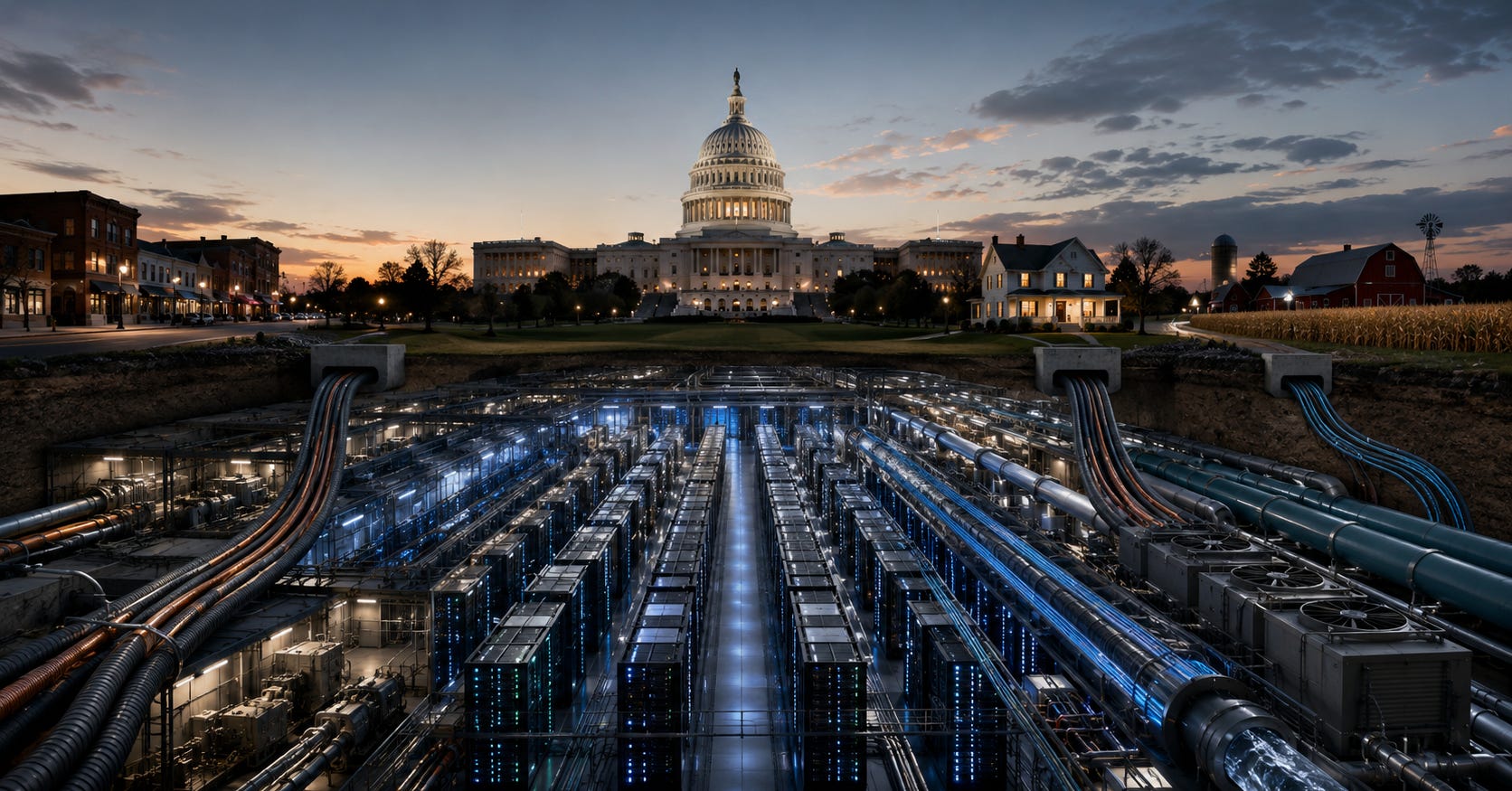
The artificial intelligence future is not floating above us in some weightless cloud.
It is being built on land. It is being wired into the electric grid. It is pulling on water systems. It is leaning on public infrastructure. It is being negotiated through zoning boards, utility deals, tax incentives, corporate promises, and political silence before most people have even had a chance to ask what they are being asked to give up.
AI needs a body. That body is the data center.
The data center needs power. It needs water. It needs land. It needs transmission lines. It needs local approval. It often wants public subsidies, public patience, and public trust. And when the costs show up, they do not always show up in Silicon Valley. They show up in somebody’s town, on somebody’s grid, near somebody’s water supply, and eventually on somebody’s bill.
So when Bernie Sanders says the American people should own a major stake in the largest AI companies, the easy thing to do is turn the whole debate into another tired left-versus-right shouting match. Call it socialism. Call it radical. Call it impossible. Call it whatever gets the cable-news panel moving.
But that misses the real question.
Bernie Sanders does not need to be completely right for Congress to be completely wrong.
His proposal raises serious questions. Who controls the public stake? Who appoints the board members? How do we keep a sovereign wealth fund from becoming another prize for insiders, lobbyists, donors, consultants, or whichever president happens to control the executive branch? Could public ownership become democratic accountability, or could it become executive power in disguise?
Those concerns should not be brushed aside. They are exactly why this debate belongs in Congress.
That is the Article I point. Congress does not have to rubber-stamp Bernie’s plan. It has to debate AI power in public, amend bad ideas, reject worse ones, and force every member to tell voters where they stand.
AI is too powerful to be governed by private boardrooms, executive orders, agency improvisation, billionaire promises, and court fights after the damage has already reached people’s kitchen tables.
The question is not only whether Bernie’s exact 50 percent ownership plan is the right answer. The question is why Congress is not already debating the answer.
If Congress does not govern AI power, somebody else will. Presidents will try to steer it by command. Agencies will fill the gaps. Courts will sort through the wreckage. Utility boards and local officials will be pressured to approve what they barely have the authority to control. And the richest companies in human history will keep building the future first and asking for public permission later.
That is the real fight.
It is not just about who owns the AI companies. It is about who pays the electric bill, who gives up the water, who absorbs the grid strain, who carries the labor shock, who gets surveilled, who gets replaced, who gets the tax break, who gets the profit, and who gets told the decision has already been made.
Americans are not rejecting the future. They are rejecting being handed the costs after the future has already been negotiated.
Support independent media that follows the power.
The Coffman Chronicle is built to track who holds power, who abuses it, who profits from it, and who pays the price.
Paid supporters get full Tony Michaels Podcast episodes, deeper transcript analysis, paid columns, archives, and the reporting framework behind the show.
If you believe independent media has to survive outside billionaire platforms, corporate media, and party-approved gatekeepers, become a paid supporter today.
Bernie Is the Spark, Not the Whole Fire
Sanders is arguing that the American people should have a major ownership stake in the largest artificial intelligence companies because AI was not created out of thin air.
It was trained on human knowledge, human writing, human art, human research, human code, human journalism, human conversation, and human culture. Generations of work, thought, creativity, and public information were pulled into these systems, often without permission, compensation, or real consent.
That is the part of the AI debate Big Tech would rather keep abstract.
They want the public to see artificial intelligence as innovation appearing from nowhere, as if billionaires dreamed the future into existence alone. But AI was built from the world we all helped create. It was built from public knowledge, public infrastructure, public universities, public research, public tolerance, and a society that produced the information these models consume.
So Sanders is asking a question that should have been asked long before now: if AI is built from the collective work of society, why should the ownership of AI’s wealth be concentrated in the hands of a few private companies?
That question is not radical. It is basic.
The answer may be complicated. Sanders’s specific plan may not be the final answer. A 50 percent public ownership stake in major AI companies is a massive proposal, and no serious person should pretend it does not raise serious questions.
But the question underneath it is not fringe.
Who owns the future when the future is built from public resources?
That debate is no longer theoretical.
On June 3, 2026, OpenAI CEO Sam Altman was on Capitol Hill as Washington debated the future of artificial intelligence. Sanders met with Altman after unveiling his proposal for a public ownership stake in major AI companies. There has not been a detailed public readout of that meeting, and we should not pretend to know exactly what was said behind closed doors.
But the meeting itself matters.
It shows that AI power is already walking the halls of Congress. The executives building this future are not waiting for the public to catch up. They are meeting with lawmakers, shaping the debate, responding to proposals, and preparing their own policy frameworks while the rest of the country is still trying to understand what artificial intelligence will mean for work, privacy, power bills, water systems, public infrastructure, and democratic control.
If Sam Altman can get in the room, the public deserves a debate on the floor.
Congress should not treat AI power as something to be negotiated privately between senators and executives while communities are left to handle the consequences locally. It should drag the whole question into public view.
That does not mean Congress has to pass Bernie’s plan as written. It can amend it. It can reject it. It can replace it. It can build something smarter, safer, narrower, stronger, or more accountable.
But Congress cannot keep pretending this is not its job.
The Public Carries the Cost
The AI boom is being sold as innovation, efficiency, productivity, and the next great leap forward. Some of that may be true. This article is not anti-technology. It is not arguing that every data center is bad or that artificial intelligence has no public value.
But there is a difference between building the future and letting private power build the future around us.
That difference is public consent.
Right now, too many communities are being asked to accept the costs before they are allowed to understand the deal. They are told the project will bring jobs, investment, tax revenue, and progress. Then come the harder questions.
How much electricity will it use? Who pays for the grid upgrades? What happens to water demand? What happens during drought? Who gets the tax break? Who carries the risk if the company’s promises do not pan out? Who is left with the infrastructure burden if the deal changes, the company sells, or the technology moves on?
Those are not anti-business questions. Those are self-government questions.
If the public is expected to carry the cost of the AI buildout, the public deserves a say in who owns the reward.
That does not automatically prove Bernie Sanders’s 50 percent public ownership proposal is the right answer. It does not mean every AI company should be run from Washington. It does not mean every data center decision should be federalized.
But it does mean the ownership question is legitimate.
Who gets rich from AI? Who gets displaced by it? Who pays for the electricity? Who gives up the water? Who receives the subsidy? Who absorbs the risk? Who controls the data? Who writes the rules?
And who gets told, after all the important decisions have been made, that this is just the price of progress?
That is the kitchen-table reality of artificial intelligence. It is not just a chatbot on a phone. It is a physical, political, economic system being built through communities and around communities.
If Congress refuses to debate that system, the public will be left negotiating town by town, project by project, utility board by utility board, against companies with national reach and global capital.
That is not democracy. That is surrender by fragmentation.
America does not have to fear technology, and every data center does not have to be stopped. The real question is whether the public gets to govern the future it is being asked to host, power, subsidize, and pay for.
If the people bear the cost, they deserve more than a thank-you note from Big Tech. They deserve power.
Scrutiny Is Not Silence
Bernie Sanders’s plan should make people ask hard questions.
That is a good thing, because serious proposals are supposed to make people ask hard questions.
Even Sanders appears to understand that this is not simple. In his own rollout, he acknowledged that government ownership in major companies is complicated, especially when artificial intelligence is only part of a company’s business. He also said that more details, including spending priorities and implementation mechanics, would be included in the legislation itself.
That means the plan is not fully answered yet, and Congress has work to do. The public should demand details, guardrails, limits, accountability, and a clear explanation of how this structure would actually serve ordinary people instead of creating another pool of power for insiders.
Congress should ask who controls the public stake. It should ask who appoints the board members. It should ask whether those board members answer to the public, Congress, the president, an independent trust, a political appointee, or a new institution that has not yet been tested. It should ask what happens when administrations change.
Slapping the word “public” on something does not automatically make it democratic. Public power can serve people, but it can also be captured.
A serious Congress would also ask whether ownership solves the data-center problem at all. A public stake in an AI company does not automatically protect a town’s water supply. It does not automatically keep electricity affordable. It does not automatically stop a bad local tax deal. It does not automatically protect artists, writers, journalists, teachers, programmers, and ordinary people whose work may have trained these systems. It does not automatically prevent surveillance abuse, deepfakes, discrimination, or job displacement.
There is another hard question Congress should ask: what happens if the AI bubble pops?
If the public receives a 50 percent stake in major AI companies and those companies continue to grow, the public could share in the upside. However, if AI valuations are inflated and the bubble bursts, the public stake could lose enormous value. Any promised dividend, public check, or social benefit tied to that fund could shrink or disappear with the market.
That is the lesson of the dot-com era. The internet was real. The technology changed the world, but many of the companies and valuations built around the internet still collapsed. A technology can be transformative and still produce a financial bubble. Both things can be true at the same time.
That is why Congress cannot treat public ownership like free money.
A stock stake is not a guaranteed public dividend. It is an asset with risk. It can rise. It can fall. It can be mismanaged. It can become a political temptation. If the government owns a large stake in AI companies, will lawmakers feel pressure to protect that stake by favoring those companies? Would regulators become softer because the public fund depends on corporate valuations? Would Congress be tempted to bail out companies because the public is now financially exposed to them?
A serious public ownership plan would need guardrails. It would need rules against bailouts. It would need independent management. It would need transparency. It would need a firewall between public investment and public regulation. It would need a plan for what happens if the fund’s value drops rather than rises. It would need to ensure that local communities are protected, even when doing so might reduce the profits of publicly owned companies.
Public ownership does not automatically equal public power.
If it is designed badly, it could turn the public into a silent shareholder in the same concentrated power we are supposed to be challenging.
That is not an argument for silence. It is an argument for Congress to do its job before the public is handed both the costs and the risk.
The Moratorium Is the Pressure Point
Public ownership is the big headline. But the data-center moratorium is the pressure point.
That is where the ownership debate meets the physical world.
AI does not become powerful simply because executives give speeches about innovation. It becomes powerful because infrastructure gets built. Land gets bought. Utility deals get signed. Water gets allocated. Transmission lines get planned. Tax incentives get negotiated. Local officials get pressured. Communities get promised jobs and progress.
By the time ordinary people realize how much power, water, land, and public money are being pulled into the project, the deal is already moving like a train.
That is why a moratorium should not be dismissed as anti-technology.
A moratorium is not automatically a rejection of the future. It can be a demand that the future follow rules before it becomes irreversible.
The Sanders and Ocasio-Cortez moratorium proposal will be attacked as extreme. Some of that criticism will be sincere. A national pause raises legitimate questions. How broad is the pause? What counts as an AI data center? How long does it last? Who grants exceptions? Could it slow useful technology? Could it hurt communities that actually want certain projects?
Those are fair questions. They should be debated, but not used to avoid the larger truth: the current system is already extreme.
It is extreme to let companies worth more than many nations negotiate with small towns as if the bargaining power is equal. It is extreme to let private AI demand reshape public electricity systems without a national debate over who pays for the upgrades. It is extreme to let water-intensive projects move forward before communities understand what that means for drought, heat, agriculture, housing, and future growth. It is extreme to hand out public subsidies to companies building private empires and then tell ratepayers, workers, and local residents to trust the process.
The moratorium is not only about stopping construction. It is about forcing a pause long enough for democracy to catch up with capital.
Big Tech moves fast because speed benefits Big Tech. If a company can buy the land, sign the utility agreement, secure the tax deal, and get local approval before the public understands the full cost, that speed becomes power. It turns public delay into private advantage. It turns confusion into leverage. It turns the phrase “innovation” into a shield against accountability.
Congress does not have to accept every word of the moratorium bill. It can narrow it, rewrite it, or build a different safeguard system. It can require environmental and utility impact studies. It can require public disclosure of energy and water use. It can prohibit secret subsidy deals. It can require community benefit agreements. It can force companies to pay for grid upgrades. It can protect ratepayers. It can give local governments federal standards to lean on when the pressure comes, but it has to do something.
Without a pause, without safeguards, and without a national debate, the buildout continues under the rules of private urgency. The companies build because delays cost them market share. Investors push because delays cost them returns. Executives promise because promises are cheaper than accountability. Politicians celebrate because ribbon-cuttings are easier than oversight. And communities are left trying to figure out what was traded away.
A moratorium is not a rejection of the future. It is a refusal to let the future be built by private power before public rules are in place.
Force the Debate
This is where the debate has to stop being theoretical.
A discharge petition is one of the few tools rank-and-file members of the House still have to force an issue onto the floor when leadership would rather keep it buried. It is not magic. It is not easy. It requires members to put their names on the line. That is precisely why it matters.
This is not about forcing every member of Congress to endorse Bernie Sanders’s 50 percent public ownership proposal. It is not about forcing every member to support every word of a data-center moratorium. It is not about pretending one bill has solved every AI question. It is about forcing Congress to stop hiding.
If members think Bernie’s plan is wrong, let them say so on the record. If they think a moratorium is too blunt, let them offer a sharper tool. If they think public ownership is dangerous, let them explain how they would stop private ownership from becoming unaccountable power. If they think AI companies should pay for the grid strain they create, let them write it down. If they think local communities deserve stronger consent rules, let them put that into law. If they think Big Tech should be trusted to police itself, let them say that out loud where voters can hear it.
That is the point of a floor debate. It forces clarity.
Right now, too much of the AI future is being shaped in places ordinary people cannot see. Private meetings. Corporate planning rooms. Utility negotiations. Local development deals. Agency memos. Executive actions. Investor calls. Lobbyist conversations. Court filings after the conflict has already begun.
A discharge petition pulls the fight into the open. It says the people’s branch does not need permission from party leadership to debate a national question. It says Article I still has tools, if lawmakers have the courage to use them.
That is Article I power in motion. It is not glamorous. It is procedural, difficult, and uncomfortable. But democracy is not supposed to be comfortable for people who avoid accountability. It is supposed to make power answer.
A discharge petition is not an endorsement of every word in one bill. It is a demand that Congress stop hiding from the biggest question of power in our time.
Congress should debate whether communities deserve meaningful consent before major AI data centers are approved. It should debate who bears the cost of grid strain. It should debate water use, public subsidies, labor protections, copyright, data rights, privacy, surveillance, transparency, and public return.
Those are not side questions. They are the questions.
Congress does not have to choose Bernie’s answer, but Congress does have to ask the questions.
Support Independent Media
If you can afford to become a paid subscriber, please consider supporting The Coffman Chronicle.
The AI future is being built fast, and the people paying the price deserve independent media that follows the power, not the press release.
Your support helps us keep asking the questions Congress, billionaires, and party leadership would rather avoid: who pays, who profits, who decides, and who gets left behind?
Sources:
“Sam Altman Goes to the Hill as OpenAI Preps Policy Framework.” Semafor, June 3, 2026.
“Sanders, Ocasio-Cortez Push Bill to Impose AI Data Center Moratorium.” AP News, March 25, 2026.
DeHaven, Tad. “Trump Opened the Door for Sanders’s Sovereign Wealth Fund.” Cato at Liberty, June 2, 2026.
“5 Signs of an AI Bubble to Watch For.” Fidelity, February 10, 2026.
“CEO of OpenAI Sam Altman Speaks with Reporters, Following Meetings on Capitol Hill.” Reuters Connect, June 3, 2026.
“The Public Should Own Half of the Big A.I. Companies.” Senator Bernie Sanders, June 1, 2026.
“NEWS: Sanders, Ocasio-Cortez Announce AI Data Center Moratorium Act.” Senator Bernie Sanders, March 25, 2026.
Tan, Huileng. “Ray Dalio Says You Can Be Right about AI and Still Lose Money.” Business Insider, June 4, 2026.
U.S. Energy Information Administration. “EIA Forecasts Strongest Four-Year Growth in U.S. Electricity Demand since 2000, Fueled by Data Centers.” January 13, 2026.
This is a terrific post. It presents, as you imply, something superficial, but what underlies the superficial proposition is the fact that Congress does not do its job: looking out for the public. And if Congress gets paid off by the private sector not to look out for the public, then Sanders' proposal is correct: the public (sector) should be empowered to look out for itself. A substantial seat at the table is absolutely required.
AI was funded by government grants. Failure of Congress to recognize that AI has serious implications for all aspects of life is short sighted and uninformed. AI must be government regulated; not used for weapons (as Trump wants), and owned at least part by the Federal government. Million/billionaires should not be dictating government policy at any level.