


Residents in parts of Georgia recently learned that towering new electrical infrastructure, tied to growing energy demand, could soon run across or near their properties. For many families, the discovery was jarring. Transmission towers are not abstract policy debates. They are physical structures that reshape landscapes, alter property use, and force communities to confront difficult questions about who benefits from rapid industrial expansion and who bears the burden.
At first glance, the story may sound like another localized dispute over utility infrastructure. Yet a growing number of recent headlines from across the country suggest something larger is unfolding. From the South to the Mid-Atlantic, from the Midwest to Lake Tahoe in the West, the accelerating buildout of artificial intelligence and hyperscale data centers is beginning to push far beyond server farms themselves and into the physical systems that sustain them, including transmission corridors, electrical grids, land-use planning, and household utility costs.
For months, warnings about AI’s enormous appetite for electricity and water sounded somewhat theoretical. Analysts projected soaring power demand, environmental advocates warned about water-intensive cooling systems, and utility executives spoke of future grid strain. What is emerging now, however, are the first visible signs that those predictions are materializing in real communities.
The cloud was never truly weightless. It simply hid the physical footprint from public view. That may be changing.
This Community Is Powered by You
What started as a small circle has grown into something much bigger, and it’s all because of readers like you.
Every time you forward this email, post it on socials, or bring someone new into the fold, you’re helping build one of the most passionate, independent political communities out there.
Want to keep the momentum going?
Share this newsletter with someone who should be part of this conversation.
Thank you for being here. It means everything.
Georgia’s Transmission Fight
Towers in the Backyard, Toombs County Region
The story from Toombs County, Georgia, resonates because it is so tangible. Residents are not arguing over distant data centers they may never see. They are confronting the prospect of transmission lines and electrical towers appearing near homes, farms, and wooded land that many assumed would remain untouched.
The broader backdrop is a massive expansion in electricity demand, largely driven by data centers. Georgia has become one of the country’s fastest-growing hubs for AI and cloud infrastructure, fueled by tax incentives, available land, and relatively favorable utility conditions. The result has been a scramble for new generation capacity and the infrastructure needed to move that power.
Utilities have long possessed the authority to acquire land for major infrastructure projects through eminent domain, the legal process that allows governments or authorized entities to acquire private property for public use with compensation. The concept itself is not new, nor is its use for electrical infrastructure. Transmission corridors, substations, highways, pipelines, and rail projects have relied on similar powers for decades. What is changing is the scale and urgency of the buildout.
The AI boom is driving a sharp increase in demand for new substations, long-distance transmission lines, and expanded generation capacity. Projects that might once have unfolded gradually over many years are now being accelerated by rapidly growing industrial electricity consumption.
For residents, the concerns are often deeply personal and practical. Transmission projects can alter viewsheds, reduce property desirability, restrict future land use, and create constant visual reminders of industrial expansion. Some homeowners also raise concerns about noise and potential long-term health effects from electromagnetic fields (EMFs).
Major health agencies have not established clear evidence that ordinary exposure from transmission infrastructure causes widespread illness, yet some studies have raised unresolved questions regarding long-term magnetic-field exposure and childhood leukemia. The scientific evidence remains limited and inconclusive, though the concerns themselves are real to the communities facing these projects.
Residents resisting the expansion of transmission are not simply reacting to aesthetics. Many feel they are being asked to sacrifice land, peace, and local control for infrastructure whose primary beneficiaries may be distant technology companies and large industrial users.
Data Centers in Sensitive Areas, Coweta County
In nearby Coweta County, the fight is ongoing as residents attempt to stop a proposed data center. In that case, conflicts overlap with environmental and water concerns. According to CBS News Atlanta, residents challenging the proposed Project Sail data-center campus argue that the nearly 830-acre site sits in the Middle Chattahoochee River basin, in an area Georgia’s Department of Natural Resources designates as a “Most Significant Groundwater Recharge Area.” The appeal also claims the project’s original regional impact study incorrectly stated the land was not in a significant recharge area.
The AI infrastructure fight is rarely about one resource at a time. The same project can raise questions about land use, electricity demand, water protection, environmental review, and local control all at once.
AI’s “Extension Cords” Stretch Across States
The Mid-Atlantic Transmission Corridor
The Georgia fight is not isolated. Increasingly, the need for land and infrastructure is spanning multiple states.
In the Mid-Atlantic, a subsidiary of Florida-based energy giant NextEra Energy has proposed the MidAtlantic Resiliency Link, a 500-kilovolt transmission line stretching roughly 105 to 110 miles across portions of Pennsylvania, Maryland, West Virginia, and Virginia. The project is designed in part to support soaring electricity demand associated with Northern Virginia’s massive concentration of data centers, often referred to as “Data Center Alley.”
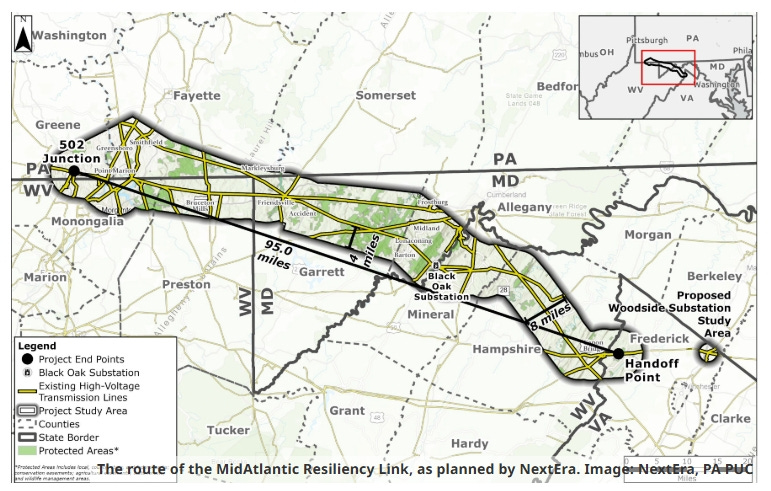
Source: The Allegheny Front
Northern Virginia has become one of the world’s largest data-center markets. The region’s facilities power everything from cloud storage to AI training systems, streaming services, and enterprise computing. Those operations require extraordinary amounts of electricity, and the transmission network feeding them is struggling to keep pace.
The proposed MidAtlantic line has already sparked opposition from residents and lawmakers concerned about land impacts, costs, and the possibility of eminent-domain proceedings. Critics argue that communities far from the data centers themselves may end up absorbing the burdens of transmission infrastructure while receiving relatively little direct economic benefit.
That tension reflects a broader question emerging around AI infrastructure. The economic rewards often flow toward technology firms, investors, and metropolitan growth hubs. The physical burdens, however, are frequently distributed outward into rural and exurban communities through power plants, substations, transmission corridors, and water infrastructure.
Wisconsin’s Landowner Backlash
A similar dynamic is unfolding in Wisconsin.
Recent reporting highlighted concerns from landowners affected by a proposed high-voltage transmission line connected to the broader “Stargate” ecosystem associated with OpenAI and Oracle. One landowner described the possibility of a 250-foot-wide transmission corridor cutting through a 70-acre property.
The details differ from the Mid-Atlantic project, yet the underlying pattern feels familiar. AI’s physical footprint does not stop at the walls of a data center. It extends outward through a vast network of supporting infrastructure that can reshape landscapes hundreds of miles away from the servers themselves.
Historically, major industrial and energy infrastructure projects have often raised environmental-justice concerns. Lower-income communities and politically weaker regions have frequently borne disproportionate burdens of land, pollution, and infrastructure. That does not mean every AI-related transmission project follows the same pattern, yet as the buildout accelerates, the question deserves scrutiny.
Lake Tahoe and the Fight Over Electrical Capacity
The Tahoe story reveals another dimension of the emerging AI infrastructure challenge. In this case, the issue is not primarily land but electricity itself.
Liberty Utilities provides power to roughly 49,000 customers on the California side of Lake Tahoe. Around 75% of that electricity currently comes through a wholesale arrangement with NV Energy, the major Nevada utility owned by Berkshire Hathaway Energy.
Recently, it was announced that the arrangement will end after May 2027.
According to filings and utility statements, Liberty Utilities says NV Energy informed the company it would no longer provide the power supply, citing growing internal needs, including exploding demand tied to data centers in northern Nevada. The Reno region has become a major technology and industrial hub, with facilities linked to companies such as Google, Microsoft, and Apple.
The Tahoe story quickly attracted national attention because of how starkly it illustrates the stakes of the new electricity race. Nearly 50,000 residents now face uncertainty over how their utility will replace most of its power supply within a relatively compressed timeframe.
To be clear, this does not mean Lake Tahoe residents are expected to lose power in 2027. Liberty Utilities has emphasized that the lights are not simply being shut off. The company is pursuing replacement energy arrangements and broader transmission access.
However, the underlying reality remains striking. One of the country’s most iconic resort regions is confronting a future in which rising data-center demand is driving a scramble for finite electrical capacity.
The geography also complicates matters. Liberty’s California customers are electrically tied more closely to Nevada’s system than to California’s main statewide grid. Building entirely new transmission infrastructure across the Sierra Nevada would be enormously expensive and environmentally contentious.
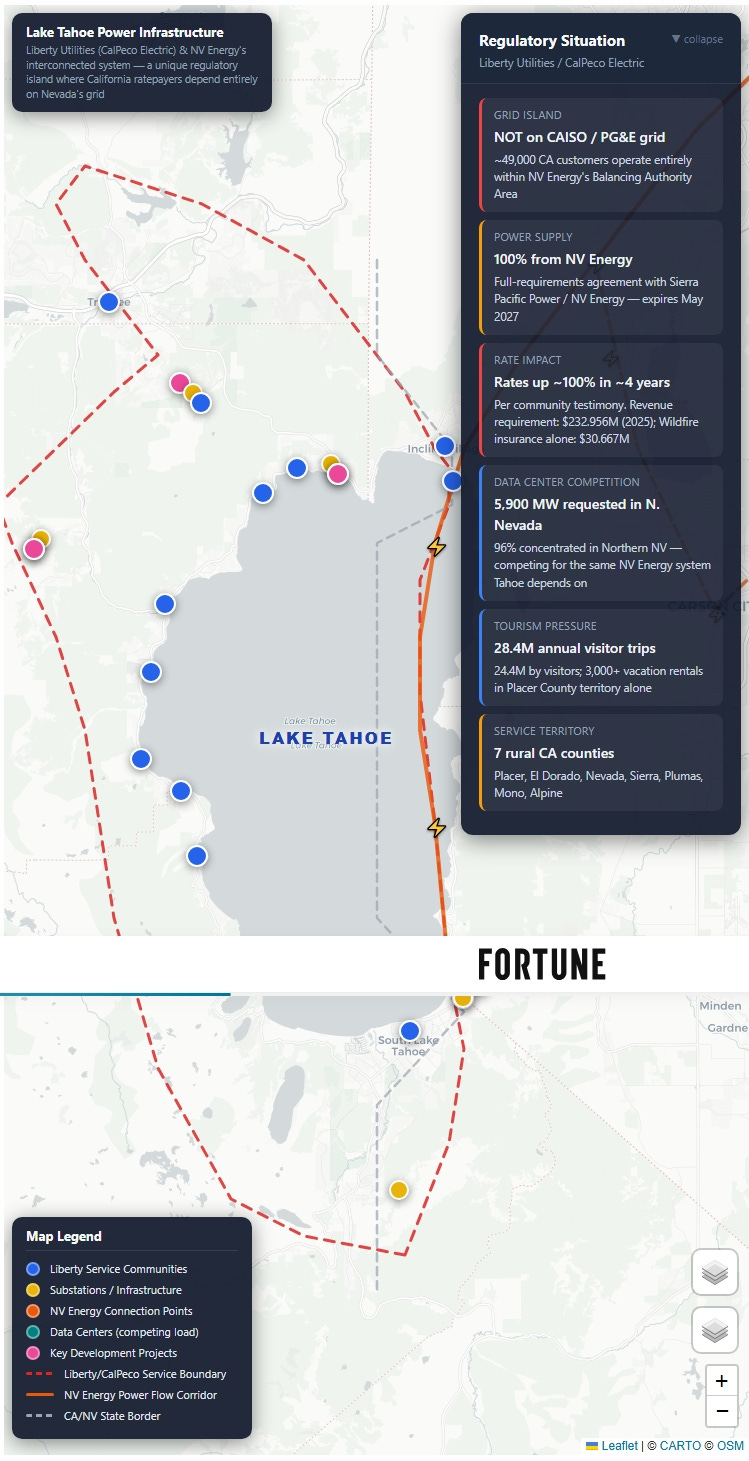
Source: Fortune
For years, warnings about AI-driven electricity demand sounded abstract. The Tahoe case makes the issue concrete. The pressure is no longer theoretical, as utility executives openly discuss whether there is enough power to meet competing demands.
The Bill Comes Due
Returning to Georgia
The final piece of the puzzle brings the story back to Georgia, this time through household utility bills rather than transmission towers.
In 2023 and 2024, Georgia regulators approved major long-term generation and infrastructure expansions for Georgia Power. The plans involve tens of billions of dollars in investment over time, including new natural-gas generation and expanded grid capacity. The Associated Press reported that roughly 80% of Georgia Power’s projected demand growth through 2031 is tied to data centers.
Utilities argue that such investments are necessary to maintain grid reliability amid rapidly rising demand. Critics, however, worry that ordinary ratepayers may ultimately shoulder significant financial risk if projected data-center growth fails to materialize at the anticipated scale or if infrastructure costs continue to balloon.
This is where the issue broadens beyond communities directly facing transmission corridors. Even households hundreds of miles from a data center may still feel the effects through higher monthly utility bills or through public subsidies and tax incentives designed to attract hyperscale development.
That is one reason these stories resonate beyond the technology sector. They touch systems people interact with every day, such as electricity, housing, land, water, and local governance.
The AI revolution is often framed in futuristic language. Discussions focus on machine learning models, productivity gains, automation, and digital transformation. However, the infrastructure supporting that revolution is intensely physical. It requires land, water, power plants, substations, transmission corridors, and enormous amounts of electricity.
Increasingly, it also requires public buy-in.
The Emerging Political Question
None of this means AI development should stop, nor does it suggest every transmission project is illegitimate or unnecessary. Modern societies depend on large-scale infrastructure. Electrical grids must evolve as demand changes.
However, the recent wave of stories from Georgia, the Mid-Atlantic, Wisconsin, and Lake Tahoe signals an important transition. The consequences of the AI buildout are no longer confined to Silicon Valley balance sheets or investor presentations. They are appearing in zoning meetings, utility hearings, property disputes, and household budgets across the country.
That shift carries political implications.
For years, the dominant public conversation around AI centered on jobs, misinformation, and automation. The next phase may focus increasingly on physical resources and public infrastructure. Citizens are beginning to ask who controls the grid, who profits from expansion, who pays for upgrades, and whose communities absorb the disruption.
Those questions are unlikely to disappear. If anything, they are probably just beginning, often in your backyard or next bill.
If you found this reporting valuable, consider subscribing. We are tracking the emerging physical footprint of the AI boom beyond the headlines and investor hype: the land fights, water battles, grid strain, utility politics, and public costs reshaping communities across the country. As these conflicts accelerate, we will continue following where the infrastructure expands, who benefits, and who is asked to pay the price.
Sources:
The Advance News, “Georgia Power Eminent Domain,” May 13, 2026.
CBS News Atlanta, “Coweta County residents file appeal to stop massive data center on protected rural land,” May 7, 2026.
The Allegheny Front, “Energy company wants eminent domain for power lines in SW Pa. for data centers in Virginia,” April 15, 2026.
E&E News by POLITICO, “Data center ‘extension cord’ draws landowners’ ire,” January 20, 2026.
ABC News, “A 600-acre AI data center could cost some Wisconsin residents their land,” February 18, 2026.
SFGATE, “Tahoe is losing a major power source amid data center growth,” May 4, 2026.
Fortune, “Nearly 50,000 Lake Tahoe residents face power loss as utility redirects lines to data centers,” May 12, 2026.
AP News, “Georgia Power says it needs a huge increase in power capacity to meet data center demand,” December 5, 2025.
The Current, “Environmental groups sue over Georgia Power’s energy expansion for data centers,” March 27, 2026.
This is one of the only well-researched and explained/described descriptions of how gigantic and sprawling the effects (physical occupation of huge chunks of land, extensive need for electricity, huge consumption of resources like water). The appetite for these data centers seems to be growing, and I do not yet have a sense of how it will help me or others in this country. I do not see how it will enrich our daily lives, and instead will only enrich the very wealthy who are behind this whole venture.
Thanks for the important update. Bottom line is we have Republicans the historical big business lovers (think Rockefeller dynasty) backing profit driven uber wealthy people sucking the money and lifeblood out of ordinary American taxpayers! Kick the kleptocrats out!