


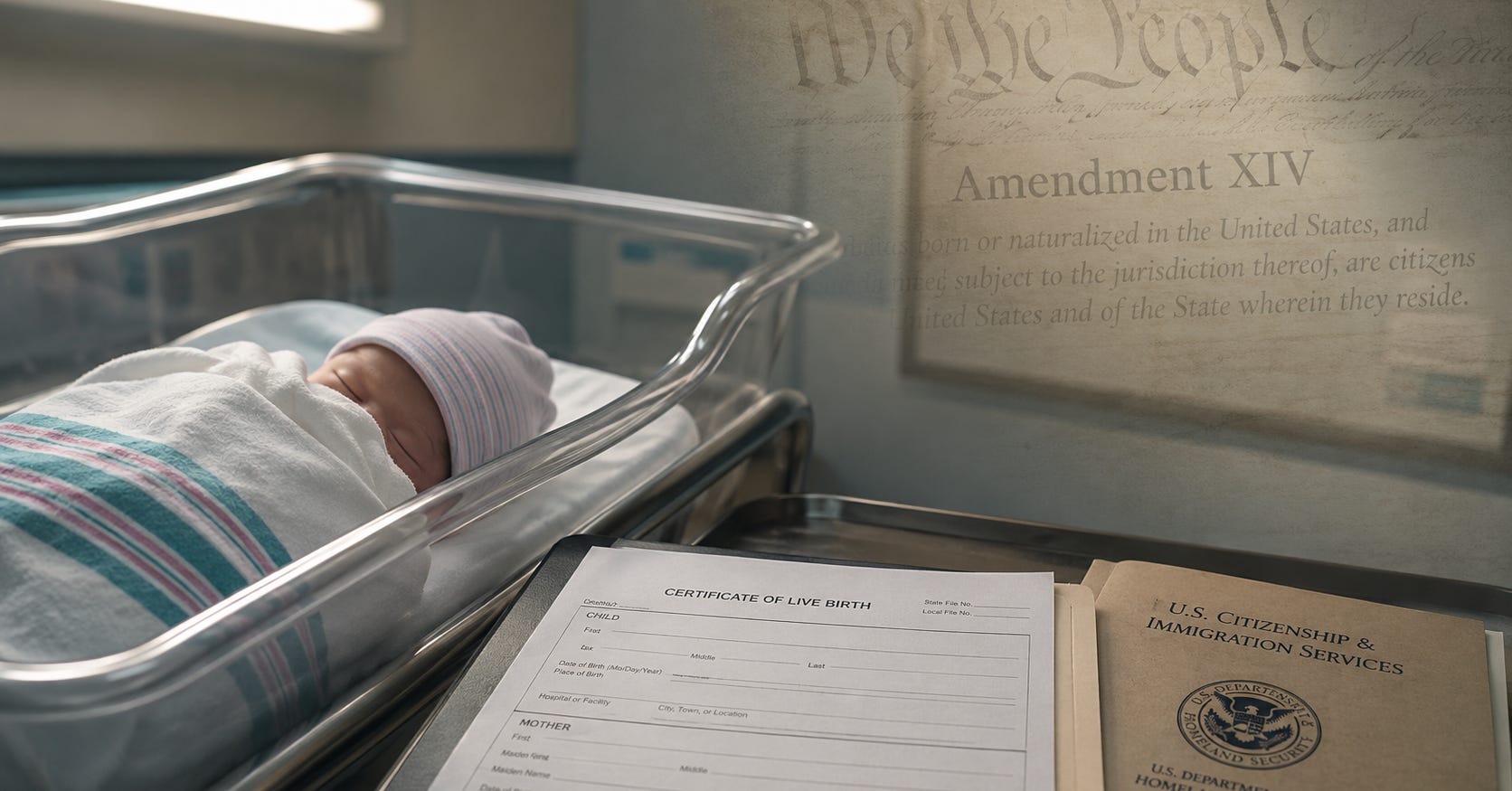
The Baby Did Not Cross the Border
The child entered the world beneath fluorescent hospital lights, wrapped in a blanket before anyone asked for papers. The baby had not crossed a border, overstayed a visa, broken a law, or chosen where to be born.
Yet under President Donald Trump’s executive order, the federal government would have looked beyond the hospital room and into the parents’ immigration files before recognizing that child as an American citizen. Was the mother lawfully present? Was her stay permanent or temporary? Was the father a citizen? Could the parents prove it?
The federal government’s recognition of the child’s citizenship would have depended not only on where the child was born, but on documents, classifications, and decisions made inside agencies controlled by the president. The government was not trying to remove someone who had entered the country unlawfully. It was trying to declare that a child born here had never fully belonged.
Other countries draw the citizenship line differently. Americans are free to debate whether our rule should change, but the deeper question is whether a president may move that line by himself.
Support independent media that follows the power.
The Coffman Chronicle is built to track who holds power, who abuses it, who profits from it, and who pays the price.
Paid supporters get full Tony Michaels Podcast episodes, deeper transcript analysis, paid columns, archives, and the reporting framework behind the show.
If you believe independent media has to survive outside billionaire platforms, corporate media, and party-approved gatekeepers, become a paid supporter today.
The Order Failed. The Claim of Power Still Matters.
On June 30, 2026, the Supreme Court held that children born in the United States to parents who are unlawfully or temporarily present are subject to American jurisdiction and are citizens under the Fourteenth Amendment.
The Court did not grant those children citizenship. It recognized that the Constitution already had. That ruling was not the same as the Court’s 2025 decision in Trump v. CASA, which addressed the reach of nationwide injunctions rather than the legality of the citizenship order. After that decision, parents pursued nationwide class relief. A district court provisionally certified the class and blocked the order before the constitutional question reached the Supreme Court.
The process revealed why the failed order still has to be discussed. A president asserted sweeping power. Federal agencies were directed to prepare for its use. The families whose children would have been affected had to find lawyers, organize, and endure multiple rounds of litigation before the government was finally told that the line could not be moved.
That is a familiar model of concentrated power: act first, shift the burden to the people being harmed, and wait to see whether a court stops the machinery before it begins operating.
The Constitution eventually held, but families had to enforce it. A republic should not require every family threatened by an unconstitutional order to become the constitutional enforcement mechanism.
The order failed, but the claim of power still matters because the next president who wants authority the Constitution never gave him will study not only the Court’s answer, but how far the government traveled before anyone forced it to stop.
America Is Not the Only Country Nor the Global Norm
America is not alone in granting citizenship to nearly everyone born within its borders. It also does not follow the rule used by most of the world.
A 2026 Pew Research Center review of citizenship laws in 191 countries found that 33—including the United States, Canada, Mexico, Brazil, and Argentina—generally grant citizenship automatically to children born there regardless of their parents’ legal status. About 50 other countries offer narrower versions, often requiring that a parent be a lawful resident, a permanent resident, or born in the country. In most nations, citizenship at birth depends primarily on the citizenship of one or both parents.
Both sides often exaggerate this comparison. The United States is not the only country with birthright citizenship, but our broad version is not the most common global model.
Germany, Ireland, Australia, and the United Kingdom recognize forms of citizenship linked to birthplace, but they impose conditions tied to parental status, residence, or generational ties. Other democracies have decided that birth alone is not always enough.
Americans may look at those systems and ask whether our own rules should change, and that is a legitimate debate, but foreign law does not rewrite American law. Britain can change its citizenship through its system. Germany can change German citizenship through Germany’s. The United States placed its rule in the Fourteenth Amendment and reinforced it through federal law.
Other countries can show us that alternatives exist. They cannot give an American president the authority to impose one in the absence of Congress.
Citizenship Was Placed Beyond Political Discretion
The Fourteenth Amendment did not place citizenship in the Constitution by accident. It came after Dred Scott, when the Supreme Court declared that Black Americans descended from enslaved people could not be citizens of the United States. The government had used political power to decide that an entire class of people could live under American law, work under American law, suffer under American law, and still never fully belong to the country enforcing those laws against them.
Congress rejected that principle through the Civil Rights Act of 1866, and the states then ratified the citizenship guarantee as part of the Fourteenth Amendment, placing it beyond ordinary political reversal.
Birthright citizenship was not constitutionalized out of blind trust in government, but because government had already shown the danger of allowing those in power to decide which families deserved membership.
The amendment rejected the idea that the government could deny citizenship to a disfavored class. Three decades later, United States v. Wong Kim Ark tested whether that guarantee would hold when the disfavored class was Chinese rather than formerly enslaved.
Wong was born in San Francisco to Chinese parents who were barred from becoming naturalized citizens. The Court nevertheless held that his birth in the United States made him an American citizen.
There have always been narrow exceptions, including children born to foreign diplomats or hostile occupying forces, but the Constitution did not create a general exception for children whose parents lacked permanent immigration status. That was the rule President Trump tried to add.
The Fourteenth Amendment turned citizenship from a political judgment about which families deserved to belong into a constitutional status the government was required to recognize. That is why changing it requires more than one president deciding that the old rule has become inconvenient.
The Opposing Argument Is Serious. Presidential Power Is Still the Wrong Answer.
There is a legitimate argument against America’s broad rule. Many countries require more than birth within their territory. Some Americans believe that citizenship should require at least one parent to be a citizen or a permanent resident. Others argue that temporary visitors should not be able to create a permanent legal connection to the country simply by giving birth here. Concerns about birth tourism, unlawful immigration,, and national allegiance are not imaginary merely because politicians sometimes exploit them.
The constitutional argument is also more serious than its loudest slogans suggest.
The dissenting justices argued that being “subject to the jurisdiction” of the United States meant more than being physically present and required to obey American law. In their view, citizenship historically depended upon a deeper relationship involving domicile, permanent allegiance, or the absence of a competing foreign attachment.
The majority rejected that interpretation. It concluded that children born here are subject to American jurisdiction, regardless of whether their parents are citizens, permanent residents, temporary visitors, or unlawfully present.
Justice Brett Kavanaugh took a different path. He rejected the majority’s constitutional reasoning but still voted against the order because Congress had never created the exceptions President Trump attempted to impose.
That distinction is the heart of the matter. A sincere constitutional disagreement does not give the president permission to declare his preferred answer to be federal law. A policy argument does not manufacture executive authority.
You can believe birthright citizenship should be narrowed and still understand that the president does not possess the power to narrow it alone. Under the recent five-justice majority decision theory of the 14th Amendment, changing that rule would require the amendment process or a future Supreme Court willing to overturn the interpretation now governing the country.
The debate is legitimate. The shortcut is not.
The Bureaucracy That Would Have Sorted Newborns
The executive order was not merely a statement about constitutional meaning. It instructed federal agencies to turn that meaning into a working system.
Officials would have needed to determine the mother’s immigration status at the time of birth, decide whether her presence was permanent or temporary, establish the father’s citizenship or residency, identify which documents constituted proof, and resolve cases in which records were missing, delayed, or disputed.
The order made the machinery even more intrusive by defining a mother and father through immediate biological parentage. That raises questions reaching far beyond the usual immigration debate. What happens when a legal parent is not a biological parent? Whose status controls after adoption, surrogacy, or donor conception? What proves paternity when a father is absent or unknown? Would families have been required to disclose private reproductive or medical information before the government recognized their child’s citizenship?
A constitutional status would have become a bureaucratic determination made by agencies controlled by the president and dependent upon immigration files, biological relationships, and disputed paperwork.
The consequences would not have remained inside Washington. They would have reached the hospital records office, the passport application, the Social Security counter, the school enrollment form, and the employer checking a future worker’s documents. Families could have spent years carrying folders between agencies, trying to prove that a child born in the United States belonged there. While not every public service depends upon citizenship, uncertainty about citizenship would follow a person across institutions and throughout life.
Concentrated power rarely remains inside an executive order. It travels through forms, databases, and agency guidance until it arrives at a kitchen table where parents are asking whether the government will recognize their child tomorrow.
Congress Had Already Spoken but Did Not Defend Its Answer
President Trump was not filling a silence Congress had left behind. Federal law already provides that a person born in the United States and subject to its jurisdiction is a citizen at birth under the Immigration and Nationality Act. The statute mirrors the Fourteenth Amendment. It does not contain the parental-status exceptions that the executive order attempted to create.
Even Justice Kavanaugh, who disagreed with the Court’s constitutional majority, still concluded that the president could not add exceptions Congress had never enacted. The executive branch was not interpreting a blank page. It was attempting to overwrite an answer Congress had already provided.
Congress did not remain completely silent. House and Senate committees held hearings, and lawmakers introduced bills both to narrow birthright citizenship and to block the executive order. A bicameral group of 216 Democratic lawmakers filed a brief before the Supreme Court opposing the order.
Therefore, it would be wrong to say Congress merely watched. Hearings aired arguments, introduced bills, announced positions, and a court brief assisted the judiciary, but none became a binding institutional answer that stopped the executive branch from testing its claim of power.
Congress could have brought funding restrictions or protective legislation to a vote. Members who believed birthright citizenship should be narrowed could have forced the constitutional question into the open and defended their proposed change before the country.
Instead, the only operative protection against the order came through litigation brought by families. That is a quieter form of legislative surrender. Congress may speak, investigate, and file briefs while still leaving the decisive work to judges and private plaintiffs. When Congress gives up power, the people lose power, even when a court eventually returns part of it.
Congress should not campaign on citizenship, avoid a binding vote, and leave the president to test the desired rule through administration.
Border Enforcement Is Not Citizenship Erasure
Defending birthright citizenship does not require pretending the United States has no right to enforce its immigration laws. Congress may decide who may enter the country, how long temporary visitors may remain, which visa programs should exist, and when a noncitizen is legally subject to removal. The government may prosecute immigration fraud, strengthen border enforcement, and regulate businesses built around exploiting citizenship rules.
However, none of that answers the question before the Court. The question was whether a president could take the immigration status of a parent and use it to deny citizenship to a child born in the United States.
Many countries make parental citizenship, residence, or legal status part of their rule. The Fourteenth Amendment adopted a broader one. The existence of other systems proves that alternatives are possible, but it does not prove that a president may import one through executive action.
A government strong enough to enforce lawful borders should also be disciplined enough to obey its own constitutional borders. Immigration enforcement determines the legal status of noncitizens. It cannot become a back door through which the president creates a new class of people born in America but refused recognition as Americans.
A country proves its strength by enforcing the law without placing the president above it.
Support Independent Media
If this work matters to you, share it with someone who believes constitutional limits should apply no matter who occupies the White House.
And if you can afford to become a paid subscriber, your support helps keep the Coffman Chronicle independent, reader-supported, and focused on the power struggles that reach from Washington into ordinary lives.
Sources:
DeSilver, Drew. “U.S.-Style Birthright Citizenship Is Uncommon around the World.” Pew Research Center, March 31, 2026.
Library of Congress. “Citizenship Clause Doctrine.” Constitution Annotated.
Library of Congress. “Fourteenth Amendment, Section 1.” Constitution Annotated.
Library of Congress. “Historical Background on Citizenship Clause.” Constitution Annotated.
Members of Congress. Brief of Members of Congress as Amici Curiae in Support of Respondents, Trump v. Barbara, no. 25-365. Supreme Court of the United States, corrected February 26, 2026.
Pew Research Center. “Birthright Citizenship around the World.” March 31, 2026.
Supreme Court of the United States. Trump v. Barbara, 609 U.S. ___ (2026). No. 25-365. Decided June 30, 2026.
Supreme Court of the United States. Trump v. CASA, Inc., 606 U.S. ___ (2025). No. 24A884. Decided June 27, 2025.
Supreme Court of the United States. United States v. Wong Kim Ark, 169 U.S. 649 (1898). Decided March 28, 1898. Library of Congress.
United States Congress. Birthright Citizenship Act of 2025. H.R. 569, 119th Cong., 1st sess. Introduced January 21, 2025.
United States Congress. Born in the USA Act. S. 646, 119th Cong., 1st sess. Introduced February 20, 2025. https://www.congress.gov/bill/119th-congress/senate-bill/646/text.
United States House Committee on the Judiciary, Subcommittee on the Constitution and Limited Government. “‘Subject to the Jurisdiction Thereof’: Birthright Citizenship and the Fourteenth Amendment.” Hearing, 119th Cong., 1st sess., February 25, 2025.
United States House of Representatives, Office of the Law Revision Counsel. “8 U.S.C. § 1401: Nationals and Citizens of United States at Birth.” United States Code.
United States Senate Committee on the Judiciary, Subcommittee on the Constitution. “Protecting American Citizenship: Birthright Citizenship for Illegal Aliens and Tourists.” Hearing, March 10, 2026.
White House. “Protecting the Meaning and Value of American Citizenship.” Executive Order 14160. January 20, 2025.
How many women would have to come here to deliver their babies for it to make any kind of impact on our country? It would also take years for that child it be old enough to have a significant impact.