


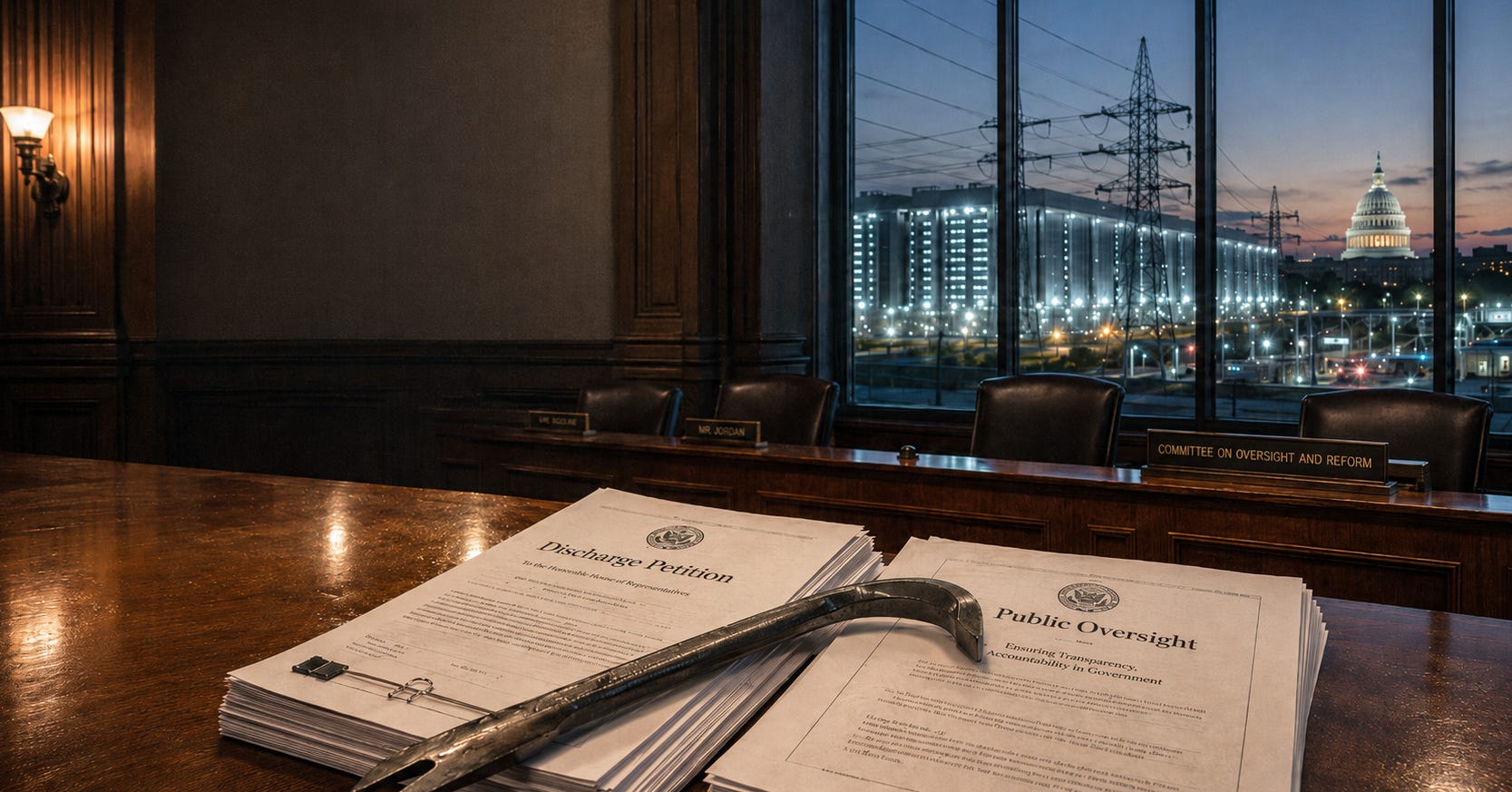
Congress already proved it still has a crowbar when leadership tries to lock the door.
The Epstein files fight did not reach the House floor because leadership suddenly discovered an appetite for transparency. It got there because members used a discharge petition, one of the few tools that can break through leadership gatekeeping. Rep. Thomas Massie helped push that effort, and the House later passed the Epstein Files Transparency Act 427–1.
The petition did not magically solve the scandal. It did not release the files on its own. It forced a choice. It made members put their names on the record. It dragged an avoided question into public view.
That matters far beyond Epstein.
The same democratic question now hangs over the AI data-center boom: who gets to decide what gets built, who gets the benefits, and who gets handed the bill?
Data centers are sold in the language of progress. Artificial intelligence. Innovation. Jobs. Competitiveness. The future. Yet the future does not float in the cloud. It lands somewhere. It takes land from a real community. It plugs into a real power grid. It draws from real water systems. It leans on tax breaks, utility upgrades, federal approvals, and local political permission. Too often, the people who will live with the consequences are brought in after the deals are already moving.
This is not an argument against technology. America can build data centers. America can compete in artificial intelligence. America can invest in infrastructure that serves the future.
However, if that future is so good for the country, it should be able to survive daylight.
Build the future, but do not build it in the dark.
Support independent media that follows the power.
The Coffman Chronicle is built to track who holds power, who abuses it, who profits from it, and who pays the price.
Paid supporters get full Tony Michaels Podcast episodes, deeper transcript analysis, paid columns, archives, and the reporting framework behind the show.
If you believe independent media has to survive outside billionaire platforms, corporate media, and party-approved gatekeepers, become a paid supporter today.
What the Epstein Fight Actually Proved
A discharge petition does not pass a law by itself. It does not order an agency to act. It does not force a president to sign anything. What it does is simpler and more important: it gives a majority of House members a way around leadership when leadership refuses to bring something to the floor.
Most Americans do not experience Congress as a place where urgent public questions naturally rise to the top. They experience it as a place where those questions disappear into committee rooms, procedural traps, donor pressure, partisan discipline, and managed silence. A bill can have public support and still die without a vote. A scandal can demand answers and still be buried.
That is why the discharge petition matters. It turns public pressure into public accountability. It says leadership does not get to be the graveyard for every uncomfortable issue.
And that is why this article is also a call to action.
The Tony Michaels Podcast and The Coffman Chronicle are asking Rep. Thomas Massie to use the same discharge-petition crowbar he used in the Epstein files fight, this time to force a House vote on the AI data-center boom. This is not to ban the future nor for a stunt. It is to make Congress choose between public oversight and private momentum.
The issue now is not secret files in a government archive. It is the physical foundation of the next economy being built through real communities, with real public resources, real energy demands, real water demands, and real political consequences. The subject is different. The democratic question is the same.
Who gets to decide whether the public gets a vote?
The AI Data-Center Boom Is Being Sold as Progress, but Built as Power
The data-center boom is being sold in the language of inevitability.
Artificial intelligence is coming. America must compete. The grid must expand. Permits must move faster. Communities must get on board. Anyone who raises concerns can be made to sound backward, anti-growth, or afraid of the future.
That framing is convenient for the people who already have power.
Once the debate is reduced to progress versus obstruction, the real questions disappear. Who owns the project? Who gets the tax break? Who pays for the power lines? Who carries the water burden? Who absorbs the rate increase if utilities build new infrastructure for private demand? Who gets the jobs, and how many remain after construction ends? Who negotiated the deal before the public ever saw the numbers?
Those are not anti-technology questions. They are democracy questions.
The cloud sounds weightless, but it is not. It needs land, electricity, water, transmission lines, substations, backup power, cooling systems, roads, tax arrangements, environmental approvals, and political permission. Every one of those needs touches ordinary people somewhere.
That is where the sales pitch starts to break down.
A data center may be marketed as innovation, but a family sees it as a higher electric bill. A farmer may see pressure on the local water supply. A governor may see a ribbon-cutting. A utility may see guaranteed demand. A tech company may see the backbone of its next profit engine. The people living near the project are often left trying to decode what was already negotiated in their name.
That is how concentrated power works in the modern economy. It does not always arrive with a closed fist. Sometimes it arrives with glossy renderings, jobs numbers, competitiveness language, and a promise that this is all too important to slow down.
But slowing down is not the same as saying no.
A temporary pause for public accountability is not sabotage. It is the bare minimum for communities being asked to host the infrastructure of a trillion-dollar technological shift. If the project is sound, the numbers should survive scrutiny. If the benefits are real, the public should be able to see them. If the costs are manageable, companies and agencies should be able to prove it before the commitments become permanent.
The danger is not that America builds data centers. The danger is that America builds them with private actors at the table early, public officials eager to help, and ordinary people invited in only after the room has already decided what the future will cost.
The Kitchen-Table Cost of the Cloud
The phrase “data center” sounds distant from daily life. It sounds like servers in a warehouse somewhere, humming in the background while the rest of the country gets faster search results, smarter software, and the next wave of artificial intelligence.
However, there is no such thing as infrastructure without a bill.
Somebody pays for the power. Somebody pays for the grid upgrades. Somebody pays for the water demand. Somebody absorbs the land-use changes. Somebody deals with the construction, transmission lines, backup generators, tax breaks, and public services needed to support the project.
Too often, that somebody is not the company standing at the ribbon-cutting.
This is where the data-center debate lands at the kitchen table. A family opening an electric bill does not care whether the rate increase came wrapped in the language of innovation. A homeowner worried about water restrictions does not feel better because the governor called the project a historic investment. A town asked to give away tax revenue does not become richer just because a company worth hundreds of billions of dollars promises future growth.
Communities have heard these promises before. Offer the tax break. Approve the land deal. Expand the road. Upgrade the power supply. Stay patient through construction. Prosperity will follow.
Sometimes there are benefits. Sometimes there are jobs. Sometimes the project works. However, sometimes the permanent jobs are fewer than advertised, the tax benefits are larger than the public understands, the infrastructure costs are shifted onto residents, and the long-term leverage stays with the company, which can threaten to build elsewhere.
That is not partnership. That is bargaining under pressure.
So the public has every right to ask for the ledger. What will this project require from the grid? Who pays if the utility needs new transmission lines or generation capacity? Will ordinary ratepayers subsidize infrastructure built to serve private tech demand? How much water will be used, and what happens during drought or local shortages? What tax breaks were offered? How many permanent jobs will exist after construction ends? What environmental reviews were shortened, waived, or streamlined?
These are not radical questions. They are basic questions any family would ask before signing a major financial commitment. But in too many infrastructure fights, ordinary people are expected to accept less transparency from billion-dollar corporations and government agencies than a bank would demand from them for a home loan.
Democracy is not supposed to run on trust alone. It is supposed to run on consent, oversight, disclosure, and the public’s ability to say, “Show us the numbers before you sign our names to the deal.”
What Congress Could Actually Force a Vote On
Congress cannot use a discharge petition to magically stop a data center or freeze every zoning board, county commission, utility filing, or private land deal in America. Pretending otherwise would weaken the argument.
However, Congress can use a discharge petition to force a vote on a bill.
That bill could create a temporary federal pause on the parts of the boom that run through federal power: permits, funding, land, agency approvals, fast-tracking, and support for related infrastructure.
That is the cleanest lane.
The White House has already treated data-center infrastructure as a federal fast-tracking priority, directing agencies in July 2025 to accelerate permitting for data centers and related infrastructure. So Congress has every right to ask what exactly is being accelerated, who benefits from that acceleration, and what the public is being asked to absorb.
A smart bill would not ban data centers or turn Congress into a national zoning board. It would say something more limited and defensible: for a set period, federal agencies cannot help accelerate the deployment of qualifying large-scale AI data-center infrastructure until the public receives a full accounting of the costs, demands, subsidies, and risks.
That pause could be 180 days.
During that time, agencies would have to disclose what these projects require from the grid, how much water they may use, what public subsidies are involved, what utility upgrades are expected, whether ratepayers could be forced to carry costs, how local communities were consulted, and whether environmental reviews were shortened in the name of speed.
That is not radical. That is oversight.
The strongest version of the bill would be built around disclosure and consent. It could require a public impact report before any qualifying project receives federal fast-track treatment. It could require agencies to publish projected electricity demand, water use, local infrastructure needs, potential ratepayer exposure, tax incentives, grants, loans, land leases, and federal benefits. It could require public hearings in affected communities before federal support is granted.
A carefully written bill should also include reasonable exceptions for hospitals, emergency systems, defense needs, grid-reliability projects, and genuinely time-sensitive public-interest infrastructure. The target should be the large-scale private AI buildout that uses public support while keeping public scrutiny at arm’s length.
A blanket ban would be vulnerable. A bill that tramples local authority could get bogged down in federalism fights before it ever delivers accountability. But a federal accountability pause is different. It does not tell every town what to do. It tells federal agencies what they cannot do until the public gets answers.
It slows the machinery long enough for democracy to catch up.
The Legal Fight Is Not a Reason to Do Nothing
Of course, the lawsuits would come.
Companies, utilities, trade groups, and possibly some states would likely argue that a pause hurts investment, delays construction, disrupts energy planning, interferes with state and local decisions, and creates uncertainty around projects already in motion.
That should surprise no one. Powerful interests do not just lobby Congress. They litigate against oversight. They treat delay as damage, transparency as interference, and public review as a threat to private momentum.
Yet the existence of a lawsuit does not mean Congress lacks power. Congress regulates federal spending. Congress oversees federal agencies. Congress can place conditions on federal money. Congress can demand reports, hearings, disclosures, and public accounting before the federal government throws its weight behind a major infrastructure buildout.
The mistake would be trying to federalize every local land-use dispute. The stronger path is narrower and cleaner: no new federal fast-tracking, no new federal land leases, no new federal financial support, no new qualifying federal permits, and no federal agency shortcuts until the public gets the true cost of the project.
That is not a reckless power grab. That is Congress supervising the federal government.
A court fight is not proof that oversight is illegal. It is proof that oversight has consequences.
And if the companies building the AI future can afford lobbyists, lawyers, consultants, tax attorneys, public-relations teams, and political access, the public can demand a Congress willing to use its own power with the same seriousness.
Build the Future in Public
The data-center fight is not only about servers, permits, or power demand. It is about who gets to shape the future before the public has a chance to understand the terms.
That is how concentrated power usually works. It arrives as inevitability. It tells people the decision has already been made. It tells communities the project is too important to question. It tells local officials that delay means losing jobs to another state. It tells ratepayers that higher costs are just the price of progress. It tells Congress that the courts will be messy, the industry will be angry, and the smart move is to stay out of the way.
But staying out of the way is not neutrality. It is a choice.
When Big Tech needs infrastructure, utilities see opportunity. When utilities need approval, governors see headlines. When governors see investment, agencies are pressured to move faster. When agencies move faster, communities are told to catch up. When communities start asking questions, they are treated like obstacles to a future that powerful people have already negotiated.
That is not democracy moving at the speed of innovation. That is public consent being chased by private momentum.
America does not have to choose between innovation and democracy. The country can build data centers, compete globally, modernize the grid, and prepare for the next technological era. But none of that requires handing public resources to private power in the dark.
If these projects are truly good for communities, then communities should see the numbers. If the jobs are real, show them. If the tax benefits pay off, prove it. If the water demand is manageable, disclose it. If the grid can handle the load without punishing ratepayers, put the evidence on the table. If federal agencies are accelerating approvals because the public interest demands it, let the public see whose interest is actually being served.
That is not anti-technology. That is self-government.
The Epstein files fight showed that Congress can still be forced into public accountability when leadership would rather avoid the vote. The data-center boom now raises the question of whether that same courage can be applied before the damage is baked into contracts, permits, rates, and landscapes.
Different door. Same crowbar.
The question before Congress is simple: will it allow federal agencies to continue helping Big Tech build the physical foundation of the AI economy without a full public ledger, or will it pause long enough for democracy to catch up?
A country confident in its future should not fear public hearings. A company confident in its project should not fear disclosure. A government confident in its decisions should not fear oversight. And a Congress that still remembers who it works for should not be afraid to put every member on the record.
Build the data centers if the case can be made. Build the grid if the public interest is real. Build the technology if the benefits are as strong as advertised, but build it in public.
If the AI future is really good for America, it should be able to survive daylight.
Support Independent Media
If this piece helped connect the dots, support the work that keeps following the pattern.
The data-center fight is not just about technology. It is about power — who has it, who gets invited into the room, and who gets handed the bill after the deal is already moving. That is exactly why independent media matters.
Coffman Chronicle is built to track these stories before they become unavoidable: the quiet policy changes, the procedural tools, the corporate pressure, the public cost, and the kitchen-table consequences that too often get buried under the language of “progress.”
If you can afford it, consider becoming a paid subscriber. Your support helps keep this work independent, reader-funded, and focused on the people who are usually brought into the conversation last.
Build the future, but build it in public.
Sources:
Congressional Institute. “6. Discharge Petitions.” 119th Congress Floor Procedures Manual.
International Energy Agency. “Energy Demand from AI.” Energy and AI.
Office of the Clerk, U.S. House of Representatives. “Discharge Petition No. 9.” September 2, 2025.
Office of the Clerk, U.S. House of Representatives. “Roll Call 289 | Bill Number: H.R. 4405.” November 18, 2025.
2024 United States Data Center Energy Usage Report. Berkeley, CA: Lawrence Berkeley National Laboratory, December 2024.
The White House. “Accelerating Federal Permitting of Data Center Infrastructure.” July 23, 2025.
The White House. “Fact Sheet: President Donald J. Trump Accelerates Federal Permitting of Data Center Infrastructure.” July 23, 2025.
U.S. Congress. Constitution Annotated: Article I, Section 7. Library of Congress.
U.S. Congress. Constitution Annotated: Overview of Commerce Clause. Library of Congress.
U.S. Congress. Constitution Annotated: Overview of Spending Clause. Library of Congress.
U.S. Department of Energy. “Clean Energy Resources to Meet Data Center Electricity Demand.” Office of Electricity.
U.S. Department of Energy. “DOE Releases New Report Evaluating Increase in Electricity Demand from Data Centers.” December 20, 2024.
U.S. Government Publishing Office. Epstein Files Transparency Act, Public Law 119-38. November 19, 2025.
“From Energy Use to Air Quality, the Many Ways Data Centers Affect U.S. Communities.” World Resources Institute, February 17, 2026.
Great vitally important points.
The billion dollar corporations who want the data centers must work with the communities to:
absolutely find ways to pay all extra costs for energy and to keep energy available as before if not better for the people,
to find ways to keep water supply clean and unaffected for local people,
to keep air quality at it's best for the people!
Also to build in a way that does not affect important farmland. This is all just for starters. If they can't do that, then it's a no go.
This AI stuff must be regulated