


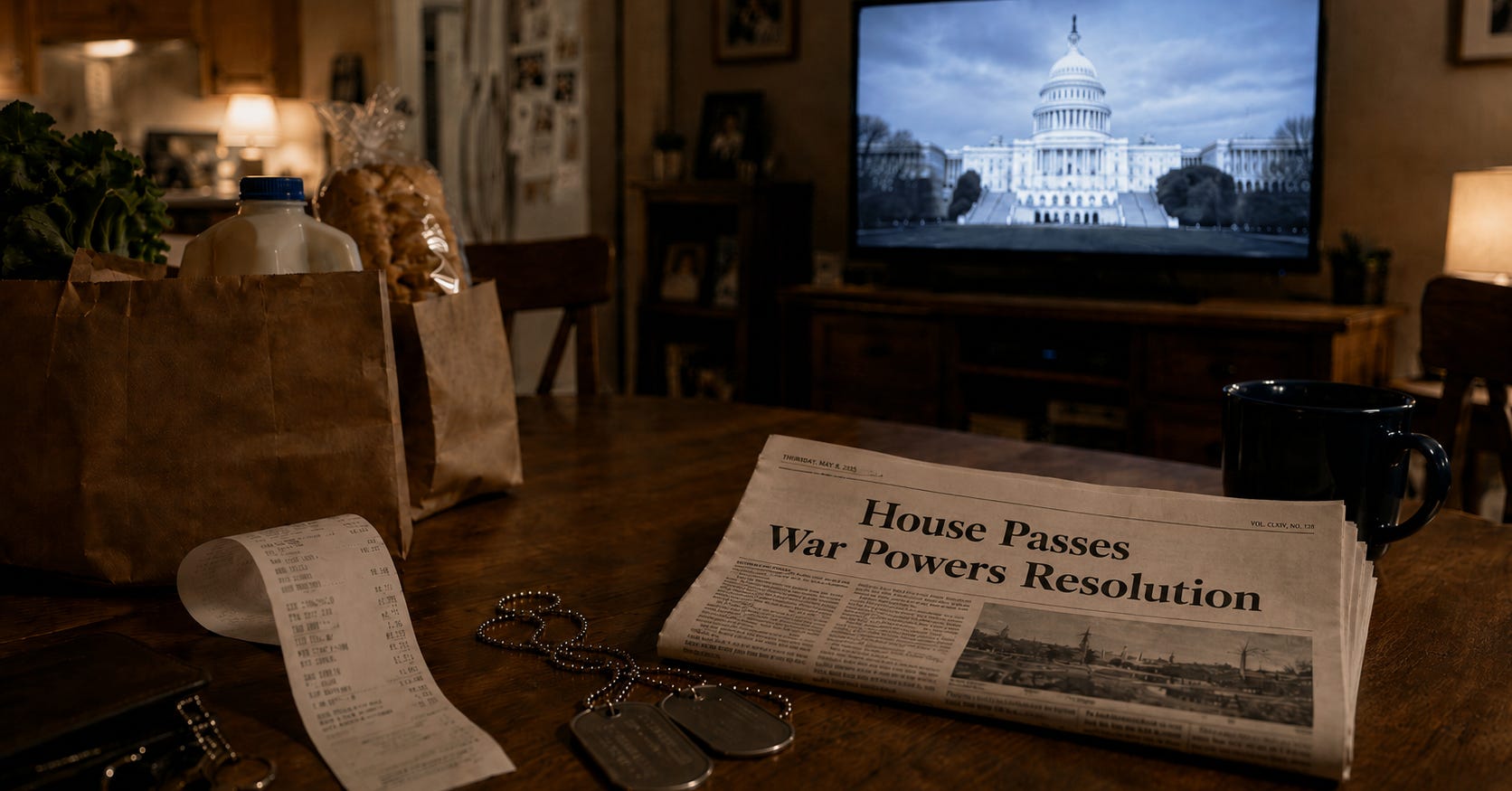
The House did not end the war with one vote.
It did not bring every service member home. It did not force Trump to surrender his claim of authority as commander in chief. It did not settle the coming Senate fight, the legal fight, or the political fight over whether a president can keep the machinery of war running after Congress has refused to authorize it.
But the House did something that matters. It broke the silence.
By passing a War Powers Resolution aimed at halting unauthorized U.S. military action against Iran, the House put the people’s branch back into a fight it should never have been allowed to dodge. For months, war has moved forward through presidential command, party loyalty, legal maneuvering, and Washington cowardice. Troops carry the risk. Families carry the fear. Workers carry the price at the pump. The public carries the cost while too many lawmakers pretend the most serious decision a republic can make belongs to one man.
That is the real story here.
This vote is not just about Trump. It is not just about Iran. It is not just about one resolution, one chamber, or one narrow roll call. It is about whether Congress still remembers that war power belongs to the people through their elected representatives.
The Constitution does not give presidents a royal war button. It gives Congress the power to decide whether this country goes to war because war is supposed to require public consent. When Congress gives up that power, the people do not just lose a constitutional argument. They lose control over the blood, money, stability, and future being spent in their name.
Support independent media that follows the power.
The Coffman Chronicle is built to track who holds power, who abuses it, who profits from it, and who pays the price.
Paid supporters get full Tony Michaels Podcast episodes, deeper transcript analysis, paid columns, archives, and the reporting framework behind the show.
If you believe independent media has to survive outside billionaire platforms, corporate media, and party-approved gatekeepers, become a paid supporter today.
What the House Actually Did
The House vote was narrow, but narrow does not mean small.
By a vote of 215 to 208, the House passed a War Powers Resolution aimed at limiting Trump’s ability to continue unauthorized military action against Iran. Four Republicans joined Democrats to pass it. That’s telling because war power is one of the places where party loyalty can become more than hypocrisy. It can become permission.
The resolution’s basic demand is simple: if the president wants to keep using U.S. forces in hostilities against Iran, he needs authorization from Congress unless the action is necessary to repel an imminent attack. That is not radical. That is not weakness. That is not some fringe theory of government. That is the constitutional order presidents have spent decades trying to work around.
We should be honest about what this vote did and did not do.
It did not end the conflict by itself. It did not erase the Senate’s role. It did not guarantee that Trump will accept Congress’s authority without a fight. It did not resolve every legal question around the War Powers Resolution, the president’s commander-in-chief power, or the kind of legislative vehicle Congress must use to force compliance.
But that is not the same as saying it was meaningless.
For months, the easiest thing for Congress to do was nothing. Nothing lets leadership dodge responsibility. Nothing lets members complain on television while avoiding a vote. Nothing lets presidents keep expanding their power in the space created by legislative cowardice.
This vote was not the finish line.
It was Congress finally stepping onto the field.
This Is Exactly Why Article I Exists
This is the part Washington wants to make complicated, because complicated things are easier to hide behind.
The basic constitutional design is not hard to understand. The president commands the military. Congress decides whether the country goes to war.
That division was not an accident. The framers did not trust one person with the unchecked power to pull an entire nation into sustained conflict. They understood that war is different from every other government decision. War spends money, burns attention, expands executive power, reshapes foreign policy, endangers service members, and asks ordinary families to carry consequences they did not create.
That is why the war power was placed in Article I, with the branch closest to the people.
Congress has the power to declare war, raise and support armies, maintain a navy, regulate the armed forces, and control the money. The president is commander in chief, but command is not ownership. A president can direct the military. A president can respond to immediate threats. A president can make battlefield decisions once lawful authority exists.
But a president is not supposed to turn military command into a personal license for open-ended war.
That distinction is relevant because concentrated power always tries to blur it. Presidents do not usually announce that they are stealing Congress’s authority. They call it urgency. They call it national security. They call it flexibility. They call it deterrence. They call it keeping options on the table.
Then, little by little, the exception becomes the system.
Article I exists to stop that slide. It exists because the people are supposed to have a voice before their country is committed to war.
When Congress gives up power, the people lose power. And when Congress gives up war power, the people lose control over the gravest decision their government can make.
The Warning Congress Already Wrote Into Law
The War Powers Resolution exists because Congress already learned what happens when presidents are allowed to widen war while lawmakers look away.
It was passed after Vietnam, over President Richard Nixon’s veto, because the country had watched executive war-making stretch far beyond what the public had clearly authorized. Presidents had learned how to move first, explain later, and dare Congress to stop them after the machinery of war was already running.
That pattern did not disappear with Vietnam. It became part of the modern presidency.
The War Powers Resolution was supposed to put limits around that drift. It was meant to force consultation. It was meant to require notice. It was meant to make presidents come back to Congress when U.S. forces are introduced into hostilities or situations where hostilities are clearly imminent.
In plain English, the law was Congress saying: you do not get to start or sustain a war and then treat the people’s branch like a spectator.
That point matters now because some people want to treat the War Powers Resolution like a procedural inconvenience, as if it is just paperwork presidents have to navigate on the way to doing whatever they already planned to do. But that is backward.
The law was not designed to give presidents a free sample of war.
It was designed to keep temporary emergency action from turning into permanent executive control. It was designed to prevent the first strike from becoming the whole war, the emergency from becoming the excuse, and the president’s judgment from becoming the country’s only vote.
So when Congress writes a law to restrain unauthorized war, then refuses to use it when unauthorized war arrives, the failure is not just presidential overreach.
It is congressional surrender.
A Public Vote Is Not Nothing
The easiest way to shrink this vote is to call it symbolic.
That word gets used a lot in Washington when powerful people want the public to stop paying attention. Symbolic means do not worry about it, nothing changed. It means the real power is somewhere else, so ordinary people should go back to watching the show instead of asking who is making the decisions.
But a public vote is not nothing.
No, this resolution does not magically settle every fight. The Senate still is important. Trump can resist. The courts may be asked to sort through the limits of the War Powers Resolution, the president’s commander-in-chief authority, and the procedural vehicle Congress uses to force compliance.
But “not automatic” is not the same thing as “meaningless.”
A vote forces members of Congress to stop hiding in vague statements and press releases. It makes them choose. It creates a record. It tells the public who believes the president can carry war forward without congressional authorization and who believes the people’s branch still has a role in deciding whether this country fights.
Hidden power survives by avoiding public accountability.
For months, lawmakers could complain in private, posture on television, blame leadership, blame the president, blame procedure, or say they had concerns while doing nothing to force the issue. The House vote changed that. It dragged the question into daylight.
In a republic, power is not only checked by courts. It is checked by votes, hearings, funding decisions, public pressure, floor fights, elections, and lawmakers being forced to put their names next to the power they are defending or surrendering.
This vote tells the country that the war power is still contested ground. It tells the Senate that the House has acted. It tells Trump that congressional silence cannot be assumed. And it tells the public that this is not some abstract argument between lawyers.
This is the people’s branch deciding whether it still wants to be a branch at all.
The Kitchen-Table Cost of Unauthorized War
Unauthorized war is never just a constitutional problem for lawyers, lawmakers, and cable news panels.
It comes home.
It comes home to the military family watching the news and wondering whether their loved one is being placed in danger under a lawful national decision or under one president’s will. It comes home to the worker paying more at the pump while politicians act like foreign policy lives in some separate room from ordinary life. It comes home through grocery prices, shipping disruptions, defense spending, taxes, debt, fear, and the quiet exhaustion of a public that keeps being told there is no money for the things people need, but somehow there is always room for another military escalation.
That is why war powers are kitchen-table powers.
They decide who carries the risk, who pays the bill, and whose children may be sent. They decide whose wages get eaten by higher prices, which programs are suddenly “too expensive” after the country has committed itself to another open-ended conflict.
Washington likes to talk about war in clean phrases. Strategy. Deterrence. Posture. Credibility. Force protection. Regional stability.
Those words may have meaning. But they can also become a fog. Behind that fog are real people who do not get to speak in classified briefings or closed-door leadership meetings. They just get the consequences.
Defense contractors benefit from permanent crisis. Presidents benefit from looking strong. Political operatives benefit from turning war into a loyalty test. Television benefits from the drama. Think tanks and consultants benefit from a world where every answer requires more weapons, more deployments, more urgency, and less democratic patience.
But ordinary people pay.
They pay in money. They pay in anxiety or their bodies, and some pay with their lives.
That is why Congress cannot be allowed to treat war authorization like paperwork. If Washington can ask families to carry the cost of war, Washington can be forced to vote on that war.
The same politicians who tell working families to tighten their belts somehow always find room for war when no one has been forced to put their name on it.
That is not strength. That is evasion.
This Is Not About Being Soft on Iran
The bad-faith answer to all of this will be predictable.
Someone will say that demanding congressional authorization means being soft on Iran. Someone will say that asking for a vote means tying the president’s hands. Someone will say that if lawmakers question the legal basis for war, they must not understand the threat.
That argument should be rejected completely. Iran’s government is dangerous. It has abused its own people, backed violence, threatened neighbors, and helped destabilize the region. Nobody has to pretend otherwise to defend the Constitution. But recognizing a foreign threat does not require surrendering the American system of government.
A constitutional republic does not survive by letting presidents turn every dangerous foreign government into a permission slip for unilateral war. If the threat is real, then the president should make the case to Congress. If the danger is serious enough to risk American lives, disrupt markets, raise costs, and reshape the country’s foreign policy, then it is serious enough for a public debate and a recorded vote.
That is not weakness. That is accountability.
The strongest country in the world should not be afraid of its own Constitution. It should not be afraid of debate. It should not be afraid of forcing lawmakers to explain why they support or oppose sustained military action. And it should not treat congressional authorization like some annoying obstacle standing between a president and the war he wants to keep.
If the case for war is strong, make it to Congress.
If the case cannot survive a public vote, maybe it is not strong enough to carry American lives.
The Excuses Are the Problem
The administration’s defense will likely come wrapped in technical language.
Maybe it will say the ceasefire changed the legal calculation. Maybe it will say the hostilities paused, narrowed, or shifted into some category that lets the White House keep control without admitting it is still carrying the country through war. Maybe it will argue that the president needs flexibility, that Congress is too slow, that the world is too dangerous, that this is not really war in the old-fashioned sense.
That is exactly why Congress has to act.
Presidents almost never say, “I am taking power that does not belong to me.” They say the situation is complicated. They say the clock has changed. They say the threat is unique. They say the lawyers have reviewed it. They say Congress will be briefed. They say they are not asking for war, just keeping options open.
Then the options become operations, operations become policy, and the policy becomes another piece of power Congress never gets back.
That is how the war power gets stolen in modern Washington. Not always with one dramatic announcement, but through delay, fog, party loyalty, legal theories, and the old habit of letting presidents move first while lawmakers complain later.
Both parties have helped build that system. Republicans remember congressional war powers when a Democrat is president. Democrats remember congressional war powers when a Republican is president. Then, when their own side controls the White House, too many of them discover patience, nuance, and deference.
That hypocrisy is not a side issue. It is the tunnel presidents use to smuggle power out of Congress.
So yes, the House vote matters. Not because it fixes everything. Not because four Republican defections erase decades of congressional surrender or one roll call can repair the damage done by years of treating war like executive property. It matters because it proves Congress is not helpless.
Members choose whether to act like representatives or bodyguards for the president. They choose whether Article I is a living power or a framed antique. They choose whether the people get a voice before war consumes more money, more attention, more stability, and possibly more lives.
Now the pressure moves to the Senate. There should be no hiding there either. Bring it to the floor. Debate it. Vote on it. Let every senator explain whether they believe the president can keep using American military power against Iran without Congress authorizing it.
That is not too much to ask. It is the minimum a republic should demand.
The real question is not whether Iran is dangerous. It is. The real question is not whether presidents need the ability to respond to emergencies. They do. The real question is who gets to decide whether temporary action becomes sustained war.
Congress may get it wrong. Congress has gotten plenty wrong. But the answer to a weak Congress is not a stronger king. The answer is a Congress forced to do its job in public.
That is what this vote began to do. It did not end the war. It did not settle the legal fight. It did not guarantee courage from the Senate or obedience from the White House. But it reminded the country of something too many powerful people want forgotten.
War power does not belong to the president. It belongs to the people through their elected representatives.
The question now is not whether Trump wants more war power. Of course he does. Every president wants more power. The question is whether Congress will keep surrendering it, and whether the people will let them.
When Congress gives up war power, the people pay for war without ever getting a vote.
Support Independent Media
If this piece matters to you, please consider becoming a paid subscriber to Coffman Chronicle.
Independent media matters most when power tries to hide behind procedure, party loyalty, legal fog, and silence. We do this work because democracy does not defend itself. The people have to understand where their power is being taken, who is taking it, and what it costs when Congress stops doing its job.
If you can afford to support this work, a paid subscription helps keep this publication independent, reader-powered, and focused on the kitchen-table consequences of concentrated power.
And if you cannot become a paid subscriber right now, sharing this article still matters. Send it to someone who needs to remember that war power does not belong to presidents.
It belongs to the people.
Sources:
“House Approves War Powers Resolution to Halt Military Action Against Iran, in a Rebuke of Trump.” AP News, June 3, 2026.
“House Rebukes Trump Over War in Iran.” Axios, June 3, 2026.
“US Senate Advances Measure Curbing Trump’s Iran War Powers.” Reuters, May 19, 2026.
U.S. Congress. “H.Con.Res.40 — Directing the President, Pursuant to Section 5(c) of the War Powers Resolution, to Remove United States Armed Forces from Hostilities with Iran.” 119th Cong., introduced June 23, 2025.
U.S. Congress. “War Powers Resolution.” United States Statutes at Large 87 (1973): 555–560.
Legal Information Institute. “50 U.S. Code Chapter 33 — War Powers Resolution.” Cornell Law School.
If the Lyin' King is allowed to do anything he wants with our military, then the threat of nuclear war is on the table.
We must stand up to The Fapweasel (Trump). He should never come close to having absolute power.