


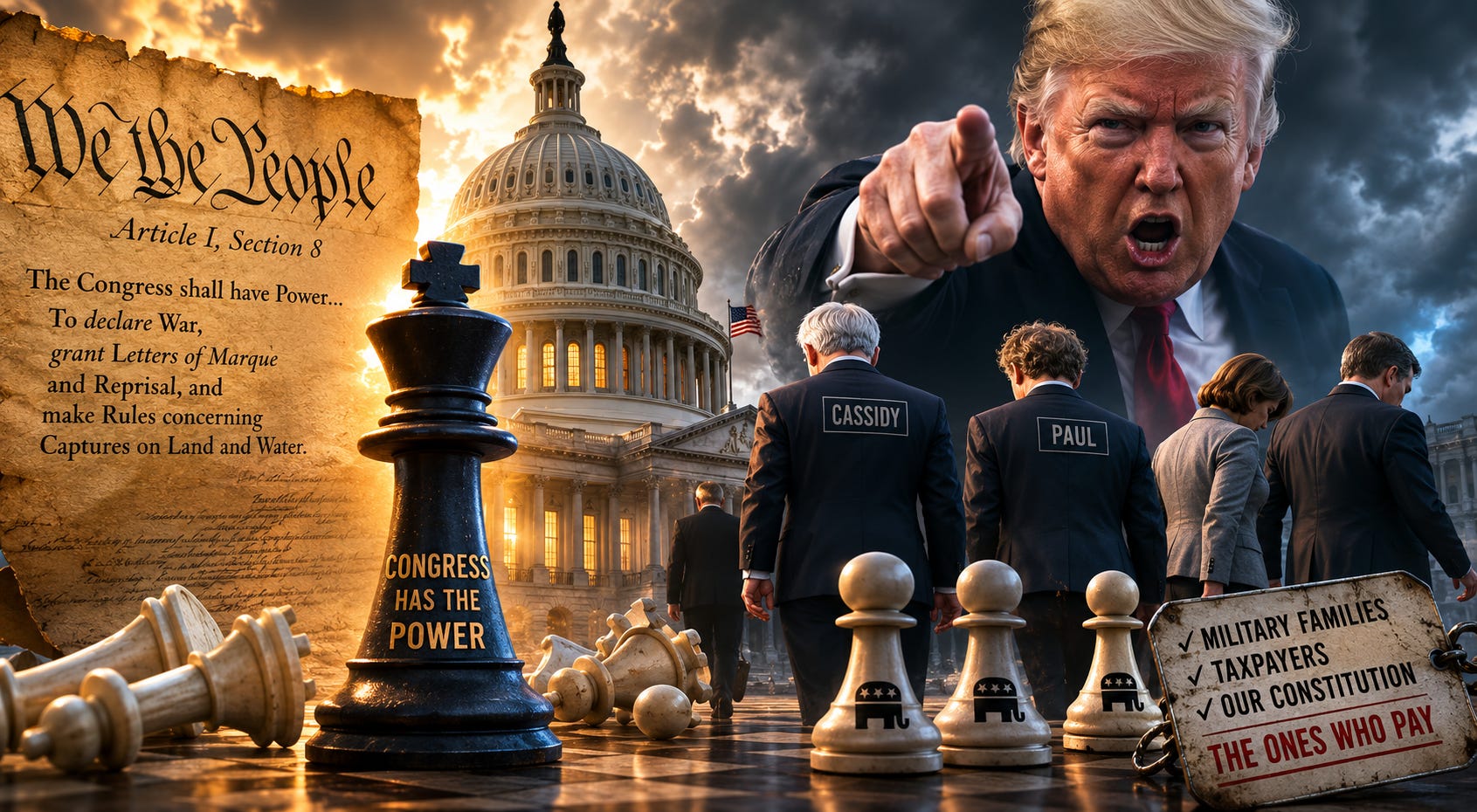
For One Day, the Senate Remembered
For one day, the United States Senate remembered that the Constitution placed the power to authorize war in Congress. On June 23rd, a bipartisan majority voted to challenge Donald Trump’s authority to renew or continue hostilities with Iran without specific congressional authorization. Four Republicans joined most Democrats. The Senate asserted that a president does not get to turn emergency military action into another round of war simply because Congress is too frightened to stop him.
Then Trump arrived on Capitol Hill.
He berated Republican senators who had defied him, publicly attacked them, and demanded loyalty. By late the following night, enough support had disappeared to block the Senate from moving forward with a separate measure that could have traveled beyond symbolic condemnation and toward binding law.
The Constitution had not changed overnight. Iran had not become a different country. Congress had not lost one of its enumerated powers between Tuesday and Wednesday. What changed was the political cost of using it.
The preliminary agreement between the United States and Iran had halted the fighting, but it had not made the constitutional question academic. The negotiations were unfinished, the peace remained uncertain, and the president retained the military machinery to resume operations. The votes asked whether renewed or further hostilities would require the consent of the people’s representatives.
Washington will try to reduce this episode to parliamentary procedure, personal feuds, and a few senators changing their minds. It is much bigger than that. The first vote proved Congress was not powerless. The second showed how quickly some senators would surrender that power when the president demanded obedience. They were willing to defend Congress’s war power until defending it required standing up to the president.
Now the administration is asking Congress for tens of billions of dollars connected to the conflict and the military resources it consumed. The president made the central decision, senators avoided responsibility, military families carried the danger, and taxpayers received the bill.
Congress did not lose its war power. Senators placed it on the table and handed it back.
Support independent media that follows the power.
The Coffman Chronicle is built to track who holds power, who abuses it, who profits from it, and who pays the price.
Paid supporters get full Tony Michaels Podcast episodes, deeper transcript analysis, paid columns, archives, and the reporting framework behind the show.
If you believe independent media has to survive outside billionaire platforms, corporate media, and party-approved gatekeepers, become a paid supporter today.
The First Vote Proved Congress Was Not Powerless
The first Senate vote did not, on its own, end military operations or create a binding prohibition on their resumption. It did something politically important but legally limited: it put Congress on record against hostilities with Iran without specific congressional authorization.
The measure was a concurrent resolution. It did not go to the president for his signature and could not become a statute. The White House could refuse to treat it as legally binding. That limitation did not, however, make the vote meaningless.
A Senate majority still declared that Congress had a role the president could not simply erase. Four Republicans joined most Democrats in asserting that military operations could not remain suspended indefinitely between emergency action and an undeclared war. The vote destroyed one of Washington’s favorite excuses: that Congress was powerless.
Congress had the constitutional authority. It had a legislative vehicle. It held a public debate and assembled a majority. Members could no longer pretend that war policy belonged entirely to the president or that their only remaining job was to watch events unfold on television.
The limitation of the concurrent resolution did not reveal Congress’s weakness. It revealed how cautiously Congress had chosen to exercise its strength. Senators were willing to register an objection without yet placing an enforceable restriction on the president’s desk.
Even so, the vote established the principle. Congress had not enacted a specific authorization for this conflict, and a majority believed its consent still mattered.
The next question was unavoidable: Would senators defend that judgment when the legislative process moved closer to producing consequences?
The first vote proved Congress was not helpless. What followed proved that helplessness is sometimes a political choice.
Symbolic Courage, Binding Fear
The second vote was not identical to the first. It concerned whether the Senate would proceed to a joint resolution directing the removal of American forces from unauthorized hostilities with Iran. Unlike a concurrent resolution, a joint resolution can pass both chambers, reach the president’s desk, and become law through his signature or a congressional override of his veto.
The June 24th vote would not have ended anything immediately. It was a procedural vote on whether to consider the measure, and the resolution still faced Senate debate, final passage, House action, an almost certain veto, and the steep challenge of an override. However, the process was moving in a different direction.
The Senate first voted 52–45 to end debate. It then rejected the motion to proceed by a 47–50 vote, with one senator voting present.
Bill Cassidy moved from supporting the concurrent resolution on Tuesday to opposing consideration of the joint resolution on Wednesday. Rand Paul moved from “yes” to “present”. Susan Collins and Lisa Murkowski continued to support proceeding, but the bipartisan majority that had existed one day earlier was gone. Paul’s present vote was not the same as a no, and it did not determine the outcome by itself. It did mean that he was no longer voting to move the legislation forward.
Congress had not suddenly authorized renewed hostilities. The constitutional text had not changed. What changed was that the Senate was moving beyond a statement the president could dismiss and toward legislation that might eventually carry legal force.
That difference is the heart of this story and the problem.
There is a form of courage that Washington rewards because it carries almost no risk. Members can issue stern statements, support nonbinding resolutions, and tell voters they defended constitutional principles. They receive the headline without forcing the confrontation.
Binding law is different. It requires members to place their names behind a consequence. It asks whether their stated principles can survive a presidential veto threat, pressure from party leadership, and the possibility of political punishment.
The first vote let senators say that congressional authorization still mattered. The second tested whether they were prepared to act on that belief. The answer appears to be that they were willing to defend Congress’s war power until defending it required standing up to the president.
Symbolic courage is easy when everyone knows the president can ignore it. Constitutional courage begins when the vote might actually restrain him.
The President’s Anger Is Not a Constitutional Argument
Trump did not answer the Senate’s constitutional challenge by asking Congress to authorize renewed military action. He did not present lawmakers with a narrow mission, a defined objective, a timetable, or a public legal framework for resuming hostilities. He demanded loyalty.
Trump attacked the Republicans who had supported the first resolution. He called them losers, accused them of helping the enemy, and confronted them during a closed-door lunch. By the end of the day, two were no longer supporting the advancement of the second measure.
Presidents pressure Congress. They bargain, threaten vetoes, appeal to the public, and warn members about the political consequences of opposition. That conflict is built into a system of separated powers.
What is not built into the Constitution is the idea that presidential anger settles the dispute. Trump’s displeasure did not create an authorization for military force. His insults did not transfer the war power from Article I to the president.
Senators are entitled to reconsider a vote when new facts emerge. A classified briefing may reveal threats or operational details the public cannot see. Cassidy said that the information provided by the administration addressed many of his concerns and that the possibility warrants serious consideration. However, it makes accountability more necessary, not less.
What information changed? Did it answer the constitutional question, or did it offer a policy argument for giving the president greater flexibility? Did senators conclude that Congress had already authorized renewed hostilities, or that opposing Trump had become too politically expensive? Those are not interchangeable conclusions.
A president can make a persuasive case that military action would be strategically useful and still lack congressional authorization to begin another round of sustained hostilities. Policy confidence does not substitute for legal authority.
Collins and Murkowski did not retreat. Their votes showed that Republican membership did not require abandoning congressional power.
Nor was this failure exclusively Republican. Pennsylvania Democrat John Fetterman opposed both measures. Congressional surrender to presidential war-making has crossed party lines and administrations. Members routinely defend legislative authority when the other party controls the White House and discover expansive commander-in-chief powers when their own party takes control.
That is why the principle must be larger than Trump. Party loyalty does not become constitutional duty merely because the president demanding it belongs to your party. A primary threat is not an enemy attack. A presidential insult is not intelligence. Losing favor with a party leader is not a national emergency.
A presidential temper tantrum may explain political cowardice, but it does not create constitutional authority.
A senator’s vote does not belong to Donald Trump. It belongs to the people who will live with what that vote permits.
Congress Did Not Lose Its Power
Congress still has power over what happens next. It can debate and pass a specific authorization for the use of military force. It can reject an authorization that is too broad, vague, or open-ended. It can impose geographic limits, define the objective, establish reporting requirements, and set an expiration date. It can demand the administration’s legal rationale, question civilian and military officials in public, and require the president to explain what would justify renewed hostilities.
Congress also controls the money. It can approve the administration’s request. It can reduce it, condition it, or prohibit the use of funds for renewed offensive operations without authorization. It can replenish defensive stockpiles and protect American personnel without writing the president a blank check for another war.
None of those powers disappeared when the first missiles were launched, yet members often describe presidential war-making as though it were a natural disaster they can only observe. The president acts, forces are committed, and Congress is told that the situation has become too urgent or too far along for intervention. Allies are depending on us. Troops may be exposed. Congress cannot undermine the mission now.
That logic turns every unauthorized military action into its own authorization. Presidents act first because they expect Congress to hesitate. Congress hesitates because the president has already acted. Delay is treated as acceptance, and the absence of a vote becomes a substitute for approval.
Silence is not consent. Fear is not authorization. Congress does not have to approve every target, deployment, or battlefield adjustment. The commander in chief directs military operations once lawful authority exists, but deciding whether the nation begins or renews sustained hostilities is not a tactical detail.
Members who support another military operation against Iran have a constitutional path. They can introduce an authorization, define its terms, and vote yes. Members who oppose renewed hostilities can vote no, restrict the mission, or prohibit funding for offensive operations. Both positions require ownership.
What too many lawmakers prefer is a third position: allow the president to retain freedom of action, avoid a direct authorization vote, and preserve the ability to praise success or condemn failure later. That is not caution. It is responsibility laundering.
The president receives the freedom to act. Congress retains the freedom to complain. The public receives neither a clear decision nor a clear account of who made it.
Congress did not lose its war power. Senators handed it back after the president demanded obedience. The obstacle is not constitutional authority. It is political will.
The War Bill Arrived After the Debate Was Dodged
The administration did not wait for Congress to settle the constitutional question before sending it the bill. After senators backed away from advancing the joint resolution, the White House requested approximately $87.6 billion in supplemental spending, most of it tied to the Iran operation, military replenishment, and related needs.
The sequence tells its own story. Congress was treated as optional when the president decided to launch the conflict. It became indispensable when the administration needed money to cover the costs.
That is how modern presidential war-making often operates. The executive branch acts first, controls the pace of events, and defines the emergency. Congress is then presented with troops who were placed at risk, munitions that were expended, and military needs that are described as urgent.
The people’s representatives are not asked whether the country should enter the war before the decision is made. They are asked afterward whether they are willing to be blamed for failing to pay the bill. That is not meaningful consent. It is political entrapment.
No responsible member of Congress wants American service members denied equipment, protection, or support. Presidents understand that. Once forces are committed, concern for those forces becomes leverage against the institution that was supposed to decide whether they should have been placed in sustained hostilities in the first place.
Congress’s failure to authorize the conflict clearly does not make its costs disappear. It just separates the decision from the accountability.
The administration commanded the operation. Senators avoided ownership of it. Military families lived with the risk. Taxpayers are now expected to finance the consequences. The American people are being asked to fund a war their representatives were too frightened to authorize and too obedient to stop.
That does not mean every dollar in the request is unnecessary. Military operations consume fuel, munitions, transportation, intelligence, cybersecurity resources, and defensive equipment. Stockpiles may need to be rebuilt, and American personnel must remain protected, but the size of the request makes congressional avoidance less defensible, not more.
Congress treats domestic investment as an invitation to interrogate every dollar. Help for housing, healthcare, schools, roads, and local communities is subjected to lectures about deficits, offsets, and fiscal restraint. War money receives a different vocabulary. It becomes urgent, necessary, unavoidable,, and already committed.
Military and domestic spending are not interchangeable line by line. Both involve public resources, public priorities, and public accountability. A government that demands exhaustive debate before helping people at home should not demand silence before spending tens of billions on a war Congress never specifically authorized.
There is always procedural caution when lawmakers are asked to restrain a president. There is suddenly urgency when the same president asks them to open the Treasury.
The People Carry What Congress Avoids
Congress can avoid a vote. The people cannot avoid what the war produces.
Service members still deploy to protect American interests and maintain readiness. Their families live with sudden schedule changes and the knowledge that an uncertain agreement may collapse into another round of danger.
Taxpayers still finance the operation and its aftermath. Workers and small businesses absorb the economic shocks created by regional instability. Families watch transportation and shipping costs show up at gas pumps, utility bills, and grocery stores.
War does not remain inside a Pentagon briefing. It reaches the mechanic driving forty miles to work. It reaches the home-health aide deciding whether the next tank of gas can wait until payday. It reaches the military spouse trying to explain uncertainty to a child. It reaches communities told there is no money for the problems in front of them, while Congress is asked to approve tens of billions for a conflict it never clearly authorized.
Not every price increase can be attributed to a single military operation. Energy markets move for many reasons. Companies make pricing decisions. Supply chains react to speculation and fear as well as physical disruption. However, that complexity does not make the public cost imaginary.
The Iran conflict disrupted shipping, increased risks in energy and transportation, and created pressure for major additional military spending. Even after an interim agreement, trade flows and prices do not automatically return to normal. Those consequences arrive at the kitchen table.
If Congress believes renewed military action may be necessary, members should define the conditions, limits, and costs before it begins. If the danger of escalation is too great, members should prohibit or restrict it.
What they should not do is leave the decision to the president while reserving the right to complain about the consequences. That arrangement protects lawmakers, not the public.
Wars generate their own arguments for continuing. Every deployment becomes a reason not to withdraw. Every expenditure becomes a reason to spend more. Every escalation is used to justify the next. Congress is supposed to interrupt that cycle before it becomes self-justifying.
Congress can avoid the authorization vote. Military families cannot avoid deployment, and taxpayers cannot avoid the bill.
This Is Not a Defense of Iran
None of this requires anyone to trust the Iranian government. Iran has threatened American interests, armed regional proxies, supported attacks against allies, and brutally repressed its own people. Congress may conclude that additional military action is necessary.
The president may also respond immediately when American forces face an imminent attack. No serious constitutional system requires the commander in chief to wait for a floor vote while Americans are under fire.
However, emergency defensive authority is not unlimited authority to begin, renew, widen, or redefine a war. Proving that Iran is dangerous does not prove that the president may wage sustained war without Congress. A hostile foreign government does not erase the American Constitution.
The more dangerous the adversary, the more important it becomes to define the mission. Is the objective protecting American forces, destroying a specific military capability, defending an ally, compelling negotiations, preventing nuclear proliferation, or overthrowing Iran’s government?
Those are different wars. Each carries different costs, timelines, escalation risks, and consequences for what happens after the first military objective is achieved. The president should not be allowed to move among them without returning to Congress.
Authorization does not guarantee wise policy. Congress can authorize bad wars, accept weak evidence, and write dangerously broad mandates, but a direct vote establishes responsibility. It forces supporters to define what they are supporting. It gives opponents an opportunity to challenge the evidence, and creates legal limits that the public can compare against what the government later does.
Americans do not have to defend Iran to demand that their own government obey constitutional limits. They do not have to oppose every military action to reject another open-ended conflict controlled by one president.
The question is not whether Iran deserves sympathy, but whether the American people deserve a vote through the representatives who are supposed to speak for them.
They do.
Congress Must Vote Before It Pays for More War
Congress should not approve unrestricted funding for renewed hostilities as though the question of authorization has been settled because it has not.
Congress may responsibly fund the protection of American personnel, replenish depleted defensive resources, and meet legitimate obligations created by the previous operation. It should distinguish those needs from money that could finance another round of offensive hostilities without a vote.
Before permitting funds to be used for renewed war, lawmakers should require a direct authorization. Members who believe another military operation may be necessary should introduce a specific authorization, defend it publicly, and place their names behind it. That authorization should identify the objective, geographic scope, and armed groups covered. It should include reporting requirements and an expiration date. It should state whether the mission is limited to defending American forces, whether it includes protecting allies, and whether it permits attacks intended to overthrow Iran’s government.
Congress should also require the administration to disclose its legal rationale. Classified operational details may need protection, but the constitutional theory cannot remain hidden from the public whose lives and money are being put at risk.
It should require regular accounting of costs, deployments, casualties, civilian harm, and progress toward the stated objective. If the mission changes, the president should have to return to Congress. An operation that begins as protection for American forces cannot quietly become regime change. A limited mission cannot expand across the region through executive momentum and secret interpretation.
Conditioning funds on those limits is legislation, not micromanagement.
Public hearings should force officials to answer basic questions. What would trigger renewed military action? What would constitute success? What would end the operation? How many additional forces might be required? What would it cost if hostilities lasted months rather than days? What would prevent another wider war? Those are the minimum questions a representative government should ask before committing more lives and public resources.
Supporters of military action should want a vote. If the mission is necessary, lawful, and clearly defined, they should be willing to authorize it. Opponents should want the same vote so the risks and alternatives are placed before the public. Only members who prefer avoiding responsibility benefit from leaving the country in constitutional fog.
Before Congress pays for more war, Congress must vote on more war. The people have already carried the consequences. Their representatives should finally carry the decision.
They Handed It Back
For one day, the Senate remembered that the power to authorize war did not belong to the president alone. Members crossed party lines and demonstrated that Congress still possessed the votes, procedures, and constitutional standing to confront executive war-making.
Then the pressure arrived. Nothing had been taken from Congress. No court had struck down its authority. No constitutional amendment had reassigned the war power. Some senators simply chose not to use it.
Washington prefers stories of institutional decline without individual responsibility. Congress is called weak, gridlocked, or irrelevant, as though its power evaporated through weather or age, but institutions do not surrender by themselves.
Members surrender them through votes, absences, procedural retreats, and decisions to place party protection above constitutional responsibility. They surrender them every time they insist that a president has gone too far, but refuse to take the next legislative step. Congress did not lose its war power. Senators placed it on the table and handed it back.
Every additional deployment, appropriation, or military preparation can now become another argument that events have progressed too far for Congress to intervene. That is how a temporary surrender hardens into precedent.
The next president will inherit the same machinery. That president may belong to another party, choose another enemy, and invoke another emergency. Members who defended broad executive power today may rediscover congressional authority then, but the power they abandoned will not automatically return because their political interests have changed.
A republic cannot survive on temporary constitutionalism. War powers cannot belong to Congress only when the president is unpopular or belongs to the opposing party. They cannot disappear when the president becomes angry or when defending the institution threatens a senator’s political standing.
The power either belongs to Congress or it does not.
If it does, Congress must use it. Members who support renewed military action should authorize it. Members who oppose it should limit or prohibit it. Members who demand more information should compel the administration to provide it before approving money that could finance another war.
Every legitimate position requires a vote. Avoidance is the only position that allows lawmakers to preserve themselves while everyone else carries the risk.
The Constitution was not written to protect Congress from difficult decisions. It was written to force those decisions into the branch most directly answerable to the people.
For one day, the Senate showed that it could remember its role, then enough senators decided that presidential anger mattered more than congressional independence. The American people may pay in the form of taxes, higher costs, military deployments, renewed escalation, or another conflict without a clear beginning or an agreed-upon end.
Congress had a chance to carry that decision with them. Instead, senators handed power back and left the people to face the consequences.
Support Independent Media
If this article helped you see the choice beneath the headlines, please share it.
Congress is not powerless. Too many members simply prefer to surrender their power when using it would require political courage. That surrender leaves presidents free to act while military families, taxpayers, and working people carry the consequences.
The Coffman Chronicle exists to follow those choices, expose where public power goes, and insist that the people’s branch belongs to the people.
If you can afford to become a paid subscriber, your support helps keep this work independent and allows Rebellion from Home to continue.
Sources:
Jalonick, Mary Clare, Steven Sloan, Joey Cappelletti, and Lisa Mascaro. “Senate Republicans Reject War Powers Resolution after Trump Berates Them at Capitol Meeting.” Associated Press, June 25, 2026.
Johnson, Jake. “Caving to Trump ‘Temper Tantrum,’ Two Republicans Flip to Block Iran War Powers Resolution.” Common Dreams, June 25, 2026.
Morgan, David, and Patricia Zengerle. “Trump, Republican Senator Engage in Shouting Match over Iran War.” Reuters, June 24, 2026.
United States. Directing the President, Pursuant to Section 5(c) of the War Powers Resolution, to Remove United States Armed Forces from Hostilities with Iran. H. Con. Res. 86. 119th Cong., 2nd sess. Engrossed in the House June 3, 2026.
United States. To Direct the Removal of United States Armed Forces from Hostilities within or against the Islamic Republic of Iran That Have Not Been Authorized by Congress. S.J. Res. 185. 119th Cong., 2nd sess. Placed on the Senate calendar May 19, 2026.
United States. House of Representatives. Office of the Clerk. “Roll Call 199: H. Con. Res. 86.” June 3, 2026.
United States. Office of Management and Budget. “Estimate No. 2: Fiscal Year 2026 Supplemental Funding Request.” Letter to Speaker Mike Johnson, June 24, 2026.
United States. Senate. “Roll Call Vote 184: H. Con. Res. 86.” 119th Cong., 2nd sess., June 23, 2026.
United States. Senate. “Types of Legislation.”
United States. Senate Democratic Caucus. “Wrap Up for Wednesday, June 24, 2026.” June 24, 2026.
United States Code. Title 50, chapter 33, “War Powers Resolution,” §§ 1541–1548.
Zengerle, Patricia. “Trump Asks Congress for More Funds to Fight Iran, Defying Rebuke on War Powers.” Reuters, June 24, 2026.
congress forgot it was congress.
The problem we have is not holding the pig accountable the problem is enforcing that accountability. Trump will not leave office procedurally or voluntarily he will have to be forcibly removed from office by the people.Americans are too nice about the hostile takeover of our democracy!