


The fight against foreign corporate dominance just hit a significant milestone—Hawaii’s State Senate has unanimously voted to protect local elections from multinational corporate interference. In a system where big money often drowns out everyday voices, this bill could begin a grassroots movement to reclaim our democracy from foreign interests.
If signed into law, this legislation will ban foreign-influenced corporations from spending money in state and local elections, making Hawaii only the second state—after Minnesota—to take this stand.
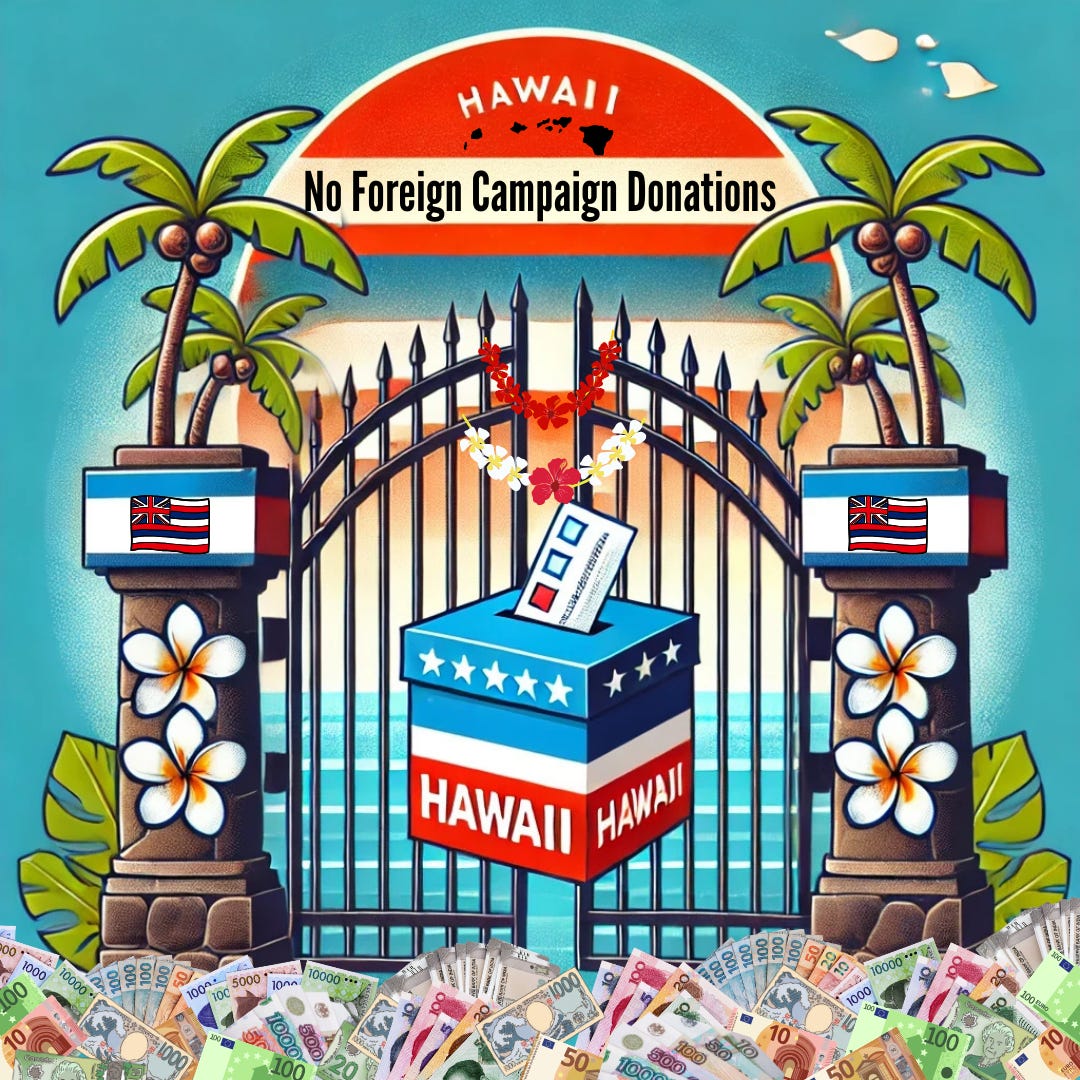
Not a Ban on All Corporate Money—But a First Step
It's important to note that while corporate money in politics remains a major issue due to Citizens United v. FEC (2010), this bill explicitly blocks foreign-influenced corporations from election spending, ensuring that multinational entities with foreign ownership cannot shape local and state elections.
This is not a sweeping ban on corporate political spending. Domestic corporations without significant foreign ownership will still be able to contribute to elections, as protected under Citizens United. However, this bill represents an important step in curbing international interference in U.S. democracy.
What Does the Bill Do?
The Hawaii bill, modeled after similar laws in Minnesota, Seattle, and San Jose, clearly restricts corporations' ability to spend on elections based on the percentage of foreign ownership.
Key Provisions:
Bans foreign-influenced corporations from making direct contributions or independent expenditures in state and local elections.
Defines a corporation as foreign-influenced if:
A single foreign entity owns 1% or more of its stock.
Multiple foreign entities own 5% or more collectively.
Covers corporate donations to candidates, political parties, PACs, and Super PACs.
These thresholds may seem small, but many multinational corporations easily meet these criteria, meaning their ability to spend on elections would be significantly reduced.
If Hawaii’s House of Representatives passes the bill and the governor signs it into law, this could set a precedent for other states looking to curb foreign corporate power over elections.
Who Benefits from This Bill?
1. Voters & Election Integrity
The biggest winners? Everyday voters. This law helps ensure that foreign interests don’t have a hand in shaping local and state policies through election spending.
This bill helps restore trust in the democratic process by reducing the role of foreign-influenced corporate money in politics. It ensures that elections aren’t swayed by corporate dollars with international ties.
2. Local & State-Level Candidates
Many grassroots candidates struggle to compete against corporate-backed opponents. By removing multinational corporate money, this bill levels the playing field, giving local candidates a fairer chance to run on ideas rather than fundraising muscle.
3. Small Businesses
Large corporations often use their financial power to influence policies that favor them at the expense of small, local businesses. By limiting their political spending, this bill ensures that elections (and, ultimately, policy decisions) reflect the interests of local economies rather than multinational conglomerates.
Who’s Fighting This Bill—And Why?
Predictably, corporate lobbyists and billion-dollar multinational firms are already pushing back—desperate to preserve their influence over our elections.
1. Big Business & Corporate Lobbying Groups
Organizations like the U.S. Chamber of Commerce are crying “free speech,” but what they really mean is “free rein” to buy politicians and rig the system in their favor.
Some tech giants and multinational corporations (like Amazon and Microsoft) have fought similar laws, arguing that they create confusing restrictions for businesses operating in multiple states.
2. Legal Experts & First Amendment Advocates
Critics point to the Citizens United v. FEC (2010) Supreme Court ruling, which held that corporations have free speech rights, including political spending. Opponents argue that this law could be challenged in court, potentially leading to a legal showdown over the balance between corporate rights and election integrity.
3. Some Politicians
While Hawaii’s Senate passed this bill unanimously, similar legislation has faced Republican opposition in other states. Some lawmakers argue that these restrictions are unnecessary government overreach, and they believe corporations—whether foreign-influenced or not—should be able to support candidates and policies that align with their business interests.
Will This Law Hold Up in Court?
Hawaii isn’t the first to attempt this; legal challenges are likely.
Seattle’s Law (2020): Amazon and other corporate entities challenged the city’s ban on foreign-influenced corporate spending, but the law remains in place.
Minnesota’s Law (2023): Minnesota became the first state to enact such a law, and while it hasn’t faced a major court battle yet, legal experts predict challenges ahead.
If Hawaii’s law is challenged in federal court, the ruling could set a national precedent, either reinforcing the state’s right to regulate election spending or reaffirming corporate free speech rights under Citizens United.
What’s Next? Could More States Follow?
Hawaii’s bill is part of a growing movement to rein in foreign corporate influence in elections. Several other states are considering similar measures:
Illinois, Massachusetts, New York, Pennsylvania – Lawmakers have introduced bills modeled after Minnesota’s and Hawaii’s.
Federal Level – Some members of Congress have proposed a nationwide ban on foreign-influenced corporate election spending, though it has yet to gain momentum.
If more states pass similar laws and survive legal challenges, this could reshape how corporate money is allowed in elections across the country. And it could be the first crucial step to finally overturning Citizens United.
Final Thoughts: A Step Toward Fairer Elections?
Hawaii just threw down the gauntlet in the fight for fair elections. The corporate elite won’t go down without a fight, but neither will we.
This is more than just a bill—it’s a blueprint for reclaiming our democracy from billionaires and foreign-influenced corporations. Will your state be next?
If you’re tired of elections being bought and sold, now’s the time to demand action. Call your state lawmakers. Organize. Speak out. If Hawaii and Minnesota can take on corporate power, so can the rest of the country.
You power the Coffman Chronicle—no billionaires, no corporate overlords. Help us expose the BS, deliver sharp insights, and keep you informed.
You can fuel the fight and join the movement for just $8 a month or $80 a year.
Not ready to subscribe? No worries, chaos loves company, and you're always welcome.
See our reporting on other state-level legislation here:


Further Reading
"Hawaii State Senate Unanimously Passes Bill Barring Multinational Corporations from Interfering in Local and State Elections." Free Speech For People, March 5, 2025. https://freespeechforpeople.org/hawaii-state-senate-unanimously-passes-bill-barring-multinational-corporations-from-interfering-in-local-and-state-elections/
"Defending Foreign Corporate Election Spending Ban in Minnesota." Campaign Legal Center, May 2024. https://campaignlegal.org/cases-actions/defending-foreign-corporate-election-spending-ban-minnesota-minnesota-chamberCampaign Legal Center
"Hawaii Bill Would Limit Political Spending by Foreign-Influenced U.S. Corporations." Center for American Progress, February 2024. https://www.americanprogress.org/article/hawaii-bill-would-limit-political-spending-by-foreign-influenced-u-s-corporations/americanprogress.org+1americanprogress.org+1
"Foreign-Influenced Corporate Money in State Elections." OpenSecrets, October 2023. https://www.opensecrets.org/news/reports/foreign-influenced-corporate-moneyOpenSecrets
"Citizens United v. Federal Election Commission." Oyez, 2010. https://www.oyez.org/cases/2008/08-205
Other countries do and have removed foreign donations to PACS, why can't/doesn't the US🤔 hunger for more more more money...follow the money.
Hopefully Hawaii does this
Interesting 🧐 I wonder if other states will follow suit? I would hope yes but double down.