


With the FBI deprioritizing far-right investigations and Trump’s second-term policies emboldening these groups, public extremist activity is reaching new heights. Below, we break down the patterns, geography, and scale of this resurgence—and why it’s happening now.
The Southern Poverty Law Center maintains an extraordinary interactive Hate Map of protests that can be filtered in various ways.
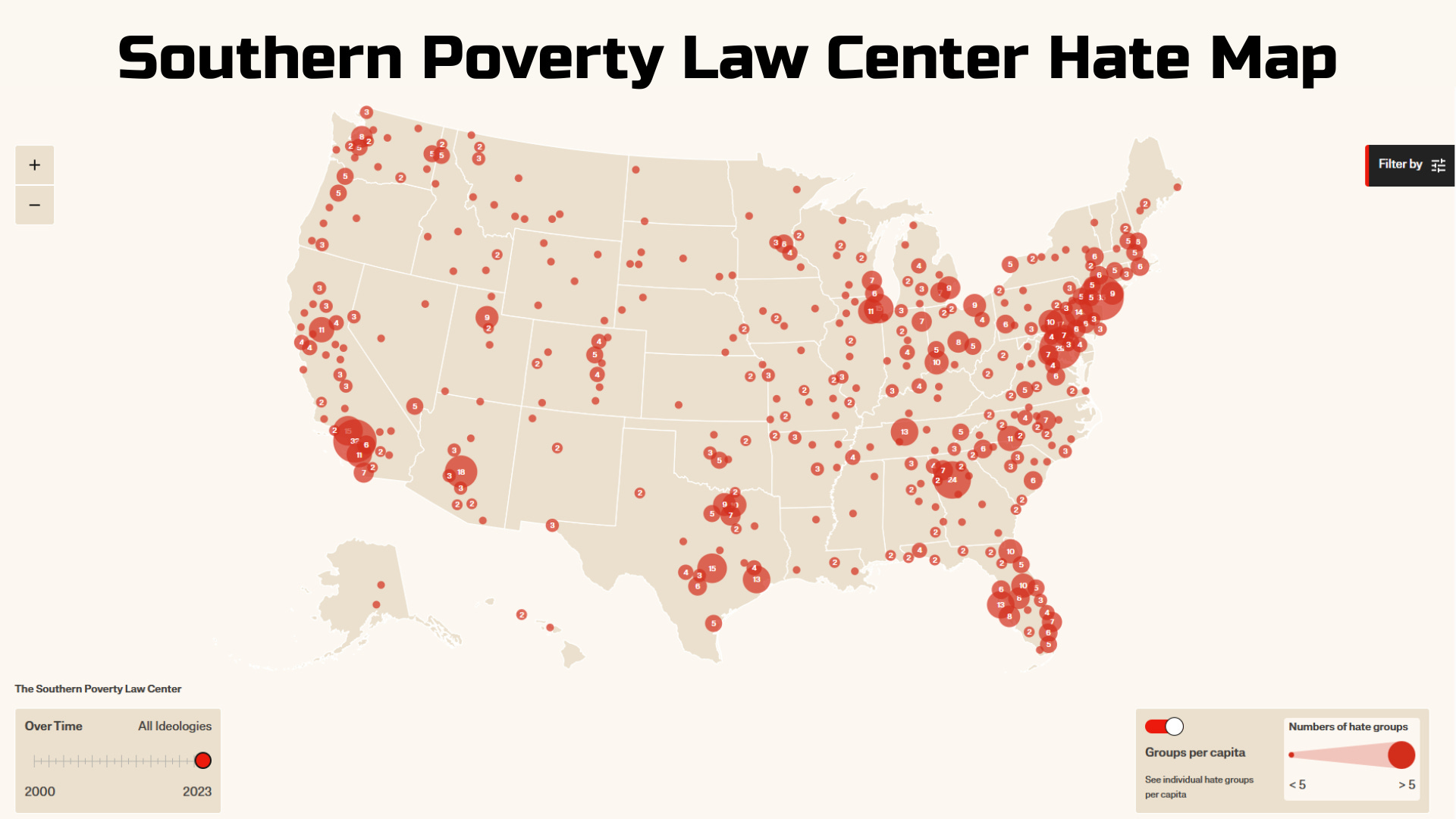
Screenshot from SPLC website showing protests in 2023, the last year data has been released.
Armed Conflict Location & Event Data Project (ACLED) also tracks protests and conflicts around the globe. See their analysis of incidents in the United States and Canada here.
The Coffman Chronicle is powered by YOU—no billionaires, no corporate overlords. Help us expose the BS, deliver sharp insights, and keep you informed.
You can fuel the fight and join the movement for just $8 a month or $80 a year.
Not ready to subscribe? No worries, chaos loves company, and you're always welcome.
How Did We Get Here?
White nationalist and militia groups have existed for decades, but their visibility and influence rise in response to key political moments:
2008–2016: Obama’s election triggered a white supremacist resurgence.
2016–2021: Trump’s presidency legitimized these groups, fueling Charlottesville and January 6th.
2021–2024: Post-January 6th crackdowns pushed many underground, but they remained active online.
2025-Present: With Trump back in power, pardons of January 6th defendants and FBI policy shifts have given these groups new momentum.
See our reporting here on how Trump’s policies fuel hate:

How Policy Changes Are Fueling Extremist Activity
One of the biggest reasons for the resurgence of far-right extremist groups is not just ideological momentum; it’s the removal of federal oversight.
Since taking office, FBI Director Kash Patel and Trump’s new Department of Justice leadership have deprioritized domestic terrorism investigations. Their strategy shifts focus away from far-right extremists and onto left-wing groups like Black Lives Matter and Antifa.
Kash Patel’s FBI:
Cut funding for domestic terrorism investigations into white nationalist groups.
Redirected federal resources to “left-wing extremism,” despite data showing right-wing violence is the greater threat.
Removed internal FBI reports that previously tracked far-right organizing, claiming they were "politicized."
Pentagon Leadership Under Pete Hegseth:
Dismantled DEI and counter-extremism programs in the military.
Halted investigations into white supremacist infiltration of armed forces.
Blocked military leaders from flagging extremist group affiliations.
What This Means in Practice:
Federal agencies are no longer actively tracking many white nationalist groups.
Fewer arrests, fewer investigations, and less oversight of far-right militia activity.
Hate crimes and extremist incidents are more likely to go unaddressed.
These policy shifts have removed nearly all barriers that once kept these groups in check. The result? They are now more emboldened, more public, and more active than we’ve seen in years.
See our reporting here about Patel & Hegseth and their roles in amplifying hate:


Tracking the Recent Surge
Since January 20, 2025, extremist protests have appeared in over a dozen states, with both large and small gatherings. Who are the players and were are they appearing?
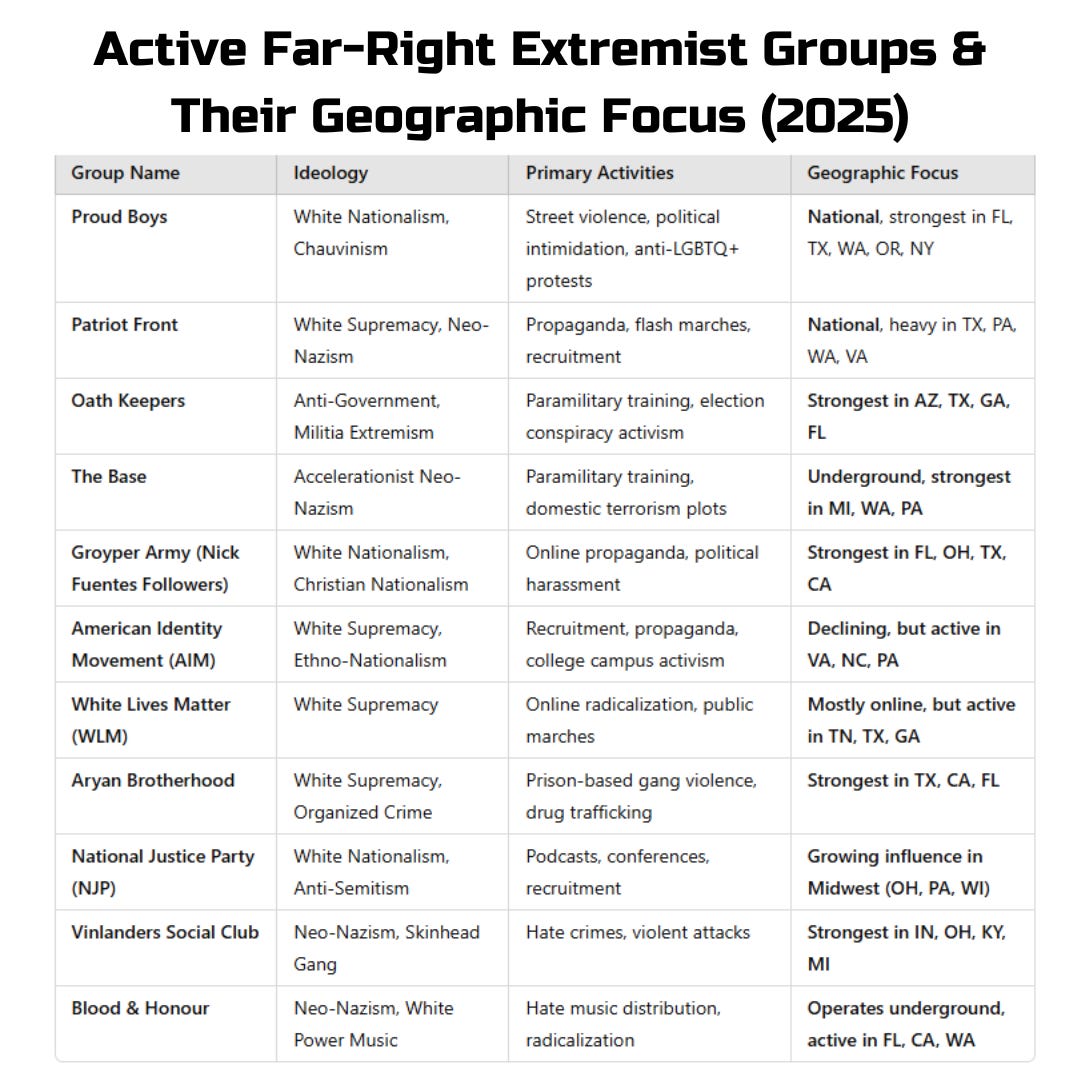
The highest extremist activity concentrations appear in Florida, Texas, Ohio, and Pennsylvania with growing groups in the midwest and south.
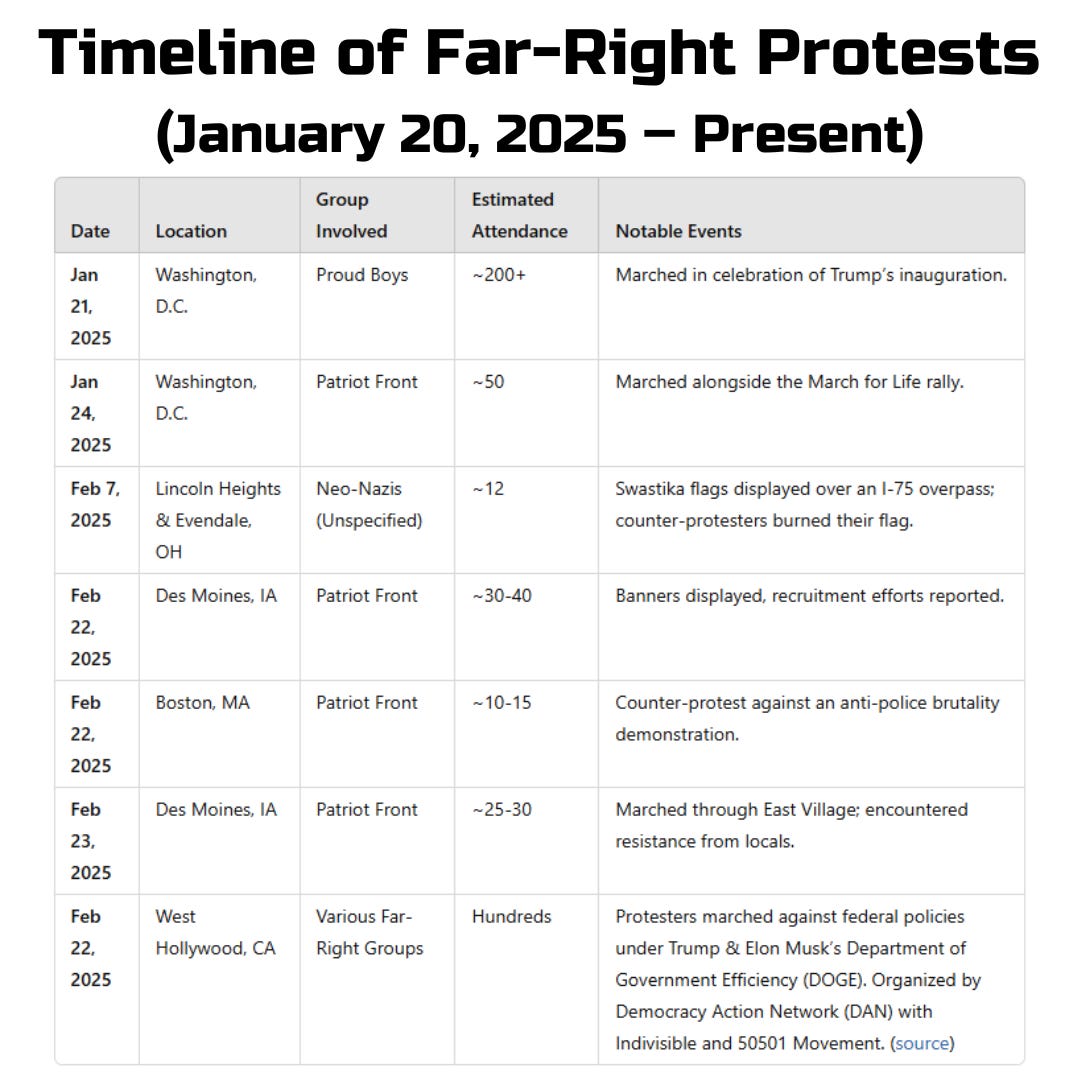
The timeline below tracks the most recent white nationalist protests and rallies, from small-scale flag-waving events to large organized marches.
The Role of Social Media in Radicalization
While these protests are highly visible, the actual recruitment pipeline operates online.
Social media platforms like Telegram, Gab, and Rumble provide white supremacist groups with private spaces to recruit and organize.
Encrypted chat groups allow extremists to plan rallies while evading law enforcement scrutiny.
Mainstream platforms (X, YouTube, Reddit) still push users toward radicalization despite claims of content moderation.
As social media policies relax under pressure from conservative lawmakers, white nationalist groups are regaining and increasing their foothold online.
What Happens Next?
Without intervention, history tells us the consequences could be severe:
Law enforcement is pulling back, reducing oversight on domestic extremism.
Recruitment is rising, particularly among younger demographics online.
Past surges in white nationalist activity have resulted in deadly attacks—Charlottesville, El Paso, Buffalo, and Pittsburgh all followed similar spikes.
The data is clear: White nationalist groups are emboldened, organized, and growing.
How This Can Be Countered
Despite the federal government’s retreat from countering far-right extremism, policy solutions still exist, but they require action at state, local, and grassroots levels.
1. Strengthening State-Level Extremism Monitoring
State attorneys general and hate crime task forces can investigate extremist networks.
Legislators in progressive states can pass laws making it easier to prosecute domestic terrorist groups.
Example: After federal agencies deprioritized white nationalist extremism, California and New York expanded their own hate crime tracking systems, filling the enforcement gap.
2. Reinstating DEI & Counter-Extremism Programs
Reverse recent Pentagon and FBI rollbacks that dismantled internal white supremacist monitoring.
Require military and law enforcement screenings for extremist affiliations.
Example: The 2021 Pentagon report on white supremacist infiltration led to policy changes, but those have now been reversed. Reinstating these measures could curb radicalization within law enforcement and the military.
3. Holding Social Media Platforms Accountable
Require transparency on extremist group activity and online radicalization pathways.
Mandate that platforms report extremist organizing the way they already track foreign terrorism.
Example: After the Christchurch mosque attack, New Zealand pressured tech companies to limit white nationalist content. The U.S. could apply similar pressure if there was political will.
4. Expanding Independent & Community-Based Monitoring
Fund independent watchdog groups like SPLC, ADL, and extremism research organizations.
Support investigative journalism that tracks white nationalist movements.
Example: Many of the biggest far-right exposes (like the identification of January 6 rioters) came from independent journalists, researchers, and antifascist activists. Funding these efforts is more important than ever.
The data is clear: White nationalist groups are more emboldened than ever, operating with fewer restrictions and growing in both size and influence. The rollback of federal monitoring, the weakening of DEI programs, and the political mainstreaming of extremist rhetoric have created a perfect storm for far-right mobilization.
If left unchecked, history tells us where this leads. When white supremacist groups grow unchallenged, violence follows—Charlottesville, El Paso, Pittsburgh, and January 6 were not isolated events. They were warnings. Warnings we are, once again, ignoring.
But the story isn’t written yet. The biggest threat to these movements is exposure. Journalists, researchers, and local communities still have the power to track, document, and counteract extremism—even as federal agencies look the other way.
Bibliography:
"Neo-Nazis Are on the March Across America" WIRED, November 2024.
"CT had among highest number of hate incidents among states in 2023, ADL data shows" New Haven Register, February 2025.
"Trump's FBI Poised to Focus Counterterror Strategy on 'Things Like BLM and Antifa'" Vanity Fair, February 2025.
"Timeline: Far-Right Terrorism in the United States 1865-2021"
Council on Foreign Relations."The Escalating Terrorism Problem in the United States" Center for Strategic and International Studies (CSIS), June 2020.
"Confronting White Supremacy" Federal Bureau of Investigation (FBI), April 2020.
"Right-Wing Extremist Terrorism in the United States" Anti-Defamation League (ADL), July 2022.
"Extremist Ideology as a Complex Contagion: The Spread of Far-Right Radicalization in the United States" Nature Communications, October 2020.
"A National Policy Blueprint to End White Supremacist Violence"
Center for American Progress, September 2019."Civil and Human Rights Organizations Oppose Kash Patel's FBI Director Nomination" The Leadership Conference on Civil and Human Rights, January 2025.
I think you may have a false statement in your table about right-wing protests. The last one in Feb. 2025 was not right wing. It was a peaceful protest in opposition to the Trump government. Maybe you meant to say that there were right-wing protestors there to counter-protest the 50501/Indivisible protest?