


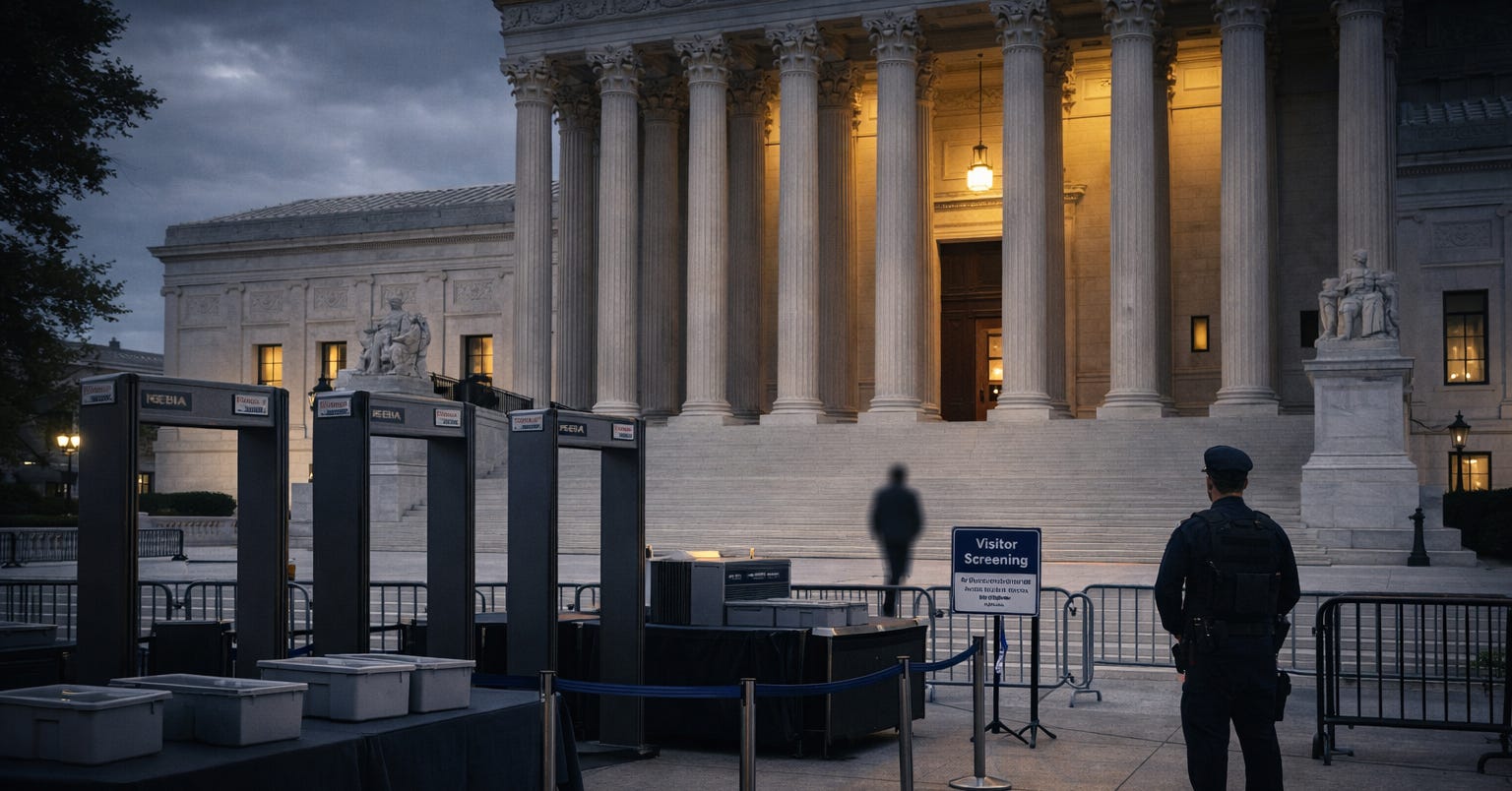
The Court is becoming a fortress
The Supreme Court wants $25.4 million more to protect itself. On paper, that sounds administrative: more security, more cyber protection, more screening, more personnel. In reality, it reads as one of the clearest signs yet that the Court sees itself operating inside a country growing more hostile, more volatile, and more distrustful of the institution at the center of some of the nation’s most divisive decisions. Reuters reports the request includes more protective agents for the justices, more Supreme Court Police officers, cybersecurity funding, a regional command post, and a new visitor screening facility, all after the judiciary said threats rose 57% in 2025.
That is what makes this story bigger than a budget line. The warning sign is not that the Court wants protection. The threats appear real, and protection may be justified. The warning sign is that protection is becoming easier to fund than legitimacy is to rebuild. Gallup reported in August 2025 that the Court’s job approval fell to 39%, the lowest point in Gallup’s trend, and Pew reported in September 2025 that favorable views remained near a historic low.
This Community Is Powered by You
What started as a small circle has grown into something much bigger, and it’s all because of readers like you.
Every time you forward this email, post it on socials, or bring someone new into the fold, you’re helping build one of the most passionate, independent political communities out there.
Want to keep the momentum going?
Share this newsletter with someone who should be part of this conversation.
Thank you for being here. It means everything.
What the Court is asking for
The request is not symbolic. Reuters reports the Supreme Court is asking Congress for an additional $25.4 million, bringing its discretionary funding request to $204.5 million. The Court wants funding for six additional protective agents per justice, administrative support staff, 25 more Supreme Court Police officers, expanded travel security, a $2 million regional command post, $2.3 million for cybersecurity, and $6.5 million to design a new visitor screening facility.
This is a multi-front effort to expand the Court’s physical and digital defenses. Reuters also reports that some security responsibilities are shifting from the U.S. Marshals Service to the Supreme Court Police, meaning the Court is not just seeking more protection but more direct control over how that protection is delivered.
Why now
The Court is not asking for this money in a vacuum. The judiciary says threats rose 57% in 2025, which makes this request feel less like routine growth and more like adaptation to a more dangerous normal. That matters because it keeps the story honest. The threat environment appears real, and a Court handling some of the country’s most explosive disputes would be reckless not to take it into account.
But the rise in threats also makes the request more revealing. What the Court is building here is not a temporary patch. It is infrastructure: a thicker perimeter, more embedded protective capacity, and a model of governance that assumes elevated risk will be part of ordinary operations. That is an inference from the structure and scale of the request Reuters describes.
Insulation before accountability
This is where the story stops looking merely administrative and starts looking like a power pattern.
When powerful institutions come under legitimacy strain, they often respond first by hardening themselves rather than reforming. The Supreme Court’s request fits that pattern. It is moving clearly and concretely on the issue of protection. What it is not doing here is asking for anything that would directly address the legitimacy crisis surrounding it. The warning sign is not that the Court wants safety. It is that insulation is arriving faster than accountability. That conclusion is an inference from the request and the surrounding trust data, not a direct quote from Reuters.
The legitimacy problem
The security request carries extra weight because it is being made by an institution already operating under a cloud of legitimacy. Gallup found the Court’s approval rating fell to 39% in 2025. Pew found that favorable views remained near a historic low and said opinions had stayed relatively stable at those depressed levels. Those are not ordinary fluctuations. They are signs of a Court whose public standing has been weakened and has stayed weak.
That problem did not begin with this budget request, and the request does not solve it. The Court has spent years at the center of explosive disputes while also absorbing sustained criticism over ethics, ideology, and democratic distance. The point is not to relitigate every grievance. The point is that physical hardening means something different when it comes from an institution the public no longer broadly trusts. Reuters’ security reporting and the polling together make that tension hard to miss.
More security, less transparency
What makes this moment more revealing is the contrast. Reuters also reported that the federal judiciary withdrew a proposed rule that would have required more disclosure about who finances some amicus briefs, sending the measure back for further consideration after critics argued it could chill participation and expose donors. Reform advocates had supported the rule as a way to reveal hidden special-interest influence in friend-of-the-court filings.
That does not prove some coordinated scheme, and it should not be overstated. But it does reveal an institutional reflex. At a moment of distrust, the judiciary is moving more clearly on protection than on openness. Protection is easier to fund than legitimacy is to rebuild, and easier to implement than transparency is to widen. That is the clearest power pattern in the story.
What this says about power
What the Supreme Court is doing here is not unique to the Court. It is part of a wider pattern in American life: institutions under strain increasingly behave like institutions under siege. They build thicker perimeters. They invest in screening, police capacity, secure travel, cyber defenses, and controlled access. Those choices may be justified on the merits, especially when threats are real. But they also reveal something deeper about how power now responds to distrust.
The Supreme Court makes this pattern especially visible because it sits so close to the center of constitutional authority. It does not stand for election. It relies heavily on public acceptance of its role and the legitimacy of its decisions. So when that institution starts investing more visibly in physical and digital self-protection while its public standing remains weak, it sends a larger signal about the country around it.
A Court protected from danger, but not from distrust
The Supreme Court may genuinely need more protection. The threats appear real, and no serious institution can ignore that. But the meaning of this request goes beyond safety. It reveals an institution preparing itself for a country it increasingly experiences as dangerous, volatile, and distrustful.
A Court can buy more screening, more security personnel, stronger cyber defenses, and a thicker perimeter. What it cannot buy as easily is renewed public trust. That is why this request feels like more than administration. It feels like an institutional crisis in physical form: one of the most powerful bodies in American life investing in protection because the climate around it has become too hostile to ignore, even as the legitimacy gap surrounding it remains unresolved.
And that may be the clearest signal of all. The crisis surrounding American institutions is no longer just political or rhetorical. It is becoming structural. It is becoming infrastructure.
Support Independent Media: The Coffman Chronicle
The Coffman Chronicle exists to follow power, expose the pattern, and tell the truth about who gets protected, who gets heard, and who gets left behind. That means digging past the official story, naming what too many outlets smooth over, and connecting policy, power, and consequence in a way that actually matters to ordinary people. If that kind of independent journalism matters to you, and you can afford to support it, please consider becoming a paid subscriber.
Sources:
Gallup. “Record Party Gaps in Job Approval of Supreme Court, Congress.” August 7, 2025.
Pew Research Center. “Favorable Views of Supreme Court Remain Near Historic Low.” September 3, 2025.
Reuters. “US Judiciary Withdraws New Requirements for Amicus Brief Disclosures.” March 27, 2026.
Reuters. “US Supreme Court Seeks $25.4 Million Funding Boost for Security, Cyber Protection.” March 26, 2026.
The Roberts version of the U.S. Supreme Court has a majority of Justices dedicated to making President Trump secure and more powerful. They have bestowed Presidential Immunity on President Trump last year. By the way, what is this based on? Certainly not the U.S. Constitution... Today is the third No Kings Nationwide Demonstrations--Perhaps the Roberts Court should reassess their recent decisions regarding a 79 year old, overweight egomaniac!
I think the loss of some respect for the Supreme Court is justified. Their ruling on Trump having "immunity" in what he does, decisions he makes. is in my mind, totally without merit or justification. Thankfully that has not met with total Supreme Court approval for everything he has done. Their request for more protection, unfortunately, well-founded. Hopefully Democrats will get an opportunity to choose new or additional judges.