


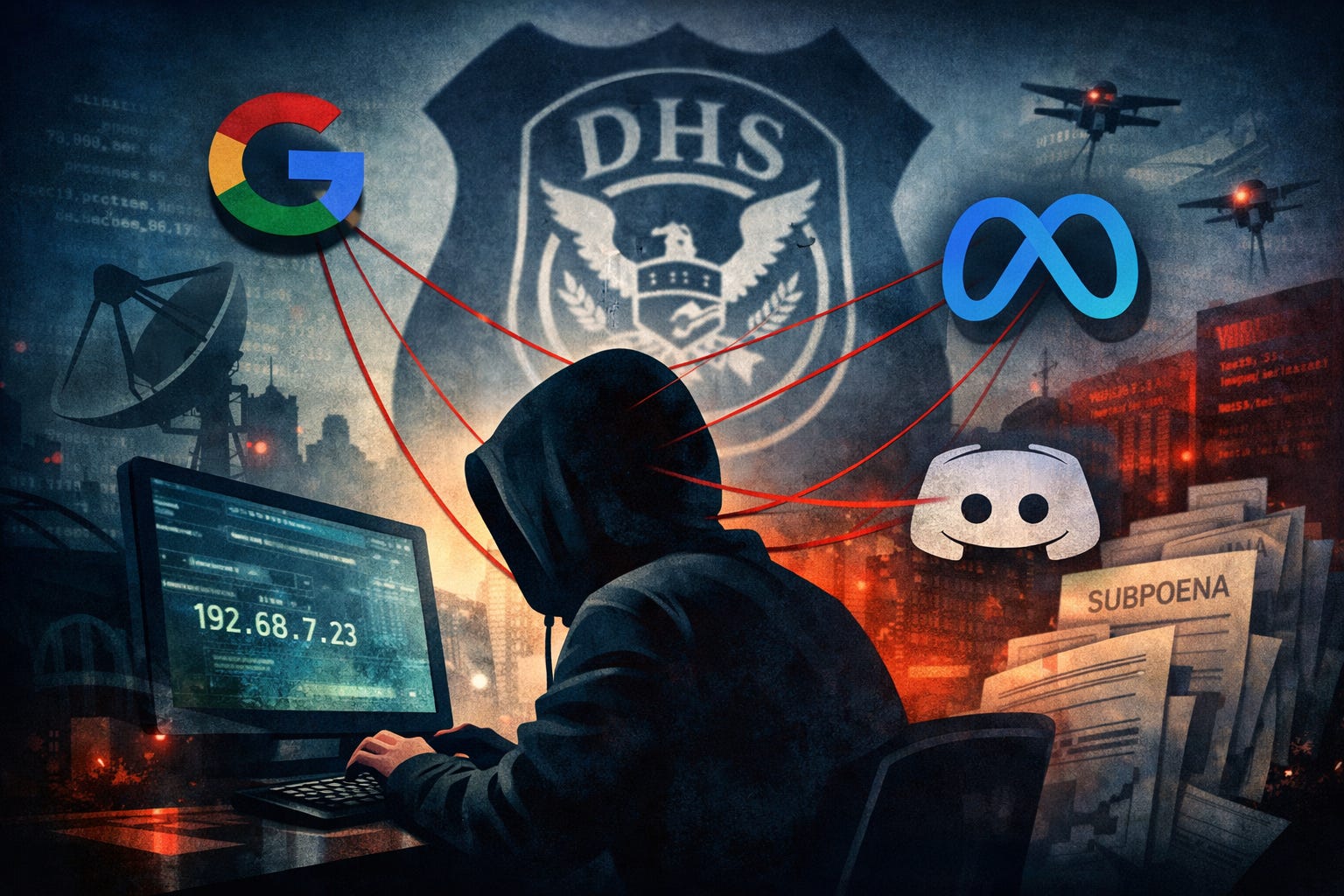
In the last several months, the Department of Homeland Security has been quietly issuing hundreds of administrative subpoenas to some of the largest tech companies in the world, including Google, Meta, Reddit, and Discord. The goal is not to track mass shooters or terrorist plots. It is to force those companies to reveal who is behind social media accounts that criticize Immigration and Customs Enforcement or share information about where ICE agents are operating.
These subpoenas demand personal details such as names, email addresses, phone numbers, IP logs, and other account-level identifiers for accounts that, in the words of one report, “do not have a real name attached” and that either post critical content about ICE or describe the locations of ICE officers.
Unlike a traditional subpoena signed by a judge, these administrative subpoenas are authorized by DHS itself. No judge reviews them before they are sent. The orders go straight from the agency’s internal machinery to the legal departments of the platforms that host much of our public and semi-public speech.
We do not know precisely when this practice began or how far back it stretches. We know about it at all because one man received a notice from Google, called the ACLU, and fought back. From that case, reporters at outlets including The Washington Post and The New York Times traced out a broader pattern and confirmed that what used to be a rarely used tool is now being deployed routinely in immigration-related speech cases.
That leaves us with two central questions. First, can DHS legally do this? Second, even if the statutes allow it, what does it mean for free speech and digital privacy when an agency starts using a dusty bureaucratic power to unmask critics at scale?
This Community Is Powered by You
What started as a small circle has grown into something much bigger, and it’s all because of readers like you.
Every time you forward this email, post it on socials, or bring someone new into the fold, you’re helping build one of the most passionate, independent political communities out there.
Want to keep the momentum going?
Share this newsletter with someone who should be part of this conversation.
Thank you for being here. It means everything.
The Dry Part: Yes, DHS Technically Has This Power
Administrative subpoenas are one of those legal instruments that most people never hear about until they are on the receiving end. Congress has given a range of federal agencies the authority to demand certain kinds of records without going to court first. DHS, through its immigration laws, is one of them. The statute allows immigration officials to subpoena “records and other evidence” that they deem relevant to an immigration investigation.
In theory, these tools exist to make routine enforcement work possible. If an agent needs employer payroll records in a workplace enforcement case or documents from a landlord in a narrow fraud investigation, an administrative subpoena can be faster than building a full criminal case and going to a judge. If the recipient believes the request is illegal or overbroad, they can refuse, and a court may eventually be asked to resolve the dispute. On paper, that is the check.
DHS has not invented this power out of thin air, and Trump-era DHS has reached for it before. In 2017, Customs and Border Protection tried to use a similar authority to force Twitter to unmask the person behind @ALT_USCIS, an anonymous account that posted internal information and criticism about Trump’s immigration policies. Twitter sued, and the government ultimately withdrew the demand.
That same year, the Justice Department sought data on roughly 1.3 million visitors to DisruptJ20.org, a website organizing protests of Trump’s inauguration. The web host fought back, and a judge narrowed the warrant, warning against sweeping up information about people engaged in protected First Amendment activity.
More recently, DHS issued subpoenas to Meta for information on Instagram accounts that posted personal details about a border agent, including Anti-ICE protest pages. In that case, afederal judge ordered Meta not to comply in at least one instance while the First Amendment issues were litigated.
All of this underscores a narrow, technical point. The authority exists. Congress gave immigration officials subpoena power. Courts have occasionally slapped down the most blatant abuses, but they have not stripped the power away.
The real problem is not the existence of administrative subpoenas on paper. It is what Trump’s DHS is now doing with them. A tool that was largely invisible, used in specific, often boring records disputes, has quietly been repurposed into a dragnet aimed at people who talk about a powerful federal agency online. The department is not using this power to chase clearly defined threats. It is using it to unmask dissent.
Who DHS Is Going After
“Anonymous” Does Not Mean Invisible
The recent reporting makes one criteria very clear. DHS is particularly focused on accounts that appear anonymous or pseudonymous to the public. The New York Times and TechCrunch describe subpoenas “focused on accounts that did not have a real name attached” and that either criticize ICE or “describe the location of ICE agents.”
In practical terms, that means the handles most of us would recognize as not using a legal name. Think of an account called @AbolishICE or @MontcoCommunityWatch, or a Discord username that is a nickname and a number. To other users, these accounts look anonymous. To the platforms, they are anything but.
Google, Meta, Reddit, and Discord generally require an email address to sign up and often a phone number as well. They log IP addresses and device identifiers every time someone connects. Some users pay for services, which adds billing information to the mix. So when DHS says it wants information on accounts without “real names,” what it wants is the bridge between that handle and the human being behind it.
It is telling that the department is not focused on people who post about ICE under their real names. It does not need a subpoena to know who those people are. Their names, photos, and often their locations are already public. These subpoenas are for the people who took the extra step of protecting themselves with pseudonyms because they understood, on some level, that criticizing a deportation machine could put a target on their backs.
A Dragnet Measured in Millions
Officials and defenders may be tempted to point out that we are “only” talking about hundreds of subpoenas. That is the number the Times highlighted and that TechCrunch and others have repeated.
However, each of those subpoenas goes to a platform with hundreds of millions of users and can cover multiple accounts or entire categories of pages. One widely cited example is Montco Community Watch, a Facebook page that warns residents of Montgomery County, Pennsylvania when ICE is active in their area. Others include Instagram and Reddit accounts that post similar alerts.
There are millions of people in the United States who have, at one point or another, reposted, liked, joined, or commented in spaces that criticize ICE or share information about raids and checkpoints. When DHS sends a subpoena for “accounts that do not have a real name attached” and that discuss ICE operations, the blast radius is not a few dozen extremists. It is a broad swath of immigrant communities, organizers, lawyers, and ordinary neighbors trying to keep each other informed and safe.
The truth is that we have no idea how many people have already been unmasked in this way or how many will be. We only know that in “recent months,” according to these reports, DHS has normalized sending these demands to multiple companies and that nothing in the statutes limits the practice to a short window in time.
The Standard Is Not “Threat.” It Is Dissent
The John Doe Case
If DHS were reserving this power for clear, imminent threats to public safety, there would still be civil liberties questions. The John Doe case shows that is not what is happening.
In October, a 67-year-old retired man living in the suburbs of Philadelphia read a Washington Post story about an Afghan asylum seeker who faced deportation. Disturbed by the idea of sending someone back to the Taliban, he did what many engaged readers might do. He searched for the name of the Department of Homeland Security lawyer handling the case, found an official email address, and wrote a four-sentence note urging the attorney to “apply principles of common sense and decency” in deciding whether to continue the deportation. He did not threaten anyone. He did not raise his voice, even in text. He essentially said: Please do the humane thing.
Roughly four hours later, DHS issued an immigration enforcement administrative subpoena to Google for information about his Gmail account. According to court filings summarized by the ACLU and the Post, the subpoena did not ask for the content of the email. DHS already had that in the prosecutor’s inbox. It asked for what surrounds the email, namely the IP addresses and timestamps of his logins, every physical address associated with the account, any alternate email addresses and usernames, the date he opened the account, and, if available, his driver’s license number, Social Security number, and credit card details.
Google notified him, as the company sometimes does when it is legally permitted to inform users of government demands. He was, by his own account, shocked and frightened. Within weeks, two DHS agents and a local police officer came to his home to question him about the email he had sent. The ACLU took his case and asked a court to block Google from complying, arguing that the subpoena violated the First Amendment and exceeded DHS’s statutory authority.
None of what happened to John Doe is consistent with a power reserved for “specific, credible threats.” His case shows something else entirely. To this DHS, it was enough that he criticized the agency’s deportation decision and urged compassion. That alone was sufficient to justify dragging his digital life into an immigration enforcement file and sending agents to his front door.
From One Email to Hundreds of Subpoenas
John Doe’s story is not an outlier in the sense of revealing a freak accident. It is the example that cracked the pattern open. After the ACLU filed suit on his behalf, The Washington Post examined DHS’s use of administrative subpoenas more broadly. The New York Times followed with reporting that a tool previously used sparingly had, in the last year, been deployed regularly, including in cases involving people who criticized ICE or shared information about ICE operations online. TechCrunch and other outlets then confirmed that “hundreds” of such subpoenas have gone out to Google, Meta, Reddit, and Discord in recent months.
In other words, we learned about this wave of social media subpoenas because a retiree who asked DHS to be humane contacted a civil liberties group, not because a tech company decided to blow the whistle publicly. The Doe case is one of the extreme instances. It is also the reason we know there are many more.
When you place his experience next to the anti-ICE subpoenas, the trajectory is obvious. If an email containing “common sense and decency” is enough to trigger a data grab and a home visit, then the bar is not “we think this person is going to kill an agent.” The bar is “this person questioned what we are doing.”
Skipping the Judge
There is a legal distinction that matters here, even though it does not offer much comfort. Under the federal electronic privacy framework, there is a sharp line between the content of communications and what is often called metadata or subscriber information.
If the government wants the content of your email inbox or the private messages in your social media account and it does not already possess those messages, it generally needs a search warrant based on probable cause, signed by a judge. That is the process that led to some of the high-profile standoffs after mass shootings, where the FBI sought to compel access to phones or encrypted chats.
Subscriber information and metadata are treated differently. Names, email addresses, phone numbers, IP logs, and device identifiers are not considered “content” under the Stored Communications Act. Agencies can often obtain that layer of information with a subpoena, rather than a warrant. In DHS’s case, that means an administrative subpoena signed in-house, with no judge reviewing it at the start.
That is what happened to John Doe. DHS did not need Google to read his email; its own attorney had already received it. What the agency wanted was everything around the email that would reveal who this critic was and how to find him. The same pattern appears in the subpoenas to social media companies. The orders seek identity and network information for accounts that match the broad criteria, not the text of their posts.
For the people on the receiving end, this distinction is cold comfort. The harm of an anti-ICE subpoena is not merely that someone at DHS might read a post that was already visible on the internet. It is that the department now has your name, your contact information, your IP history, and whatever other account-level details the platform is willing to hand over. The subpoena strips away the protective layer of pseudonymity and turns a screen name into a person in a file.
“Just Metadata” Is a Dangerous Fiction
It is easy to hear “metadata” and think of something harmless and abstract. In 2026, that is a mistake. An IP address is not a random number any more than a street address is a random sequence of letters. It points to a physical connection. Combined with timestamps, it shows where you were, when, and on which device. A subscriber record ties that connection to a name, an email account, a phone number, and often to other accounts in the same digital ecosystem.
In John Doe’s case, the subpoena demanded not only IP logs and timestamps but also any physical addresses associated with the account, alternate usernames, and, if available, his driver’s license number, Social Security number, and credit card details. That is not a request to see a single message. It is a request to light up a person’s entire digital footprint.
When DHS sends similar demands to Google, Meta, Reddit, and Discord for ICE-related accounts, it is asking for the keys to identity. Once an account is in the net, the subpoena does not distinguish between someone who posted “ICE is fascist,” someone who warned “ICE is at 5th and Main, be careful,” and someone who might have written an actual threat. The filter is set in advance. Anyone the query catches is now unmasked, regardless of what they personally said.
Calling that “just metadata” is like calling a house key “just a piece of metal.” The entire point is that it opens the door.
From File to Watchlist
The government does not need to obtain a search warrant for each person it unmasked in order to change their lives. Once a name and IP history are attached to an account in a DHS database, the person behind it is no longer a random user on the internet. They are someone DHS knows has participated in a particular conversation about a particular agency.
For U.S. citizens, that can mean being flagged in internal systems, landing on “officer safety” lists, or receiving extra scrutiny if their name appears in a future investigation or at an airport. For immigrants, green card holders, asylum seekers, and undocumented people, the stakes are higher. Immigration enforcement already relies heavily on discretionary judgments. Being tagged as someone who runs or participates in an anti-ICE account is not likely to help when a file lands on a decision-maker’s desk.
In a dragnet this vague, it is entirely possible that the only thing some people did “wrong” was fail to explicitly praise ICE. That is enough to get them sorted into the “problem” column and left there until or unless a human reviews the record, if that ever happens.
We do not yet know how DHS is storing and cross-referencing this information. We can infer, from past experience and from the sparse details in reporting, that agents have treated this kind of data as a basis for questioning people, opening further inquiries, and sharing names internally under the banner of “officer safety” or “potential interference with operations.”
Whether or not most of the people unmasked by these subpoenas will ever be charged with anything is almost beside the point. The primary effect of a vague dragnet is not mass prosecution. It is mass sorting.
Silence as Self-Defense
The chilling effect here is not theoretical. John Doe told reporters that he was shocked and frightened when Google notified him of the subpoena and that he worried he would now be on some kind of list and face trouble when he traveled.
He is a retired man in the suburbs whose “offense” was to ask DHS to apply common sense and decency. It is not difficult to imagine the effect on people with far more to lose.
If you are undocumented, on a student visa, or living in a mixed-status household, the lesson is obvious. If a polite email to a government attorney can bring a subpoena for your account and agents to your door, continuing to post about ICE, even under a handle, begins to feel reckless. If you are a citizen organizing deportation-defense campaigns, a lawyer who helps clients understand their rights, or a college student running an anti-ICE meme account, the rational move, after seeing these stories, is not to parse statutory language. It is to go quiet.
DHS does not have to ban criticism of ICE in order to drastically reduce it. It simply has to make the consequences of speaking unpredictable and frightening enough that many people decide silence is safer. Whether or not that is the official intent, it is the most probable outcome of this campaign. Silence becomes a form of self-defense.
Discord, “Teen by Default,” and the End of the Back Room
For years, many organizers and communities have treated Discord as the back room of the internet. Where platforms like Facebook and X are built around public feeds that are trivially easy for companies and governments to scan at scale, Discord is built around invite-only servers and semi-private channels. That structure has made it attractive to everyone from gamers to local mutual aid groups to immigration advocates trying to coordinate without dumping every detail into a global search box.
Discord is now on the list of companies receiving DHS subpoenas for ICE-related accounts.
At the same time, Discord is rolling out a global “teen by default” age-assurance system this March. All existing accounts will be treated as teen accounts with restricted settings unless Discord’s internal age-inference model is confident that the user is an adult or the user completes an age-verification step. For adults whose age cannot be inferred from existing data, that verification may involve uploading a government ID or recording a short video selfie so that a partner can perform facial age estimation.
Discord stresses that facial scans run on the device, that IDs are used to derive age and then deleted, and that the company only receives an age band, not full identity details.
However, the effect is still to build a more structured identity scaffold around accounts, coupled with an AI system that profiles users by behavior and history to infer age. That comes on the heels of a 2025 incident in which a third-party verification vendor used by Discord was breached, exposing tens of thousands of ID images.
In isolation, age gating is a child-safety story. In the context of DHS subpoenas, it becomes something more troubling. When the same platform that people have used to organize quietly now has more reasons to collect age-related signals and to tie accounts to inferred adult status, a government demand for “subscriber information and related metadata” sweeps in a richer, more revealing picture of who is in those rooms. It makes it that much simpler to turn “BorderWatcher#1837” into “this adult living in this city on these devices.”
The line between public square and side room is already thin online. Administrative subpoenas to Discord, combined with steadily more intrusive identity practices, all but erase it for people who thought a handle and a private server were enough to keep them off the state’s radar.
We Have Been Here Before
The mechanisms are new. The impulse is not.
In the McCarthy era, congressional committees demanded lists of members from unions, civil-rights organizations, and artistic circles, then treated presence on those lists as grounds for suspicion regardless of individual conduct. Careers were destroyed, and people were blacklisted from entire industries, not because they had been convicted of crimes, but because their names appeared near the wrong causes.
During the Vietnam War, high-profile critics such as Jane Fonda were surveilled and placed on watchlists by the FBI, CIA, and NSA. Declassified material has shown that anti-war activists were tracked and smeared, often with disinformation fed to the press, not for espionage but for the political crime of opposing the war. The point was not just to monitor them. It was to make them cautionary tales.
The pattern is depressingly familiar. Speak loudly against a war, a security policy, or a powerful enforcement agency, and the state begins to treat you less as a citizen with rights and more as a problem to be managed. The tools have changed from phone taps and physical dossier cabinets to IP logs and data centers. The logic has not.
What DHS is doing with these subpoenas is the modern version of demanding a list of names.
What Needs to Happen Next
The problem here is not simply an overzealous clerk or a handful of ham-fisted subpoenas. It is an architecture of law and technology that treats our digital identities as fair game unless and until a court is forced to intervene.
Congress
Congress bears a large share of the blame. Federal electronic privacy law still rests heavily on frameworks written in the 1980s, when email was exotic and social media did not exist. That law draws a hard line between “content” and “non-content” data and assumes that anything in the latter category is relatively harmless. In practice, those “non-content” records are now the keys to who we are, where we are, and how we move through the world.
A meaningful digital privacy law would start from the premise that your rights do not evaporate because your political speech happens through a handle and a platform account rather than a union hall or a church basement. At a minimum, Congress should require a judge, and a heightened First Amendment standard, whenever the government seeks to unmask speakers engaged in political or issue advocacy. It should prohibit broad, topic-based identity dragnets of the sort DHS is now using against people who talk about ICE. It should treat IP addresses, device IDs, and extended login histories as sensitive data that generally require a warrant, not as low-tier metadata that agencies can seize with self-signed paperwork.
Tech Companies
Tech companies have their own choices to make. Some have notified users when subpoenas arrive and have pushed back when requests are overbroad. Others have quietly complied. None have been fully transparent about how often administrative subpoenas, as opposed to court-ordered warrants, are used to unmask their users. Companies that profit from hosting speech about government power have a responsibility to do more than hand over the guest list at the first knock. They can refuse, they can narrow, and they can force DHS to explain itself in front of a judge.
Civil Law
Civil liberties groups will continue to bring individual cases like John Doe’s, and there may well be class-action litigation on behalf of people swept into topic-based dragnets. That work matters. In Doe’s case, DHS withdrew the subpoena on February 10th, demonstrating that pressure works. It is also a sign that the system is backwards. Rights that exist only if you can find a lawyer and take on a federal agency are rights in name more than in practice.
Ultimately, this is about what kind of democracy we want to be. A country in which criticizing a deportation agency, or warning your neighbors that ICE is on the block, is treated as suspicious behavior is a country that has lost its sense of what the First Amendment is for. DHS’s subpoenas are not just legal instruments. They are a test.
The authority to issue administrative subpoenas will probably remain on the books. The question is whether we allow that authority to be used as a quiet weapon against dissent, or whether we insist that the line between keeping people safe and keeping people silent be drawn in public, by laws and courts, rather than in secret, by search queries and self-signed letters.
Want more reporting like this in your inbox? Subscribe to our newsletter for sharp, people-centered coverage of immigration, civil liberties, and digital privacy — and the concrete ways they collide in real lives. No doomscroll, no spin, just the context and accountability you need to push back.
Sources:
“Homeland Security is targeting Americans with this secretive legal weapon” — February 3, 2026, The Washington Post
“Doe v. DHS” (case summary) — January 31, 2026, American Civil Liberties Union
“ACLU Moves to Quash Abusive Subpoena Aimed at Tracking Down Man Who Criticized Department of Homeland Security” — February 3, 2026, American Civil Liberties Union
“Department of Homeland Security Withdraws Subpoena Targeting Man Who Criticized Them” — February 10, 2026, American Civil Liberties Union
“How DHS is using a controversial legal tool to target critics of immigration enforcement” — February 9, 2026, Straight Arrow News
“Court Sides with ACLU, Strikes Down DHS Subpoena for Google Data” — February 13, 2026, Davis Vanguard
8 U.S.C. § 1225 — Inspection by immigration officers (with subpoena authority at subsection (d)(4)) — Legal Information Institute, Cornell Law School
“The Immigration Subpoena Power” — Vol. 125, No. 1 (January 2025), Columbia Law Review / Cardozo Law Faculty Articles
“Know Your Rights: ICE Administrative Subpoenas” — April 18, 2025, American Civil Liberties Union
“Discord will require a face scan or ID for full access next month” — February 9, 2026, The Verge
“A Social Media App Is Now Requiring Facial ID, but It’s Not the One You Think” — February 9, 2026, Lifewire
“Discord Launches Teen-by-Default Settings Globally” — February 9, 2026, Discord
“Discord Voluntarily Pushes Mandatory Age Verification Despite Recent Data Breach” — February 11, 2026, EFF
McCarthyism is what trump's mentor, Roy Cohn, is infamous for.
Sickening.