


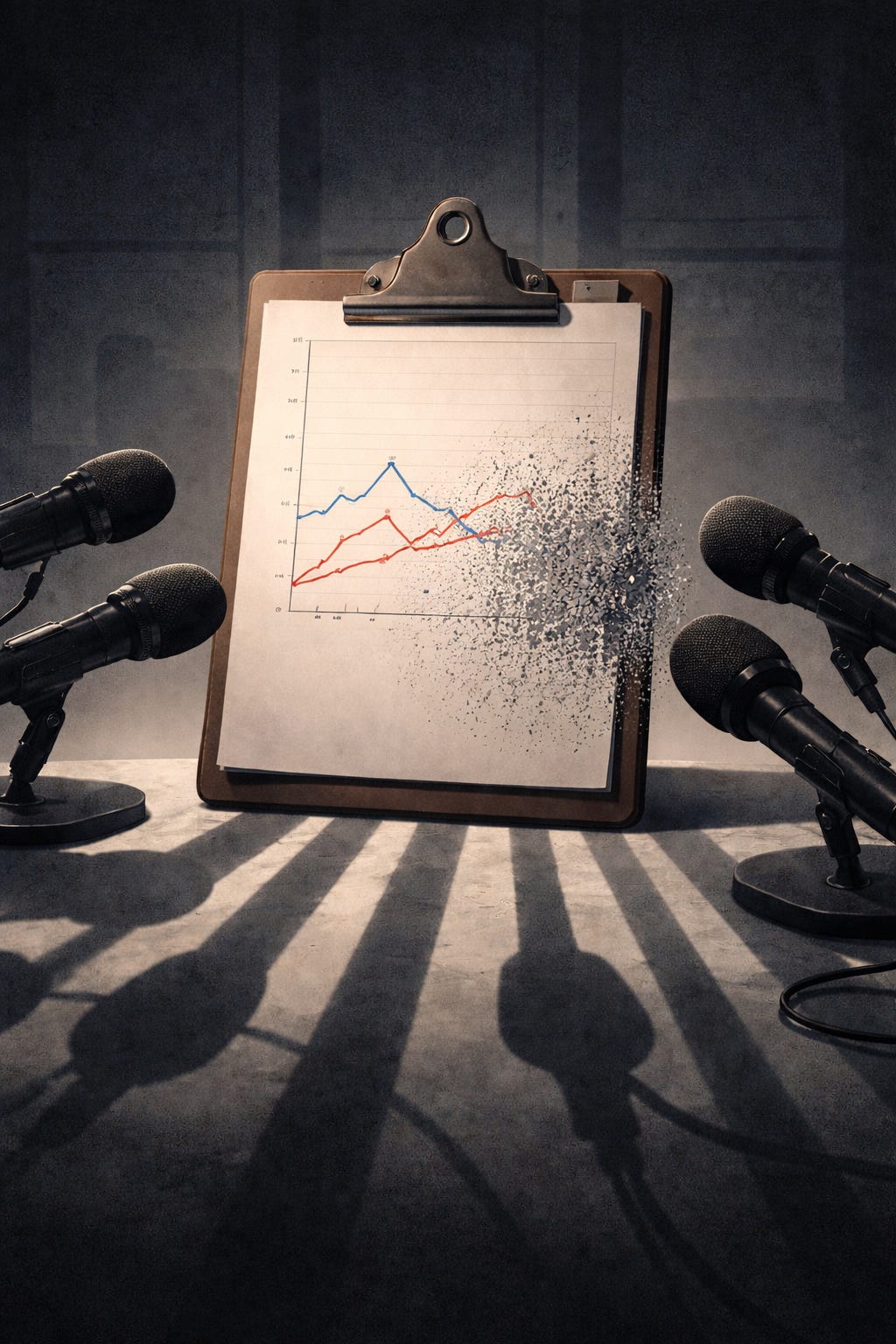
On approximately February 11, 2026, Gallup, the renowned polling agency, sent a brief statement to select news agencies. Immediately, headlines exploded. I caught it on social media while dopamine mining and scrolled right past it. Then it appeared again, now including statements connecting it to the most recent polling on Trump’s floundering approval rating. Now I started reading it like a hostage note.
There’s something darkly funny about how much time some of us (hi, it’s me) have spent parsing a few paragraphs of Gallup corporate boilerplate.
On paper, the story is fairly simple. After nearly 90 years, Gallup is ending its famous presidential approval and political favorability tracking. They say it’s a strategic shift due to the emergence of too many other pollsters doing this now, rising costs, technological advances, and a desire to focus on broader issue-based work.
In another timeline, that’s a mildly interesting “end of an era” item for political nerds and history buffs. Jeopardy and Trivial Pursuit enthusiasts would file it away under “Last President with a Gallup Approval Rating.”
In this deeply dystopian one, it landed like a small, slightly desperate “Nothing to see here. Nope. Definitely not getting out while the getting is… possible.”
In the end, the fact that so many of us immediately reached for hostage-video metaphors says more about the current political environment than it does about Gallup’s internal motives.
This Community Is Powered by You
What started as a small circle has grown into something much bigger, and it’s all because of readers like you.
Every time you forward this email, post it on socials, or bring someone new into the fold, you’re helping build one of the most passionate, independent political communities out there.
Want to keep the momentum going?
Share this newsletter with someone who should be part of this conversation.
Thank you for being here. It means everything.
In a normal timeline, this is a nerdy milestone
Imagine this announcement dropped in, say, 2010.
The coverage would probably sound like: “Gallup, the pollster that popularized the presidential approval rating in the 1930s, is retiring the series as polling methods evolve.” There’d be charts: FDR to Obama, spikes for wars and crashes, troughs for scandals. Commentators would talk about landlines vs. cell phones, the rise of online polling, response rates, and aggregation sites. Gallup would wrap itself in a self-congratulatory retrospective and tease shiny new metrics on global well-being or democracy.
It would be a little nostalgic, a little geeky, and mostly about methods and history, not power and fear.
The headline would feel quaint, the end of an era, not can this democracy’s institutions still safely measure the president’s unpopularity?
In this timeline, every story snapped to the same frame
Instead, the actual coverage in 2026 looked more like: “Gallup will stop tracking presidential approval after nearly 90 years. The firm says this is a strategic shift based on its research priorities and not the result of pressure from the White House.”
That second sentence—“not the result of pressure from the White House”—or its close cousin showed up everywhere. Reporters called; Gallup gave them a short statement about “evolution” and “thought leadership,” and when asked whether Trump or the administration pressured them, the spokesperson replied with a carefully lawyered line: “This is a strategic shift solely based on Gallup’s research goals and priorities.”
“Solely” is doing a lot of work in that sentence in the current political environment.
Consider the context. For a decade, we have lived largely under a president who has spent years rage-tweeting about “fake polls,” “low ratings,” “fake news,” and “alternative facts.” He has repeatedly threatened to sue media and pollsters over unfavorable numbers, and has upped the game with multiple high-dollar suits against major media companies and the search or arrest of reporters. At the same time, his second term has watched his approval sink into the 30s in Gallup’s own measurements, and we live in a political climate where watchdogs, courts, universities, and newsrooms are routinely portrayed as enemies.
Put all that together, and even a bland corporate paragraph starts to feel like it’s vibrating with distress.
The wording isn’t a smoking gun, but we treat it like one
When you strip it down, Gallup’s public rationale is classic corporate/legal speak:
The decision “reflects an evolution” in how they focus their public research.
Presidential approval and favorability are now widely produced and aggregated by others.
These measures “no longer represent an area where Gallup can make its most distinctive contribution.”
They want to focus on long-term, methodologically sound research on issues and conditions that shape people’s lives.
If you printed that on letterhead in a stable era, most of us would skim right past it. It’s the exact language any big institution uses when it sunsets a legacy product and pivots to something more on-mission.
The interesting twist is not that Gallup used this language, but that so many of us immediately started interrogating it like forensic linguists. Was the word “solely” in the original written statement, or did it first appear as an answer in Q&A? Does that word indicate preemptive defensiveness or just careful legalese? Did they explicitly deny White House pressure unprompted, or only when asked? Why mention “distinctive contribution” instead of simply saying “this is expensive and redundant”? Is it notable which agencies were sent the original letter? Is that a direct quote from a spokesperson or a prewritten response?
That kind of close reading is what people used to do with Soviet communiqués and Vatican statements. Now we’re doing it with a polling firm’s boilerplate.
And that’s the point. The language itself is fairly standard. It’s the environment that turns it into an object of suspicion.
The timeline problem
Then there’s the chronology.
If Gallup had quietly started de-emphasizing presidential approval in a pre-Trump era, the story would look very different. For a moment, it actually seemed like that was the case. A lot of people (myself included) misremembered the scaling back of daily tracking as happening around 2013.
That would have made a nice arc. In 2013, Gallup begins to rethink daily tracking before the Trump show announces casting. In 2026, quietly retire the series as part of a long strategic evolution.
However, the real timeline undercuts that comforting story. In 2018, during Trump’s first term, Gallup moved from daily presidential approval updates to weekly reporting with smaller samples. In 2026, during Trump’s second term, after a run of rough numbers, they decided to end presidential approval and political favorability tracking altogether.
That’s two big visible steps back from their most iconic political metric, both while Trump is onstage.
That doesn’t prove they changed course because of him, of course. However, it does mean that from the outside, it’s very easy to draw a straight line:
Trump era → less daily visibility → eventually no Gallup approval rating at all.
Even if the internal reasons are 70% boring (costs, methods, crowded field) and only 30% “also, this is a political nightmare now,” the sequence lives in a political world where people are primed to see retreat.
And that, again, is about us as much as about them.
Marketing 101: the version that would have felt normal
There’s another way to see how skewed the environment is. Imagine the rollout you’d do if your only goals were clarity and trust.
If you’re Gallup and you’re going to kill a 90-year flagship metric in the middle of Trump 2.0, you don’t just casually email a couple of reporters and hope for the best. You stage a funeral. You do the “From FDR to Now” charts, the wistful webinar, and the “as we enter a new era of measurement” speech. You announce a coffee table book or an indie documentary. You do it between administrations. You absolutely do not drop the news right after you’ve clocked the guy at 36 percent, then reassure a select number of outlets in a very calm email that no, you definitely were not pressured.
That’s the Marketing-101, democracy-respecting version: honest about methods, proud of history, visibly independent.
The fact that we got something much flatter and more reactive—short quotes, legalese, a hard “solely based on our goals” denial—doesn’t automatically mean sinister influence. It does suggest a familiar combination, though.
Internal debates are mostly driven by methods and budgets.
Communications and optics are treated as an afterthought.
Lawyers and leadership are insisting on specific phrases for risk reasons.
Very little attention is paid to how this will look in a hyper-charged, low-trust environment.
This, again, tells us something about the environment.
Why we’re reading everything like a hostage video
What’s really sad—and revealing—is that we’ve ended up applying hostage-tape heuristics to a pollster’s statement.
We’re asking questions like does this sound like someone speaking freely? Does this fit their normal messaging? Are they over-denying something? Is that one strange word (“solely”) a clue?
That’s not normal. Well, at least, it shouldn’t be. Yet here we are, reading commas like Kremlinologists and hearing echoes of proof of life videos and “honey, this isn’t what it looks like.”
We’re doing it because we have been primed to this new normal. There have been years of retaliation against media, civil servants, and watchdogs for saying things that those in power don’t like, an undermining of intellectualism, science, and those pesky facts. We’ve watched allegedly neutral institutions fold themselves into knots to avoid becoming the next target. Mostly, we have learned, painfully, that “of course no one would pressure them like that” and “no one would ever” are no longer safe assumptions. Political norms of all stripes have eroded under the pressure of audacity and the shrug of safeguards.
Now, when Gallup says, “This is a strategic shift solely based on our research goals and priorities,” many of us hear: “Please take our word for it. They have our mom.”
Whether or not that’s fair to Gallup, it’s a rational response to the broader climate. We no longer assume institutions are free. We assume they’re managing threats.
That’s the real story lurking under this episode.
The poll that keeps going even after it’s gone
In the end, Gallup’s presidential approval series is probably not vanishing for one simple reason. It’s more complicated than “they caved” or “they were planning this all along.” Cost, methodology, a crowded market, institutional self-preservation, fear of backlash—all of that can coexist. Honestly, in this current timeline, they are the new drivers.
Other pollsters will still ask some version of “Do you approve or disapprove of the job the president is doing?” Aggregators will still chart it. The number itself will live on.
The more interesting question is what this moment says about us. We expected the likelihood of pressure. We took a paragraph of generic corporate mush and read it like a coded confession. Now, we instinctively treat even mundane institutional decisions as potential indicators of authoritarian gravity. It isn’t even conspiracy-centric, just not out of the realm of possibility. In an era where it takes collegiate-level research to ensure a headline isn’t satire, we have been trained to see underlying authoritarian motives in the same way some people evaluate literature.
In another timeline, Gallup retiring a poll would have been a quaint footnote in polling history.
In this one, it became a tiny test of whether a major institution can still stand in the open and retire a program without a search for the smoking gun, and a reminder that even when the words are boring, the air around them is charged.
In the end, the saddest part of this story isn’t that Gallup ended an approval series. It is that a democracy in decent health wouldn’t make us wonder who might have been in the room when they decided to say goodbye?
In a healthy democracy, nobody feels the need to read generic corporate mush for signs of duress. The fact that we do is the real poll result.
If you just read 2,000 words about Gallup’s corporate boilerplate, you’re my kind of nerd. Subscribe for more deep dives into what our institutions say, and what we hear when we no longer trust them.
Sources:
The Independent - “Gallup to end monthly presidential polls after 80 years – as Trump’s approval ratings continue to slide,” February 11, 2026
Axios – “Gallup’s presidential approval ratings poll is ending after eight decades,” February 11, 2026
The Guardian – “Gallup to stop tracking presidential approval ratings after 88 years,” February 11, 2026
People – “Gallup Ends Presidential Approval Ratings After Nearly 90 Years of Documenting Public Opinion,” February 11, 2026
UPI – “Gallup to stop measuring presidential approval ratings,” February 11, 2026
Straight Arrow News – “Gallup ends nearly 90-year run of presidential approval polling,” February 12, 2026
The Straits Times – “US pollster Gallup stops tracking presidential approval: report,” February 12, 2026
The Daily Beast – “Top Pollster to Stop Tracking Trump’s Awful Approval Rating,” February 11, 2026
Indy100 – “Presidential approval rating polls to stop after 88 years as Trump sits at 37 per cent: ‘A huge loss’,” February 12, 2026
WLBT – “After 88 years, Gallup will stop measuring presidential approval ratings,” February 13, 2026
A couple weeks ago, somewhere in the vomit of a trump decree, he did say he was going to sue the dishonest pollsters. So there you go, Gallup caved in advance, as good fascist do. No mystery here.
It is so true how we analyze things now, like Gallup's decision, when we would not have given it a second thought before. I find myself questioning, wondering about many different decisions being made. We are naturally suspect now about the possible pressure or threats behind the decisions. Sad, really, that we cannot take anything at face value anymore. But good that we are aware and intelligent enough to question and not believe everything dished out to us. Great piece, important point to make. Thank you!