


Recently, Georgia has seen a surge in legislative activity concerning the materials accessible in public and school libraries. Two notable bills introduced in the 2025-2026 Regular Session—Senate Bill 74 (SB 74) and Senate Bill 248 (SB 248)—aim to address concerns over content deemed inappropriate for minors. However, these bills do much more than that; they represent a concerted effort to criminalize librarians and force self-censorship across all types of libraries.
There is widespread disinformation and confusion about the current Georgia law regarding librarians in public, academic, and school libraries. Much of this confusion originates from Senator Max Burns, the sponsor of SB 74 and several other bills related to education and libraries. He is not just targeting school librarians—his legislation threatens all librarians, from higher education faculty to K-12 media specialists. Let’s break these laws down.
The Coffman Chronicle is powered by YOU—no billionaires, no corporate overlords. Help us expose the BS, deliver sharp insights, and keep you informed.
You can fuel the fight and join the movement for just $8 a month or $80 a year.
Not ready to subscribe? No worries, chaos loves company, and you're always welcome.
Senate Bill 74: Repealing Librarian Exemptions
Introduced on February 3, 2025, SB 74 seeks to amend Georgia Code § 16-12-103 by removing exemptions for public and academic (colleges and universities) libraries.
SB 74 does not just remove library exemptions concerning parental complaints and book removal requests. It goes a step further by criminalizing all types of librarians with aggravated charges of providing indecent materials to minors. This is particularly alarming considering that colleges and universities primarily serve adults—fully grown, legally autonomous adults.
Why Did Librarians Have This Protection?
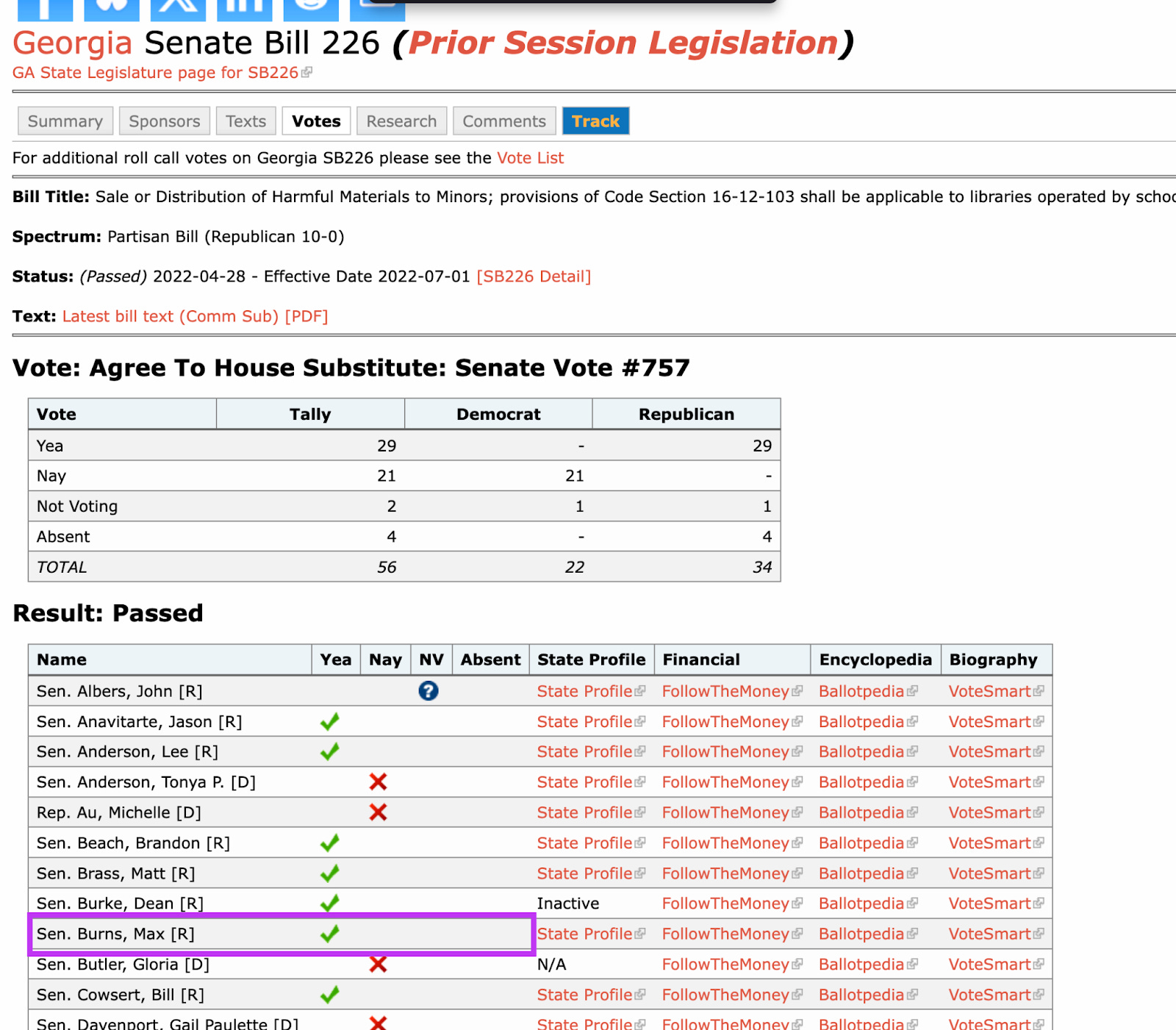
Despite Senator Burns’ claims, Georgia librarians never had special exemptions or protections. The supposed "protections" he refers to stem from Senate Bill 226, which he voted in favor of during the 2021-2022 legislative session. SB 226 exempted public and academic libraries from undergoing the same review processes as school libraries when handling book challenges.
Senator Burns’ Push for Self-Censorship
In a March 1, 2025, interview with the Georgia Recorder, later republished by The Chattanooga Times Free Press, Senator Max Burns stated:
"For unknown reasons, librarians were exempted from following Georgia law. I'd like to point out teachers were not exempted. Coaches were not exempted. Pastors were not exempted."
This argument is misleading at best and outright deceptive at worst. Different libraries serve different communities. Academic libraries primarily serve adults, while public libraries cater to various age groups with diverse interests. Treating all libraries the same ignores these differences and is a blatant attempt to impose unnecessary restrictions.
Burns knows this. He has participated in enough discussions about libraries to understand why exemptions were in place. He knowingly voted for SB 226, yet he now feigns ignorance to push an agenda that criminalizes librarians and forces them into self-censorship.

The “exemption” Senator Burns is so concerned about.
Why Is SB 74 Being Spun as a Good Bill?
The sponsors of SB 74 want to make it appear as though they are simply ensuring fairness and protecting children. By falsely framing the bill as a necessary measure to remove so-called "special privileges" for librarians, they hope the public won’t question its true purpose—controlling public access to information.
Senate Bill 248: Establishing the Georgia Council on Library Materials Standards
Introduced on February 24, 2025, SB 248 aims to establish the Georgia Council on Library Materials Standards.
This council would define terms like "harmful to minors," "restricted materials," and "sexually explicit materials." It would also set statewide standards for local school boards regarding the designation and management of restricted instructional and library materials.
This bill is problematic for several reasons:
Librarians are already highly qualified professionals. Most have at least a Master of Library and Information Science (MLIS), and academic librarians often hold additional graduate degrees in subject specialties. School librarians (media specialists) undergo extensive training and certification. They do not need politically appointed bureaucrats dictating their professional responsibilities.
This is about control, not education. The GOP’s goal is not to protect children but to limit public access to information by creating a centralized "ministry of truth."
Who Do These Bills Hurt? Why Should You Care?
SB 74 and SB 248 will have widespread negative consequences for Georgians:
Brain Drain: If passed, these laws could drive skilled professionals out of Georgia, leading to an economic and academic decline. The effects might not be immediate, but they will become evident over time.
Educational Decline: Children will receive a subpar education if restricted from accessing information.
Higher Education Impact: Georgia’s well-regarded universities may see decreased enrollment as prospective students opt for institutions in states that respect academic freedom. This could also impact the Georgia HOPE Scholarship program, which funds college tuition for high-achieving students.
Economic Consequences: Education is directly tied to economic and social mobility. Limiting access to knowledge suppresses future opportunities and weakens the workforce.
Conclusion
These bills are not about protecting children; they are about control. By forcing libraries to self-censor and criminalizing professionals who provide access to knowledge, Georgia lawmakers are ensuring that future generations will be less educated and less empowered to question authority. The goal is clear: limiting access to information will make the populace easier to manipulate.
If these bills pass, Georgia will suffer the consequences—intellectually, socially, and economically. The fight for libraries is a fight for democracy itself.
Check out the Library of Democracy for more great content such as this piece about the Senator behind this legislation:


This is absolute insanity- the book banners and burners are not the "good guys" in any - well, books. Or movies. Or societies. This never turns out well.
Now I understand how MTG got re- elected. Georgians are 3rd on the I'm so stupid list, behind only Texas and Louisiana.