


The Room They Could Not Ignore
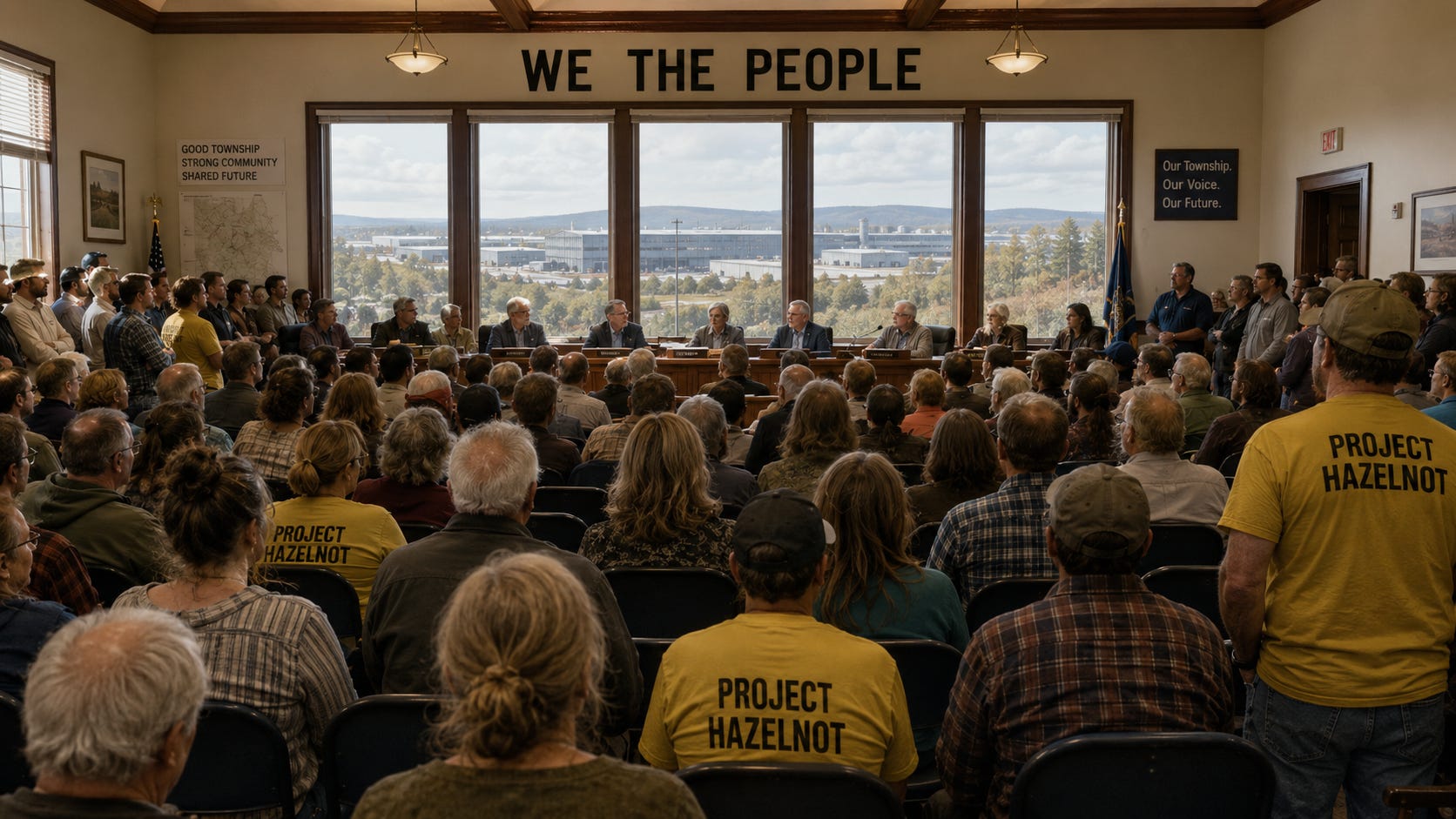
Behind the Hazle Township supervisors, black letters on the wall spelled out three familiar words: “We the People.” That night, the words had a crowd beneath them.
About a hundred residents filled Hazle Township Commons on June 8th. Some stood because the seats were taken. Others wore bright yellow shirts carrying a blunt message for the developers of Project Hazelnut: “Project Hazelnot.” They had come to confront a proposal for 15 data-center buildings and major electrical infrastructure across nearly 1,300 acres of their community.
The opposition did not belong to a single political party or ideology. What united residents was the place where the project’s promises and consequences would arrive. An organizer working with communities across northeastern Pennsylvania said the fight had “obliterated” traditional party lines.
NorthPoint Development could point to investment, jobs, and tax revenue. Residents could point to questions the township’s zoning ordinance had never been written to answer.
On that night, the supervisors voted unanimously to declare parts of that ordinance invalid and begin a 180-day municipal curative amendment process, giving the township time to write specific rules for data centers.
Project Hazelnut had not been defeated, NorthPoint had not withdrawn, but the project had been forced to move at the speed of the community expected to carry it.
Support independent media that follows the power.
The Coffman Chronicle is built to track who holds power, who abuses it, who profits from it, and who pays the price.
Paid supporters get full Tony Michaels Podcast episodes, deeper transcript analysis, paid columns, archives, and the reporting framework behind the show.
If you believe independent media has to survive outside billionaire platforms, corporate media, and party-approved gatekeepers, become a paid supporter today.
The Township Did Not Kill the Project
The vote did not ban data centers or permanently reject Project Hazelnut.
The supervisors found that the township ordinance did not specifically address data centers or related uses. Their action created a limited 180-day moratorium while township officials and the planning commission prepare a curative amendment. During that period, residents may offer input at planning commission meetings, and a public hearing must be held before the new ordinance receives a final vote.
The scale explains the urgency. Project Hazelnut proposes 15 data-center buildings, a private electrical substation, a switchyard, and supporting facilities on roughly 1,300 acres. NorthPoint promotes the proposal through projected construction work, permanent jobs, tax revenue, infrastructure improvements, and other economic benefits.
Hazle Township had already denied land-development approval in November 2025. A Luzerne County judge later agreed that the proposal belonged before the township zoning hearing board through the special-exception process. As of the June 8th meeting, NorthPoint had not filed that application.
The township did not close the door. It stopped pretending that older rules were automatically sufficient to govern a project of this scale.
Hazle Township did not say development could never happen. It said that development this large should not occur before public rules exist to govern it.
Democracy Is Not a Development Delay
Hazle Township needs economic opportunity. Construction jobs, permanent employment, and tax revenue are important to the region. The digital services Americans use every day require physical infrastructure somewhere, and NorthPoint has the right to argue that Project Hazelnut can provide it while benefiting the region.
The company says the campus would create more than 1,300 construction jobs and more than 950 permanent positions, fund infrastructure improvements, preserve open space, and generate millions in tax revenue. Those promises deserve fair examination, not automatic rejection because they come from the developer seeking approval.
However, asking a company to prove its case is not hostility toward progress. Residents have raised questions about wastewater, noise, emergency planning, generator emissions, and the demands a project this large could place on the region. NorthPoint has offered answers and proposed safeguards. The public process must determine whether those answers are supported, sufficient, and enforceable.
Public review is not red tape when the public will be carrying the consequences.
The choice is not development or stagnation. It is whether Hazle Township establishes clear obligations before investment, job projections, and promised revenue create pressure to treat approval as inevitable.
A company may have the resources to build quickly. That does not give it the right to pressure the government into making a decision quickly.
The Consequences Did Not Ask for Party Registration
A Food & Water Watch organizer described the resistance surrounding northeastern Pennsylvania’s data-center proposals as a place where party lines had been “obliterated.” That did not mean the people involved suddenly became politically identical. They may still disagree about presidents, immigration, guns, abortion, climate policy, government spending, and nearly every cultural argument used to sort Americans into camps.
However, Project Hazelnut would not distribute its consequences according to voter registration. Construction traffic would not avoid Republican roads. Electricity demand would not appear only on Democratic bills. Noise would not stop at the property line of a non-aligned voter. Changes involving land, infrastructure, emergency services, and local government would belong to the community as a whole.
The data center did not divide Hazle Township into Republican and Democratic areas. It placed ordinary people who would live with the consequences across from concentrated power, asking them to accept those consequences.
While that does not make the parties identical or erase ideology, it proves something narrower: citizens can recognize a shared material interest without resolving every disagreement.
They did not need to vote alike to understand that the same decision would reach all of them. That recognition did not erase their differences. It gave them a reason to stand together anyway.
Concentrated Power Wants Citizens Alone
A major developer does not enter a local dispute alone. It arrives with capital, attorneys, engineers, consultants, technical studies, public-relations professionals, and the ability to remain involved for years.
One resident cannot match that machinery. One person can be ignored as uninformed, and a few neighbors can be dismissed as resistant to progress. Opposition associated with one political faction can be reduced to partisan warfare. Technical language can convince ordinary people that they lack the knowledge or standing to question what is being proposed around them.
That imbalance grows more powerful when citizens distrust one another more than they distrust decisions being made over their heads. Concentrated power benefits when people remain isolated, exhausted, divided by national politics, overwhelmed by complexity, or convinced that the important choices have already been settled somewhere outside the room.
Solidarity breaks that advantage. Residents acting together can compare claims with records, share information, attend meetings, request documents, question projections, organize neighbors, and remain present after the headlines fade. None of those actions equals corporate wealth. Together, they change the political cost of ignoring the public.
Solidarity is not believing the same things, but rather refusing to let disagreement make everyone individually powerless.
That is citizen stewardship in practice. Citizens are not customers waiting for the government to provide a satisfactory service. They are participants in self-government. Their responsibility is not to become specialists overnight, but to learn enough to ask better questions, listen to competing evidence, defend a fair process, and refuse to surrender public decisions to whoever arrives with the most money or technical vocabulary.
Solidarity is how ordinary citizens turn individual concern into enough democratic power to confront concentrated power.
The supervisors made the official decision, but the vote did not come out of nowhere. Organized residents created the attention, pressure, and political space that made it possible to slow the process.
A community standing together becomes a power that corporations and government must answer.
A Community-Benefits Package Is Not a Substitute for Consent
After the township slowed the process, NorthPoint announced a proposed $165 million community-benefits package, placing a substantial financial offer inside the same public debate residents had forced open.
The plan includes a $45 million fund offering $10,000 to eligible Hazle Township households, a $15 million fund for education, workforce training, arts, recreation, and youth programs, and $105 million paid to the township at $7 million annually for 15 years. The household grants would begin only if the project is approved and the first data center building receives an occupancy certificate.
Those are substantial promises, and they should not be dismissed merely because the company offering them also wants approval. A development of this scale should deliver meaningful value to the community that supports it.
However, benefits are not consent, and investment proposals that only come after pushback are worth examining closely.
Money cannot replace independent analysis, transparent decision-making, enforceable infrastructure protections, honest estimates of public costs, or accountability after construction begins. The package is part of NorthPoint’s case for approval, but it cannot substitute for the process that must determine whether approval is justified.
The stronger question is whether the benefits are calibrated to the project’s measurable public costs or treated as a reason to stop examining those costs closely enough. A $10,000 payment may genuinely help a family, and millions of dollars may support legitimate public needs. Money can be part of a responsible agreement, but it cannot purchase the public’s obligation to stop asking questions.
The Pause Created Duties for Everyone
The 180-day amendment did not hand victory to one side. It created responsibilities for everyone.
NorthPoint has a corporate stewardship duty to provide accurate projections, disclose foreseeable infrastructure demands, answer difficult questions, and accept enforceable obligations proportional to the project’s scale. A company asking a community to host a development this large must be willing to live under rules strong enough to protect the public after construction begins.
Township officials have a government stewardship duty to write clear standards, obtain credible information, evaluate competing claims honestly, and resist pressure toward either automatic approval or automatic rejection. Their job is not to deliver a predetermined outcome. It is to make sure the outcome comes from a process the public can understand and trust.
Residents have duties too. Solidarity cannot end when the meeting room empties. Citizens must follow the proposed ordinance, attend hearings, examine new evidence, question claims from all sides, and hold officials accountable for the rules they ultimately adopt.
Private companies may build and profit. The public must own the rules. Owning the rules does not guarantee citizens the decision they prefer, but it does mean the decision cannot be reduced to corporate momentum, political convenience, or the size of a promised check.
The amendment created 180 days. Stewardship will be measured by how everyone uses them.
They Stopped Power From Moving Without Them
Project Hazelnut may still be approved. NorthPoint retains its plans, resources, attorneys, and the right to continue making its case. However, the June vote changed who had to be heard before a final decision could be made.
The residents of Hazle Township could have remained separated by party labels, cultural disagreements, and the national arguments that teach Americans to distrust one another. Instead, they recognized that they shared exposure to a decision shaped by far more money, expertise, and institutional power than any one of them possessed.
They stood together long enough to force that power back into a public process.
Communities across the country are told that large developments are inevitable, that technical decisions belong to experts, and that ordinary people enter the conversation too late to matter. Hazle Township offers another lesson, and they only the latest example of public pushback generating real dialogue.
Concentrated power wants citizens alone, divided by party, overwhelmed by technical language, and convinced that the important decisions have already been made. Increasingly, residents are refusing that role. They may not stop development forever, but they can stop power from moving without them.
That is what citizen stewardship looks like, how solidarity becomes democratic power, and that is how ordinary people fight back.
Support Independent Media
The Coffman Chronicle follows concentrated power wherever it reaches the people expected to carry the consequences. If you can afford it, please consider becoming a paid subscriber and supporting independent reporting that defends citizen stewardship, democratic accountability, and the right of ordinary people to stand together and be heard.
Sources:
Bolus, Kat. “Residents Raise Questions as Developer Describes Hazle Twp. Data Center Plans at DEP Hearing.” WVIA News, February 18, 2026.
Learn-Andes, Jennifer. “Project Hazlenut Developer Announces $165 Million Community Benefits Package Proposal.” Times Leader, June 25, 2026.
Pennsylvania Office of Transformation and Opportunity. “Project Hazelnut.” Commonwealth of Pennsylvania.
Roarty, Margaret. “Hazle Twp. Finds Zoning Ordinance Invalid, Will Draft Amendment to Address Data Centers.” Times Leader, June 8, 2026.
Sablan, Nina. “Echoes of the Past in Pennsylvania Coal Towns’ Fight Against Data Centers.” Inside Climate News, July 2, 2026.
Thank you for your very thorough article on how communities can work together across party lines to discuss and try to solve the problems associated with the data centers.
You spell out all the important considerations communities need to be able to discuss. I wish every community having this issue could use this article as a blueprint to help them through it!
Where should data centers be built. I would say in Quebec and Labrador at the Quebec Hydro generating stations where there is plenty of power and cold water. Consider the Churchill Falls generating station -
https://en.wikipedia.org/wiki/Churchill_Falls_Generating_Station
The power generated is 5.4GW (5400MW). They should be able to get a good deal from the power company since building next to the dam would mean avoiding the transmission line losses. They would need almost no power for cooling since there is plenty of cold water available. The only drawback for the data center is they would have to build a fiber-optic backbone to connect with the internet and could not fob off the cost of this needed infrastructure on existing utility users like is done in the US.