


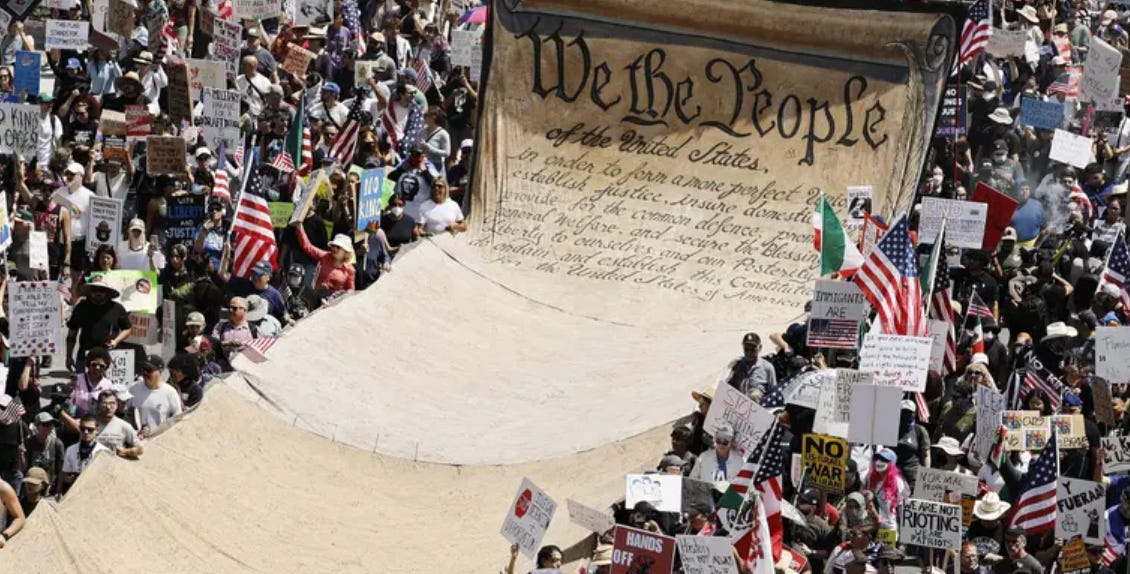
They keep telling you protests don’t work, that marching doesn’t change policy, that demonstrations “fizzle,” that nothing really happens once the crowd goes home. You hear it from cable panels, op-eds, and the same political voices who insist resistance is performative and pointless.
And yet — quietly, methodically, expensively — the state is behaving as if protest is a threat that must be contained.
Surveillance is expanding. Prosecutors are stretching charges. Legislatures are rewriting protest laws. Federal agencies are monitoring organizers. Police departments are stockpiling equipment and intelligence. Media outlets are framing every mobilization in terms of inconvenience, disruption, or decline.
Those two things cannot both be true.
If protests didn’t work, power wouldn’t be spending this much time, money, and political capital trying to neutralize them.
Want to Know Your Rights?
Download a free digital copy of the U.S. Constitution, the same document Trump is trying to bulldoze. Learn exactly what he’s breaking, and how to fight back.
100,000+ strong — and counting.
This holiday, become a paid subscriber for just $1 a week and help us keep the truth alive.
Join The Coffman Chronicle — $1/Week
The Narrative Weapon
Modern protest coverage rarely asks whether movements succeed. It asks whether they succeed fast enough.
That framing does the work of suppression without ever appearing repressive. Instead of outright outlawing protest, institutions shrink their perceived value by redefining success as an immediate policy win, a standard no democratic movement has ever met.
Civil rights didn’t “work” the week people marched in Selma. Labor didn’t “work” the first time workers walked out. Women’s suffrage didn’t “work” because one protest convinced Congress. These movements worked because sustained pressure rewrote what power could ignore. Historical evidence shows that protest movements have shaped major legislative and social changes when broad participation applies systemic pressure over time, even if immediate wins aren’t visible.
Yet today’s coverage treats protest like a viral moment. If it doesn’t produce legislation by the next news cycle, it’s labeled a failure.
That narrative isn’t neutral. It teaches people not to participate. It convinces working families that showing up is wasted effort. It creates exhaustion before repression even begins.
And that’s the point.
The Tell: Power Doesn’t Crack Down on Things That Don’t Matter
If protests were truly harmless, if they were just noise, just vibes, just people blowing off steam, the response would be indifference. That’s not what’s happening. What’s happening is escalation.
Across the country, law enforcement agencies, prosecutors, and legislatures are treating sustained protest as a strategic threat, not a nuisance. Federal agencies have expanded monitoring of activist networks under broad banners like “domestic extremism,” often sweeping in groups engaged in nonviolent civil resistance and sharing intelligence with local law enforcement. Known protest movements, such as the “No Kings” demonstrations, have attracted broad participation but still face heightened scrutiny.
At the state level, lawmakers have reworked protest laws by increasing penalties for blocking infrastructure and expanding grounds for felony charges, moves that only happen when authorities feel challenged. Prosecutors use sweeping statutes to inflate legal risk even if cases later collapse, turning prosecution itself into punishment. Patrol budgets balloon with crowd-control gear, surveillance tech, and units devoted to monitoring civic action.
Then there’s the messaging. Officials publicly dismiss protest as ineffective while privately warning of threats to order, commerce, and security. This two-track strategy — dismiss outwardly, suppress privately — is not sloppy rhetoric. It’s repression by reframing.
Protest doesn’t just occupy streets. It changes calculations. Enforcement costs, agency priorities, and political risk assessments all shift when civic pressure persists. That’s why crackdowns arrive after movements refuse to dissipate on schedule.
Why This Frame Exists (and Who It Serves)
The “protests don’t work” narrative didn’t emerge by accident. It exists because it’s useful to institutions most disrupted by sustained civic pressure.
Modern media is built around speed, spectacle, and resolution. Protests, by contrast, are slow, cumulative, and deliberately unresolved. They don’t fit neatly into 24-hour news cycles, so coverage adapts, not by tracking outcomes, but by reframing expectations. Success gets compressed into an impossible timeline where only instantaneous, headline-ready wins count.
Meanwhile, reporters depend on institutional sources, such as agencies, elected officials, and law enforcement, who are deeply uncomfortable with coverage that acknowledges protest as an effective lever of power. It implies vulnerability and invites further challenge.
There’s another function too: discouragement without repression. If people can be convinced that participation is pointless, fewer laws are needed to quell them. Cynicism becomes the mechanism of control. Headlines telling people protests are fading or “losing momentum” serve to demobilize without a single baton swing.
Scholars note that protest movements succeed when they signal broad discontent and shift elite calculations over time, mechanisms ignored by stories focused on immediate outcomes.
What Success Actually Looks Like (And Why You’re Not Supposed to See It)
Here’s the misdirection they depend on. They’ve trained the public to look for the wrong kind of win.
Success is supposed to look like a bill signing, a televised announcement, a clean before-and-after moment that fits inside a headline. When that doesn’t happen, people are told the movement failed. However, that isn’t how power actually concedes ground, and it never has been.
When protest works, it almost never announces itself. It moves quietly, defensively, and incrementally, through bureaucratic friction and political recalculation, not because officials are generous, but because acknowledging protest pressure would invite more of it.
Policies don’t get “defeated.” They get delayed. Enforcement doesn’t get canceled. Instead, it gets selective. Programs don’t get repealed, but narrowed, reinterpreted, paused, or quietly underfunded. These are concrete shifts that affect policy rollout and implementation without dramatic public moments.
None of it makes headlines. All of it changes lives.
This is why coverage rarely tracks institutional recalibrations. Doing so requires admitting protest works even when official endorsements don’t materialize. And once people internalize the idea that only televised victories count, the work of demobilization is already done.
The Kitchen-Table Consequence: Who Pays When You’re Told to Sit Down
When people are convinced that protest doesn’t work, someone benefits immediately, and it isn’t working families.
Discouragement isn’t neutral. It has a balance sheet.
When participation drops, enforcement gets easier. When resistance fades, timelines accelerate. When people stop showing up, decisions that once carried political risk become routine administrative acts. The harm doesn’t arrive all at once. It arrives quietly, efficiently, and right on schedule.
At the kitchen table, that looks like this:
Rent goes up because tenant protections stall.
Benefits disappear because rule changes proceed without pushback.
Workplace hazards go unchallenged because oversight activism wanes.
Clinics close, permits are approved, deportations proceed.
None of these requires a dramatic vote or broadcast event. They happen because sustained pressure — a political cost — has been removed.
For institutions, that’s efficiency. For households, it’s damage.
This dynamic matters because peaceful protest movements have historically produced substantive change, even if that change isn’t immediately visible. Nonviolent civil resistance campaigns have been shown to be more successful than violent ones in achieving broad outcomes because they attract larger participation and shift elite and public perceptions.
See our previous reporting here:
Note: Overtime, articles roll into our archive. Become a paid subscriber for exclusive perks including occassional early access, unique content, and full acccess to our full archive.

Working families don’t have access to boardrooms, lawyers, or capital leverage. Protest is often the only tool that raises the cost of harm high enough to make it visible to power. When people are convinced protest is futile, those costs vanish, and so does leverage.
What Sustained Participation Actually Demands
If protest works by shifting incentives over time, then understanding how it does that changes how people show up.
Large-scale peaceful mobilization — even at levels like 3.5% of a population — has historically been a tipping point, where authorities find it hard to ignore resistance and are more likely to yield concessions or slow policy implementation. This isn’t a magic number, but a useful empirical insight: sustained, widespread engagement forces elites to reassess political risk and resource allocation.
That’s why crackdowns follow persistence. That’s why media narratives downplay slow pressure. That’s why quiet institutional shifts happen outside public view.
Successful protest isn’t about dramatic wins. It’s about raising costs, expanding participation, and refusing to disappear when coverage wanes. It is strategic, cumulative, and most powerful when it shapes public expectations about what power must respond to.
This means participation isn’t failure just because it didn’t make a headline. Persistence isn’t pointless just because there wasn’t a bill signing. Pressure doesn’t dissipate simply because the cameras left.
And if you understand that — if your community understands that — then what looked like “ineffective” becomes unmistakably effective resistance.
SUPPORT INDEPENDENT MEDIA. KEEP THE PRESSURE ON
If protests didn’t work, power wouldn’t work this hard to silence them. And if independent journalism didn’t matter, it wouldn’t be ignored, sidelined, or squeezed the same way.
The Coffman Chronicle exists to do what legacy media won’t: track pressure over time, expose quiet concessions, and connect power’s behavior to the kitchen-table consequences you live with every day.
Paid subscribers make that possible. Not algorithms. Not access journalism. Not sanitized narratives that tell you to sit down and wait.
If this piece clarified something you’ve felt but haven’t seen explained, if it gave language to what you’re witnessing, consider becoming a paid subscriber.
Because pressure works, and so does supporting the media that refuses to look away.
Sources:
How Peaceful Protest by Just 3.5 Percent of Americans Could Force Major Policy Changes From the Trump Administration. August 6, 2025. Center for American Progress
The Power of Protest in the US. April 7, 2025. Brookings
The ‘3.5% Rule’: How a Small Minority Can Change the World. Harvard Kennedy School
“Why Are the Media Ignoring Growing Resistance to Trump?” June 13, 2025. The Guardian
How Effective is Protesting? According to Historians and Political Scientists: Very. December 25, 2025. The Guardian
Why Nonviolent Resistance Beats Violent Force in Effecting Social, Political Change. Harvard Gazette
Do Protests Matter? New Study Examines How Protests Bring About Change. American Sociological Association
if we continue, we win, we all win
Yes, the only purpose why those in power do this is to discourage people.