


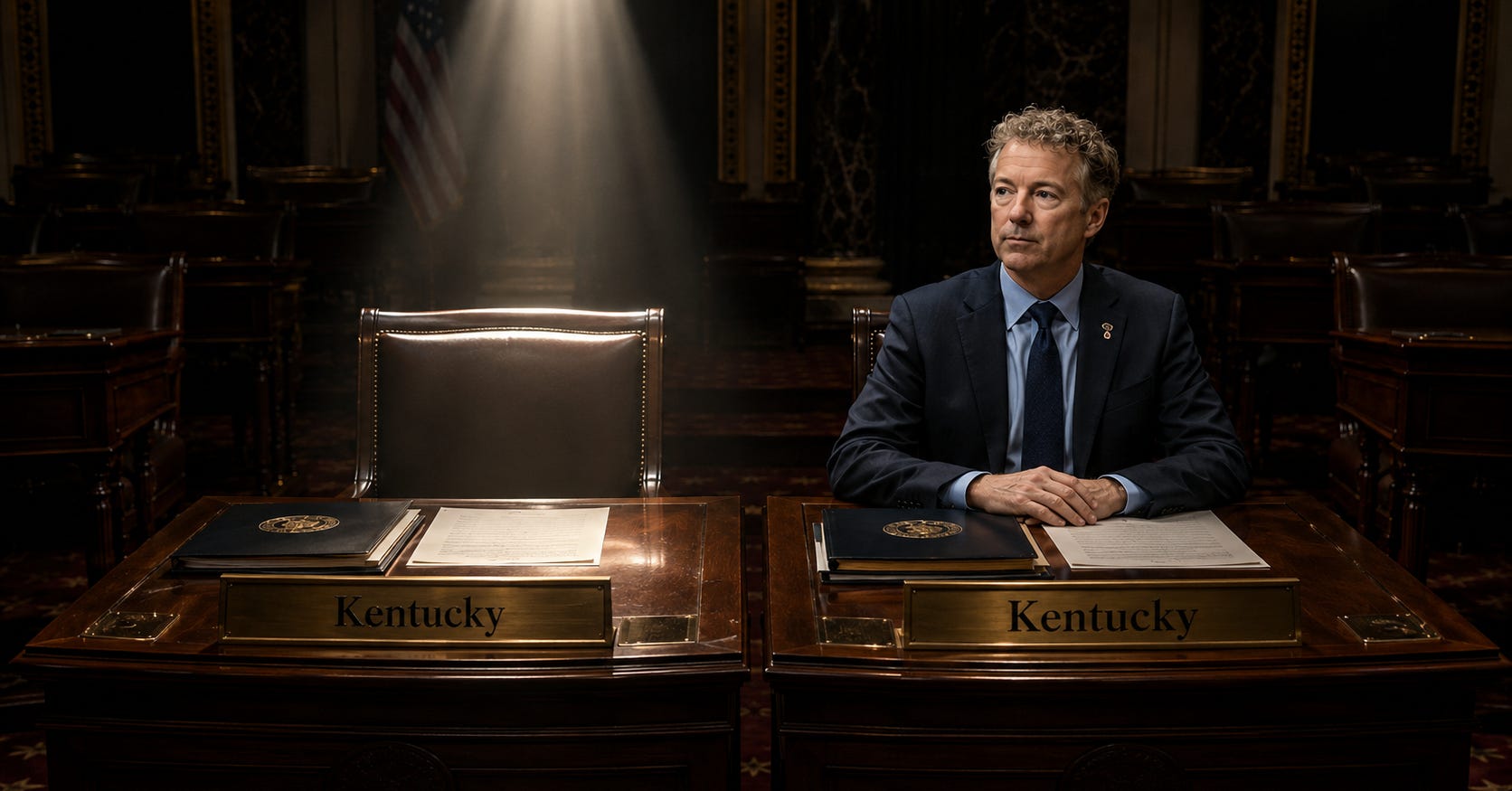
Kentucky still has Mitch McConnell’s name in the United States Senate, but that is not the same thing as representation. A Senate seat is not represented by a nameplate, nor by a staff statement, a party leader’s reassurance, or a legal technicality that says the office has not become vacant. Kentucky is represented when its senator can appear, vote, speak, answer, and serve.
That is the public question McConnell’s absence has forced into the open. This is not about whether an aging public servant deserves dignity, whether illness should become a partisan weapon, or whether the public has a right to every diagnosis, test result, hospital note, or private medical detail. However, the people of Kentucky have a right to know whether one of their two voices in the United States Senate is still functioning as their voice.
A strange thing can happen inside the American government. A seat can remain legally occupied while the people attached to that seat are left functionally unrepresented. The title stays in place. The staff keeps working. Party leaders offer calm words. The machinery avoids the word vacancy. Meanwhile, the voters wait for a public appearance, a vote, a direct explanation, or something stronger than secondhand reassurance from the people with the most incentive to manage the silence.
That is the scandal here: Kentucky may not be represented, and the system seems better prepared to protect the seat's status than the people it belongs to.
Support independent media that follows the power.
The Coffman Chronicle is built to track who holds power, who abuses it, who profits from it, and who pays the price.
Paid supporters get full Tony Michaels Podcast episodes, deeper transcript analysis, paid columns, archives, and the reporting framework behind the show.
If you believe independent media has to survive outside billionaire platforms, corporate media, and party-approved gatekeepers, become a paid supporter today.
What We Know, and What We Do Not
The facts are limited, and that is part of the problem.
Reuters reported on July 9th that McConnell remained absent from the Senate because of undisclosed health issues as the chamber prepared to return from its July 4 recess. He had not been seen publicly since mid-June, when he was taken from his Washington-area home to a hospital. His office has said he is recovering, improving, and staying engaged with Senate and Kentucky matters, but details about his condition remain withheld. Governor Andy Beshear has called on McConnell to provide an update, saying public speculation is unfair to both the senator and his constituents.
That may all be true, but it is secondhand. The people of Kentucky have not heard directly from McConnell in a way that answers the basic public question. They have not seen him appear before them, nor have they received a clear explanation of what happened, when he might return, or whether he can perform the ordinary duties of his office.
Due to that gap, Kentucky voters are being asked to trust a representation system they cannot see. A senator’s office says he is engaged, and party leaders claim he is alert. Allies may say the public should be patient. Critics may speculate. Meanwhile, online rumors fill the space where public accountability should be.
None of that is representation. It is fog around representation, and when the question is whether a state still has one of its two elected voices in the United States Senate, fog is not enough.
Privacy Is Not the Same as Silence
Mitch McConnell is entitled to human dignity, and that has to remain clear. Politics has a way of turning sickness into sport. A hospital room should not become a campaign prop, nor an aging body a punchline. A medical condition should not invite strangers to diagnose, mock, or celebrate another person’s weakness. That is not accountability. That is cruelty.
McConnell does not owe the public every private detail of his care, or voters his test results, doctor’s notes, medications, treatment plan, or the intimate facts of what his body is enduring. Public service does not erase the basic decency owed to a human being.
Yet public office is different from private life. A United States senator holds power that belongs to the people. He casts votes in their name, speaks for them in national debates, and helps decide war, spending, judges, appointments, investigations, disaster aid, farm policy, health care, and the rules that shape ordinary life far beyond Washington.
That power is not personal property. Right or wrong, public office, like celebrity status, comes with a degree of scrutiny, and for a politician, it requires some transparency about the person's ability to perform their duties.
So there is a line between medical privacy and public accountability. The public does not need McConnell’s chart, but it does need to know whether Kentucky still has a senator. Can he appear? Can he vote? Can he speak? Can he answer? Can he serve?
Those are not medical questions. They are representation questions.
Kentucky Has a Vacancy Rule, Not an Incapacity Rule
Kentucky law knows what to do with a vacancy. That is the easy case.
If a United States Senate seat becomes vacant, Kentucky law directs the governor to issue and sign a writ of election, and the winner of that special election holds office for the remainder of the unexpired term. The 2024 legislation that reshaped the process repealed the previous statute that required the governor to fill a U.S. Senate vacancy, amending KRS 118.720 to require a special election instead, according to the Kentucky Legislative Research Commission
That means Kentucky has a rule for the moment the office is formally empty. However, this situation is not that clean. McConnell has not resigned or been expelled. His seat has not been declared vacant. His name remains attached to the office, and as long as that remains true, the vacancy machinery does not fully turn on.
That is the blind spot. The law can see a vacant seat. It struggles to see an unavailable senator.
A senator can be absent from public view, miss votes, and communicate only through staff. Party leaders can offer reassurance, and the public can wonder whether one of its two voices in the Senate still exists in practice. Yet unless the seat becomes legally vacant, Kentucky voters appear to be trapped in a gray zone where the office is occupied on paper while representation may be lacking in reality.
Kentucky has a rule for a dead, resigned, or expelled senator. It does not appear to have a meaningful public rule for a senator who disappears from view while the title remains in place. The seat can still have a name. The people can still lack a voice.
The Governor Asked for an Answer. He Did Not Start a Clock.
Beshear asked the question Kentucky voters deserve to have answered. He asked McConnell to update the people of Kentucky about his health and ability to serve.
However, he did not start a clock. Beshear did not set a public deadline and say silence after that point would trigger a formal process. He did not order an examination, summon a hearing, or activate a clear legal mechanism to determine whether Kentucky still has one of its two Senate seats.
Why? Because there does not appear to be one. That is not a weakness in the letter. It is a weakness in the system.
The governor can ask. McConnell’s office can answer when it chooses, how it chooses, or not at all. Staff can keep issuing carefully shaped statements. Party leaders can keep offering secondhand reassurance. The public can keep waiting for something direct, visible, and accountable.
The Seat Can Be Occupied While Kentucky Is Underrepresented
This is the part Washington would rather reduce to procedure. The seat is not vacant. The office still exists, the staff still answers, the phones still ring, and the letterhead still carries McConnell’s name. The party still counts him as a Republican senator from Kentucky.
However, representation is not letterhead. Representation is not a voicemail system, a press aide’s sentence, or a leadership talking point. It is not the legal fiction that nothing serious has happened until the seat is formally empty.
Kentucky voters did not elect a staff operation. They did not elect Senate Republican leadership to speak for them or elect anonymous reassurances. They did not elect a private chain of updates moving from hospital room to aide to leader to reporter to public. They elected a senator.
That senator’s job is not symbolic. A senator votes, appears, questions nominees, and debates legislation. A senator helps decide whether money is spent, judges are confirmed, wars are funded, agencies are overseen, disasters receive aid, farmers get support, or working families are protected or ignored.
When that public work stops, representation is injured. The seat may be legally occupied, but that does not mean Kentucky is represented.
If McConnell can perform the duties of office, Kentucky deserves to hear that directly and credibly. If he cannot, Kentucky deserves to know that, too, not because voters own his body or because illness cancels dignity, but because the office belongs to them.
New Jersey voters recently found themselves in a similar situation when Representative Thomas Kean, Jr. was absent for several months, missing hundreds of votes. When he finally reappeared, stating that he had sought medical care for depression, voters did not begrudge him the struggle. They were frustrated that, for that time period, they had no information about why their district had no voice.
In this case, the office is even more important. States have multiple representatives in Congress. They have two Senators. Importantly, certain functions of a Senator do not take place in the House.
A Senate seat is not a private possession that can be held in silence until a party decides the timing is convenient. It is one of Kentucky’s two voices in the national government, and a voice that cannot speak for the people is not made whole by someone else saying it still exists.
The Political Handling Looks Intentional
No one is questioning whether McConnell’s illness is intentional. They are asking whether the silence around it is.
Politics does not require a conspiracy to become deliberate. Silence, timing, statements, and the absence of detail can be managed. A public office can be surrounded by enough careful language that no one quite knows what is happening, while everyone with power avoids the one question that matters. Can he serve?
That is why the political handling looks intentional. No one has proved a hidden medical truth, and every unanswered question is not proof of misconduct, but the handling serves an obvious political purpose. It keeps the seat legally occupied, delays the hard conversation, protects party leadership from an immediate succession fight, and allows staff and allies to offer reassurance without forcing a public test of whether Kentucky’s representation is real or theoretical.
A legal gray zone is never empty. If the law does not clearly say what happens when a senator becomes unavailable for a prolonged period, someone still benefits from that silence. If the public has no deadline, no standard, and no process, power does not pause politely until democracy catches up. Power occupies the gap.
A state can lose practical representation before it loses a seat. Constituents in New Jersey had no representation on the floor while Kean was out. In 2024, Texas Representative Kay Granger missed six months of floor votes before being found living in a nursing home suffering from dementia. She remained in office until her term ended, her salary and that of her staff continuing to be paid while her voters had no say. Until McConnell returns or his seat is declared vacant, his voters will also go without a voting member who can attend committee work, participate in floor debates, or act as their official voice. That is not representation. That is control of the placeholder.
The seat remains useful for headcounts, messaging, timing, and avoiding a succession fight before the party is ready. That is the danger of concentrated power. It turns public offices into assets to be managed instead of trusts to be served. It teaches parties to think first about control, optics, and advantage. The people come later, after the strategy has already been protected.
Privacy protects the person. Silence protects the power.
The Kitchen-Table Test
Now take this out of Washington. Imagine a nurse missing weeks of shifts while a hospital tells patients, “Trust us, she is engaged.” Imagine a truck driver taken off the road while the company tells regulators, “Trust us, he is improving.” Imagine a teacher absent from the classroom while the district tells parents, “Trust us, she is working with staff.” Imagine a warehouse worker gone for days while management tells co-workers, “Trust us, he is still part of the team.”
Working people know what happens next. There are forms, deadlines, doctor's notes, return-to-work slips, attendance points, disability reviews, insurance paperwork, human resources calls, and supervisors asking when the person can return and whether the job can still be done.
Sometimes those rules are necessary. Often they are cold. Yet they exist because the work has consequences for other people. Patients need care. Children need teachers. Roads need safe drivers. Orders need to be filled. Families need paychecks. Public responsibilities do not vanish because someone else says the person is “engaged.”
That standard cannot disappear when the job is one of the most powerful public offices in the country. The powerful get privacy wrapped around authority. Working people get paperwork wrapped around survival.
That is the kitchen-table injury. The people who live under the rules are often forced to prove everything. The people who write the rules can sometimes disappear behind title, staff, party, and silence.
McConnell deserves dignity as a person. Kentucky deserves representation as a state. Those two truths can coexist. In a decent republic, they have to.
What Accountability Should Look Like
Accountability does not require cruelty. It does not require the publication of medical records, the turning of a senator’s hospital room into a public hearing, or the pretending that every temporary illness is a constitutional crisis.
A republic can protect medical privacy and still protect representation. The question should be narrow: can the senator perform the basic duties of office? Can he appear when the Senate is in session? Can he vote? Can he participate in committee work? Can he communicate directly with constituents in some credible public way? Can he make decisions in the office he was elected to hold?
The public does not need a diagnosis to answer those questions. It needs a process.
One possible standard would be simple: after thirty days of missed public Senate work, a senator should provide either a direct public capacity statement or an official certification that the senator remains able to perform the duties of office. That statement would not need to disclose a diagnosis, publish medical records, or expose private treatment.
It would answer the public question: Can this elected official still do the job?
That kind of process could protect private medical facts while still requiring a clear public capacity-to-serve answer after an extended absence. It could require direct communication from the senator when possible, or a formal certification through an official channel when direct communication is not possible. It could establish a timeline so voters are not left waiting indefinitely while staff and party leaders manage the message.
A Senate seat belongs to the public before it belongs to any person, and if public office is stewardship, then the first duty of stewardship is not to make the people guess whether their voice still exists.
A Senator, Not a Statement
The people of Kentucky are not asking to own Mitch McConnell’s medical records. They are asking whether one of their two voices in the United States Senate still exists in practice.
That is not a cruel question. It is not even a partisan question. It is not a demand for gossip, punishment, or humiliation. It is the minimum question citizens are allowed to ask in a republic: Can the person elected to represent us still represent us?
If the answer is yes, Kentuckians deserve to hear it in a direct and credible way. If the answer is no, Kentuckians deserve more than silence, staff statements, and party management.
The seat does not belong to McConnell’s office, to Senate Republican leadership, to the governor, or to whichever party thinks it can benefit from waiting, delaying, or controlling the timing of the truth. It belongs to Kentucky.
Public office is not possession. It is stewardship. The title is not the representation. The staff is not the senator. The party is not the people.
This is what underrepresentation looks like when power wears a suit, hires staff, and keeps the title. A Senate seat belongs to the voters before it belongs to the person who holds it.
McConnell deserves dignity. Kentucky deserves representation. And no system worthy of a republic should force the public to choose between the two. The seat may be legally occupied. That does not mean Kentucky is represented. Kentucky deserves a senator, not a statement.
Support Independent Media
If Kentucky deserves a senator, not a statement, then every state deserves the same standard.
Public office is stewardship. Representation should not disappear behind staff updates, party management, or legal gray zones.
If this work helps you think more clearly about power, accountability, and who government is supposed to serve, please share it. And if you can afford it, consider becoming a paid subscriber so Coffman Chronicle can keep doing this work.
Sources:
Barrow, Bill. “Kentucky Gov. Andy Beshear Asks Sen. Mitch McConnell to Give a Public Update on His Condition.” AP News, July 8, 2026.
Beshear, Andy. “Letter to Senator Mitch McConnell.” Office of the Governor, Commonwealth of Kentucky, July 8, 2026.
Kentucky Legislative Research Commission. “House Bill 622, 2024 Regular Session.” Last updated September 26, 2024.
Kentucky Legislative Research Commission. “KRS 118.720: Proclamation for Special Election for Congressional Representative or United States Senator—Winner of Special Election to Hold Office for Remainder of Unexpired Term.” Effective April 12, 2024.
Morgan, David. “Mitch McConnell’s Health Absence a Mystery with US Senate Poised to Return.” Reuters, July 9, 2026.
Office of the Governor, Commonwealth of Kentucky. “Gov. Beshear Requests Update on Health of Sen. McConnell.” Kentucky.gov, July 8, 2026.
I have a feeling that his often nasty demeanor is not missed, but taxpayers are paying the salary of a MIA Senator, so they do deserve timely and accurate follow-up about his absence!
The same was true when Senator Dianne Feinstein was absent.