


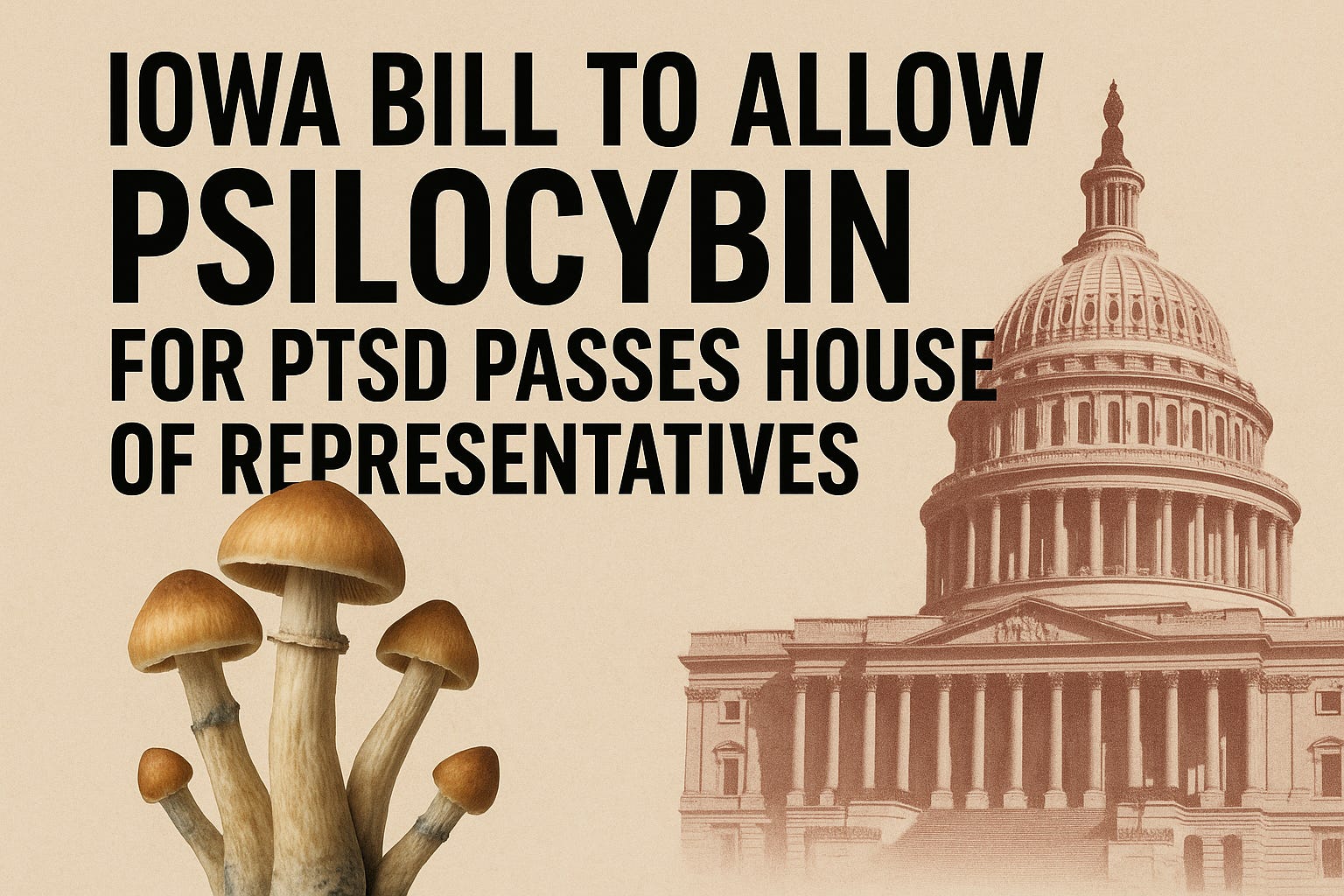
Iowa did something almost unthinkable in a political climate defined by dysfunction—it came together. In April 2025, the Iowa House of Representatives voted 84 to 6 in favor of legalizing psilocybin therapy for PTSD, particularly aimed at helping veterans. This wasn’t a fringe proposal. It passed with overwhelming bipartisan support. The message was clear: America is ready to try something new.
This isn’t just an Iowa story. Across the country, red and blue states are moving to recognize what science and suffering have made increasingly impossible to ignore: psychedelics like psilocybin may offer hope where traditional treatments have failed. With suicide rates spiking and opioid deaths still surging, there’s real urgency to rethink mental health care.
Even Donald Trump, newly re-elected and back in the Oval Office, has signaled openness to this shift. He’s repeatedly called for mental health reform, has championed veteran care, and supported exploring nontraditional therapies. His appointment of Robert F. Kennedy Jr. as Secretary of Health and Human Services sent shockwaves through both parties, framed as a bold move to shake up the system.
But behind the headlines, another story is playing out, one that threatens to sabotage this movement before it even starts.
Independent News. Just $1/Week.
We just hit 12,000 subscribers—thank you! We’re offering full access to The Coffman Chronicle for just $1 a week ($52/year) to celebrate.
Get exclusive analysis and fearless reporting you won’t find in corporate media.
Support truth. Stay informed.
The Rising Wave
Iowa’s landslide vote is part of a broader, bipartisan awakening to the promise of psychedelic-assisted therapy. In 2020, Oregon made history by legalizing psilocybin for supervised therapeutic use. Since then, Colorado and New Mexico have followed suit, with other states—like Massachusetts, Illinois, and Texas—considering legislation or pilot programs.
The U.S. Department of Veterans Affairs is funding clinical trials to explore psilocybin’s potential for treating PTSD, depression, and substance use disorders. The Food and Drug Administration (FDA) has granted psilocybin a “Breakthrough Therapy” designation, indicating that the compound shows serious promise.
Seattle, Denver, Detroit, and Washington, D.C. have decriminalized psilocybin. Public support is growing fast, especially among veterans, first responders, and patients who’ve cycled through ineffective antidepressants and mood stabilizers.
Veterans are dying by suicide at a rate of nearly 17 per day, according to VA data. Countless Americans suffer from treatment-resistant depression. And families devastated by the opioid crisis are desperate for alternatives.
In that context, psilocybin represents more than a new medicine. It represents a new kind of hope, a way forward that fuses scientific innovation with a moral imperative to do better.
Take James McAlister, a 38-year-old Marine Corps veteran who participated in a psilocybin trial in Colorado. After struggling for years with PTSD, hypervigilance, and suicidal ideation, James says the experience “reset something in [his] brain” that no other treatment had touched. “I did more healing in one session than in five years of therapy,” he told a local outlet. “For the first time, I felt like life was worth showing up for.”
Dr. Petros D. Petridis, a clinical assistant professor at NYU Grossman School of Medicine, emphasized that McAlister’s story isn’t unique:
“Our findings suggest that the mental health benefits of psilocybin therapy for cancer patients may reach far beyond what we have previously understood.”
We need more than state laws and public enthusiasm to realize that promise. We need a federal government prepared to fund, regulate, and implement this treatment responsibly.
The administation’s record on health is problematic. See some of our reporting here:

Trump’s Promises and Appointments
On the surface, the Trump administration appears to support the psychedelic renaissance. The president has repeatedly called for new solutions to the mental health crisis, especially among veterans. He’s framed himself as a disruptor, willing to break through government red tape to deliver relief where the “corrupt establishment” has failed. In campaign speeches, Trump has name-dropped psilocybin and MDMA as “promising treatments.”
Then came his most attention-grabbing appointment: naming Robert F. Kennedy Jr. Secretary of Health and Human Services. The decision stunned both parties. Trump, the Republican standard-bearer, had just installed a lifelong Democrat and one-time presidential rival in a critical cabinet post.
To many voters, it looked like a gesture of unity, or at least proof that Trump was serious about shaking up the health bureaucracy. After all, Kennedy had long railed against pharmaceutical overreach, vaccine mandates, and government censorship. His anti-establishment reputation made him a natural fit for Trump’s “drain the swamp” theater.
Make no mistake: Trump’s picks for health care leadership are problematic. See our reporting here:
Note: This article is over 45 days old and now lives in our archive. Consider becoming a paid subscriber for the full 450+ article archive, exclusive reporting, and occasional early access.


However, it didn’t take long for Kennedy’s views to collide with the administration’s stated goals.
As HHS Secretary, RFK Jr. has promoted a vision of mental health care that minimizes or rejects pharmaceutical intervention. He’s stated that mental illness is best treated through diet, exercise, and lifestyle changes, not medication. He has even suggested that antidepressants are more addictive than heroin, a claim widely condemned by mental health experts.
Sean Leonard, a psychiatric nurse practitioner specializing in addiction medicine, pushed back:
“SSRIs are not addictive in the way substances like heroin are. They don't produce cravings or compulsive use, and withdrawal symptoms are generally mild and manageable.”
In a striking example of this philosophy, Kennedy has proposed taxpayer-funded “wellness farms”, rural retreats where individuals struggling with addiction or dependence on psychiatric medications would detox and heal through organic farming and immersion in nature. He has suggested funding them through tax revenue from federally legalized marijuana. While Kennedy portrays these farms as humane alternatives to traditional clinical care, critics argue they exclude evidence-based treatment and raise ethical concerns about feasibility and oversight, especially for vulnerable populations.
This ideology doesn’t just sideline psychiatry; it actively undermines the scientific infrastructure needed to support psychedelic therapy. For psilocybin to become a real option, it must undergo rigorous trials, clinical rollouts, and long-term data monitoring. All of which depend on the very institutions Kennedy—and Trump’s budget—are working to dismantle.
The Sabotage
While Trump and his allies talk up psilocybin therapy as a bold, breakthrough solution, their actual policies tell a much darker story. Behind the speeches and symbolic appointments, the administration is gutting the very infrastructure required to bring psychedelic treatments safely to the people who need them most.
In March 2025, the Department of Health and Human Services announced a massive internal restructuring. Nearly 10,000 employees were laid off, and the agency’s 28 subdivisions were slashed to just 15. This reorganization eliminated or defunded key programs related to addiction services, community health centers, mental health grants, and public research coordination.
Then came the blow to the National Institutes of Health (NIH). In the 2025 budget, the Trump administration proposed a 40% cut to NIH. These aren’t hypothetical numbers; over 800 research projects have already been canceled. Indirect cost coverage—essential for supporting trial infrastructure—has been slashed to 15%, down from nearly 30%.
That means studies on PTSD, treatment-resistant depression, and addiction may not just be delayed; they may never happen at all.
Even the Department of Veterans Affairs, one of the only federal bodies supporting psilocybin therapy, is increasingly isolated, dependent on waivers or private donors rather than systemic federal backing.
Why This Matters
This isn’t an academic debate. It’s a life-or-death matter for veterans, trauma survivors, and anyone who’s been let down by the broken mental health system.
Without federal support, psilocybin therapy will remain the privilege of the wealthy and well-connected. Veterans relying on the VA? Working-class families in rural Iowa? They’ll be left behind.
Without oversight and structure, the entire movement risks collapsing under its own hype. We could lose the chance to turn this into real medicine, replaced instead by wellness fads, unregulated clinics, or moral panic when something goes wrong.
The irony is unbearable: the very administration that claims to champion these therapies is undermining their future.
The Bigger Pattern
This is bigger than psilocybin. It’s the same playbook we’ve seen again and again:
Promise the revolution. Deliver the wrecking ball.
Trump talks about breaking through corruption. But instead of rebuilding the system, he guts it. He promised better healthcare, but slashed protections. He touted support for science, then defunded research. And now, he’s applauding psilocybin while pulling the plug on the public institutions that make it viable.
It’s not incompetence. It’s strategic sabotage.
Call to Action
If we want psilocybin to fulfill its promise, we need more than photo ops and talking points.
We need to:
Restore NIH and HHS funding
Demand accountability from RFK Jr. and the agencies he oversees
Push Congress to protect public research and access
Ensure these therapies are safe, regulated, and available to everyone, not just the elite
Hope alone isn’t enough. Science alone isn’t enough. We need a system that delivers both to survive.
Now is the time to speak up. Now is the time to act.
We just hit 12,000 subscribers—thank you! We’re offering full access to The Coffman Chronicle for just $1 a week ($52/year) to celebrate.
Get exclusive analysis and fearless reporting you won’t find in corporate media.
Bibliography
NYU Langone Health. “Psychedelic Drug Therapy May Address Mental Health Concerns in People with Cancer, Addiction.” NYU Langone Health, 2023.
USA Today. “RFK Jr. Wrong on SSRIs, Heroin, School Shooters: Experts Counter Claims.” USA Today, January 30, 2025.
Washington Post. “Major Cuts Are Set to Hit HHS. Here's What's Affected.” Washington Post, March 27, 2025.
Foley & Lardner LLP. “New Mexico Becomes Third State to Legalize Access to Psilocybin.” Foley.com, April 2025.
Marijuana Moment. “Trump Administration Will Take 'Bold Stance' On Psychedelics Access For Veterans, Former Top VA Official Predicts.” Marijuana Moment, April 22, 2025.
Texas Tribune. “Texas Lawmakers Back Psychedelics Research for Veterans.” Texas Tribune, December 14, 2023.
New York Post. “RFK Jr. Proposed Taxpayer-Funded ‘Wellness Farms’ to Deal with Opioid Addiction.” NY Post, January 26, 2025.
The Cut. “RFK Jr.’s ‘Wellness Farms’ Vision Is as Wild as You Think.” The Cut, 2025.
Supporting psychedelics seems like an outrageous mistake for a fascist to make, but, so much the better for the rest of us.
With Trump, we should never assume that incompetence and deliberate intent are mutually exclusive. He is obviously incapable of rational thought or analysis on many issues, so he just substitutes his own prejudices and ideology as the basis for those decisions. He is indifferent to the affects of those decisions on real
people (primarily, all of us who aren’t billionaires or his toadies).