


On paper, it’s just logistics.
Thousands of National Guard troops have been activated across 19 Republican-led states, tasked with assisting the Department of Homeland Security and Immigration and Customs Enforcement. Officially, their role is limited to administrative support, such as processing paperwork, handling data, and transporting detainees. They aren’t patrolling streets. They aren’t knocking on doors. They aren’t arresting anyone.
Not yet.
But just beneath the surface of this seemingly innocuous mobilization lies a framework with the potential to expand rapidly and dangerously. What’s being sold as a targeted law-and-order operation could, with the stroke of a governor’s pen, evolve into a sprawling enforcement regime, one that doesn’t just threaten civil liberties but risks igniting cultural conflict and armed resistance in the very communities that helped elect the president behind it.
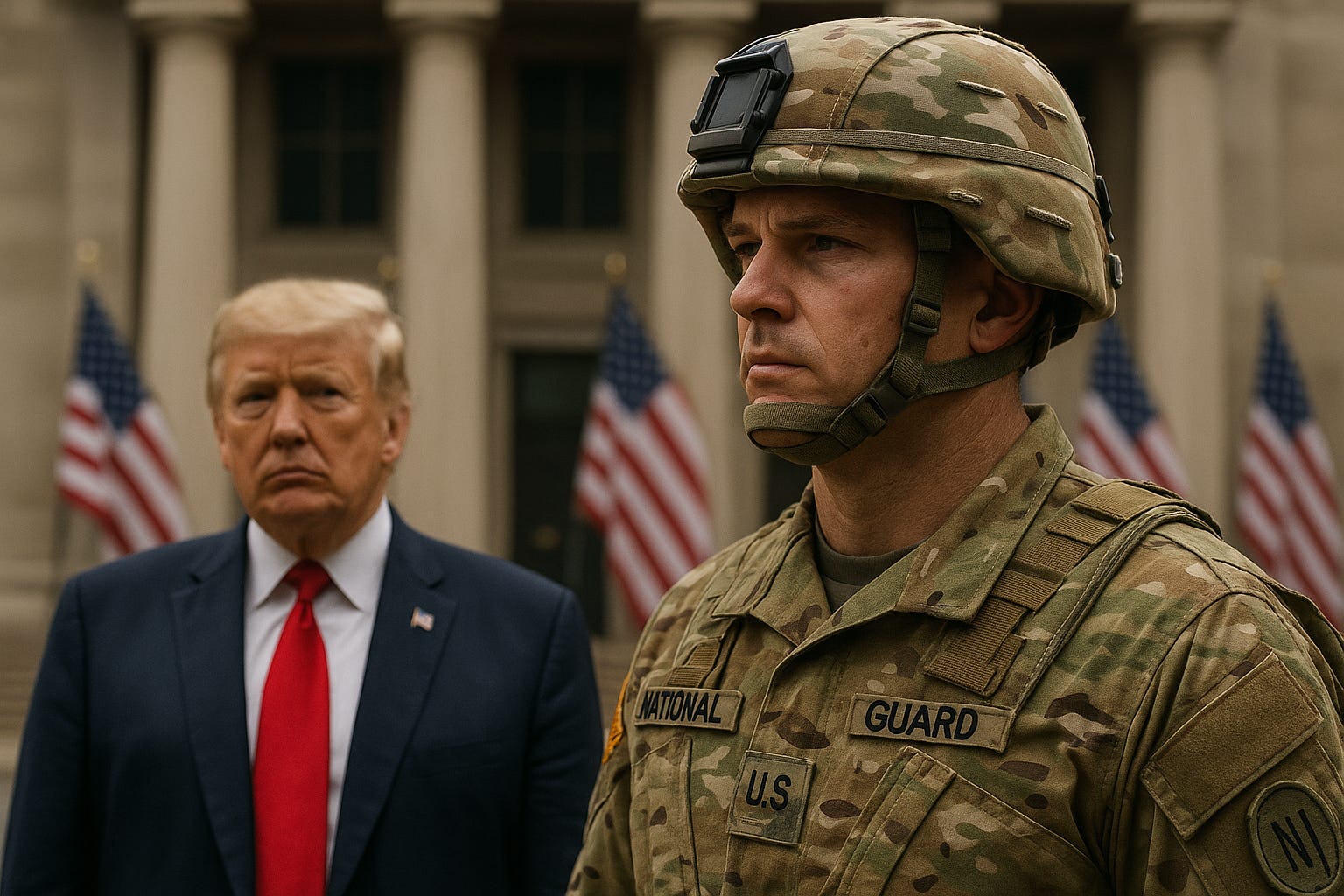
AI Generated
Stay Informed. Stay Loud.
Subscribe to The Coffman Chronicle for no-BS political analysis, action guides, and daily truth bombs you won’t get from corporate media.
The Legal Framework That Enables Escalation
These deployments operate under Title 32 of the U.S. Code, a legal mechanism that places National Guard troops under the command of their state governors while allowing the federal government to foot the bill. It’s a neat workaround, one that provides the appearance of local control and state sovereignty while quietly creating the conditions for unchecked federal power.
Under this authority, governors don’t need permission from Congress or the Department of Defense to shift the mission. If a governor in Texas or Georgia or Florida decides tomorrow that the Guard should stop processing paperwork and start assisting in field operations, there’s nothing legally stopping them— no legislative hearing, no public vote, and no meaningful oversight.
They can expand the mission from logistics to patrols. From clerical work to joint raids. From data processing to boots on the ground in immigrant neighborhoods, protest zones, and beyond.
And in a political environment where escalation is often rewarded, that shift feels not just possible, but likely.
This deployment isn’t happening in isolation. As we examined in our earlier article, "Leaked Pentagon Plan: Reaction Force for Civil Unrest", the federal government has been laying the groundwork for a more permanent, militarized domestic presence. These 19-state Guard mobilizations could serve as the quiet implementation of that broader strategy.
See our article about the reaction force model here:

How We’ll Know It’s Happening
The signs of escalation won’t necessarily arrive with a press conference or a headline. They’ll show up in local stories, social media posts, and word-of-mouth accounts. This may look like troops appearing at routine traffic stops, a National Guard vehicle idling near a community center, guardsmen in uniform providing "support" during an ICE operation, or a protest encircled not just by police, but by soldiers with rifles.
These moments will mark the transition from bureaucracy to enforcement and from public safety to state power.
And when it begins, the impact will not be evenly distributed.
Cultural Misunderstanding as Grounds for Detainment
Many of the states involved in these deployments contain culturally distinct communities that are often misunderstood, even by fellow residents. In Texas Hill Country, for instance, there are German-speaking Mennonite and Brethren communities that still use dialects foreign to outsiders. In Ohio and Indiana, Amish towns operate on their own quiet terms, often without driver’s licenses or state IDs. In East Tennessee, Appalachian English can be so thick that even locals from nearby counties have trouble understanding it.
In Louisiana, Cajun and Creole speakers still preserve linguistic traditions that sound foreign to untrained ears. In parts of New Mexico, descendants of Spanish land grants speak a form of Spanish rooted in centuries-old dialects. Across the Dakotas and the Southwest, Native communities speak in their own Indigenous tongues.
To a National Guard member unfamiliar with these communities — someone deployed from another part of the state, trained for logistics but suddenly thrust into a support role for enforcement — these differences may be misinterpreted as resistance, as non-cooperation, or as evidence of undocumented status.
In that split-second misjudgment, a citizen becomes a suspect. A cultural artifact becomes a red flag. And the cycle of misunderstanding feeds into detention, fear, and silence.
Red America Isn’t Just Cultural. It’s Armed
This deployment also enters dangerous terrain because many of the same red states involved are among the most heavily armed in the country. They’re home to not just gun owners, but to organized militia groups, sovereign citizen movements, and white nationalist enclaves. These factions, though often politically aligned with Trump, are ideologically committed to resisting what they perceive as government overreach, even when it comes from someone they voted for.
The irony is sharp. Trump’s administration may believe it’s enforcing order in blue cities and border towns, but by sending state-controlled troops into rural areas, it may instead provoke backlash from the very people who pride themselves on resisting centralized control.
One mistaken arrest — a man with the wrong name, the wrong accent, or no ID — could be the spark that ignites a local standoff. One ICE raid that sweeps up a white, rural contractor who hires undocumented workers could turn a pro-Trump county into an armed encampment of outraged voters. The myth of “they’re only coming for the bad ones” would be shattered.
MAGA, Militias, and White Nationalists Aren’t the Same, But They Can All Explode
It’s critical to understand that not all Trump-aligned factions are the same. MAGA supporters tend to center their loyalty around Trump personally. They’re generally pro-police, pro-military, and supportive of National Guard deployments until something happens that touches their family, their church, or their neighborhood.
Militia groups, on the other hand, are fiercely anti-federal. Their allegiance is to guns, land, and what they see as constitutional liberty — not to any one president. These groups have historically resisted even Republican administrations if they perceived them as infringing on their rights.
White nationalist groups occupy their own corner of the ecosystem. While many see Trump as useful, their primary loyalty is to racial purity and anti-immigrant ideology. They’ll support enforcement if it targets non-white communities. But if that power sweeps up a German-speaking rancher or a Slavic-descended farmworker with the wrong last name? Their support can vanish in an instant.
All three groups are volatile. All are armed. And all are operating in states where National Guard troops are now being deployed — not to fight wildfires or rebuild after floods, but to support domestic enforcement operations.
Even Racists Have Grandchildren
There’s another truth that lingers quietly in the background: even those most hardened in their beliefs have people they love who don’t fit neatly into ideological categories.
The racist uncle who ranted about “illegals” at Thanksgiving might have a daughter who married a Mexican national. Their grandchildren — beautiful, bilingual, with indigenous features and a non-Anglo last name — are growing up in towns where ICE raids and Guard deployments are becoming more common. What happens when one of those grandchildren is mistakenly detained during a sweep?
What happens when “they” is suddenly “us”?
That moment — when ideology collides with lived experience — is where belief begins to break down. And it’s in those ruptures that real danger, and real change, can take root.
The Calm Before the Storm?
For now, the deployments remain administrative. Quiet. Contained.
But the legal structure, the cultural misunderstandings, the armed tensions, and the lack of oversight all point toward a scenario that could escalate rapidly and violently.
If the Guard stays in back offices and motorpools, we may look back on this as a blip in the timeline. But if governors escalate their missions, if communities begin to feel the weight of military presence in their daily lives, and if even one town experiences a flashpoint moment, then this won’t be remembered as an isolated deployment.
It will be remembered as a test run.
And red America may soon realize that the crackdown they cheered is one they were never truly exempt from.
Stay Informed. Stay Loud.
Subscribe to The Coffman Chronicle for no-BS political analysis, action guides, and daily truth bombs you won’t get from corporate media.
Sources:
“National Guard mobilizing in 19 states amid immigration, crime crackdown” – Fox News
“Can Trump send the National Guard to cities around the US?” – Reuters
“One Week of Trump’s DC Takeover Attempt” – Brennan Center for Justice
“Hegseth authorizes National Guard to carry weapons in D.C. deployment” – The Washington Post
“Trump mobilizing up to 1,700 National Guardsman in 19 states to widen crime and immigration crackdown” – The Independent
“Deployment of the U.S. Military for Immigration Enforcement” – Just Security
“3 more GOP governors authorize deployment of National Guard troops as part of Trump show of force” – AP News
“US judge hears if Trump team broke law during LA ICE protests” – The Guardian
“Pentagon plan would create military 'reaction force' for civil unrest” – The Washington Post

Taking dangerous baby steps towards total military control.. horrific and must be stopped NOW!!!!
This is disgusting and I agree with Ellen that it’s dangerous! The red states could turn on the Trump-Project 2025 government 🤗 in physical ways. I love that!! Be here in California I’m doing something to fight for a more perfect Union!!