


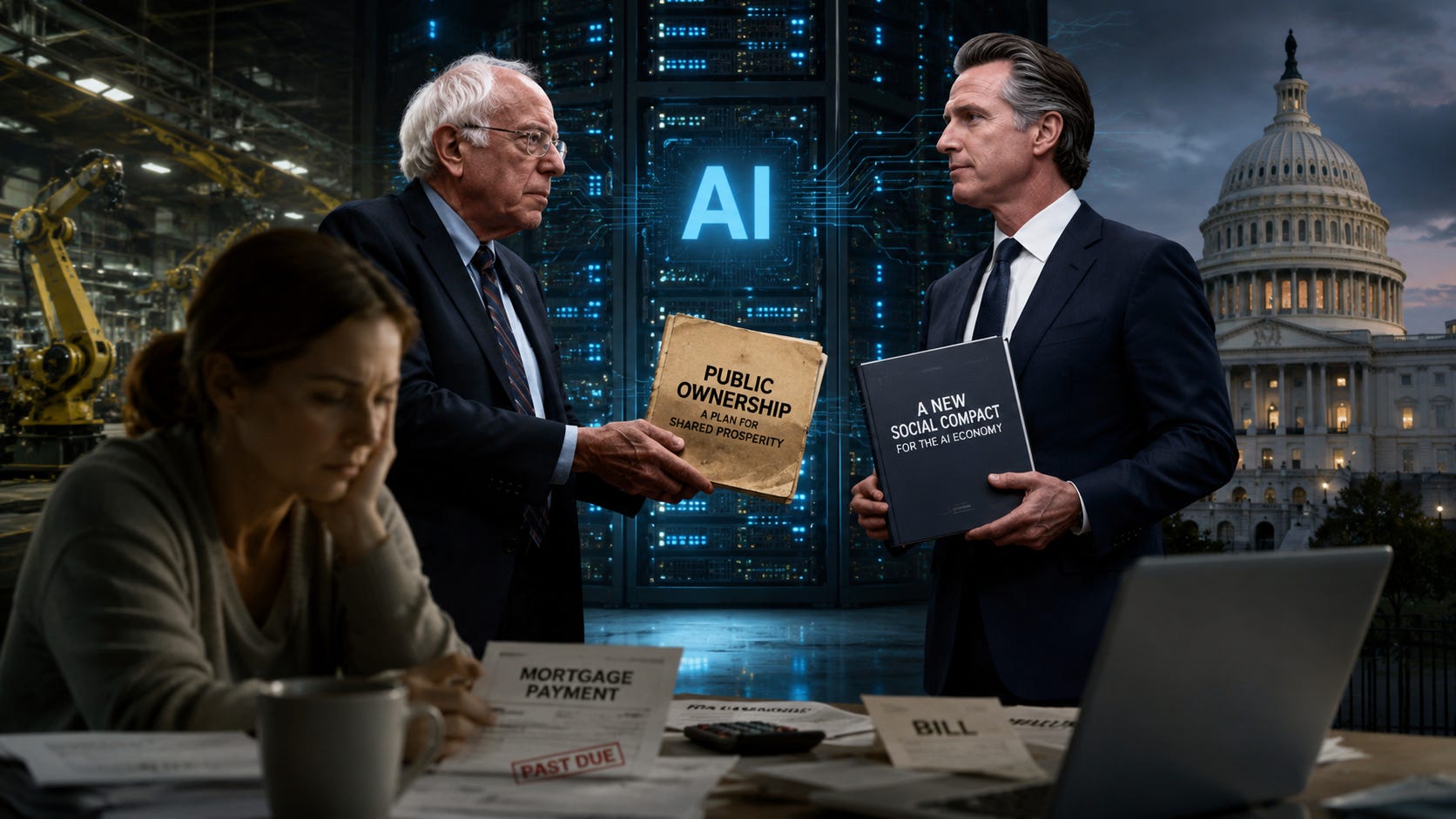
The Worker Does Not Need Washington to Own the Company Replacing Her
Imagine a paralegal sitting at her kitchen table after work, reading that the firm where she has spent fifteen years is preparing to use artificial intelligence to perform more of the research, document review, and drafting that once required a full staff.
She does not know whether her job will disappear next month or shrink over the next three years. She does know the mortgage will still be due, her health insurance is tied to the job, and her retirement account cannot replace another decade of wages.
Now imagine Washington telling her it has a plan: the federal government might acquire shares in the companies building the technology that could replace her.
That is not protection. She does not need Washington to profit if the company eliminating her job becomes more valuable. She needs Congress to decide who bears the cost when technological progress destroys a paycheck, weakens bargaining power, or hollows out a community.
Gavin Newsom’s new proposal matters because it shows that the Democratic establishment has accepted the populist diagnosis. Billionaire wealth is concentrating. The tax code treats wages and appreciating assets differently. Artificial intelligence could widen the divide between those who own the technology and those whose work it disrupts.
However, accepting the diagnosis is not the same as choosing the right cure.
The public deserves the benefits of AI prosperity. That does not mean Washington should become a shareholder in the machine.
Support independent media that follows the power.
The Coffman Chronicle is built to track who holds power, who abuses it, who profits from it, and who pays the price.
Paid supporters get full Tony Michaels Podcast episodes, deeper transcript analysis, paid columns, archives, and the reporting framework behind the show.
If you believe independent media has to survive outside billionaire platforms, corporate media, and party-approved gatekeepers, become a paid supporter today.
Newsom Is Translating Bernie, Not Rejecting Him
Bernie Sanders has proposed giving the public 50% ownership of the country’s largest AI companies through a federal sovereign wealth fund. Newsom’s proposal is less defined and more carefully branded. He calls for a national public-equity fund that would take a “major stake” in the AI economy, alongside a federal minimum tax on people worth more than $100 million and changes aimed at billionaire tax advantages.
Those are not identical plans, but they grow from the same public-ownership instinct. AI is creating enormous wealth, and public institutions helped make that wealth possible. Workers may carry much of the disruption. Therefore, the government should obtain an ownership stake on behalf of the public.
Newsom is not moving away from Sanders’s economic diagnosis. He is translating it into language designed to fit more comfortably inside the Democratic establishment. Put more bluntly, he is laundering the public stakeholder instinct through establishment language.
That does not make the proposal meaningless or insincere. It makes it politically revealing. An idea the center once would have dismissed as too far left is now being repackaged as a national economic agenda because the center can no longer defend the conditions that produced it.
The realignment is not that Bernie finally became acceptable to the center, but rather that the center can no longer defend the economy Bernie was condemning.
The Old Economic Story Is No Longer Defensible
For decades, Americans were told that concentrated investment would eventually produce broadly shared prosperity. Let corporations grow large enough. Let financiers accumulate enough capital. Let technology move quickly. The resulting innovation, productivity, and wealth would supposedly spread outward through better jobs, higher wages, cheaper goods, and new opportunities.
Workers who lost one kind of job would move into another. Communities left behind by one industry would attract the next. The government’s role was largely to encourage growth and help people adjust after the decisions had already been made.
That was the promise. The lived economy delivered something else.
Workers watched corporate valuations rise while housing, healthcare, childcare, education, and retirement grew further out of reach. Productivity increased, but bargaining power weakened. New industries created extraordinary fortunes, while many of the people whose labor and communities made those fortunes possible were left with insecure work, disappearing benefits, and lectures about adapting to change.
Artificial intelligence could sharpen those contradictions. AI may produce useful tools, medical advances, scientific discoveries, and new forms of work. The Square New Deal does not require pretending innovation is evil, but innovation does not determine distribution.
A technology can create enormous national wealth while directing most of the ownership and bargaining power toward a small number of firms and investors. It can make some workers more productive while making others easier to replace. It can reduce the cost of performing a task without lowering the cost of housing, medicine, childcare, or retirement for the person whose job disappeared.
Nor does this wealth emerge from a vacuum. The AI economy rests upon public research, educated workers, energy grids, communications networks, courts, intellectual-property law, government procurement, defense investment, and the stability of the republic.
Private companies may build the products and take real risks, but they build upon foundations that the public financed and generations of workers maintained.
Newsom deserves credit for admitting that private growth alone will not guarantee public prosperity. However, the establishment did not suddenly discover economic concentration. Instead, it discovered that concentration had become politically impossible to explain away.
They Are Right About the Diagnosis
Newsom and Sanders are right that an economy can produce staggering private fortunes without providing security for the people who support it. They are correct that AI could accelerate that imbalance. They are right that the federal government cannot stand aside while gains rise and costs fall. They are also right that the tax code does not treat wages and accumulated wealth with equal urgency.
A worker receives a paycheck, sees taxes withheld immediately, and lives on what remains. A billionaire whose fortune is held largely in appreciating assets can grow substantially wealthier without receiving anything resembling an ordinary paycheck. Some also borrow against those assets, delay taxable events, and use inheritance or estate rules unavailable to people who depend on wages.
The problem is not that every wealthy person has broken the law. The law treats accumulated wealth and earned income as though they belong to different economic worlds.
Newsom is also right that a national problem requires national law. He opposes California’s one-time billionaire tax in part because wealthy residents can move, and he argues that a federal minimum tax would be harder to escape by crossing a state line. Whatever one thinks of his fight against the California measure, the scale argument is sound. Dominant AI firms operate through national markets, federal contracts, interstate infrastructure, and a federal tax code.
Congress is the proper venue. The American people have a legitimate claim on how that wealth is taxed and how that power is governed, but a public claim does not require a government stock certificate.
AI companies do not owe America equity. They owe America stewardship.
When the Regulator Becomes a Shareholder
A public equity fund sounds democratic because its shares are described as belonging to everyone. However, “the public” cannot vote corporate shares, negotiate acquisitions, or decide when an investment should be sold. Government institutions would have to do those things on the public’s behalf. Someone in Washington would decide which companies qualify, how much equity the public receives, how those shares are valued, and what powers come with ownership.
That would make Washington more than a regulator. It would make Washington an investor. The government already writes the rules, awards contracts, enforces antitrust law, protects workers and privacy, blocks mergers, and penalizes misconduct. Once it owns shares in the same companies, those duties become entangled with a financial interest.
Suppose an AI firm grows so dominant that antitrust officials believe it should be broken apart. What happens if that company also represents a large share of the public fund’s value?
Suppose stronger worker protections, privacy restrictions, or energy requirements reduce profits. Will officials act only as the public’s referee, or will they begin calculating what enforcement could cost the portfolio?
The conflict would exist even if every official were honest. A fund manager would be expected to preserve value. A regulator would be expected to restrain power. A better board or a cleaner audit cannot erase that contradiction.
Government ownership could also turn dominant firms into state-favored incumbents. The larger they became, the more valuable the public stake might become. The more competitors they absorbed, the stronger the portfolio could appear. Washington could become financially invested in the same consolidation it is supposed to prevent.
Corporate concentration is dangerous, and concentrated government power can be dangerous too. Merging them does not democratize power. It gives each concentration a reason to protect the other.
When the regulator becomes a shareholder, the public interest begins competing with the government’s own portfolio. The Square New Deal does not address corporate oligarchy by making the state a partner in it.
The Square New Deal Alternative: Constitutional Stewardship
Rejecting government ownership does not mean leaving AI companies free to govern themselves. Private companies may own artificial intelligence, but the American people must own the rules. That is constitutional stewardship.
The larger a company’s power over workers, infrastructure, information, and public life, the greater its obligations to the republic that made that power possible. Those obligations do not require Washington to hold shares. They require Congress to write enforceable law.
A dominant AI company should not be allowed to rely on public research, federal contracts, national infrastructure, educated labor, energy systems, courts, and legal privileges while treating every resulting gain as exclusively private.
Private success may be rewarded, but ownership does not erase obligation. The government’s proper role is not to join the company, but to govern it.
That preserves the government’s independence to tax, investigate, regulate, penalize, restructure, or break apart a dominant firm without worrying about damage to a federal investment portfolio.
Public authority should stand above concentrated capital, not sit beside it at the shareholders’ table.
Tax the Windfall. Regulate the Power. Protect the Workers.
Congress already possesses more direct tools than government equity.
It should start by taxing the windfall. A federal billionaire-tax framework should address accumulated wealth and the advantages created by extreme asset concentration. Workers should not pay reliably from every paycheck while billionaires structure their finances around appreciating assets, favorable borrowing, inheritance rules, and arrangements unavailable to wage earners. The principle is not punishment. It is equal civic obligation.
An AI windfall tax or stewardship assessment should address a different problem: extraordinary corporate gains tied to market dominance, reliance on public support, large-scale labor displacement, control of essential infrastructure, and measurable costs transferred to workers and communities.
Congress should design the assessment so that it rises with extraordinary profits, market concentration, dependence on public contracts or research, and the disruption a company shifts onto the public. Innovation is not the offense. Extraordinary extraction is.
The obligation should be calculated in dollars, collected under federal law, deposited into the Treasury, and appropriated by Congress. It should not be converted into corporate stock, federal voting rights, or public revenue dependent on rising corporate valuations. Tax the gain in dollars. Do not collect it in corporate control.
Taxation alone, however, is not enough. A company should not be allowed to pay a tax and purchase permission to dominate the economy.
Congress must confront acquisitions of emerging competitors, control of computing infrastructure and data, worker surveillance, privacy violations, algorithmic discrimination, intellectual-property abuse, and local energy and water burdens.
Workers should receive notice and bargaining rights when AI is used to eliminate jobs, restructure work, monitor employees, or reduce compensation. People affected by automated decisions involving employment, credit, housing, healthcare, or public benefits should receive an explanation and a meaningful right to challenge errors.
Companies causing large-scale displacement should have direct obligations to the workers and communities bearing the loss, including severance, wage insurance, continued benefits, retraining connected to real jobs, and transition support for local public services.
A dividend cannot substitute for democracy, and a tax payment cannot purchase permission to dominate the economy.
Lower the Cost of Life
The purpose of taxing AI windfalls is not to create a larger federal balance sheet, but to make technological prosperity visible in ordinary life.
Can people afford housing? Can they see a doctor without fearing the bill? Can they find childcare that does not consume an entire paycheck? Can they retire after a lifetime of work? Can they survive a layoff without losing their home, health insurance, and savings at the same time?
Those are the Square New Deal questions.
Revenue should lower the cost of housing, healthcare, childcare, education, and retirement. It should support wage insurance, portable benefits, serious transition assistance, and investment in communities harmed by automation. However, there is no guarantee that the revenue will be spent this way unless it is codified into law.
Public spending cannot become a permanent subsidy for a low-wage, high-profit economy. Workers also need bargaining power. If AI allows a company to produce more with fewer labor hours, some of that productivity gain should appear in higher wages, shorter workweeks, better benefits, and stronger retirement contributions. Instead of relying on the government to use the revenue to provide safety nets, they should require companies to remove the need for such safety nets by taking care of their workers.
Technological progress should improve the worker’s life before it eliminates the worker’s livelihood.
A public-equity fund asks whether the government’s portfolio has gained value. Stewardship asks whether the public has gained security. A worker cannot pay the mortgage, fill a prescription, or retire securely with the theoretical value of Washington’s stock portfolio.
The purpose of the windfall tax is not to make the government richer on paper. It is to make working people more secure in real life.
The Realignment Has Reached the Establishment
Newsom’s announcement shows how far the economic debate has moved. The Democratic establishment once treated concentrated wealth as a problem to be softened around the edges. The underlying structure—who owned the gains, who carried the risk, and who possessed enough power to write the terms—was rarely challenged.
That position is becoming impossible to maintain. An economy cannot produce record fortunes, rising productivity, and revolutionary technologies while millions remain unable to afford housing, healthcare, childcare, education, and retirement without eventually creating a political revolt.
The revolt speaks in different ideological languages: corporate greed, monopoly, socialism for the rich, or a rigged economy. Beneath those differences is a shared recognition that the economic order is not distributing security, power, and obligation fairly. That is the realignment.
Newsom did not create it. Bernie Sanders did not create it. Donald Trump did not create it. Political leaders have recognized, translated, exploited, or redirected parts of it, but the pressure came from people living inside an economy that no longer matched the promises made about it.
The center is moving because the ground beneath it has already moved.
Three answers are emerging. The first leaves concentrated private wealth largely intact and hopes that markets eventually distribute the gains. The second merges public authority with private concentration through government ownership. The third keeps companies private but subjects their power to taxation, competition, worker rights, and constitutional law.
The Square New Deal chooses the third path.
Private economic power can exist without becoming sovereign, and public authority can be strong without becoming a business partner. The purpose of government is not to own every source of power. It is to make every source of power answer to the public good.
Do Not Make Washington a Co-Owner of the Machine
Return to the paralegal at the kitchen table. She deserves more than reassurance that Washington might own shares in the corporation making her job less secure. She deserves a government willing to govern.
A republic does not need to own a corporation in order to make that corporation obey the law. It does not need shares to tax extraordinary gains, protect workers, restrain monopolies, enforce privacy, or compensate communities carrying the costs. It needs political courage.
The Square New Deal rejects the choice between private oligarchy and government-shareholder capitalism. One allows concentrated corporations to rule without sufficient public obligation. The other risks making public officials partners in the concentration.
Constitutional stewardship keeps companies private but makes their obligations public. It preserves the government’s independence to govern without placing the republic on the corporate balance sheet.
Newsom’s announcement is more proof of the realignment. Even establishment Democrats now know the old economy is politically indefensible, but replacing billionaire capitalism with government-shareholder capitalism is not the Square New Deal.
Private companies can own AI, but the American people must own the rules. Tax the windfall. Regulate the power. Protect the workers. Do not let Washington become a co-owner of the machine.
Support the Coffman Chronicle
If this argument matters to you, share it with someone who believes America must choose between corporate rule and government ownership.
We do not need a better master of concentrated power. We need rules strong enough to make every center of power answer to the people.
If you can afford to become a paid subscriber, your support helps keep the Coffman Chronicle independent and allows me to keep building the Square New Deal case for constitutional stewardship, working-class security, and a republic that still belongs to its citizens.
Sources:
Board of Governors of the Federal Reserve System. “Distributional Financial Accounts Overview.” Updated June 18, 2026.
Cooper, Jonathan J. “Newsom Urges a National ‘Billionaires’ Tax’ While Fighting One in California.” Associated Press, June 26, 2026.
Federal Trade Commission. “FTC Issues Staff Report on AI Partnerships & Investments Study.” January 17, 2025.
Fox, Edward G., and Zachary Liscow. “The Rich’s Real Tax Trick Isn’t ‘Buy, Borrow, Die.’” TaxVox, Tax Policy Center, June 15, 2026.
Gmyrek, Paweł, Janine Berg, Karol Kamiński, Filip Konopczyński, Agnieszka Ładna, Balint Nafradi, Konrad Rosłaniec, and Marek Troszyński. “Generative AI and Jobs: A 2025 Update.” International Labour Organization, May 20, 2025.
Newsom, Gavin. “It’s Time for a National Billionaires’ Tax and a New Social Compact.” Gavin Newsom’s Substack, June 26, 2026.
Sanders, Bernie. “The Public Should Own Half of the Big A.I. Companies.” Office of Senator Bernie Sanders, June 1, 2026.
Sanders, Bernie. “Sanders Introduces Legislation to Create $7 Trillion AI Sovereign Wealth Fund.” Office of Senator Bernie Sanders, June 18, 2026.
U.S. Department of Energy. “DOE Releases New Report Evaluating Increase in Electricity Demand from Data Centers.” December 20, 2024.
U.S. Government Accountability Office. Artificial Intelligence: Generative AI’s Environmental and Human Effects. GAO-25-107172. April 22, 2025.

I agree with the Chronicle, but I would frame the problem differently. It is not just a wealth divide; it is a capital-income divide. Billionaires have amassed capital which is not taxed that was built on the backs of labor, but labor is taxed. What is needed, in my view, is a tax on capital accumulation so that billionaires do not escape their responsibility to share their wealth with those that helped create it.
Ok so we’re back to pointing out that monopolies are bad and harm consumers? Didn’t we do that in the 1960s? I’m not willing to trust investment in a company where the valuation of the company is given by the same people who control that company. And, if the company failed I would have to bail them out or lose money. Sounds like the “trickle down” scam of Reagan with the “too big to fail” of Bush II. What about a yearly payout to citizens like in Alaska or Norway? It’s not oil, be we the users fed the language into the AI programs, so our use was the oil. Right now we got AI barons, before that we had oil barons, then we had steel barons, and in the beginning we had land barons. Robber barons.. they killed Native Americans!