


The Lincoln Memorial Reflecting Pool has reflected many things over the last century— presidents and protesters, tourists and schoolchildren, celebrations and tragedies. It has reflected the Washington Monument, the changing skyline of the nation’s capital, and the endless parade of visitors who arrive expecting to find something meaningful in a long, shallow body of water.
This month, however, it is reflecting something else. Algae. So much algae.
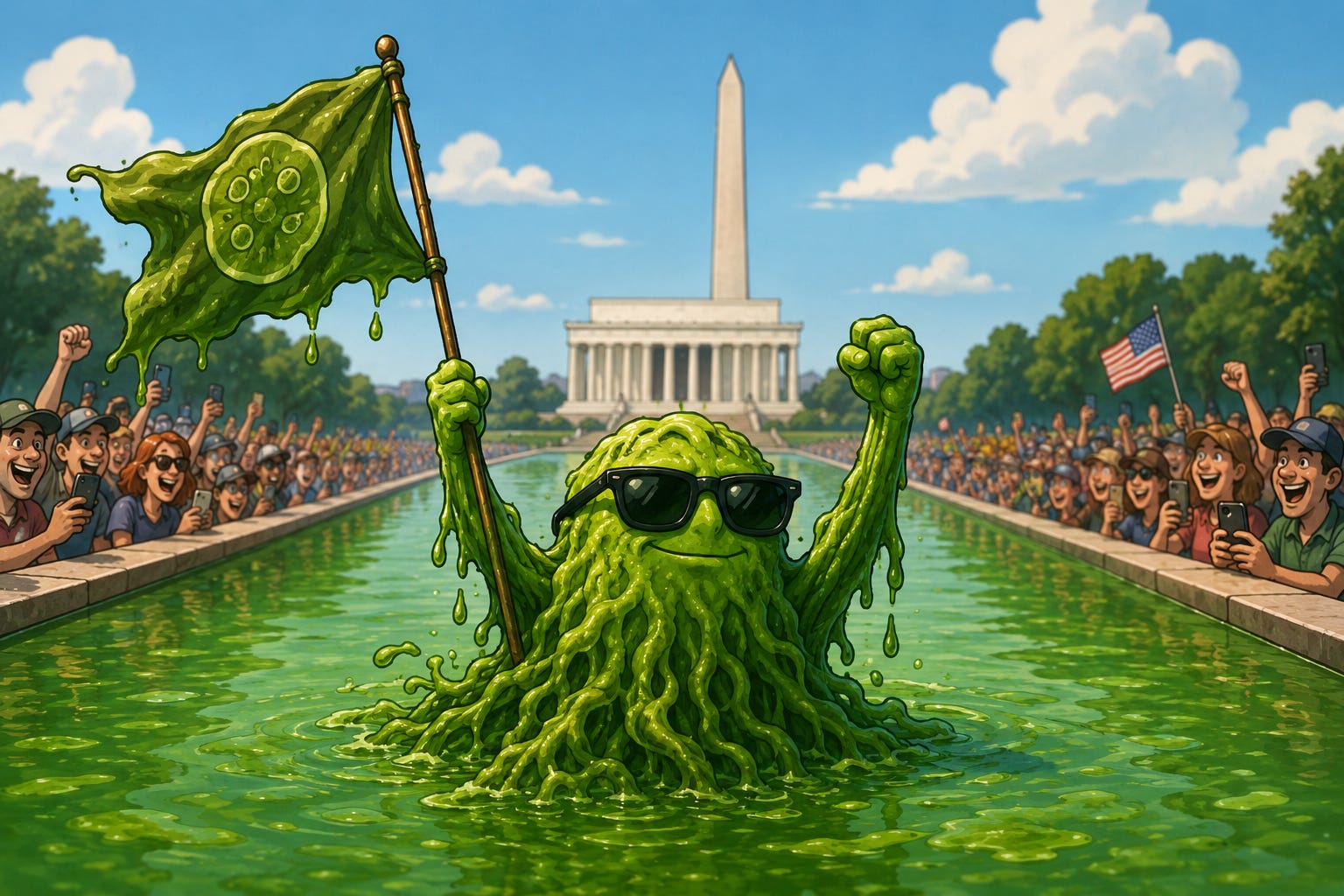
The algae became so prominent, so quickly, that it escaped the boundaries of infrastructure and entered the realm of internet folklore. Social media transformed the bloom into a political movement, a conquering force, and, perhaps most importantly, an underdog.
The memes are funny. The story is somehow funnier.
Because democracy doesn’t defend itself, and neither does your sanity. Subscribe here to keep your eyes open and your sarcasm sharp.
A Century of Reflection
The Reflecting Pool is older than most Americans realize. Construction began in 1921 as part of the Lincoln Memorial grounds, and the memorial itself was dedicated the following year. Designed by architect Henry Bacon and landscape architect Frederick Law Olmsted Jr., the pool was intended to create the dramatic visual corridor stretching between Lincoln and the Washington Monument.
It succeeded. For more than a century, the Reflecting Pool has become one of the most recognizable civic spaces in the United States. It has served as the backdrop for presidential ceremonies, civil rights demonstrations, anti-war protests, and countless moments of national reflection.
Yet beneath the symbolism lies a simple reality. The Reflecting Pool is infrastructure. Water must circulate, sediment managed. Pumps must operate and surfaces be maintained. The monument may inspire poetry, but the maintenance schedule is decidedly less romantic.
Like much of America’s infrastructure, the pool receives the most attention when something goes wrong. And in the last two weeks, boy did it.
The Maintenance Problem Nobody Notices
The recent controversy did not begin with algae. Algae have always been part of the story.
Built on difficult ground, it gradually settled and developed leaks. Sediment accumulated, and water quality became harder to manage. Recurring algae growth became one of the many headaches associated with maintaining a large, shallow body of water exposed to the summer sun.
These issues eventually led to a major reconstruction between 2010 and 2012 under Obama. The pool was stabilized, circulation systems were upgraded, and extensive rehabilitation work was completed.
While the project improved conditions considerably, it did not eliminate algae. As anyone tasked with maintaining a water feature knows, few things do.
The Blue Pool
Long before the algae appeared, the internet had already begun writing the first act of the story. The Trump administration approved an expedited renovation project that ultimately cost more than $14 million, several million dollars above the original estimate. ABC has recently reported that the cost may actually be higher. The work was awarded through a no-bid process justified under emergency authorities and was completed on June 6 in advance of major summer celebrations during America250.
The renovation included a striking visual change. The pool was coated in a dark blue (American Flag Blue, per Trump) surface that immediately attracted attention online. Some simply disliked the aesthetics. Others questioned whether the darker color might alter water temperatures or create unintended consequences. Engineers, environmentalists, amateur scientists, and professional cynics all began offering theories, warnings, predictions, and jokes.
Whether those concerns ultimately prove correct is almost beside the point. The important detail is that the audience was already paying attention. The trolls had taken their seats before opening night, and they were primed for action.
Fifteen Days
The renovation was completed on June 6. By June 16, major news outlets were reporting significant algae growth in the pool.
The following day, crews were spotted treating the water with hydrogen peroxide in what was likely a well-intentioned effort to suppress the bloom. A mere eleven days after completion, workers were already attempting to chemically manage the problem the project was supposed to address.
On June 18, reports emerged that portions of the newly installed blue surface were peeling. At this point, the story could have settled into the familiar category of an expensive public-works embarrassment, yet another example of the Trump administration’s incompetence.
Somehow, it became stranger.
On June 19, former Olympic canoeist David Hearn was arrested after interacting with material that he says was already loose and peeling from the installation. Hearn’s background as a materials scientist only added to the surreal quality of the story. It is difficult to improve upon the headline “Olympian and materials scientist arrested while examining a peeling multimillion-dollar repair,” so we will not attempt to do so.
Security around the site increased, whether to protect visitors or the algae remains unknown. National Guard personnel appeared in the area.
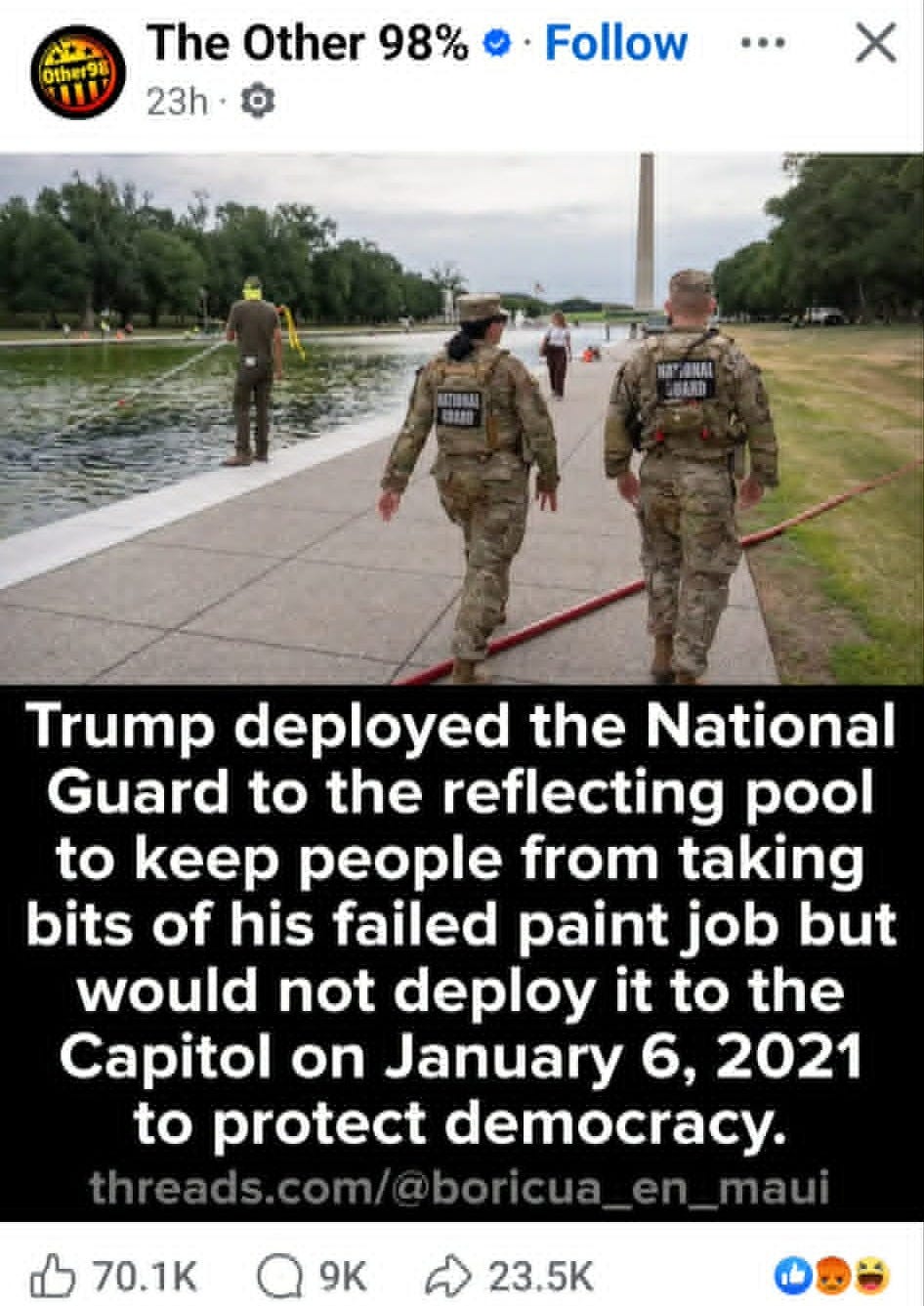
On Saturday, President Trump publicly attributed the problems to vandalism and suggested that individuals had damaged the installation because, naturally.
On Sunday, Attorney General Jeanine Pirro warned that alleged vandals would face prosecution. Around the same time, the discussion turned to yet another round of repairs, with President Trump suggesting that the Reflecting Pool might need to be drained again.
It has been an intense and absurdly busy two weeks since the work was completed. It is also the length of time necessary for the internet to stop treating the story as infrastructure news and start treating it as folklore.
The Algae Wars
The first jokes appeared almost immediately. They multiplied the moment photographs showed the pristine blue surface surrendering even a hint of green.
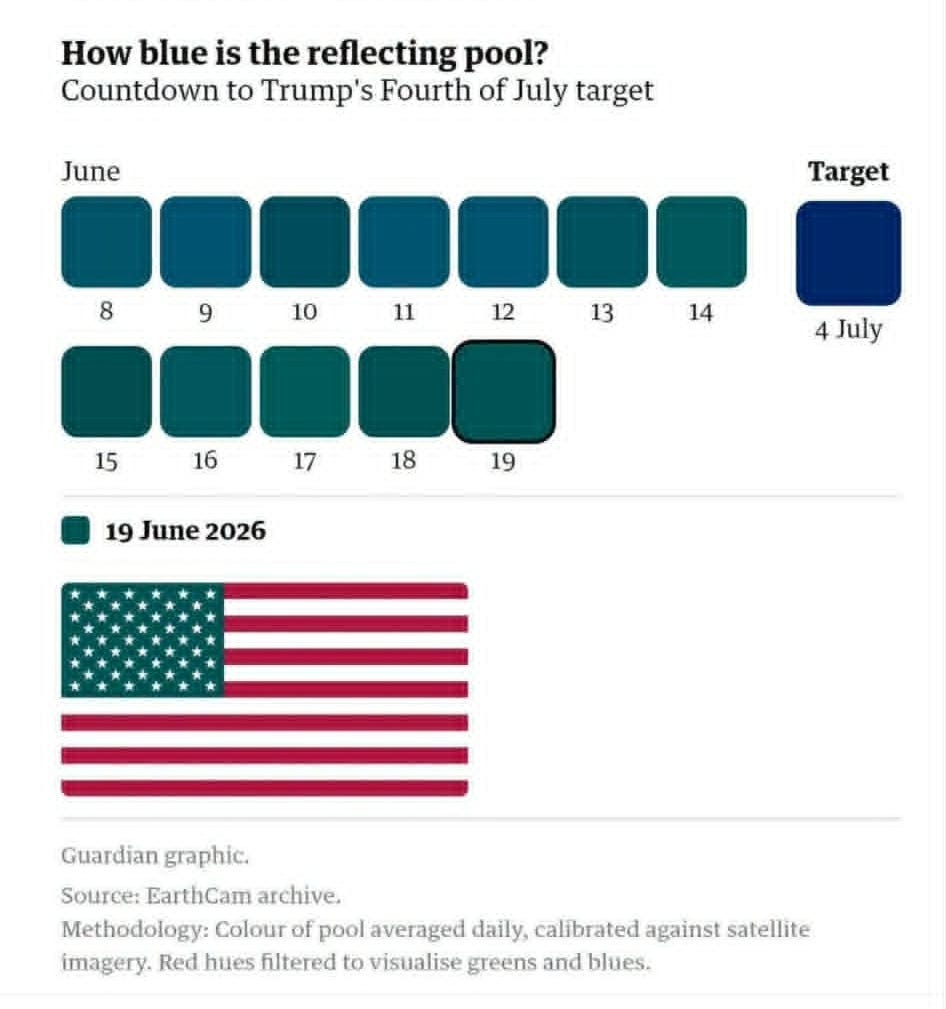
The Guardian
Once the peeling liner entered the story, the memes exploded. The peroxide treatments helped. The arrest of an Olympian materials scientist was pure fuel. The National Guard, vandalism allegations, prosecution threats, and discussion of draining the pool again transformed the situation from a maintenance problem into an ongoing serialized drama.
The internet responded accordingly, and the algae acquired a personality, motivations, and a constituency. The internet did not treat the algae as a form of contamination, but as a main character.
Why People Started Rooting for Pond Scum


Part of the appeal is obvious. A multimillion-dollar project appeared to fail almost immediately. At a moment when many Americans are being told to tighten their belts, accept cuts, lower expectations, and embrace austerity, a $14 million-plus renovation producing algae, a peeling liner, peroxide treatments, arrests, and threats of federal prosecution was always going to attract ridicule.

Attribution unknown
However, the reaction goes deeper than mockery. While many see a story about infrastructure, others detect environmental realities colliding with political deadlines. Some imagine a cautionary tale about the limits of control, branding, and public relations. Still others see something surprisingly hopeful.
The Collective
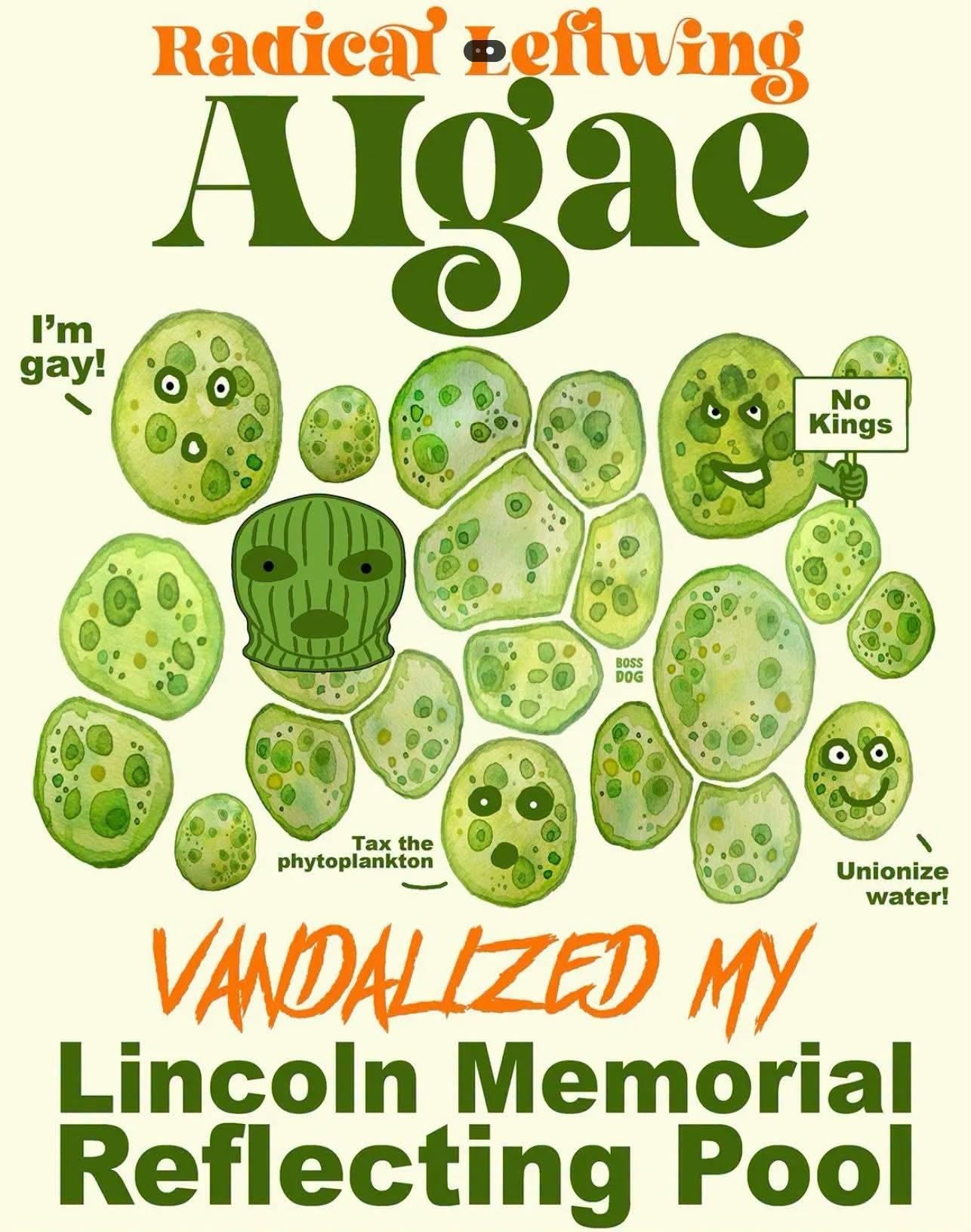
An algae bloom is not an individual achievement. No single algae cell turns a pool green. A bloom emerges from countless tiny organisms responding to the same conditions at the same time. Individually, they are insignificant. Collectively, they become impossible to ignore.
That may explain why the algae resonates so strongly as a symbol. The bloom has no leader, spokesperson, public relations strategy, procurement authority, or budget. It simply grows.
Attribution unknown
For readers inclined toward progressive and populist traditions, the metaphor is difficult to miss. The most significant democratic movements in American history have rarely begun with powerful institutions. They have emerged from ordinary people acting together, accumulating influence through numbers rather than hierarchy.
It is easy to understand why so many people have found themselves cheering for it.
What the Algae Reflects
The Reflecting Pool was renovated to enhance its reflectivity. Instead, it has become reflective in an entirely different sense.
It reflects our complicated relationship with infrastructure, our skepticism toward institutions and official narratives, our environmental anxieties, and our fascination with unintended consequences. It reflects a political culture that increasingly struggles to distinguish between governance, performance, and spectacle. Most of all, it reflects a persistent American belief that large institutions are not the only forces that shape events.
Sometimes power arrives from the top down. Sometimes it emerges from the bottom up. And sometimes it arrives as a green bloom spreading across a shallow pool, reminding everyone that reality has a way of participating in the conversation.
Not bad for pond scum.
The Reflecting Pool was built to help Americans reflect.
If you appreciate journalism that mixes facts, history, humor, and a willingness to ask what a story means—not just what happened—please consider subscribing.
The algae thanks you for your solidarity.
Receipts:
“Paint is already peeling from Trump’s renovated Washington Reflecting Pool,” Reuters, June 18, 2026.
“People ticketed for vandalizing Washington Reflecting Pool will be fully prosecuted, U.S. attorney says,” Reuters, June 21, 2026.
“Trump, blaming alleged vandals, says Washington Reflecting Pool needs repairs,” Reuters, June 21, 2026.
“Algae returns to Lincoln Memorial Reflecting Pool after multimillion-dollar renovation,” The Guardian, June 16, 2026.
“Trump blames vandalism for Reflecting Pool problems after algae bloom and peeling liner,” The Guardian, June 20, 2026.
“Reflecting Pool renovations cost more than $16 million, records show,” ABC News, June 19, 2026.
“Algae detected at higher levels than any June in at least five years after Reflecting Pool renovation,” The Washington Post, June 18, 2026.
“Former Olympian David Hearn arrested after touching Reflecting Pool amid vandalism claims,” People, June 19, 2026.
“America’s Great Outdoors: Salazar Announces Successful Renovation of Lincoln Memorial Reflecting Pool,” U.S. Department of the Interior, August 7, 2012.
“The Making of the Lincoln Memorial,” National Park Service.
“Why the Lincoln Memorial Reflecting Pool Needed a Massive Restoration,” History.com, April 24, 2026.
Thanks, great article.
HYSTERICAL and RIGHT ON TARGET as well. I had to forward it to my Dem sister.
I, too, am rooting for the pond scum--but STOP the arrests of shocked and disgusted bystanders who reach--both intrigued and terrified..