


On Friday evening, April 24, 2026, all 22 members of the National Science Board received the same email. Their positions were terminated, effective immediately.
There would be no transition period, no staggered departures, and no public explanation accompanying the initial notices. It was just a clean sweep of the governing body that oversees the National Science Foundation (NSF), the federal agency responsible for funding a significant share of basic scientific research in the United States.
The National Science Board (NSB) is not a ceremonial panel. Its members are nominated by the president, confirmed by the Senate, and appointed to six-year staggered terms designed to span administrations. That structure exists for a reason. It ensures continuity, insulates scientific decision-making from political swings, and provides independent oversight of NSF’s policies, priorities, and long-term strategy. The board also advises both the president and Congress on the state of U.S. science and engineering.
By Friday night, that structure was gone. Alone, this would be an alarming headline. However, this is just the latest and boldest move against the scientific infrastructure under this administration.

This Community Is Powered by You
What started as a small circle has grown into something much bigger, and it’s all because of readers like you.
Every time you forward this email, post it on socials, or bring someone new into the fold, you’re helping build one of the most passionate, independent political communities out there.
Want to keep the momentum going?
Share this newsletter with someone who should be part of this conversation.
Thank you for being here. It means everything.
What the National Science Board is and why it matters
To understand the significance of the firings, it helps to understand what was removed.
The National Science Foundation funds research across disciplines that range from physics and engineering to computer science, biology, and the social sciences. Unlike agencies focused on applied or clinical work, NSF specializes in basic research, the foundational discoveries that often take years or decades to translate into real-world technologies.
The National Science Board sits at the center of that system. It approves major initiatives, helps set priorities, and provides oversight intended to keep NSF aligned with long-term national interests rather than short-term political goals.
The staggered terms of its members are a defining feature. At any given time, the board is meant to include appointees from multiple administrations. That design prevents any single president from reshaping the board all at once.
And yet, the firings on April 24 did exactly that.
An agency already under strain
The board’s removal did not occur in a vacuum. It landed on an agency that had already been operating under extraordinary strain for more than a year.
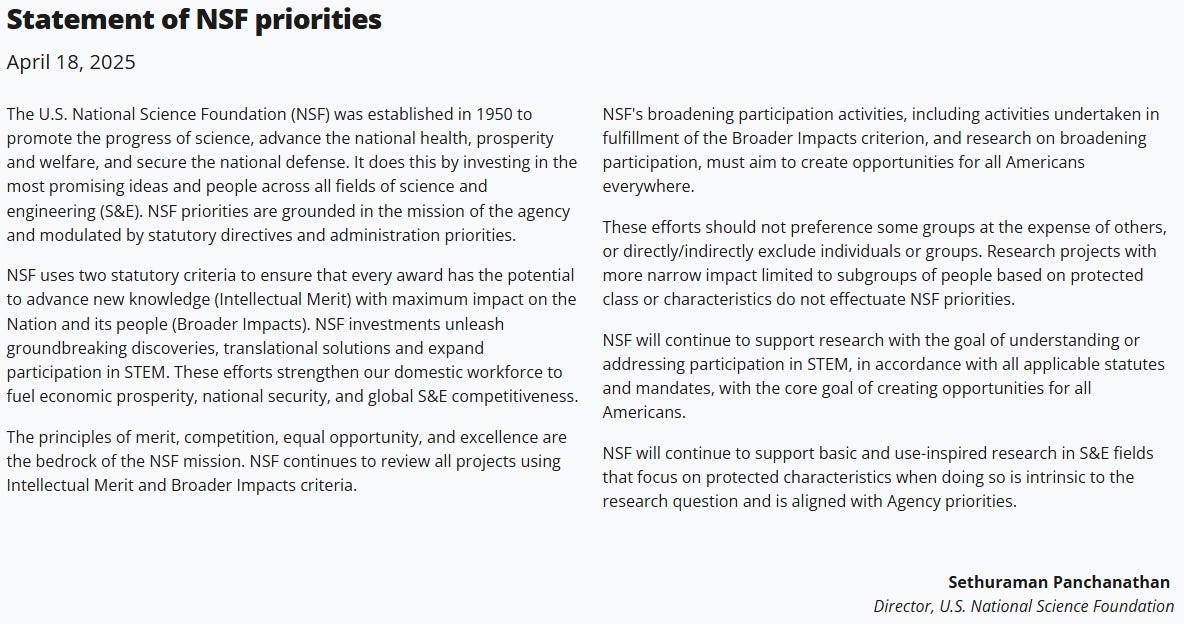
On April 24, 2025, six days after he announced the revised NSF priorities to align with Trump’s executive orders, Sethuraman Panchanathan resigned as director of the National Science Foundation before completing his six-year term. In his departure statement, he wrote that he had “done all I can” and that it was time to “pass the baton to new leadership.”
NSF
Panchanathan’s tenure spanned some of the most turbulent years in recent scientific and institutional history. He led the NSF through the COVID-19 pandemic, the subsequent research and economic recovery, and the expansion of federal science investment under the CHIPS and Science Act. He also did so without a Senate-confirmed deputy director beneath him, a position that has remained unfilled since 2014.
Since his resignation, the NSF has had no Senate-confirmed director. The agency is currently led on an acting basis by its chief of staff, Brian Stone, who is performing the duties of the director without Senate confirmation.
Leadership continuity, already thin, effectively disappeared.
Cuts, disruptions, and a shrinking foundation
At the same time, NSF has been absorbing operational shocks tied to broader federal policy changes, including DOGE reforms.
The numbers are stark. The Trump administration proposed cutting NSF’s roughly $9 billion budget by more than half, a reduction Congress declined to approve for fiscal year 2026. Scientific American reported that the administration proposed cuts of that scale two years in a row. The same report found that NSF has lost more than 30% of its staff since January 2025.
Grant funding has also been disrupted, with delays and cancellations affecting researchers who rely on predictable funding cycles to keep labs running, support graduate students, and sustain long-term projects. Advisory committees across multiple scientific disciplines have been disbanded, removing another layer of expert guidance at precisely the moment the agency needed more stability, not less.
Even NSF’s physical footprint has been unsettled. The agency vacated its former Alexandria headquarters in January 2026 before its new space was ready, leaving many staff working remotely even as the administration has publicly pushed federal workers back into offices.
Each of these changes might be manageable on its own. Together, they create a pattern of disruption that extends from staffing to funding to governance to the basic logistics of where the agency’s employees are supposed to work.
A broader shift in the politics of science
These developments at the NSF are part of a wider shift in how science is being treated in federal policymaking.
In recent months, scientific research and academic institutions have faced increased scrutiny, particularly around funding priorities, ideological framing, and perceived political bias. Advisory structures across agencies have been reduced or reshaped. In some cases, research areas tied to climate, public health, or social science have been drawn into political conflict.
See some of our previous reporting here:
Note: Articles roll into the archive over time. Become a paid subscriber for full access to our extensive catalog.


The result is a more contested environment for scientific work, one in which the traditional separation between research and politics has become harder to maintain.
Against that backdrop, the removal of the National Science Board looks less like an isolated decision and more like a continuation of a broader trend.
The nominee waiting in the wings
Into this environment steps the administration’s nominee to lead NSF, Jim O’Neill.
O’Neill is not a traditional candidate for the role. He is known primarily as a technology investor affiliated with Peter Thiel and a former official at the U.S. Department of Health and Human Services, with a background in health policy and regulatory reform. His past views have included arguments for more permissive drug approval processes, positioning him well outside the mainstream of federal scientific leadership.
Historically, NSF directors have been scientists, engineers, or major university research leaders. Their credibility has come from deep engagement with the scientific enterprise they oversee.
O’Neill’s nomination represents a clear break from that pattern. More importantly, it comes at a moment when the institution he would lead has been stripped of many of its traditional stabilizers. Concerns have already been expressed from within the scientific community as well as members of Congress.
The AI contradiction
The timing raises a larger strategic question.
The administration has made artificial intelligence a central priority, framing it as a key arena of global competition. Yet the National Science Foundation is one of the primary federal engines for the basic research and workforce development that underpin advances in AI.
Weakening NSF while emphasizing AI leadership creates a tension that is difficult to ignore.
See our recent reporting here:
Note: Articles roll into our archive over time. Become a paid subscriber for full access to our extensive catalog.


Basic research does not operate on political timelines. It depends on stable funding, long-term planning, and a steady pipeline of talent. Disruptions to that system do not simply delay progress. They can redirect it elsewhere. And perhaps that is the point.
Other countries continue to invest, recruit, and build capacity. Scientific momentum does not wait for institutional stability to return.
The story is the impact
It is possible to debate the intent behind each individual decision affecting NSF over the past year. Those debates are likely to continue in Congress, in the courts, and across the scientific community.
However, intent is not the most important question at this moment.
The reality is that, as of April 24, 2026, the National Science Foundation is operating without a Senate-confirmed director, without a Senate-confirmed deputy director, without its governing board, and with reduced advisory, staffing, and funding capacity.
That is not a theoretical concern, but an operational condition.
Science does not pause while institutions reorganize. Research projects stall, funding pipelines narrow, and talent moves on. Momentum, once lost, is difficult to recover.
You can call this reform. You can call it restructuring. The result is an agency without the stability it was designed to have, at a time when stability may matter most.
If you want clear-eyed analysis of where policy meets reality and what it means before the consequences fully land, subscribe to the newsletter.
Sources:
Associated Press, “Trump administration fires independent board overseeing the National Science Foundation,” April 27, 2026.
Scientific American, “Entire NSF science advisory board fired by Trump administration,” April 26, 2026.
Nature, “Entire NSF science advisory board fired by Trump administration,” April 26, 2026.
The Washington Post, “Trump ousts National Science Board members,” April 25, 2026.
NSF, “Statement by Director Sethuraman Panchanathan on his departure,” April 24, 2025.
NSF, “Leadership,” current NSF leadership page.
NSF, “Implementation of Recent Executive Orders.”
AIP FYI, “Work Continues on New NSF HQ,” February 20, 2026.
GSA, “GSA and NSF Announce NSF Headquarters Relocation to Modern, Right-Sized, and Mission-Ready Space,” November 14, 2025.
White House, “Nominations Sent to the Senate,” March 2, 2026.
U.S. Senate, “Nominations in Committee (Civilian),” current Senate nominations page.
Computing Research Association, “President Trump to Nominate Jim O’Neill, Former HHS Official, to be Next NSF Director,” March 3, 2026.
Union of Concerned Scientists, “Nominee to Lead the National Science Foundation is an ‘Unacceptable Choice’ that Senate Should Reject,” March 17, 2026.
NSF, “Statement from NSF Chief of Staff Brian Stone, performing the duties of the NSF Director, on the White House AI Action Plan,” July 23, 2025.
NSF, “NSF announces $100 million investment in National Artificial Intelligence Research Institutes,” July 29, 2025.
AIP FYI, “Trump Plan Highlights AI for Science,” July 31, 2025.
The Guardian, “Trump cuts to science research threaten his administration’s own AI action plan,” August 14, 2025.
This Administration is in a war against intelligence, science, learning, education, debate, and democracy. And it is winning and it will take many years - more than my lifetime - to undo the damage. God save America - we don't seem to be able to do that.
Yep. Keep the citizens dumb and stupid. Who needs science when you have plenty of money! What a stupid mentality, but really it’s just another way to fund the permanent tax breaks for the wealthy and corporations. We need to keep repeating that point whenever it applies.