


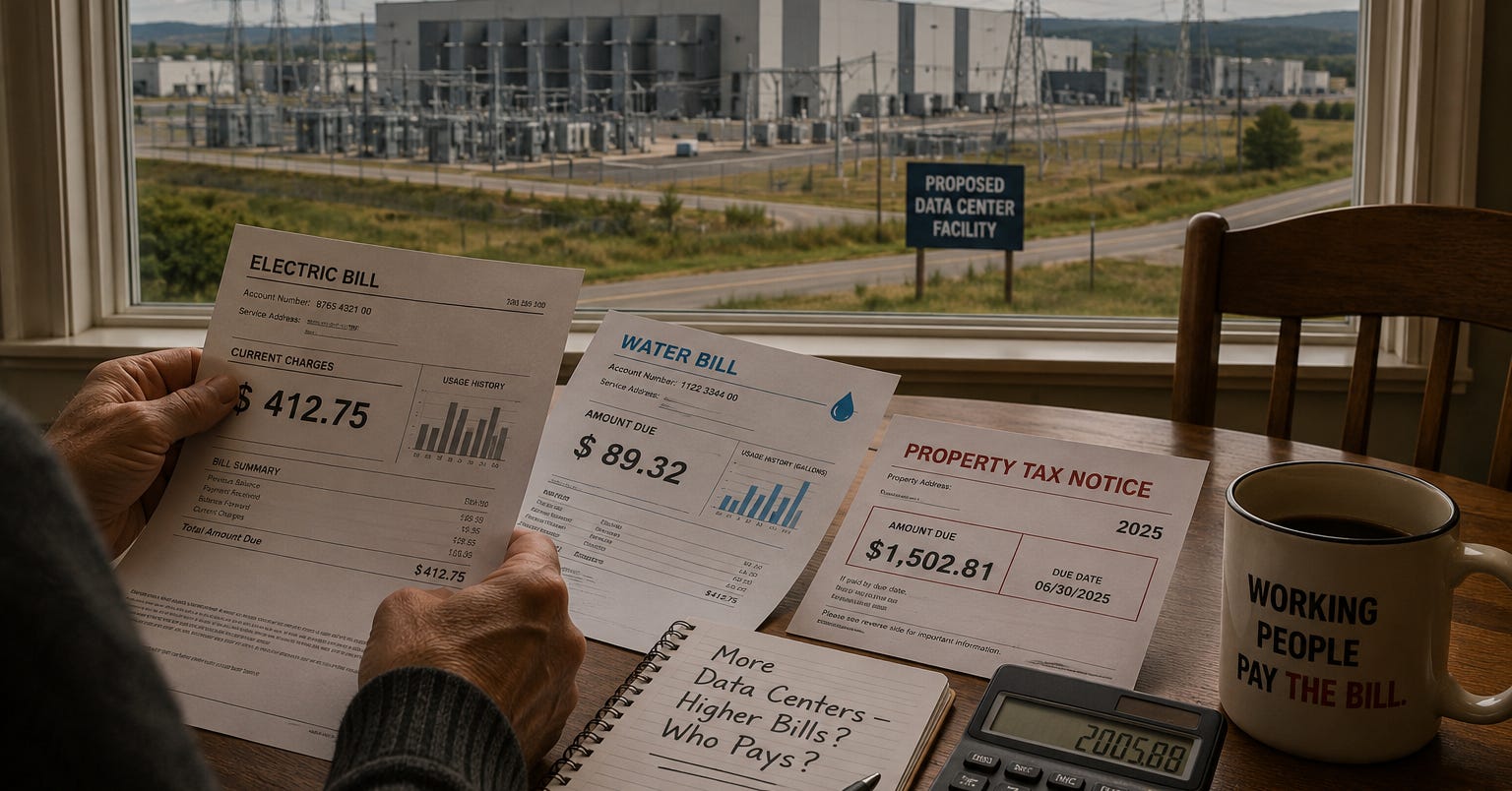
The cloud was never in the sky.
That was the trick of the language. Call it “the cloud,” and it sounds weightless. Clean. Invisible. Something floating above the real world instead of landing inside it. But the AI boom is not floating above anything. It is landing on somebody’s electric grid, somebody’s water supply, somebody’s farmland, somebody’s road system, somebody’s tax base, and somebody’s monthly utility bill.
Pennsylvania is starting to figure that out.
Across the Commonwealth, and across the country, data centers are being sold as the infrastructure of the future. The pitch is familiar: jobs, investment, innovation, competitiveness, growth. Every economic-development package seems to arrive with the same shiny words. But behind those words are physical demands that do not disappear because a press release calls them progress. These facilities need land. They need electricity. They need cooling. They need water. They need transmission lines, substations, zoning approvals, tax incentives, utility coordination, and political permission.
Too often, the people who have to live with those costs are brought into the conversation after the deal is already moving.
That is why Pennsylvania’s new fight over data centers matters. It is not just another zoning dispute. It is not just a technology story. It is a test of whether communities still have the power to slow down concentrated money before it turns public resources into private infrastructure.
The question is not whether artificial intelligence is coming. It is already here. The question is whether the future will be built in public, with consent, transparency, and accountability, or whether corporations will build it first and then bill that everyone else.
Support independent media that follows the power.
The Coffman Chronicle is built to track who holds power, who abuses it, who profits from it, and who pays the price.
Paid supporters get full Tony Michaels Podcast episodes, deeper transcript analysis, paid columns, archives, and the reporting framework behind the show.
If you believe independent media has to survive outside billionaire platforms, corporate media, and party-approved gatekeepers, become a paid supporter today.
The Backlash Has Entered the Legislature
The backlash is no longer limited to crowded township meetings, angry Facebook groups, or one-off local zoning fights. It has reached the Pennsylvania Legislature.
State Sen. Jarrett Coleman and state Rep. Jamie Walsh have introduced a package of bills aimed at slowing the rapid spread of data centers in Pennsylvania. One bill would repeal the tax break that has helped make the Commonwealth more attractive to data-center developers. The other would allow municipalities to place an 18-month moratorium on new or unapproved data-center applications while they update their local rules.
These bills have not become law. They are proposals. But proposals matter because they tell us where the pressure is going.
For years, communities have been told these projects are just local development questions. A company buys land. A township reviews an application. A utility works on power. A state agency handles incentives. A developer talks about jobs. Each piece is treated like a separate technical decision.
But when you put those pieces together, the picture changes. This is not just a local land-use dispute. It is the physical infrastructure of the AI economy, built through scattered decisions that most people do not see until the project is already underway.
In a state like Pennsylvania, that matters because plenty of small municipalities do not have teams of full-time planners sitting around waiting for billion-dollar infrastructure proposals. Some have part-time officials, volunteer boards, a solicitor, a few staff members, and residents who show up after work because they heard something big might be coming to a road near their house. That is not a fair fight when the other side arrives with consultants, lawyers, engineers, utility partners, and a polished economic-impact packet.
Pennsylvania’s proposal is an attempt to stop that pattern before it hardens. It says towns should not have to approve or reject massive data-center projects using outdated zoning rules written for a different kind of development. It says communities deserve time to understand the power demand, water demand, noise, traffic, emergency-service strain, land-use impact, and long-term public cost before they are locked into a deal they cannot easily unwind.
This bill package should not be dismissed as anti-technology. It is not a vote against the future. It is a demand that the future stop arriving as a private negotiation with a public bill attached.
The data-center industry wants speed. Developers want approvals. Utilities want commitments. Governors want investment announcements. Politicians want ribbon cuttings.
But the people who have to live with the consequences need something else first. They need time.
Pennsylvania is not trying to stop the future. Pennsylvania is trying to stop the lock-in.
This Is Not Anti-Technology. It Is Anti-Being Steamrolled.
The first move from the industry will be obvious. They will say any pause is anti-growth. They will say any moratorium is anti-business. They will say any demand for more transparency is fear of the future dressed up as local control.
That argument should be rejected at the door.
The issue is not whether Pennsylvania should have a place in the AI economy. Of course it should. The issue is not whether America will need more computing power. It will. The issue is not whether data centers exist or whether technology should move forward. It already is.
The issue is who gets to set the terms.
There is a difference between building the future and being steamrolled by it. There is a difference between progress negotiated in public and progress imposed through private deals, technical approvals, tax breaks, utility agreements, and zoning rules that were never written for this scale of demand.
Communities are not objecting to an idea floating in the air. They are responding to physical projects with physical consequences. They are looking at land use. They are looking at water demand. They are looking at power consumption. They are looking at noise, roads, local infrastructure, emergency services, and tax tradeoffs. They are asking what every responsible community should ask before a massive project changes the place they live.
Who benefits? Who pays? Who decides? Who carries the risk if the promise fails?
Those are not anti-technology questions. Those are democracy questions.
The powerful love to confuse consent with obstruction because obstruction sounds unreasonable and consent sounds dangerous. If the public can demand consent, then the public can demand conditions. If the public can demand conditions, then the public can change the deal. And if the public can change the deal, then concentrated power no longer gets to call every private demand a public necessity.
That is the heart of this fight.
Pennsylvanians are not being asked whether they like innovation. They are being asked whether they are willing to let some of the richest companies on Earth turn local resources into private infrastructure before the public gets a full accounting of the cost.
That is not progress. That is surrender with better branding.
A real future does not require communities to stay quiet until the ribbon-cutting. A real future can survive public meetings, zoning updates, cost disclosures, water-use studies, power-demand projections, and honest debate. If these projects are as beneficial as the industry claims, they should be able to withstand sunlight.
And if they cannot, that tells the public something, too.
The Pause Button Is the Point
That is why the 18-month moratorium is so important. It is not a side detail or a procedural footnote. It is the whole argument in practical form.
Pennsylvania is not saying communities need forever to figure this out. It is saying they need time. Time to study the costs. Time to update zoning. Time to understand what kind of power demand is being placed on the grid. Time to ask how much water will be used and where that water will come from. Time to consider noise, setbacks, traffic, emergency services, road wear, land-use changes, and the strain on local infrastructure.
The industry will call that delay, but delay is not always obstruction. Sometimes, delay is democracy doing its job.
A town cannot govern a 21st-century data-center project with rules written for a different scale of development. Local officials cannot protect residents if they are forced to make decisions before they understand the demands on electricity, water, roads, emergency services, and local budgets. Voters cannot hold anyone accountable if the deal moves faster than the public can read the fine print.
That is the point of the pause. The 18-month moratorium gives municipalities room to move from reaction to regulation. It gives communities a chance to stop chasing the deal from behind and start setting the terms in front of it.
Because once these projects are locked in, the leverage changes. Once the utility agreements are made, the tax structures are approved, the land is committed, the substations are planned, and public money starts flowing, communities are no longer negotiating from consent. They are negotiating from dependency.
That is exactly how concentrated power prefers to operate. Move fast. Fragment the decision. Lock in the infrastructure. Then tell the public it is too late.
Pennsylvania’s 18-month pause challenges that pattern. It says time belongs to the people, too. It says speed is not the only value that matters. It says communities should not be forced to choose between blind approval and total rejection because no one gave them enough time to govern responsibly.
That is not anti-business, anti-AI, or fear of the future. That is self-government.
Corporate power wants speed. Communities need time. The 18-month moratorium is the fight over who controls the clock.
Speed Is the Weapon
The fight over data centers is really a fight over speed. That is the part that concentrated power never wants to say out loud. It is not just trying to win the argument. It is trying to outrun the argument. It wants the land purchased, the utility agreements signed, the tax incentives approved, the zoning decisions made, the grid commitments planned, and the political ribbon cut before the public understands what happened.
By the time residents start asking hard questions, the answer is already familiar. It is too late now.
That is how modern power works. It does not always arrive as a single decision with a single vote. It arrives in fragments. One board handles zoning. One agency handles permitting. One utility handles electricity. One state office handles tax incentives. One commission handles water. One developer handles land. One consultant writes the economic-impact study. One politician announces the jobs.
Each piece is presented as narrow, technical, and manageable. But together, those pieces build the physical infrastructure of the AI economy. That is the danger.
A community may think it is debating a single land-use application when it is really being drawn into a long-term commitment to energy, water, taxes, and infrastructure. A state may think it is offering a targeted tax incentive when it is really helping some of the world’s wealthiest companies shift public costs onto ordinary people. A utility may say it is meeting new demand when that demand could shape ratepayer exposure for years.
Nobody is asked to approve the whole picture because it is rarely presented to the public at once.
That is not an accident. Fragmentation protects concentrated power. It keeps residents fighting one small piece of the deal while the larger machine keeps moving.
This is why speed matters. Once the infrastructure is built, the politics change. Once a community becomes dependent on the promised investment, jobs, tax base, or grid upgrades, the leverage shifts away from the public. The people are no longer being asked whether they consent. They are being asked to adapt.
That is not democracy. That is momentum pretending to be inevitability.
Pennsylvania’s proposed pause challenges the most important part of that pattern. It does not merely ask whether a data center should be built. It asks whether the public should have enough time to review the entire deal before it becomes permanent.
If the benefits are real, show them. If the grid can handle the demand, prove it. If the water use is manageable, disclose it. If the tax break pays for itself, put the numbers in the public domain. If the jobs are permanent, say how many. If ratepayers will not be stuck with the cost, show the guarantees.
If the industry cannot answer those questions without demanding speed, then speed was never just a convenience. Speed was the strategy.
The Bill Comes Home
This is where the AI boom stops being abstract. Most people do not sit around the dinner table debating server capacity, machine-learning models, or corporate cloud infrastructure. They are trying to pay the electric bill. They are trying to keep water affordable. They are trying to understand why public money keeps finding its way to private giants while ordinary families are told there is never enough for schools, roads, health care, emergency services, or tax relief.
A data center may be sold as innovation, but the cost does not stay in Silicon Valley. It shows up somewhere. It shows up in the power demand placed on the grid. It shows up in the water needed for cooling. It shows up in the land taken out of other uses. It shows up in transmission lines, substations, local roads, emergency planning, tax incentives, and utility decisions that ordinary people may not notice until the bill arrives.
When a massive data center comes to town, the public deserves to know who pays for the grid upgrades. The public deserves to know whether ordinary ratepayers could be exposed to higher costs. The public deserves to know whether the promised jobs are permanent local jobs or mostly temporary construction work. The public deserves to know how much water will be used, what happens during dry periods, and whether local systems can meet demand without shifting costs onto everyone else.
The public also deserves to know what is being given away.
If a company worth billions or trillions of dollars gets a tax break, that is not free. That is money the public treasury does not collect. That is revenue not available for something else. It may be defended as economic development, but economic development should be measured honestly. If the people are being asked to subsidize the infrastructure of the AI economy, then the people deserve to see the return before the deal is celebrated.
That is the kitchen-table question. Why should ordinary Pennsylvanians pay high utility bills, rising local costs, and state taxes while some of the richest companies on Earth ask for public help to build private infrastructure?
That question does not make someone anti-business. It makes them awake.
The AI boom may be sold in the language of innovation, but the bill shows up in the language of rent, taxes, water, and electricity. And when the bill lands on the kitchen table, people have every right to ask who ordered it.
The Public Gets a Timer
This is the power imbalance hiding underneath the whole debate. When a major data-center developer comes to town, it does not show up alone. It shows up with lawyers. It shows up with lobbyists. It shows up with engineers, consultants, utility partners, economic impact studies, public relations teams, architectural renderings, job estimates, tax projections, and private meetings with people who know how the process works.
The public usually shows up tired.
Residents show up after work. They show up after feeding their families, paying bills, helping with homework, caring for their parents, and trying to keep their own lives together. Then they are handed a few minutes at a microphone to respond to a project that may already have months or years of planning behind it.
That is not an equal process. That is organized money walking into a public room and asking disorganized citizens to catch up in real time.
Public input is not the same as power. A comment period is not the same as consent. A hearing is not the same as negotiation. Three minutes at a microphone is not the same as being at the table when the deal is shaped.
The corporation gets the machinery of power. The public gets a timer.
That is the democratic problem Pennsylvania is beginning to name. If residents are expected to live with the water demand, the power demand, the noise, the roads, the emergency-service strain, the land-use change, the tax tradeoff, and the utility pressure, then they should not be treated like late-stage spectators in their own community’s future.
They should be treated like owners. That is what public consent means. It does not mean every person gets exactly what they want. It does not mean that no project can ever move forward. It means the people affected by the project get a real chance to understand the whole deal, debate the tradeoffs, set conditions, and hold officials accountable before the decision becomes functionally irreversible.
That is the difference between democracy and managed participation. Managed participation lets people speak after power has already moved. Democracy lets people shape what power is allowed to do.
The people who live in these communities are not obstacles to progress. They are the reason progress exists in the first place.
Pennsylvania Is Building the Playbook
Pennsylvania’s proposal has potential impacts beyond its borders.
If this were only a local fight over a single project or township, it would still matter to the people who live there. But this is bigger than that. Pennsylvania is showing other states what a practical response to the data-center boom can look like before the boom becomes too politically and physically locked in to challenge.
That is the part that concentrated power should worry about. One town saying no can be isolated. One county asking questions can be dismissed as NIMBYism. One community demanding answers can be painted as anti-growth, anti-jobs, or afraid of the future. But one state creating a model that other states can copy is something different.
That turns resistance into a blueprint. If Pennsylvania can say municipalities deserve time to study data-center impacts before approvals are finalized, why can’t Ohio? Why can’t Virginia? Why can’t Georgia, Texas, Arizona, Michigan, North Carolina, or any other state be asked to absorb the physical cost of the AI boom?
The questions do not stop at state lines. How much electricity will these facilities need? Who pays for grid upgrades? How much water will they use? What happens during drought conditions? How much public money is being offered through tax breaks or incentives? Are the promised jobs permanent, local, and substantial, or mostly temporary construction work? What does the community get if the company later automates, downsizes, sells, or leaves?
Every state facing this buildout should be asking those questions before the deal is locked in.
Pennsylvania’s 18-month moratorium proposal offers a governing tool, not a final answer. Pause the rush. Update the zoning. Measure the power demand. Measure the water demand. Study the roads, noise, emergency services, land use, tax impact, and ratepayer exposure. Then let communities make decisions with facts in front of them, rather than a corporate press release in their hands. That is how scattered outrage becomes public policy.
The real threat to concentrated power is not one town standing up at one meeting. It is one state showing the rest how to slow the deal down before the public gets trapped in it.
The AI boom is national, but the costs land locally. That means the response has to move at both levels. Congress has to demand national transparency, but states and municipalities also need tools to protect their own people. Pennsylvania may be showing what those tools can look like. Not panic. Not prohibition. Not blind approval. A pause. A review. A demand for public accounting before private power rewrites the terms.
That is a model worth spreading.
Massie’s 180 Days and Pennsylvania’s 18 Months
That brings the fight back to Congress.
Pennsylvania’s proposed 18-month moratorium would give municipalities time to study the local impact of data centers before approvals are locked in. But Tony Michaels has raised the other side of the same argument: Congress could create national breathing room with a proposed 180-day federal pause, pushed through a discharge petition strategy.
Those two ideas fit together.
Massie’s 180 days would slow the machine. Pennsylvania’s 18 months would give the people time to catch up.
A federal pause would not write Pennsylvania’s zoning rules. It would not pass the Commonwealth’s bills. It would not decide every township dispute or answer every water, land, tax, and utility question. But it could slow the federal side of the buildout long enough for voters, local officials, and state lawmakers to act before the most important decisions are locked in.
Federal power is already part of this story. Data-center expansion is not just happening through private land deals and local zoning boards. It can involve federal permitting, federal energy policy, federal infrastructure support, environmental review, national security arguments, tax policy, utility regulation, and executive branch pressure to move faster in the name of competition.
If Washington is helping to accelerate the AI infrastructure boom, then Congress has every right to ask exactly what is being accelerated. Who benefits? Who pays? Who gets the power? Who carries the grid cost? Who gets the water? Who gets the tax breaks? Who absorbs the long-term risk if the public promises do not match the private profit?
That is not obstruction. That is oversight.
A 180-day federal pause would create time for public accounting. It would give Congress room to hold hearings, demand disclosures, and force agencies and companies to put numbers on the table. It would give states like Pennsylvania time to advance their own legislation. It would give municipalities time to update local rules. It would give voters time to pressure candidates and lawmakers before the next round of deals becomes permanent.
That is the part concentrated power hates. It does not hate delay because delay is inefficient. It hates delay because delay gives people time to organize. Time gives communities a chance to compare notes. Time gives lawmakers a chance to respond. Time gives other states a chance to follow Pennsylvania’s lead. Time turns scattered frustration into coordinated power.
That is why the 180-day federal pause and the 18-month Pennsylvania moratorium should be understood as parts of the same fight. One works from the top down. The other works from the ground up. The federal pause slows the national machinery of fast-tracking, subsidies, and public support. The state and local moratorium gives communities a practical tool to examine the cost before they are forced to live with it.
Together, they answer the industry’s favorite weapon: speed.
This is not about freezing the future. It is about refusing to let the future be finalized before the public can read the contract. If the AI buildout is truly good for communities, then it can survive 180 days of federal scrutiny and 18 months of local review. If the numbers are strong, show them. If the benefits are real, prove them. If the costs are manageable, disclose them.
The companies asking for public resources should not be afraid of public time, and Congress should not be afraid to give the people that time.
Make Congress Choose
That is why the discharge petition matters—not because it is magic, because it automatically passes a law, or because it can solve every data-center fight in America with one procedural move. It cannot. A discharge petition does something simpler and more important. It forces a choice.
Most of Congress is designed to let powerful people avoid clear choices. Bills can disappear in committee. Leadership can refuse to schedule a vote. Members can claim they support an idea while quietly letting it die behind closed doors. Everyone can blame procedure, timing, jurisdiction, party strategy, or some other excuse that sounds official enough to hide the truth.
A discharge petition cuts through that fog. It says that if enough members of the House want a vote, leadership cannot bury the issue forever. It puts names on paper. It forces members to decide whether they are willing to bring something into public view.
A discharge petition on AI data-center accountability would not be about stopping every project. It would be about forcing Congress to answer a basic question before federal power helps private companies lock in the next stage of the AI buildout: Do the American people deserve transparency before public resources are committed? That should not be controversial.
If federal agencies are helping accelerate data-center infrastructure, Congress should know the cost. If public money, federal support, permitting shortcuts, energy policy, or infrastructure coordination are helping this buildout move faster, Congress should demand answers in public. How much electricity will be needed? How much water? What grid upgrades are required? Who pays for those upgrades? What subsidies or tax incentives are involved? What communities were consulted? What environmental reviews were shortened? How many permanent jobs will actually exist after construction ends?
Those questions do not kill innovation. They expose whether the public is being asked to subsidize private power without knowing the terms.
That is why Thomas Massie matters, but only in the right way. He should not be treated as the hero of the story. He should be treated as the test. He has already shown that a discharge petition can force a buried issue into public view. He has already lost his primary and thus has no political capital to lose.
This is a different issue, but the same principle applies. Make Congress choose. Do members support a temporary pause and public accounting before federal support accelerates the deployment of massive AI infrastructure, or do they support letting the deals move forward while communities find out the costs later? Do they support transparency before the lock-in, or excuses after the fact? Do they believe the public should see the deal before the deal becomes permanent?
That is the vote, and that is why this matters for 2026. The discharge petition would turn a complicated infrastructure story into a simple public test. Every member could be asked where they stood. Every candidate could be asked whether they support public consent before the cloud lands on local grids, water systems, land, and utility bills.
Congress becomes useful when it organizes the people’s power against concentrated power. That does not guarantee victory. But it creates pressure. It creates a vote. It creates a public record, and sometimes, in a republic that has grown too comfortable letting power hide behind procedure, forcing the public record is where self-government begins again.
When Congress Gives Up Power, People Lose Power
This is where the Constitution enters the story, not as decoration, a civics-class reference, or a slogan people wave around when it benefits their side. The Constitution matters here because this fight is about who gets to decide the terms governing national infrastructure before it becomes permanent.
Article I created Congress for a reason. It is supposed to be the branch closest to the people. It is supposed to take local concerns, state concerns, public costs, regional conflicts, and national priorities and force them into open debate. That process is not supposed to be fast. It is supposed to be accountable.
Congress was not designed to make concentrated power more efficient. It was designed to make concentrated power answer.
The AI data-center boom is moving through a different kind of energy. Corporate energy. Executive energy. Emergency energy. Competitive energy. The language is always urgent. We have to move now. We have to beat China. We have to attract investment. We have to modernize. We cannot let regulation slow us down. We cannot let local objections kill innovation. However, democracy is not a glitch in the system. Democracy is the system.
If the future of artificial intelligence requires enormous new demands on electricity, water, land, tax policy, federal support, state incentives, and local zoning, then that future should be debated through representative government before the public is asked to carry the cost. Congress should hold hearings. State legislatures should write rules. Municipalities should update zoning. Voters should know what is being promised, what is being given away, and who is expected to pay if the promises fail.
That is not big government. That is constitutional government. The alternative is what Americans are living through now: massive public decisions broken into private fragments. A tax break here. A zoning approval there. A utility agreement somewhere else. A federal fast-track process in the background. A governor’s economic-development announcement. A corporate press release. A few public meetings. Then, suddenly, the future has already been negotiated.
That is how the people lose power without ever being told that power was taken.
This is the heart of Article I Populism: when Congress gives up power, the people lose power. When lawmakers stop using their oversight authority, corporate power fills the vacuum. When Congress lets executive agencies, private companies, utilities, donors, and consultants shape national infrastructure without public accountability, ordinary people are pushed farther from the room where decisions are made.
Then those same ordinary people are told they are too late, too local, too emotional, too uninformed, or too anti-progress to object. That is backward. The people are not the obstacle to the future. The people are the constitutional owners of the future.
That does not mean every community gets a veto over every project. It does not mean every objection is automatically right. It means the public has a right to know the terms before the terms become permanent. It means elected representatives have a duty to ask hard questions before public resources are committed. It means Congress cannot sit back while the infrastructure of the AI economy is built through corporate speed and executive shortcuts.
Article I exists to slow power down before it hardens. That is why the Pennsylvania bill is so important. That is why the 18-month moratorium, the 180-day federal pause, and this discharge petition matter. They all point toward the same democratic principle: before concentrated power builds the future, the people deserve a say in the terms.
The future should not be governed by whoever moves fastest with the most money. It should be governed by the people who have to live in it.
The 2026 Midterm Test
The AI data-center boom touches too many aspects of everyday life to be left out of the election conversation. It touches electricity. It touches water. It touches land. It touches tax breaks. It touches utility bills. It touches public money. It touches local control. It touches jobs. It touches environmental protection. It touches on whether communities still get a real say before massive private infrastructure is built with public help. That makes it a campaign issue.
Every candidate running for Congress should be required to answer whether they support public disclosure of data-center power and water use before federal support moves projects forward. Every candidate should have to answer whether they support hearings on ratepayer exposure, grid upgrades, tax incentives, permanent jobs, environmental shortcuts, and local consent. Every candidate should be required to answer whether they believe the public deserves to see the cost before it becomes permanent.
State candidates should face the same test. Do they support giving municipalities time to update zoning before massive data-center applications are approved? Do they support repealing tax breaks that hand public revenue to companies wealthy enough to build their own infrastructure? Do they support requiring developers to disclose projected water use, power demand, noise, road impacts, emergency-service needs, and long-term local costs? Do they believe communities should get meaningful input before the deal is functionally done?
Those are not partisan questions. They are power questions.
That is what makes this issue politically dangerous for both parties. Republicans talk about local control, but too many are willing to let giant corporations centralize power over water, land, and infrastructure when the project is wrapped in the language of investment. Democrats talk about working people, but too many are willing to partner with concentrated corporate systems when the project comes wrapped in the language of innovation.
Meanwhile, ordinary people are left asking the question both parties would rather avoid. Who exactly is this being built for?
If the answer is the public, then the public should see the deal. If the answer is working people, then working people should not be stuck with hidden costs. If the answer is local communities, then local communities should not be brought in after the lobbyists, lawyers, developers, utilities, and politicians have already shaped the terms.
Pennsylvania’s proposal gives voters something concrete to demand. Not a slogan. Not a vague promise to “stand up to Big Tech.” Not another campaign speech about innovation. A real standard.
Pause the rush. Show the costs. Update the zoning. Hold the hearings. Disclose the tax breaks. Protect the ratepayers. Let the people decide before the cloud lands on their grid, water, land, and utility bills.
That is a winning demand because it is not anti-growth. It is pro-accountability. It does not tell voters to fear the future. It tells voters they have a right to own the future being built around them.
The question for 2026 is simple. Who decides the future, the companies building it, or the people who have to live in it? Every candidate should have to answer that question before Election Day. And every voter should remember the answer after the bills start arriving.
Build the Future, But Build It in Public
That is the demand. America is going to build more data centers. Artificial intelligence will require infrastructure. Computing power will shape the next economy. Nobody serious should pretend otherwise, but the fact that something is coming does not mean the people have to surrender the terms.
That is the line Pennsylvania is beginning to draw. Build the future, but build it in public. Show the power demand. Show the water demand. Show the grid upgrades. Show the tax breaks. Show the jobs. Show the local impact. Show the ratepayer risk. Show the public cost before the public is expected to celebrate the private investment.
If the benefits are real, they can survive scrutiny. If the costs are manageable, they can survive disclosure. If the jobs are meaningful, they can survive measurement. If the water use is responsible, it can survive public review. If the grid can handle the demand, prove it before families are asked to pay more to keep the lights on.
That is not radical. That is basic self-government.
The AI boom should not arrive like a landlord changing the locks. It should not show up as a done deal with a public comment period tacked onto the end. It should not be negotiated by corporations, utilities, consultants, lobbyists, agencies, and politicians while residents are left to decode the consequences after work on a Tuesday night.
The people who live with the future should have power over the future. That is why other states should be watching. These are not perfect solutions, and nobody should pretend they are, but they are ways to slow down a machine that has been moving faster than public consent.
Sometimes, slowing the machine is the first act of democracy. The concentrated power behind the AI boom wants the country to believe there are only two choices: blind approval or backward-looking rejection. That is false. There is a third choice, and it is the only democratic one. Build, but disclose. Innovate, but account. Compete, but do not steamroll. Modernize, but do not turn public resources into private infrastructure without public consent.
Pennsylvania may not have all the answers yet, but it is asking the right question before it is too late: Who gets to decide how the cloud lands here?
That question should be asked in every state, in every congressional district. It should be asked at every township meeting, every utility hearing, every campaign stop, and every ribbon cutting where public officials praise private investment without showing the public the bill.
The future is coming either way. The only question is whether it arrives as a public decision or as a private deal with a public bill attached.
Support Independent Media That Follows the Power
If this article helped you see the data-center fight differently, please consider becoming a paid subscriber to The Coffman Chronicle.
The cloud does not live in the sky. It lands in real towns, on real grids, in real water systems, and eventually on real bills paid by working people. Corporate power counts on these deals staying fragmented, technical, and boring until the public finds out too late.
We are here to connect the pieces before the lock-in happens.
If you can afford to become a paid subscriber, it helps keep this work independent. If you cannot, sharing this article helps too. Send it to someone in your town, a local official, or a candidate who needs to answer the real question: who gets to decide the future, the companies building it, or the people who have to live in it?
Build the future, but build it in public.
Sources:
Berkeley Lab News Center. “Berkeley Lab Report Evaluates Increase in Electricity Demand from Data Centers.” January 15, 2025.
“Coleman, Walsh Seek to Combat Data Center Spread.” Senator Jarrett Coleman. May 27, 2026.
Environmental and Energy Study Institute. “Data Centers and Water Consumption.” June 25, 2025.
International Energy Agency. “Energy Demand from AI.”
Pennsylvania General Assembly. “House Bill 2532, Printer’s No. 3433: Bill Text.” 2025–2026 Regular Session.
“Governor Shapiro Releases Full Governor’s Responsible Infrastructure Development (GRID) Standards to Protect Pennsylvanians and Establish Strict Guardrails to Hold Data Center Developers Accountable.” Commonwealth of Pennsylvania. May 27, 2026.
The White House. “Accelerating Federal Permitting of Data Center Infrastructure.” July 23, 2025.
The way I see it is that using up a community's water supply is murder. And anyone creating/maintaining a data center that used that water is therefore complicit with their deaths.
There may have been a time when tax breaks were useful to attract large corporate facilities to a declining area. The mega-corps would shop around for the best deal, and that would be the deciding factor.
The community that said "We can really use more jobs and the boost to our local economy, but that 'tax relief is too high."
The response? "If you aren't willing to meet our conditions, we'll walk." Fear of losing the much-needed municipal income was often the only inducement needed to agree to corporate demands.
What if communities called their bluff?
"Go ahead."
Time to spread a little NIMBY, to my mind.