


On January 22, 2026, National Park Service crews arrived at Independence Mall in Philadelphia with trucks and tools and began removing history from the walls. They removed 34 interpretive panels from the President’s House Site, the outdoor exhibit that tells visitors not only that George Washington lived and worked there, but that he enslaved nine Black people in that same space. By the end of the day, the posts and frames were still standing, but the stories of Oney Judge, Hercules, and the others had been stripped away.
On February 16, 2026, Presidents’ Day, a federal judge ordered the Trump administration to restore those panels to their positions on January 21. Judge Cynthia M. Rufe of the Eastern District of Pennsylvania called the removal “arbitrary and capricious,” a legal term meaning an agency acted without a rational explanation or in disregard of relevant factors. She warned that leaving the site in its gutted state would give visitors “a false account” of the nation’s history and compared the federal government’s approach to the memory-erasing regime in George Orwell’s 1984.
The court did not rescue the exhibit because a judge preferred one version of history over another. It happened because of something more mundane and more powerful: a cooperative agreement, a federal statute, and a set of administrative law rules that say the executive branch cannot change reality on a whim.
To understand why this case matters, and why it did not happen at other sites affected by the same policy, you have to start with what the President’s House is and with the executive order that made it vulnerable.
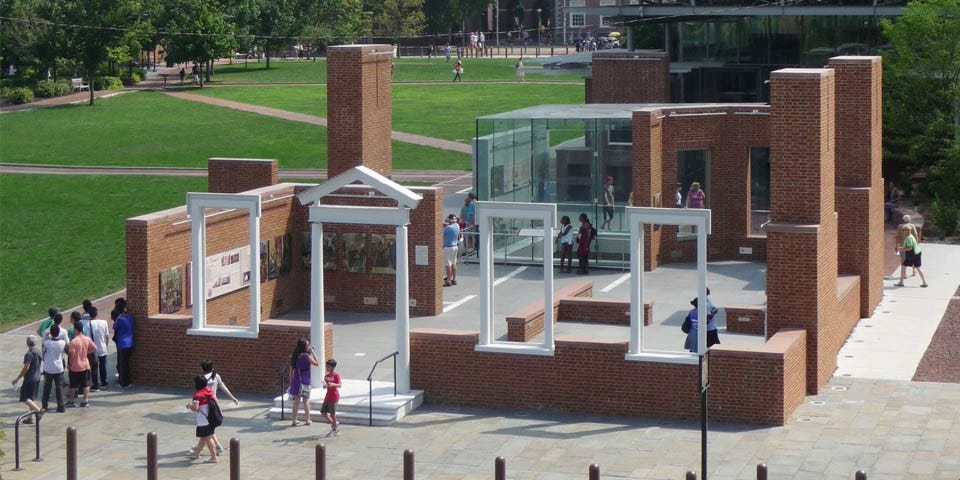

Photo: NPS site
This Community Is Powered by You
What started as a small circle has grown into something much bigger, and it’s all because of readers like you.
Every time you forward this email, post it on socials, or bring someone new into the fold, you’re helping build one of the most passionate, independent political communities out there.
Want to keep the momentum going?
Share this newsletter with someone who should be part of this conversation.
Thank you for being here. It means everything.
The House That Refused To Forget
The President’s House Site sits just steps from the Liberty Bell and Independence Hall, right in the symbolic heart of the founding story. Beneath the glass and stone are the foundations of the house that served as the executive mansion when Philadelphia was the nation’s capital. For generations, the official story on that ground celebrated the presidency and the Revolution while saying very little about the people Washington owned.
Local Black activists, historians, and city officials spent years fighting to change that. In 2010, the National Park Service and the City of Philadelphia opened an exhibit titled “Freedom and Slavery in the Making of a New Nation.” It did something that should not be radical, but still is in many public spaces. It named and centered the nine enslaved Africans brought to Philadelphia by Washington, and it framed their lives alongside the high politics of the early republic.
That exhibit did not appear by the grace of a friendly superintendent. It was the product of a 2006 cooperative agreement between the city and the federal government, later amended, that set out in writing how the site would be interpreted. The agreement recognized the city’s continuing interests at Independence National Historical Park and committed the parties to commemorate “all those who lived in the house while it was used as the executive mansion, including the nine enslaved Africans brought by George Washington.”
For more than 15 years, anyone who came to see “the first White House” encountered, in text and video, the reality that Washington rotated enslaved people in and out of Pennsylvania to evade the state’s gradual emancipation law. That was not a controversial new thesis. It was the federal government finally catching up to the scholarship and to the people who had been saying for decades that you cannot tell this story honestly if you omit the people in chains.
That is the version of history that vanished overnight in January.
The Executive Order That Opened the Door
The removal did not come out of nowhere. In March 2025, Donald Trump signed Executive Order 14253, officially titled “Restoring Truth and Sanity to American History.”
On its face, the order directed federal agencies, including the Department of the Interior and the Smithsonian, to review their exhibits, signage, and online materials for “improper ideology,” “divisive narratives,” and content that “inappropriately disparages Americans past or living (including persons living in colonial times).” It told agencies to correct materials it said “perpetuate a false reconstruction of American history,” and to emphasize “the progress of the American people” and “American greatness.”
Those phrases are not defined anywhere in the order. That vagueness was not an accident. In the name of “truth” and “sanity,” the order handed political appointees and agency lawyers a set of elastic terms that could be stretched to cover almost any narrative that made certain audiences uncomfortable. Criticism of the Confederacy has been called “divisive.” Acknowledging the brutality of Native dispossession has been criticized as “disparaging” to “pioneers.” Calling slavery what it was has been attacked as “anti-American.” EO 14253 folded all of that grievance politics into official federal policy language.
The legal shield behind this kind of directive is something called the government speech doctrine. In a series of Supreme Court cases, the Court has held that when the government speaks in its own voice, it may choose its message in ways that would be unconstitutional if it were regulating private speech. That doctrine is why the state can issue its own license plate designs or decide what goes in its pamphlets without offering equal space to every possible viewpoint. It is also why administrations that want to sanitize history write executive orders like this one as instructions about what “the federal government” should say, rather than as direct restrictions on what private people may say.
On paper, then, EO 14253 looks like a classic “we choose our own message” document. In practice, it became something more severe: a green light to start ripping out the parts of public history that this White House considered too “negative.”
From Paper To Crowbars
Within The Deparment of the Interior, EO 14253 was implemented through follow-on guidance that instructed bureaus, such as the National Park Service, to review their interpretive materials against the new “truth and sanity” standard. The directive told staff to identify displays that “inappropriately disparage” Americans, remove or rewrite them, and restore older language when more recent content was deemed “ideological.”
The President’s House was not the only place touched by this review. Reporters and advocacy groups have documented panels about Native American displacement, Japanese American incarceration, and climate change being flagged or taken down at park units across the country. Signs describing the forced removal of Indigenous communities at some western parks have been removed or rewritten. New notices appeared at certain historic sites, asking visitors to report exhibits they believed were too “negative” about Americans, inviting complaints about accurate history as if it were vandalism.
Most of those changes happened quietly. There were no press releases announcing that a particular sign about boarding schools had been pulled or that the word “massacre” had been swapped for “battle” on a wayside. The Sierra Club had to sue under the Freedom of Information Act in January 2026 just to try to force Interior to disclose basic records about how and where the “history purge” was happening. Major outlets have reported numerous incidents early this year.
In Philadelphia, however, the purge was impossible to miss. The President’s House stands in the middle of a busy civic space, and plenty of people knew exactly what the exhibit looked like before the crews arrived. When they saw the panels gone and the structure stripped bare, there was no way to spin it as routine maintenance.
The city responded the same day, filing a lawsuit in federal court. That speed and that plaintiff are part of why this case looks very different from what is happening at more remote or less resourced sites.
Why Philadelphia Could Say No
The city’s lawsuit did not argue that the executive order was unconstitutional in the abstract. It took a more concrete path. Philadelphia sued the Department of the Interior, the National Park Service, and named officials under the Administrative Procedure Act, which is the law that governs how federal agencies must make decisions. The APA is the reason agencies have to explain themselves, consider relevant facts, follow their own rules, and avoid abrupt about-faces without justification. It allows courts to set aside agency actions that are “arbitrary and capricious,” “contrary to law,” or taken “without observance of procedure required by law.”
The city argued that tearing down the slavery exhibit violated both the APA and the cooperative agreement. In plain language, the complaint said that the federal government promised in writing to tell this story in partnership with Philadelphia, acted for years as though that promise mattered, and then, one January morning, unilaterally pretended that commitment did not exist. Citing EO 14253, the complaint said, did not excuse a failure to honor that agreement or to explain why years of interpretive practice had suddenly become unacceptable.
Judge Rufe agreed, at least at this early stage. In granting a preliminary injunction, she ruled that the removal of the panels was a final agency action subject to review and that Philadelphia was likely to prevail on its APA claims. She accepted that the cooperative agreement, though formally expired, still structured the relationship between the parties and the expectations around the site. She found that NPS had failed to offer a reasoned explanation for abandoning the long-standing interpretive approach and that gutting the exhibit without the city’s consent likely violated the agreement’s core understanding.
Her order requires the federal government to restore the panels and related materials “to their condition as of January 21, 2026” and to refrain from further unilateral changes while the case proceeds. It does not forbid the executive branch from ever touching an exhibit again. It does something subtler and more important. It says that even when the president claims broad power to direct “government speech,” federal agencies still have to obey contracts, statutes, and basic principles of rational decision making.
For other sites, that combination of facts is rare. Many parks lack a detailed cooperative agreement with a city that serves as a legal anchor. Many affected communities do not have in-house counsel ready to file on day one. Philadelphia had both. The law did not somehow care more about enslaved people in one location than another. It responded to the specific tools available there.
What This Means Beyond One Exhibit
The President’s House ruling does not automatically protect other sites where history is being softened or stripped. However, it does show that the executive’s power to rewrite public memory is not unlimited, even under a broad executive order.
At some places, the statute itself provides a hook. Sand Creek Massacre National Historic Site in Colorado was created by Congress in 2000 with that exact name, and the law establishing it describes the 1864 killing of Cheyenne and Arapaho people as a massacre. The term is not a curator’s editorial choice, but rather a legislative finding. If Interior tried to rename the site or systematically scrub the word “massacre” from official interpretive materials, the tribes connected to Sand Creek would have a straightforward argument that the agency was acting “not in accordance with law” within the meaning of the APA, because it was contradicting the statute that defines the site’s purpose.
Manzanar National Historic Site in California, which interprets the incarceration of Japanese Americans during the Second World War, has unusually explicit enabling language as well. When Congress created the site in 1992, it directed the National Park Service to tell the story of the “relocation, internment, and incarceration” of people of Japanese ancestry. That phrase was chosen in the wake of the Civil Liberties Act of 1988, in which the federal government formally acknowledged that the mass removal and confinement were unjust and based on “racial prejudice, wartime hysteria, and a failure of political leadership.” If federal officials began to systematically replace “incarceration” with euphemisms like “wartime relocation” on Manzanar’s signage, survivors and descendants would have at least a colorable claim that the agency was subverting the site’s statutory mission.
Many other parks and monuments do not have such specific language. Their enabling acts tell the Park Service to preserve “natural and historic objects” or to protect “scenery and wildlife.” In those places, tribes or other affected communities would need to point to treaty rights, consultation requirements, management plans, or other formal commitments to show that the government has more than free rein. There may be cases to bring, especially where consultation has been ignored. However, the hurdles are higher, and the bandwidth to clear them is limited.
That is where Congress comes back into the picture. Lawmakers like to lament executive “overreach,” but they also wrote the vague statutes that leave so much room for manipulation. If Congress does not like watching presidents weaponize words like “divisive” and “disparaging” to erase uncomfortable history, it can narrow that space. It can amend site statutes to make clear that certain episodes must be interpreted honestly and explicitly, it can write into law that particular terms cannot be removed or softened without new legislation, and it can condition Interior’s funding on compliance with those requirements. Those would not be radical moves. They would be Congress finally using the power it already has.
The Senate’s Moment
All of this is colliding with another event in Washington, the confirmation hearing of a new director of the National Park Service, Scott Socha. That hearing will be, in theory, one of the few moments when the legislative branch can look a pending senior executive official in the eye and say, “We wrote the laws you will be expected to enforce. Do you understand what they require?”
If senators choose to treat the confirmation as a generic exam on whether the nominee “loves our parks,” the opportunity will pass. If they treat it as a serious interrogation of how the agency is handling history under EO 14253, it could become a real check.
The questions do not have to be complicated. Senators can read aloud the statutory language for sites like Sand Creek and Manzanar and ask the nominee to affirm, plainly, that an executive order about “disparaging” content cannot override those statutes. They can enter Judge Rufe’s ruling into the record and ask whether the nominee accepts that the agency acted unlawfully when it tore down the President’s House exhibit without the city’s consent. They can ask whether the nominee will issue written guidance instructing Park Service staff that historically accurate content cannot be removed simply because it makes some visitors (or politicians) uncomfortable, and that any proposed changes to exhibits about slavery, Native history, or incarceration will go through public processes and consultation with the communities whose histories are at stake.
None of that would guarantee compliance. A nominee can nod along at a hearing and later drift with the political winds. However, a hearing like that would at least make the conflict explicit. Either the Senate is willing to defend the laws it passed and the histories it once voted to preserve, or it is content to let vague executive language about “sanity” and “greatness” quietly hollow those commitments out.
See our previous reporting on Socha’s record and experience here.

A Small Line In A Flooded Zone
Steve Bannon once described the strategy out loud. Keep the public sphere so flooded with provocations and crises that media, activists, and lawyers cannot possibly keep up. It is not subtle, but it is effective.
Challenging an executive order in federal court requires plaintiffs with standing, lawyers who understand both history and administrative law, money, time, and stamina. Most communities whose histories are being softened or erased on public land do not have all of those pieces. They are already fighting on other fronts, such as voting, policing, land rights, health care, and education. In that environment, a sign that quietly disappears in a remote corner of a national park may simply be one injustice too many to chase.
Philadelphia was an exception. It had a cooperative agreement in its files, an exhibit in the center of a major city, and lawyers within the city government willing to file suit the same day the panels came down. Judge Rufe’s order does not end the broader campaign to sanitize public history, and it may yet be narrowed or overturned on appeal. However, it proves an important point. Even in a system tilted toward executive discretion, there are still places where facts, contracts, and statutes can hold.
The President’s House case is about nine enslaved people whose names were nearly pushed back into silence, and about a court saying that you cannot simply pretend they were never there because a president signed a piece of paper in March 2025. It is also a test for Congress and the Senate. They can shrug and move on to the next manufactured crisis, or they can treat this episode as a warning about what happens when legislative power is ceded and not reclaimed.
History on public land will never be free of politics. However, it does not have to be entirely at the mercy of whichever administration is most willing to call truth “disparaging.”
If you want more reporting that connects the fine print of executive orders to the stories getting erased on the ground, this is what The Coffman Chronicle does here every week. Subscribe to get the next deep dive in your inbox, and share this piece with someone who believes that if those in the past wanted to be remembered better, they should have behaved better.
Sources:
“US judge tells National Park Service to reinstall Philadelphia slavery exhibit” — Reuters — February 16, 2026.
“US judge orders Trump administration to restore Philadelphia slavery exhibit” — The Guardian — February 16, 2026.
“Trump administration ordered to restore George Washington slavery exhibit it removed in Philadelphia” — Associated Press — February 16, 2026.
“Judge orders slavery exhibit to be restored after Trump administration removal” — The Washington Post — February 16, 2026.
“Trump administration must restore slavery exhibit at Philly’s President’s House, federal judge rules” — WHYY — February 16, 2026.
“Federal Judge Invokes ‘1984’ While Ordering Trump Administration to Restore Slavery Exhibit in Philadelphia Park” — People — February 16, 2026.
“Judge orders slavery exhibit returned to President’s House” — NBC10 Philadelphia — February 16, 2026.
“Statement on the Freedom and Slavery Exhibit Removal at Independence National Historical Park” — Organization of American Historians — January 24, 2026.
“RESTORING TRUTH AND SANITY TO AMERICAN HISTORY: Executive Order 14253 of March 27, 2025” — White House — March 27, 2025.
“Restoring Truth and Sanity to American History” (Executive Order 14253, Document No. 2025-05838) — Federal Register — April 3, 2025.
“Executive Order 14253—Restoring Truth and Sanity to American History” — The American Presidency Project, UCSB — March 27, 2025.
“Executive Order 14253” — Wikipedia
“Restoring Truth and Sanity to American History (Executive Order #14253)” — Congressional Black Caucus Foundation — March 27, 2025.
“Statement on Executive Order ‘Restoring Truth and Sanity to American History’” — Organization of American Historians — March 31, 2025.
“Smithsonian Institution: Potential Effects of Executive Order 14253 ‘Restoring Truth and Sanity to American History’” — Congressional Research Service — April 23, 2025.
“A Black Studies Professor’s View on ‘Restoring Truth and Sanity to American History’” — History Colorado — August 1, 2025.
“National park signs related to Native Americans, climate change to be removed” — The Washington Post — January 27, 2026.
“US national parks told to remove signs on mistreatment of Native Americans, climate change” — Reuters — January 27, 2026.
“The NPS Just Yanked Historical Signs From the Grand Canyon, Glacier, and Other Parks” — Outside — January 28, 2026.
“New Park Signs Undermine Rangers, Aim to Erase History” — National Parks Conservation Association — June 12, 2025.
“National parks remove ‘negative’ history signage under new directive” — Ozarks at Large, KUAF — December 17, 2025.
“Trump’s administration continues its effort to censor history” — American National Parks Reform — September 23, 2025.
“SO 3431 – Restoring Truth and Sanity to American History” (Interior Secretary’s implementation order) — U.S. Department of the Interior — May 20, 2025.
Excellent Articles on our present administration's attempts to erase truth in the history of the United States. Let's hope and ensure that the Court's intervention to preserve our monuments, museums, literature, and other cultural heritage is replicated nationally. We, the People, whose ancestors formulated this "Great Experiment" of our democratic republic, the United States of America, deserve better and must continue to dedicate our efforts to restore, rebuild, and support the accurate, inclusive, factual truth in representing our history.
If people are made to feel uncomfortable about our true history, then good, for those issues involving slavery, treatment of our indigenous populations, and the incarceration of Japanese Americans during WWII, we need to be uncomfortable. Being uncomfortable encourages most of us to examine our own views of the past reality and try to improve the present and future. My brother teaches history and civics to hs students and does not gloss over the truth in history. It encourages healthy discussion and surprisingly there haven’t been complaints from parents. What Trump is trying to do does not try “In order to form a more perfect union”, he’s trying to censure history. And I must ask women in particular,(but also men) who agree with what Trump is doing—do you also think we don’t deserve to vote?