


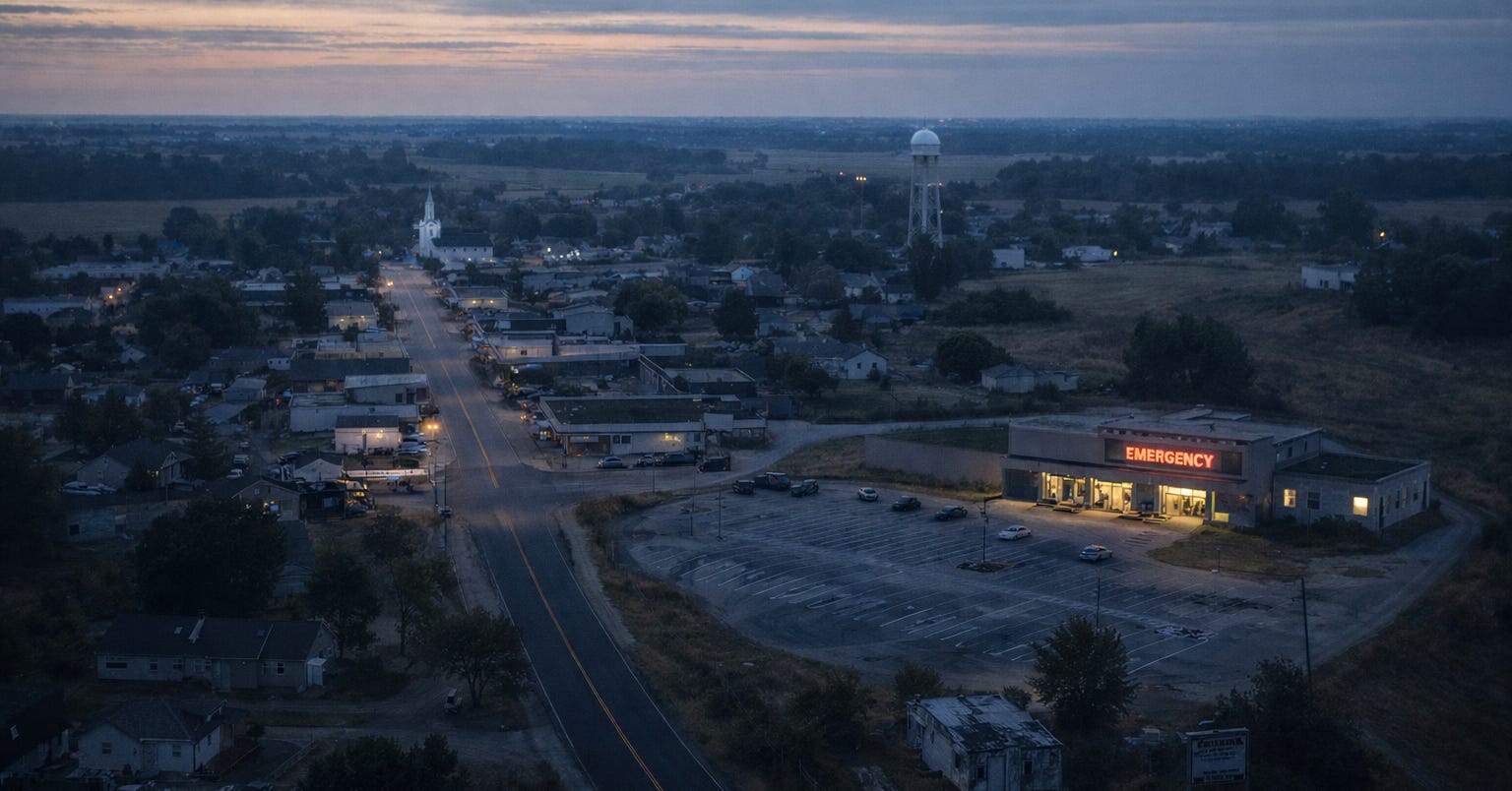
They wrap themselves in the language of working people, small towns, and forgotten America. They pose in hard hats, praise “real America,” and talk as if they are fighting for the people this economy left behind. But if you follow the policy instead of the branding, a different picture comes into focus. The Trump administration is not cutting healthcare evenly. It is cutting where working-class people are most exposed: in Medicaid, in rural hospitals, in low-income coverage pathways, and in the fragile systems that keep care within reach for families already living one emergency away from financial ruin. KFF says the 2025 reconciliation law is projected to increase the number of uninsured by about 10 million by 2034, while Reuters reports that more than 40% of rural hospitals are already operating at a loss.
That is what makes this more than a budget story. When healthcare gets cut at the top, the pain does not stay there. It lands in towns where the hospital is one of the last major employers. It lands on the mother, who now has to drive farther to deliver her baby. It lands on the diabetic worker who loses coverage, skips care, and hopes nothing gets worse before payday. It lands in counties where the ER is not just a building, but the thin line between a crisis and a funeral. Reuters reports that roughly 60 million Americans live in rural areas served by only about 2,000 rural hospitals, many of them heavily dependent on Medicare and Medicaid reimbursements that already fall short.
And that is the pattern hiding in plain sight. The same political movement that claims to speak for the working class keeps targeting the parts of the healthcare system that working people rely on when life goes wrong. The administration can point to smaller rescue funds and branded reforms, but those promises do not erase the larger reality: this agenda shifts risk downward. The people with money will still find care. The people without it will wait longer, drive farther, pay more, or go without. That is not reform. It is abandonment dressed up as fiscal discipline. KFF says the rural health fund is temporary, providing $10 billion per year from fiscal years 2026 through 2030, even as broader Medicaid and ACA changes are not time-limited.
This Community Is Powered by You
What started as a small circle has grown into something much bigger, and it’s all because of readers like you.
Every time you forward this email, post it on socials, or bring someone new into the fold, you’re helping build one of the most passionate, independent political communities out there.
Want to keep the momentum going?
Share this newsletter with someone who should be part of this conversation.
Thank you for being here. It means everything.
This is not one story. It is a pattern.
Taken one at a time, each move can be sold as technical, budgetary, or bureaucratic. A change to Medicaid eligibility here. A reimbursement squeeze there. A rural hospital closure explained away as a local management problem. A coverage pathway narrowed in the name of efficiency. A public-health grant frozen in the language of discipline. That is how this kind of agenda protects itself. It breaks the damage into separate headlines so the public never sees the whole picture.
But the whole picture is exactly what matters.
What we are looking at is not a random pile of healthcare stories. It is a governing pattern that keeps shifting cost, instability, and loss of access onto the people least able to absorb it. The administration does not have to announce that it is targeting the working class for the effect to be real. It only has to keep tightening the systems that people rely on most. Medicaid is one of the clearest examples. KFF says the Medicaid changes set in motion for 2026 are projected to increase the number of uninsured people by 7.5 million by 2034, with 5.3 million of those losses tied to new work requirements alone.
Those losses do not land on some abstract average American. They land where the system is already thin, fragile, and underfunded. Rural communities often have fewer providers, fewer hospitals, longer travel times, and heavier reliance on public insurance. When coverage shrinks in places like that, the consequences multiply fast. Reuters’ reporting on rural hospitals and KFF’s work on Medicaid in rural areas point in the same direction: many of these communities are already operating with very little slack.
That is why rural hospitals belong at the center of this story. These hospitals depend heavily on Medicare and Medicaid reimbursements, which already fall short of covering the real cost of care. So when Washington tightens coverage, delays enrollment, or cuts reimbursement-linked support, it is not just trimming a budget line. It is putting pressure on the emergency room, the maternity ward, the ambulance route, and one of the last major employers holding a rural town together.

Medicaid is the main target
If this article has a center of gravity, it is Medicaid. That is where the pattern becomes hardest to explain away, because Medicaid is not some niche program serving a tiny slice of the country. It is one of the main ways working-class Americans, poor families, disabled people, children, and many rural communities get healthcare at all. KFF says the 2025 law’s Medicaid changes are projected to leave 7.5 million more people uninsured by 2034.
The scale matters. KFF says 5.3 million of the people expected to lose coverage under the Medicaid changes would do so solely because of new work requirements. Those are not bookkeeping adjustments. Those are policy choices that will push millions of people out of coverage or make it harder to keep coverage.
The justification is just as revealing as the policy. Work requirements are sold as a push toward responsibility, but the people most likely to lose coverage are often people living complicated, low-margin lives who get tripped up by paperwork, reporting rules, unstable schedules, caregiving burdens, or illness. In practice, the policy does not just test willingness to work. It tests the ability to navigate bureaucracy while poor.
When people lose Medicaid, the damage does not stop with their insurance card. It spills outward into the rest of the healthcare system, especially in places already operating on thin margins. KFF says Medicaid covers nearly half of all births in rural areas and one-fifth of inpatient discharges in rural hospitals. It also says Medicaid expansion has been associated with better rural hospital finances and a lower likelihood of closure. That means cutting Medicaid is not just a hit to individual enrollees. It is a hit to the hospitals, maternity wards, and provider networks that whole communities depend on.
That is why Medicaid belongs at the center of this story. For working-class families, it is often the difference between seeing a doctor and waiting until the crisis gets worse. It is the difference between preventive care and the emergency room. It is the difference between a hospital staying open and a county becoming one more medical desert. That is not an accidental side effect of the policy. It is the foreseeable result.
Rural hospitals are where the damage becomes visible
If Medicaid is where the policy choice is made, rural hospitals are where the consequences become impossible to hide. This is where an argument about federal budgets stops being abstract and turns into miles, minutes, and funerals. As noted by Reuters, a large share of rural America is already held together by financially unstable institutions before the next round of cuts fully hits.
And when a rural hospital starts to fail, it usually does not fail all at once. First, a service line disappears. Then labor and delivery goes away. Then surgery gets cut back. Then the inpatient wing closes. Then the hospital is reclassified, downgraded, or shuttered outright. KFF says that from 2010 to 2022, rural hospitals closed 238 obstetrics units while only 26 opened new ones.
That matters because “the hospital is still open” can be a deeply misleading phrase. A hospital without maternity care is not the same hospital. A hospital without surgery is not the same hospital. A hospital without inpatient beds is not the same hospital. In many places, what disappears first are the services that make a community feel medically livable: having a baby close to home, getting stabilized after a heart attack, seeing a specialist without losing half a day to driving, missing work, childcare, and gas money. Reuters notes that rural areas already face fewer doctors, worse health outcomes, and longer distances to care than urban communities.
This is not a fringe problem affecting a handful of unlucky towns. Reuters’ March 2026 reporting and KFF’s rural-hospital data show the same broader reality: vulnerability is concentrated across large stretches of the South and Midwest, while rural service lines have been shrinking for years. This is not a story about isolated management failures. It is a story about a system that no longer reliably supports care in huge parts of the country.
And this is where the class dimension comes into focus. People with money can travel. They can take time off. They can absorb surprise bills, seek care in larger regional systems, or move closer to services if they have to. Working-class people often cannot. They are the ones who pay when the ER is farther away, when the ambulance ride is longer, when the maternity ward is gone, when the nearest specialist is two counties over, and when a town loses one of its last major employers at the same time it loses its hospital. Rural hospital collapse is not just a healthcare story. It is a story about how economic insecurity and medical insecurity feed each other until whole communities start to hollow out.
The replacement promises do not match the damage
This is where the story stops being only about cuts and becomes a story about political misdirection. The administration and its allies can point to the $50 billion Rural Health Transformation Fund as proof that they are protecting rural care. On paper, that sounds substantial. In practice, it looks much more like a patch than a solution. When the program rolled out, it was explicitly designed to offset the same budget cuts expected to hit rural hospitals, meaning the administration was already admitting there was damage to offset.
The bigger problem is that the math and structure do not align with the rhetoric. AP reported that estimates suggest rural hospitals could lose around $137 billion over the next decade because of the budget measure. Reuters likewise reports that rural hospitals are already financially fragile, meaning these systems were in no position to absorb another round of stress and then wait for a limited, temporary rescue fund to sort things out.
And the fund's design makes the gap even harder to ignore. KFF says the rural health fund is temporary: $10 billion per year from fiscal years 2026 through 2030. Even in the most generous reading, that is a time-limited cushion against deeper, longer-lasting structural losses. That is not the same thing as protecting rural healthcare.
That is the pattern again: weaken a broad system of public support, then promote a narrower branded initiative as proof that no one is being abandoned. But a temporary fund cannot fully replace stable coverage. A pilot cannot replace a maternity ward. A press release cannot replace an emergency room. For working-class families living in places where care is already one closure away from crisis, the difference is not academic. It is the difference between access and absence.
The cuts go beyond hospitals
The pattern does not stop at Medicaid or rural hospitals. It shows up anywhere low-income and working-class people depend on public systems to close the gap between what healthcare costs and what their lives can actually bear. One example is the Affordable Care Act marketplace. KFF says the 2025 budget law contributes to a projected 10 million increase in the uninsured by 2034, in part through changes affecting Medicaid and ACA coverage. When low-income enrollment pathways are narrowed and eligibility becomes harder to maintain, the people hit first are those least equipped to absorb the disruption.
The people affected are not sitting on extra cash or flexible options. They are the people most likely to lose coverage due to a missed deadline, a confusing notice, an unstable work schedule, a paperwork problem, or an income fluctuation that makes their eligibility harder to document. When policymakers make those pathways harder to use, they are not creating discipline in some abstract system. They are increasing the odds that working people go uninsured because their lives are precarious and hard to fit into neat administrative boxes.
The same governing style shows up in public-health funding. Reuters reported on February 12, 2026, that California, Colorado, Illinois, and Minnesota sued over the administration’s decision to terminate about $600 million in public-health funding. The states argued the cuts were unlawful and politically motivated, and Reuters reported that the money supported disease outbreak response, emergency planning, and HIV prevention.
That may sound separate from the hospital story, but it is part of the same picture. Working-class communities are rarely protected by just one program. They rely on layers of support: Medicaid, marketplace coverage, community clinics, addiction services, emergency planning, disease surveillance, maternal care, and local public-health capacity. When those layers are thinned across the board, the damage compounds. A person who loses affordable coverage is more likely to delay care. A county with fewer public-health resources is less able to catch the next crisis early. A hospital already running in the red has less capacity to absorb uncompensated care when more uninsured people show up. The result is not one dramatic collapse. It is a slower unraveling that leaves ordinary people with fewer backups every time something goes wrong.
The political hypocrisy at the center of it
This is the part of the story that should make people angry.
For years, Trump and the broader Republican movement have wrapped themselves in the language of the forgotten American. They talk about coal towns, factory towns, farming communities, churchgoing families, and the people they say coastal elites stopped seeing. They sell themselves as the voice of the working class and the defenders of small-town America. But when you strip away the branding and look at what happens to the systems people actually rely on, the picture changes fast.
That is the hypocrisy at its center. You cannot credibly say you are fighting for working people while backing policies that make it harder for working people to see a doctor, keep coverage, deliver a child close to home, or survive a medical emergency without financial ruin. You cannot pose as the guardian of rural America while tolerating a healthcare structure that leaves rural counties with fewer services, fewer providers, and longer drives to care. KFF notes that Medicaid covers nearly half of births in rural areas, which means cuts to Medicaid are not some distant ideological victory. They reach directly into the most intimate and vulnerable moments in family life.
The speeches talk about dignity. The budgets produce fragility. The slogans talk about protecting families. The policies weaken the systems families depend on when someone gets sick, pregnant, injured, addicted, disabled, or old. That contradiction is not accidental. It is how modern politics often works: symbolic loyalty upward, material loss downward.
The cruel genius of this model is that it spreads the pain out just enough to make accountability harder. One town loses maternity care. Another loses a hospital wing. Another sees more people thrown off coverage. Another loses addiction-treatment capacity or a public-health grant. Each injury can be framed as technical, local, or unfortunate. Together, they form a very clear pattern. The people being praised the loudest are often the ones being protected the least.

Why this matters beyond rural America
It would be easy for some readers to look at all this and tell themselves it is a rural story, a red-state story, or somebody else’s problem. That would be a mistake. Rural communities are where the damage is easiest to see first, but they are not the only places living with the consequences. When Medicaid shrinks, when low-income coverage becomes harder to maintain, and when hospitals already operating on thin margins lose more financial stability, the pressure does not stay neatly contained within one county line.
Healthcare systems are interconnected even when politics tries to sort people into separate boxes. A hospital closure in one rural county can push more patients into neighboring systems. More uninsured patients mean more uncompensated care. Uncompensated care places greater financial pressure on clinics, hospitals, and community health centers that are already stretched. When coverage is weakened at scale, the burden moves outward.
The same is true for families that do not think of themselves as poor until one illness proves otherwise. Working people in small cities, outer suburbs, and exurban counties are often only one layoff, one injury, one complicated pregnancy, or one bad diagnosis away from needing the very safety-net systems now being weakened. Once those systems are thinner, everyone feels it differently, but everyone feels it. Wait times get longer. Travel distances grow. Local provider shortages worsen. Regional inequality deepens. Care becomes less about medical need and more about whether your ZIP code, job, and bank account give you room to maneuver. Rural America is the warning light. The rest of the country should stop pretending the alarm is not for them.
They are not cutting healthcare evenly
By now, the pattern should be hard to miss. These are not neutral trims spread fairly across the system. They are decisions that hit hardest where people have the least cushion: low-income families, rural communities, working people with unstable schedules, patients who rely on Medicaid, and towns whose hospitals were already one budget shock away from crisis. When the systems carrying that kind of weight are weakened, the damage does not fall evenly. It falls downward.
That is the truth buried under all the branding. A movement that says it fights for forgotten Americans is backing policies that make it harder for forgotten Americans to keep coverage, harder for their hospitals to stay open, and harder for their communities to hold on to basic care. This is not a system being made leaner for everyone. It is a system being made harsher for the people who already live closest to the edge.
And once you see that clearly, the language of reform starts to look a lot more like the language of abandonment. The people with money will still find care. The people with flexible jobs will still travel. The people with private options will still have exits. But the working class, the poor, the elderly, the disabled, and the rural families held together by thin public systems will be asked to absorb the loss.
That is the real shape of this agenda. Not shared sacrifice. Not reform. Just a harsher system for the people already closest to the edge.
Support Independent Media: The Coffman Chronicle
The Coffman Chronicle is built to do the kind of reporting and analysis too many outlets skim past: the power, the policy, and the kitchen-table consequences that hit ordinary people long before the headlines catch up. We follow the receipts, connect the dots, and tell the truth about who pays when the people in charge make their choices. If you can afford to become a paid subscriber, your support helps keep this work independent, reader-backed, and unafraid to keep digging, keep writing, and keep saying plainly what too many powerful people would rather go unspoken.
Sources:
“Trump Administration Rolls Out Rural Health Funding Program Intended to Offset Medicaid Cuts.” AP News, December 29, 2025.
“5 Key Facts About Medicaid Coverage for People Living in Rural Areas.” KFF, June 26, 2025.
“10 Things to Know About Rural Hospitals.” KFF, April 16, 2025.
“A Closer Look at the $50 Billion Rural Health Fund in the New Reconciliation Law.” KFF, August 4, 2025.
“Health Provisions in the 2025 Federal Budget Reconciliation Law.” KFF, August 22, 2025.
“Medicaid: What to Watch in 2026.” KFF, January 23, 2026.
“Four States Sue Trump Administration over Cuts to Public Health Funding.” Reuters, February 12, 2026.
“The Fragile Economies at the Heart of Rural Hospitals.” Reuters, March 19, 2026.
Where I live the nearest trauma center in over an hour away. When I was working as a 911 dispatcher in the 90s we had hospitals that were 30 minutes away by ambulance. Now it's a helicopter ride if one is available. This need to be fixed.
Could someone please explain to me why these betrayed people keep voting for Republicans?