


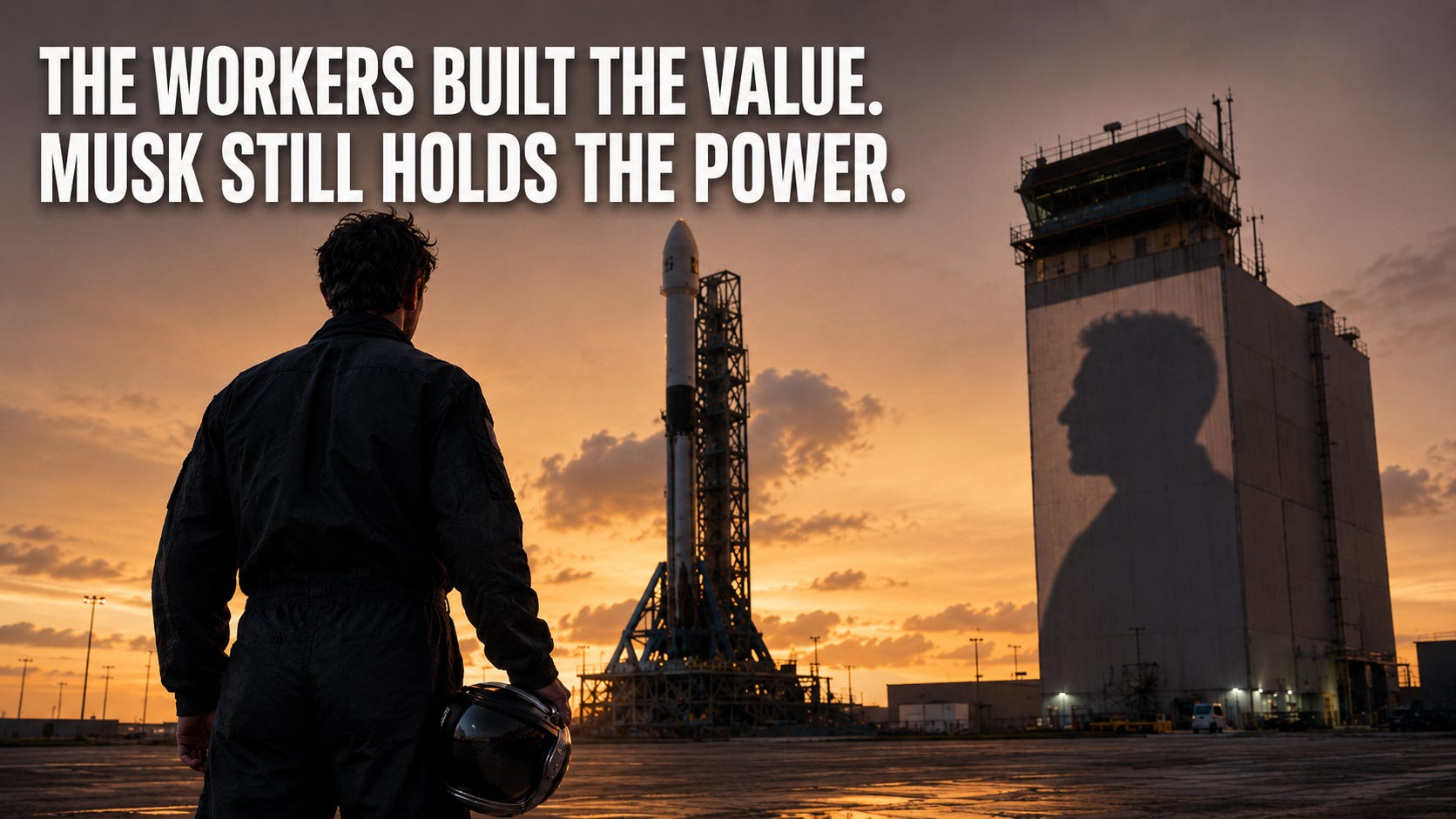
This Is Not an Elon Musk Redemption Story
Picture a technician leaving a SpaceX facility after another long shift. Maybe that worker helped assemble an engine, test a component, or solve one of the thousands of problems that must be answered before a rocket can leave the ground. Part of that worker’s compensation may include stock that could become the largest financial asset their family has ever owned.
The opportunity is real, but so is the dependence beneath it. The worker’s paycheck, healthcare, career, and stock may all be tied to the same company. Leaving could mean walking away from unvested shares. Speaking too openly about workplace conditions could place more than a job at risk. Even the chance to buy discounted stock means little when rent, groceries, childcare, and medical bills have already consumed the paycheck.
The Coffman Chronicle has spent years warning about Elon Musk’s concentration of power. His wealth extends to political communication, satellite infrastructure, spaceflight, artificial intelligence, government contracting, and systems that public institutions increasingly depend on. The problem is not simply that Musk is rich. It is that one unelected billionaire has converted private wealth into forms of public power that democratic institutions struggle to check.
Nothing about employee stock erases that concern. SpaceX equity does not turn Musk into a working-class hero, prove that every employee is treated fairly, or establish that the company is a good steward. Employee equity is compensation for helping build the company, not charity from the billionaire who controls it.
Still, SpaceX appears to show that workers can receive more than a paycheck when the company they helped build becomes extraordinarily valuable. The practice may be limited or uneven, but it exposes a larger truth: workers can own a piece of tomorrow without destroying private enterprise, eliminating investors, or preventing a founder from becoming enormously wealthy.
You do not have to like Elon Musk to believe the people who built SpaceX deserve a meaningful share of what they created.
The real question is why workers anywhere should have to wait for permission from the billionaire at the top.
Support independent media that follows the power.
The Coffman Chronicle is built to track who holds power, who abuses it, who profits from it, and who pays the price.
Paid supporters get full Tony Michaels Podcast episodes, deeper transcript analysis, paid columns, archives, and the reporting framework behind the show.
If you believe independent media has to survive outside billionaire platforms, corporate media, and party-approved gatekeepers, become a paid supporter today.
SpaceX Was Not Built by One Man
America’s favorite version of the SpaceX story begins and ends with the billionaire, now trillionaire. Musk is cast as the visionary, the risk-taker, and the force behind the company, while everyone else appears as supporting cast.
That is not how companies are built. Musk supplied private capital and made consequential decisions that could have ended in failure. Those contributions count, and the Square New Deal does not deny that risk and entrepreneurship deserve a return. However, Musk was never the only person carrying risk.
Engineers solved problems that had defeated earlier attempts. Machinists and welders turned designs into hardware. Programmers wrote systems in which a small failure could destroy years of work. Technicians, production employees, launch crews, administrators, and contractors made the operation real.
Those workers helped create the value now embedded in SpaceX. Many also accepted compensation tied partly to equity that might never become valuable or could disappear if they left before vesting. The billionaire risked money, while workers risked years of labor, future earnings, and career stability.
The public carried risk too. NASA and other federal agencies did not simply hand SpaceX free money. Taxpayers received launches, cargo transportation, technological capability, and competition in return. Those partnerships also supplied revenue, credibility, and an anchor customer in a market where government demand is foundational.
Federal support helped SpaceX move from ambitious startup to critical national contractor. A successful NASA mission did more than satisfy a contract. It proved that the company could deliver, reassured future customers, and gave SpaceX a path toward long-term viability.
Musk risked money. Workers risked years of labor. Taxpayers helped create the market. Yet the mythology remembers mainly the risk carried by the man whose name sits at the top.
When several groups help create prosperity, the return should not flow as though only one of them was there.
Employee Equity Is Compensation, Not Charity
The easiest way to misunderstand the SpaceX story is to say that Musk is “sharing his wealth” with employees. That gives the trillionaire too much credit and the workers too little.
Stock options, restricted shares, and employee stock purchase programs are forms of compensation. Companies use them to recruit skilled people, retain employees, reduce immediate cash costs, and tie a worker’s future more closely to the company’s success. For some SpaceX employees, equity may have become life-changing wealth.
That wealth is real, but it is not charity.
The workers performed the labor that helped make the shares valuable. They also accepted uncertainty. If the company had failed, the stock could have been worth little or nothing. If they left before vesting, they could lose part of what they had spent years working toward.
The company benefited from the arrangement as well. Equity can discourage workers from leaving and can become a set of golden handcuffs when stock, pay, healthcare, and career are all tied to one employer.
SpaceX’s programs deserve scrutiny rather than celebration. How much equity reaches production employees compared with executives and senior engineers? How many workers receive company-funded shares, and how many are merely permitted to buy stock from their own paychecks? What happens to unvested equity when employees leave? Are contractors included? Does stock supplement strong wages, or does it substitute for the money workers need now?
A stock grant can build wealth, but it cannot pay the electric bill unless it can be sold. An option may become valuable years from now, but it does not make groceries cheaper this week.
The honest conclusion is narrower than either praise or dismissal. Employee equity is compensation for helping build the company, not charity from the billionaire who controls it.
The deeper question is whether companies should merely allow workers to buy into prosperity or whether the company itself should share more of what those workers helped create.
Even Sam Walton Understood the Ownership Question
Sam Walton is not an obvious figure to invoke in an argument about shared prosperity. Walmart’s record on wages, labor practices, and corporate power makes any attempt to turn him into a working-class hero unserious.
Still, Walton’s early profit-sharing model recognized something many corporations prefer to forget: workers should share in the value they help create.
Eligible Walmart employees could accumulate wealth as the company grew, and the company contributed to the plan. That is different from merely inviting workers to purchase stock with whatever remains after their bills are paid.
An employee stock-purchase plan allows workers to use their wages to buy shares of the company. Company-funded profit sharing says that because workers helped create the profit, the company will place part of that value into their hands.
Walton did not surrender control of Walmart, and private ownership did not disappear. Investors still earned returns, and the founder remained extraordinarily wealthy. Workers simply had a better chance of rising with the company rather than standing still while nearly all the long-term gains flowed upward.
Even Sam Walton understood that workers should receive more than the privilege of watching the owner become richer.
That does not excuse Walmart’s later record or make Walton a saint. It shows that company-funded worker ownership is not a socialist invention. The real failure is that American capitalism still treats such sharing as an optional act of leadership rather than a normal part of the bargain.
A Share of Wealth Is Not a Share of Power
Employee stock can change a worker’s financial future without changing who controls the workplace.
Musk can allow employees to participate in financial upside while surrendering very little of the power that makes his position consequential. Workers may own shares without gaining influence over safety, scheduling, discipline, political spending, corporate governance, government relationships, or the use of infrastructure on which the public increasingly depends.
Return to the SpaceX technician. The stock in that worker’s account may be worth more than anything their family has owned, but its value may depend on staying until the shares vest. Speaking out, challenging management, or leaving for another job could put both present income and future wealth at risk.
When wages, healthcare, retirement, career prospects, and stock are tied to a single employer, the company gains leverage over nearly every aspect of the worker’s economic life. A termination, downturn, or conflict with management can threaten several layers of security at once.
Shared wealth is better than concentrating every gain at the top, but improved compensation is not the same as dispersed power. A billionaire can share enough wealth to strengthen employee loyalty while surrendering almost none of the control that makes him dangerous.
The Square New Deal, therefore, cannot stop at stock. Workers need reasonable vesting periods, transparent valuations, regular opportunities to sell vested shares, and the freedom to diversify. They also need retirement security that does not depend entirely on one employer, along with the right to discuss working conditions, organize, and challenge unsafe practices without retaliation.
A company should not give workers stock with one hand while demanding silence with the other. Employee ownership should make workers more independent, not make every part of their financial lives dependent on one employer. SpaceX may share part of the wealth its workers create, but Musk still holds the power. The Square New Deal must account for both.
The Workers Left Outside the Ownership Story
Corporate ownership programs often sound broader than they are. A company may say employees share in success while excluding many people who keep the operation running. Engineers and technicians may receive equity while janitors, drivers, security staff, food-service workers, maintenance teams, construction crews, and temporary employees remain outside the ownership story.
Their labor still supports the company. Their names simply appear on someone else’s payroll.
That creates an easy loophole. A corporation can offer stock to a highly skilled core workforce, outsource lower-paid jobs, and then point to the equity program as proof that prosperity is being shared.
The public usually sees the launch. It rarely sees the workforce beneath the launch.
The Square New Deal cannot judge stewardship by looking only at the employees a corporation finds convenient to count. Not every contractor must receive identical stock grants, but a company should not escape responsibility for low wages, weak benefits, or unsafe conditions simply by placing another corporate name between itself and the worker.
For large corporations receiving public contracts, subsidies, or tax benefits, basic standards should follow the work. Otherwise, companies can give stock to specialists, outsource lower-paid jobs, and advertise a culture of ownership while leaving much of the real workforce behind. That is not shared prosperity. It is selective prosperity wrapped in better branding.
Stewardship cannot stop at the edge of the payroll system the corporation designed for itself. If a company depends on the work, the company should be accountable for the conditions under which that work is performed.
The Public Helped Build the Company Musk Controls
SpaceX did not rise through private capital and employee labor alone. The American public helped create the conditions in which the company could survive, prove itself, and grow.
NASA did not simply hand Musk free money. The government used milestone-based agreements, purchased launches and cargo services, and received real value in return. Taxpayers were buying capability.
However, the relationship also supplied SpaceX with development support, revenue, credibility, and an anchor customer in an industry where the public sector helps shape the market. A successful NASA mission did more than satisfy a contract. It proved that SpaceX could deliver and helped transform a fragile company into a critical national contractor.
The question is whether the public negotiated enough in return for helping build a company that would eventually control critical infrastructure and accumulate extraordinary private power. The public return should match the form and scale of public support.
A routine government purchase does not create a permanent public claim on the seller. If an agency buys office furniture, the public return is the furniture, fair pricing, and performance. The calculation changes when the government provides major development funding, guarantees a market, builds infrastructure, assumes unusual risk, or helps create technology that later produces immense private wealth.
In those cases, the bargain should be stronger. It might include lower long-term prices, repayment after profitability, domestic-job commitments, living-wage requirements, broad employee ownership, community benefits, or emergency public-access protections. In some circumstances, warrants, royalties, or revenue sharing may also be appropriate.
The answer will not be identical for every contract, but the principle should be consistent. Taxpayers do not need to own every company the government hires, yet the public return should never be vague, accidental, or contingent on the owner’s gratitude.
SpaceX is not selling paper clips. Its systems touch national security, communications, and space access. As government dependence grows, so does the danger of allowing one private owner to become indispensable without meaningful democratic checks.
Public investment should create public value, not merely private valuation and deeper dependence on the person who controls it. The public should bargain like a real partner before private power becomes too large to negotiate with.
The Square New Deal Stewardship Test
SpaceX gives us one useful fact. Some workers can share in the company’s financial growth, which they helped build. That matters, but it is not enough.
A company should not earn the title of good steward just because it offers one attractive benefit while failing in every other respect. Stewardship must be judged across the full relationship among the company, its workers, the public, and the communities carrying the cost of its success.
Can workers afford to live where the work is performed? Do ordinary employees receive company-funded equity or merely permission to buy stock from wages they already earned? Is ownership distributed broadly, or does most of it remain concentrated among executives and highly paid specialists? Can workers organize and challenge unsafe conditions without fearing the loss of both their jobs and unvested shares?
Are vesting periods reasonable? Can workers sell vested shares and diversify? Are contractors being pushed outside the wage-and-ownership story? Did taxpayers receive value proportionate to their support? Does the company help cover the pressure it places on housing, roads, utilities, schools, and public services? Does one owner retain extraordinary control over infrastructure, information, or public capacity?
SpaceX provides evidence that some employees may have shared substantially in the company’s rising value. Public information does not yet establish how broad, fair, or secure that participation has been across the workforce. Employee equity also does not resolve questions about worker voice, contractor treatment, public accountability, or Musk’s concentration of control.
SpaceX proves that shared ownership is possible, but it does not prove that SpaceX has passed the stewardship test. Employee stock is evidence of one stewardship practice. It is not a certificate of good behavior for the company or its owner.
Stewardship is not sainthood. It is a standard for the distribution of power, prosperity, and responsibility.
Good Wages Today, Ownership Tomorrow
The Square New Deal begins with a simple idea. Workers should not have to choose between surviving today and sharing in the prosperity they help create tomorrow.
A living wage and employee ownership solve different problems.
Wages pay for life now. They cover rent, groceries, transportation, healthcare, childcare, utilities, and the ordinary costs of participating in a community. A paycheck that does not meet those needs cannot be repaired by pointing to stock that may become valuable years later.
Ownership gives workers a claim on future value. When a company grows more productive, gains market share, or reaches a valuation no one imagined, the people who helped build that success should not be left with nothing but memories of the hours they worked.
Workers deserve both. A company should not pay inadequate wages and defend the arrangement by saying employees may someday become wealthy from stock. Rent does not wait for a liquidity event, and the grocery store does not accept options. Decent wages alone are also incomplete when nearly all long-term appreciation flows to founders, executives, and investors.
The first Square New Deal promise is security today through wages that reflect the local cost of living. When corporations pay less, they shift part of the labor bill onto families, credit cards, public assistance, emergency rooms, and charities.
The second promise is ownership tomorrow through company-funded paths such as stock grants, profit-sharing deposits, retirement contributions, cash bonuses, or equity pools distributed across job categories and pay levels.
Good wages provide security today. Ownership provides a stake in tomorrow. Workers cannot buy a meaningful stake in tomorrow when today’s paycheck is already gone.
Congress Must Write the Terms
The weakness in the current system is not that every billionaire refuses to share prosperity, but rather that workers receive a meaningful stake only when the people at the top choose to provide one.
That is not a durable economic bargain. At best, it is a lottery based on who owns the company.
The Square New Deal is not built on the hope that America will produce kinder billionaires. It is built on public rules that reward good stewardship and impose a cost when corporations shift responsibilities onto workers, taxpayers, and communities.
Congress writes the tax code, funds NASA, regulates commerce and securities, establishes labor protections, and determines the conditions attached to contracts, grants, subsidies, and tax benefits. Those choices shape who receives the rewards of growth and who carries the cost.
Congress should ask how broadly employee equity is distributed, how much reaches ordinary workers, how much is forfeited when employees leave, and whether contractors are excluded. It should also ask what safeguards are needed when a private contractor becomes indispensable to national infrastructure.
These are Article I questions because they concern the terms under which public power and public money enter the private economy.
The answers should reflect the size and form of support. A small family company should not face the same requirements as a corporation receiving billions in federal contracts, and a routine purchase should not be treated like a major development partnership.
However, large companies should not treat public assistance as an entitlement while treating worker prosperity as optional.
The Square New Deal could reward broad employee ownership, attach living-wage and community-benefit standards to major public support, and require reporting that shows how equity is divided between leadership and the workforce.
Its low-wage and community-impact fee would provide the other side of the bargain. Large companies paying below a locally adjusted living-wage standard would help cover the costs pushed onto schools, housing, healthcare, transportation, and public assistance. Companies that pay strong wages, share profits, and invest in their communities could receive meaningful credits.
Good stewardship should be rewarded. Bad stewardship should carry a cost. Neither should depend on the mood, personality, or public image of the billionaire in charge.
When Congress refuses to establish the terms, billionaires set them for themselves. The question is not whether Americans should trust Elon Musk to share. The question is whether the people’s elected branch will write rules that no longer require that trust.
This Is Not Socialism. It Is a Better Bargain.
The predictable response is that asking corporations to share more prosperity with workers sounds like socialism. It does not.
The Square New Deal does not nationalize companies, confiscate businesses, abolish investors, or prevent founders from becoming wealthy. It recognizes private ownership, entrepreneurial risk, and profit. It simply refuses to pretend that capital is the only contribution deserving a lasting reward.
Workers contribute labor and skill. Communities provide roads, schools, utilities, housing markets, and emergency services. Taxpayers support research, infrastructure, and contracts that often enable private growth.
The Square New Deal proposes a better bargain. Founders can remain wealthy. Investors can earn returns. Companies can compete and innovate. Workers can earn living wages and receive a share of future value. Taxpayers and communities can receive enforceable value when public resources help reduce private risk.
The argument is not that Musk should become poor so SpaceX workers can prosper. It is that his prosperity should not require everyone else’s contribution to become disposable once the company succeeds.
Tony Michaels puts it plainly:
It is not “eat the rich.” We need to eat with the rich, so we all have prosperity.
The American people come first, not the abstraction of America as a brand, market, or corporate platform. American prosperity is more important than Elon Musk’s mythology, SpaceX’s valuation, or any one company’s product.
The Square New Deal does not ask successful people to surrender their prosperity. It asks why prosperity should become more exclusive as the company becomes more successful.
That is not socialism. It is a better bargain for a country that has spent too long rewarding the people who own the work while overlooking the people who do it.
Musk Shows Why the Rules Cannot Be Left to Musk
SpaceX gives us evidence that workers can share in the value they create. Elon Musk provides evidence of why that sharing cannot be left to the person who holds nearly all the power. Employee equity may have created real wealth for SpaceX workers, but stock ownership does not turn Musk into a steward.
A stewardship judgment must examine wages, distribution, worker voice, contractor treatment, public return, community impact, and concentrated control. A company does not pass because some employees received stock while the owner retained extraordinary power over the workplace, public contracts, and infrastructure on which the government increasingly depends.
Musk does not deserve praise. SpaceX shows worker ownership can exist without destroying private enterprise. SpaceX can remain profitable. Musk can remain wealthy. Investors can earn returns. Workers can still receive a lasting claim on the value their labor helped create. Once that possibility is visible, the question changes: Why should it remain optional?
Return to the technician leaving the SpaceX facility. That worker should not have to choose among speaking honestly, protecting unvested shares, paying bills today, buying a piece of tomorrow, or keeping a job and preserving financial independence.
A better system would provide living wages, company-funded ownership, reasonable vesting, diversification rights, and protection from retaliation. It would reward companies that share prosperity and impose stronger terms when taxpayers assume greater risk. Most of all, workers would not have to wait for a billionaire to decide that sharing is useful.
SpaceX may demonstrate one practice worth expanding. Elon Musk still demonstrates the concentrated power the Square New Deal is meant to restrain.
Americans should not have to trust Musk to do the right thing. We do not need better billionaires. We need better rules.
Support Independent Media
If this kind of independent reporting matters to you, consider becoming a paid subscriber to The Coffman Chronicle—if you can afford to. Your support helps fund the research, writing, and fact-checking behind articles like this one.
We are building a case for an economy where workers share in the prosperity they create, taxpayers receive a real return, and concentrated power is held accountable. Paid subscriptions help keep that work going.
Sources:
National Aeronautics and Space Administration. “First Contracted SpaceX Resupply Mission Launches with NASA Cargo to Space Station.” October 7, 2012.
National Aeronautics and Space Administration. “NASA Announces Launch Date and Milestones for SpaceX Flight.” December 9, 2011.
National Labor Relations Board. “Protected Concerted Activity.”
National Labor Relations Board. “Space Exploration Technologies Corporation (‘SpaceX’), Case 19-CA-303870.” Filed September 21, 2022.
Space Exploration Technologies Corp. “Prospectus for the Issuance of New Shares.” Free Writing Prospectus, Registration Statement No. 333-296070. U.S. Securities and Exchange Commission, June 5, 2026.
SpaceX. “Careers.”
U.S. Congress. House. Committee on Ways and Means. Subcommittee on Oversight. Employee and Employer Views on Retirement Security. 107th Cong., 2nd sess., March 5, 2002. Washington, DC: U.S. Government Printing Office, 2002.
U.S. Department of Labor. Employee Benefits Security Administration. “Employee Ownership.”]
NASA: Commercial Partners Are Making Progress, but Face Aggressive Schedules to Demonstrate Critical Space Station Cargo Transport Capabilities. GAO-09-618. June 16, 2009.
Fuck musk
Elon is just greedy and evil really. Just like trumpstein and all the people in power who support them. It's sickening.
We need better rules especially because we can’t count on billionaires to not be greedy or to be better people, they just aren't. The American workers are what made them billionaires. They would not be billionaires without our hard work.
If they were intrinsically better then they would know without having to be forced to, to value the workers and give them safe working conditions, and good access to healthcare and a much better living wage and ability to improve their lives appropriately and to not harm the environment we live in while doing that.
Trickle down economics has killed the "American dream." It allowed the ceos to become billionaires on our backs and it keeps getting worse.
They now actually seem driven to destroy us and all we care about. How does everything they have done since trump's inauguration make any other sense? It's doesn't! It must be their plan for some godforsaken reasoning.
I am sorry but I feel the despair of it at this moment. I do still try to have hope that we will come out better soon.
Many people like you guys are trying to do their part to inform and grow awareness and solutions.
Thank you.