


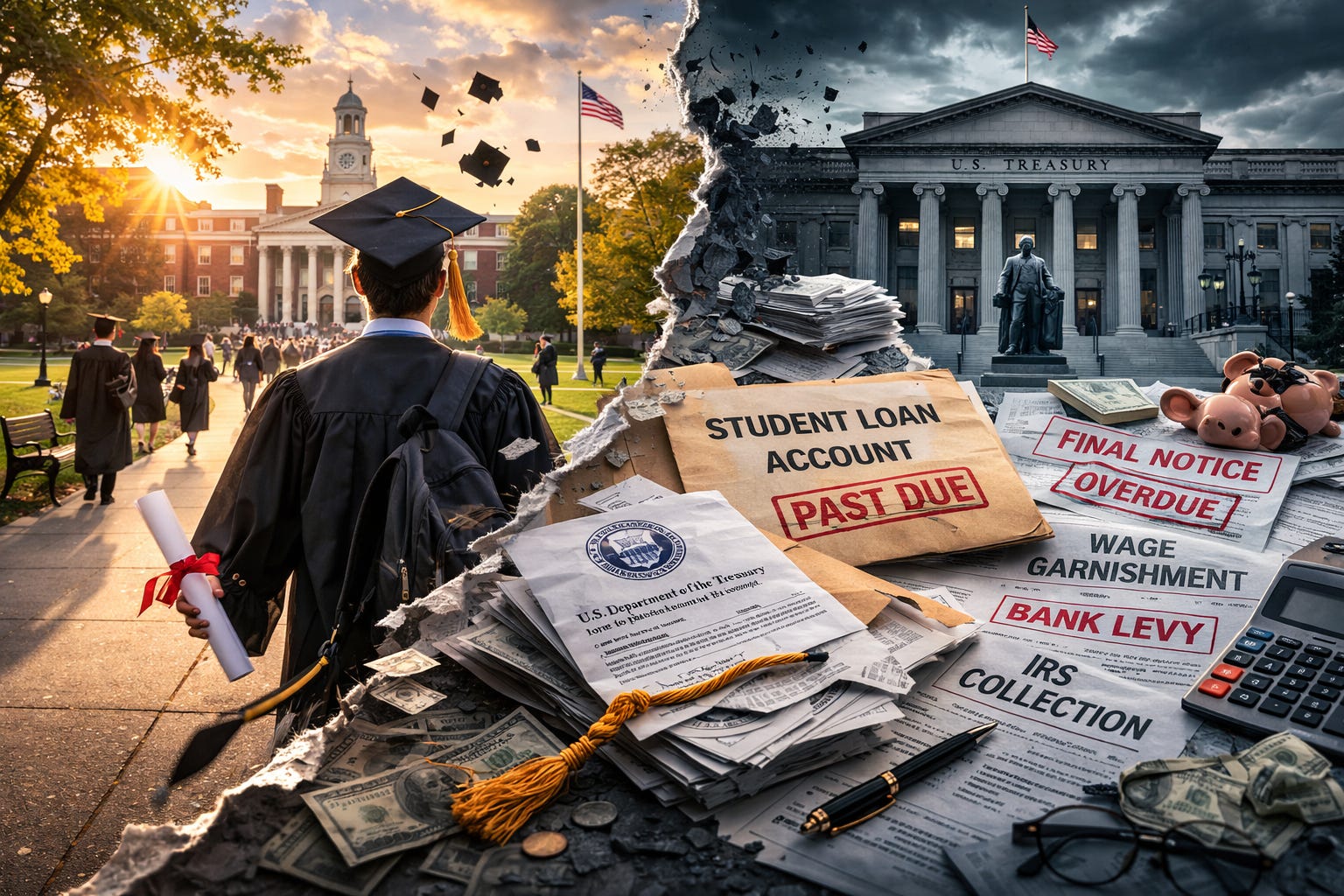
For millions of Americans, student debt is not a policy debate. It is the bill that shows up with the rent, the groceries, the utilities, and every other number that already does not add up. It is what people took on because college was supposed to widen their future, only to find that the debt followed them into adulthood and sat down at the kitchen table with everything else.
That is what makes the Trump administration’s latest move matter. Reuters reported on March 19 that the administration is shifting the collection of defaulted federal student loans from the Department of Education to the Treasury Department, with the possibility that Treasury’s role could later expand. That may sound like a bureaucratic adjustment. It is really a question about what student debt becomes when it moves farther away from education and closer to federal collection.
This Community Is Powered by You
What started as a small circle has grown into something much bigger, and it’s all because of readers like you.
Every time you forward this email, post it on socials, or bring someone new into the fold, you’re helping build one of the most passionate, independent political communities out there.
Want to keep the momentum going?
Share this newsletter with someone who should be part of this conversation.
Thank you for being here. It means everything.
What Actually Changed
On March 19, 2026, the Treasury Department and the Department of Education announced what they called a “historic federal student assistance partnership.” Reuters reported that the first phase moves operational responsibility for collecting defaulted federal student loans to the Treasury under a new interagency agreement. Treasury and Education also said later phases could expand Treasury’s role to include non-defaulted loans and other Federal Student Aid functions, “to the extent practicable and permitted by law.”
This is not, at least yet, a total handoff of the entire federal student-loan system. The administration is starting with defaulted loans. But Reuters reported the federal portfolio stands at about $1.7 trillion, with less than 40% of borrowers currently in repayment and nearly 25% already in default. In a distressed system, moving the defaulted slice is not marginal. It means the most financially vulnerable part of the portfolio is being moved first.
The administration is presenting the move as efficiency and better service. Treasury and Education both described it as a way to improve aid administration and return defaulted borrowers to repayment. But they also described the shift as part of a broader effort to “break up the Federal education bureaucracy,” which makes clear this is not just customer-service reform. It is part of a larger project of stripping major functions away from Education.
Why Treasury Changes the Meaning of the System
What makes this move more consequential than it sounds is that Treasury changes the system's meaning even before the handoff gets any bigger. A student-loan office inside the Department of Education is at least supposed to operate within an education mission: aid, access, repayment options, and the broader question of whether college remains reachable for people without family wealth. Treasury operates from a different center of gravity. It is a finance-and-collections agency. That institutional difference matters because it changes the lens through which borrowers are seen.
That is why this is not just a matter of reporting lines or who answers the phone. When a debt system moves deeper into Treasury’s orbit, questions that once sat inside an education framework start getting pulled toward a collections framework instead. Treasury and Education framed the partnership as reform, but in their own language, they also made clear that it fits the broader effort to break up the federal education bureaucracy. This is a reordering of power, not a housekeeping move.
For borrowers, the signal is hard to miss. The administration is not beginning with stable borrowers. It is beginning with borrowers in the deepest trouble. That is the heart of the debt-state angle here: student debt is being treated less as a consequence of how the country funds higher education and more like a distressed federal asset to be managed and recovered.
What This Looks Like at the Kitchen Table
At the kitchen table, the policy language gets a lot simpler. A lot of borrowers are not choosing between a student-loan payment and some luxury. They are choosing between a student-loan payment and groceries, rent, a car repair, childcare, or the credit-card balance they ran up trying to stay afloat. Reuters reported the portfolio is about $1.7 trillion, with less than 40% of borrowers in repayment and nearly 25% already in default. AP reported roughly 12 million Americans are behind on their student loans. That is not a niche population. It is a distressed-debt system affecting millions of households.
AP also reported that borrowers do not need to take any immediate action and that ordinary repayment processes remain unchanged for now, but the first phase still covers about $180 billion in defaulted loans, with future phases potentially reaching much further. For borrowers already struggling to keep track of servicers, repayment plans, and changing rules, such a transition can mean more confusion, more mistakes, and more fear about what comes next.
There is also the basic reality of default. AP reported that borrowers in default can face severe credit damage and that the government has powers such as withholding pay and Social Security benefits, even though involuntary collections remain paused for now. So when the administration says Treasury will help bring defaulted borrowers back into repayment, borrowers have reason to hear something more ominous underneath the sales pitch. Treasury is entering because millions of people are already in trouble.
This Burden Does Not Fall Evenly
This burden does not fall evenly, and that is where the class dimension becomes impossible to ignore. Wealthier families are far more likely to pay tuition out of pocket, absorb rising college costs, or shield their children from the worst parts of the loan system. Poor and working-class students are much more likely to borrow in the first place, which means they are also the ones most exposed when the government hardens the machinery around repayment and default. When opportunity is financed through family wealth for some people and through long-term debt for everyone else, a shift toward a harsher collection framework will land hardest at the bottom.
That is why the move cannot be understood as neutral simply because the policy is written in universal terms. A formally universal system can still be brutally unequal in its effects. Reuters reported that nearly 25% of borrowers are already in default, while AP reported that about 12 million Americans are behind on payments. Those are not just administrative numbers. They are signs that millions of people are already trying to carry educational debt without the cushion that wealth provides.
And that is the point where the class consequences start speaking for themselves. You do not have to prove that every architect of this policy announced a war on poor people. You only have to look at who gets protected and who gets exposed. Families with assets can often buy their children room to recover. Families without those assets borrow for the same chance, then spend years living under the consequences if upward mobility does not pay off fast enough. So when student-loan management moves deeper into Treasury’s orbit, it is not cracking down on privilege. It is tightening the screws on people who never had much margin to begin with.
Hollowing Out Education Without Abolishing It
The Treasury handoff also matters because it fits a broader pattern: you do not have to abolish the Department of Education in law if you can empty it in practice. Reuters reported that fully dissolving the department would still require Congress, but the administration has already begun peeling away major functions and redistributing them across the federal government. Student loan collection is moving toward Treasury, while other responsibilities have been pushed to Labor, HHS, State, and Interior.
That is what makes the student-loan story bigger than just student loans. A department’s real power does not live only in its nameplate. It lives in what it actually controls: money, administration, expertise, and the ability to set rules. Once those functions are scattered, the department can still exist on paper while losing much of its practical force. Reuters reported that the administration has already been shifting Education responsibilities to other agencies, even as Congress has taken no vote to formally eliminate the department.
AP reported the current move begins with about $180 billion in defaulted loans, roughly 11% of the total federal portfolio, but is openly described as the first step toward something larger. That means the administration is not just managing distress inside the student-loan system. It is testing how much of Education’s core machinery can be moved elsewhere without a direct political fight over what is being lost.
A Broader Pattern of Narrowing Access
The student-loan handoff also fits a broader pattern of narrowing support for the students and schools with the least cushion. AP reported in September 2025 that the administration cut grant programs serving minority-serving institutions, including schools with large shares of Black, Hispanic, Asian American, Pacific Islander, and Native American students. Those programs were created to address longstanding disparities in educational access and support.
That matters here because debt and access are part of the same pipeline. Students from wealthier families are more likely to enter college with financial backing, finish with less debt, and recover more easily if things go wrong. Students from poor and working-class families are more likely to need loans, attend institutions serving under-resourced communities, and feel the damage when support systems are weakened on the front end and collection systems are hardened on the back end. The result is not just a tougher repayment environment. It is a narrower path into and through higher education for the people already starting with the least margin.
Put together, the pattern is hard to miss: less institutional support, more financial pressure, and a system increasingly comfortable asking struggling students and borrowers to absorb the risk alone. You do not have to prove a private confession of motive to see the social outcome. If public support is weakened for the students and schools with the least cushion while debt management is pushed deeper into the machinery of collection, the burden keeps landing in the same place.
Why This Story Is Being Underread
Part of why this story is being underread is that it arrives dressed up as process. “Student-loan management transfer” sounds technical and bureaucratic. But this is exactly how large shifts in public power often move: not with a dramatic speech, but with an interagency agreement. Reuters and AP both framed the move as a major structural shift, yet it still sounds smaller than it is because the language around it is so administrative.
That gap between language and stakes is part of the danger. The first phase alone covers about $180 billion in defaulted loans, and both Reuters and AP reported that the handoff could eventually reach much farther. This is not a back-office tweak. It is a change with direct household consequences in a debt system already touching millions of homes.
It is also easy to underread because student debt has been normalized as background stress. But AP reported that about 12 million Americans are behind on their student loans, and Reuters reported that nearly 25% of borrowers are already in default. That means this is not some niche enforcement story. It is a widespread household balance-sheet story hidden behind an administrative headline.
From Opportunity to Extraction
Student debt was sold for years as the price of opportunity. For millions of Americans, it became the price of access to a future they were told they had to pursue, followed by years of payments, confusion, and financial strain once they got there. Now the Trump administration is moving the most distressed part of that system out of the Department of Education and into the Treasury Department, with the possibility of going much further. Call it a partnership if you want. Call it efficiency if you want. But when educational debt moves deeper into the orbit of federal collection, the government is not just changing administrators. It is changing the terms of the relationship.
That relationship is not neutral. Wealth still buys options. Everyone else borrows for them. So when the state hardens the machinery around educational debt, the people who feel it first are the ones who never had much margin to begin with: borrowers already behind, families without a financial cushion, students who needed loans because there was no one around to write the check for them. You do not have to prove a private confession of motive to see the pattern. If support is weakened on the front end, collection is strengthened on the back end, and the burden keeps landing on those with the least wealth, then the consequences speak for themselves.
That is what makes this more than a student-loan story. It is a story about what kind of state the government is becoming for ordinary people. A state that helps open the door to opportunity is one thing. A state that keeps the debt, narrows the support, and sharpens the collection tools after people fall behind is something else. For millions of borrowers, this is not a paperwork change. It is a warning.
Support Independent Media-The Coffman Chronicle
If this piece hit a nerve, it should. Stories like this are often buried under bureaucratic language on purpose, even when they carry real consequences for millions of working people. The Coffman Chronicle exists to drag those stories into the light, follow the paper trail, and explain what they mean at the kitchen table. If you value that kind of reporting, consider becoming a paid subscriber if you can afford it. Your support helps keep this work independent, relentless, and focused on the people power usually expects to ignore.
Sources:
“Student Loans to Go to Treasury Department as Trump Continues to Dismantle Education Department.” AP News, March 19, 2026.
“Student Loans Are Headed to the Treasury Department. Here’s What to Know If You Have Student Debt.” AP News, March 20, 2026.
“Trump Administration Cuts Grants for Minority-Serving Colleges.” AP News, September 10, 2025.
“Trump Administration Moving Federal Student Loan Management to Treasury Department.” Reuters, March 19, 2026.
“U.S. Department of Education and U.S. Department of the Treasury Announce Historic Federal Student Assistance Partnership.” U.S. Department of Education, March 19, 2026.
Student debt, mortgage/rent, taxes, insurance and childcare‼️ Pro-life GOP does not support families! GOP has destroyed America and has contributed to global insecurity! What ignorant fools! The fall of Rome looks trite from this view!
Conservatives and the donor class who controls them only embrace things through a laser focus of the "profit" driven business model. IMO focusing on money that only benefits the wealthy is wrong. The focus should be on the students. Because they and our country will reap the benefits when the population is well educated.