


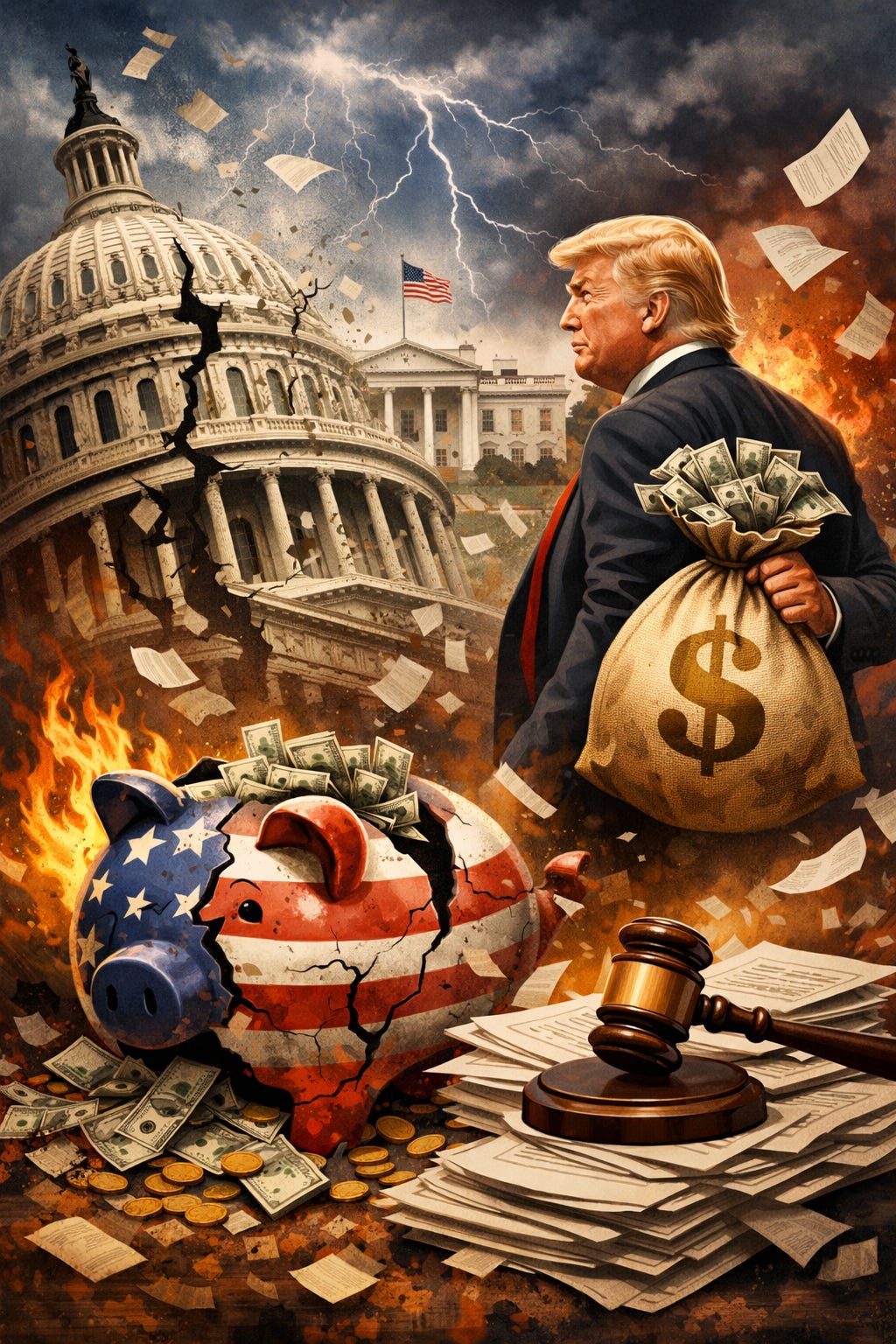
Donald Trump is suing two of the most powerful institutions under his command, the Internal Revenue Service and the U.S. Treasury Department, for $10 billion. The basis of the lawsuit is a leak. In 2020, The New York Times published detailed information from Trump’s long-concealed tax returns, revealing years of tax avoidance and questionable financial practices. The leak didn’t come from a government official or whistleblower. It came from Charles Littlejohn, a contractor working inside the IRS, who secretly accessed and leaked tax data from Trump and other wealthy Americans. He pleaded guilty in 2023 and was sentenced to five years in prison, the maximum allowed by law.
Justice, in the legal sense, was served. The leaker is behind bars. Yet Trump is suing the government anyway, not the man who leaked the documents, but the federal agencies that employed him. He claims the leak caused him emotional distress, reputational harm, and financial damage. That harm, he says, entitles him to billions of dollars in damages.
However, the records never should have been a secret to begin with.
This Community Is Powered by You
What started as a small circle has grown into something much bigger, and it’s all because of readers like you.
Every time you forward this email, post it on socials, or bring someone new into the fold, you’re helping build one of the most passionate, independent political communities out there.
Want to keep the momentum going?
Share this newsletter with someone who should be part of this conversation.
Thank you for being here. It means everything.
The Norm That Worked Until It Didn’t
Since the 1970s, every major presidential candidate has voluntarily released their tax returns. The tradition began in the aftermath of Watergate, when public trust in the presidency collapsed, and a newly cautious political culture sought to rebuild it through transparency. Releasing one’s tax returns became a signal of honesty and accountability, not required by law, but expected by the public, and adhered to by Democrats and Republicans alike.
Then came Trump.
In 2016, Donald Trump broke the tradition, claiming he couldn’t release his taxes because he was “under audit”, a claim that had no legal standing and was never verified. He refused again in 2020 and 2024. Unlike every president from Jimmy Carter to Joe Biden, Trump saw no benefit in transparency. Honestly, why would he? He paid $750 in federal income taxes in 2016 and 2017, according to the leaked documents. He claimed enormous losses to avoid taxes and held financial ties to foreign entities while serving as president. The returns told a story that contradicted his public persona and may have undermined his political mythology. So, he buried them.
And Congress let him.
We Had Every Chance
In the years after Trump’s first campaign, Democrats introduced multiple bills to codify the expectation that every presidential candidate and sitting president must publicly release a decade of tax returns. One of the clearest examples came in 2019, when the House passed legislation requiring this very disclosure. It died in the Senate.
Again, in 2021, Democrats included mandatory tax transparency in the For the People Act (H.R. 1), a sweeping democracy reform package. That bill was blocked by Republicans and conservative Democrats. They called it overreach. They said it was partisan. They said norms were enough.
They were wrong.
A Norm Is Only as Strong as the Worst Person Willing to Break It
This moment — a sitting president suing the U.S. government for $10 billion over the fallout of his own secrecy — is the final, absurd beat in a years-long warning siren. We have, for too long, built our democracy on good faith and personal honor. We’ve assumed that those who rise to power will be shaped by the weight of the office, not determined to break it. We’ve convinced ourselves that character, not code, would protect us.
Yet the hard truth is norms are only worth the paper they’re not written on.
When a president decides not to follow them — not to disclose, not to cooperate, not to concede — there is no recourse unless we’ve made it law. The presidency is too powerful an office to depend on the decency of its occupant. We cannot rely on the emergence of the best among us. We must legislate for the worst of us, because the worst of us can still get elected.
Now We All Pay
Trump’s lawsuit forces the U.S. government to defend itself with taxpayer-funded attorneys from the Department of Justice. That means we’re all paying the legal bills for a case that never needed to exist. And if any court agrees with him on statutory grounds, procedural failings, or institutional negligence, the result could be a historic payout of billions of dollars, directly from the U.S. Treasury to Donald Trump.
All of it — every court date, every motion, every dollar — stems from one decision made over and over again, to trust that norms were strong enough.
The Reckoning Is Ours
The leak shouldn’t have happened. Trump’s tax returns should have been public long before 2020. Charles Littlejohn committed a crime, and he is serving time. However, the real failure lies not with any one contractor or leaker. It belongs to a political system that saw a norm shatter and chose not to act. It belongs to a Congress that allowed tradition to stand in for statute. It belongs to a country that has too often assumed its democratic habits were self-sustaining.
They’re not.
Now we face a reckoning, not just in court, but in what we choose to do next. We can let this play out, again and again, with future candidates and future scandals. Or we can finally accept the truth that power without rules will always bend the system toward abuse.
Trump didn’t create that vulnerability. He exploited it. The real mistake was leaving it open in the first place.
Stay Ahead of the Narrative
If you’re tired of watching democratic norms collapse in real time and want deeper context, sharper analysis, and unapologetic clarity, subscribe to get future posts directly in your inbox. No both-sides fog. Just the truth, before it costs us more.
Subscribe now because the next crisis is already on the docket.
Sources:
Trump sues IRS, Treasury Department for $10 billion over tax return leak — Reuters, January 29, 2026.
Trump sues IRS, Treasury Department for $10 billion over tax return leak — ABC News, February 1, 2026.
Trump sues IRS, Treasury Department for $10 billion over tax return leak (AP) — Associated Press, January 30, 2026.
Why Trump Is Suing the IRS and Treasury Department for $10 Billion — TIME, January 30, 2026.
Trump sues IRS, Treasury for US$10 billion for tax‑return leak — The Business Times, January 30, 2026.
Former IRS Contractor Sentenced for Disclosing Tax Return Information to News Organizations — U.S. Department of Justice, January 29, 2024.
Charles E. Littlejohn – Wikipedia — Wikipedia
Not being a lawyer can a massive class action lawsuit be filed against Trump cheating taxpayers this costing them money to make up for his theft?
Say $1000 for each person of company that paid taxes ?
That should break this turd once and for ALL
If memory serves me right when the Democrats had control of the House under Trump's first term they tried to get his tax returns but were blocked in doing so by his Treasury Secretary. But the real problem is there seems to be no law enforcement statute for both emoluments clauses. So Trump's been allowed to take the oath of office twice unlawfully in willful violation of both of those clauses. That should not have happened because it opens the door for even more corruption. In a functioning congress, the Ways and Means committee should have had access to his tax returns to they could determine which foreign emoluments if any he could accept. So not only did Trump get away with his unlawfulness taking foreign and domestic emoluments but he effectively blocked Congress from doing their lawful oversight of this violations. And the same continues into his second term at a more alarming pace.