


The Project That Has Not Applied Yet
Bradford County, Pennsylvania, has no formal data-center application to review. There is no publicly identified developer, application number, or hearing date. According to Bradford County’s Planning Director, no formal land development application for a data center has been filed with the county as of July 30th.
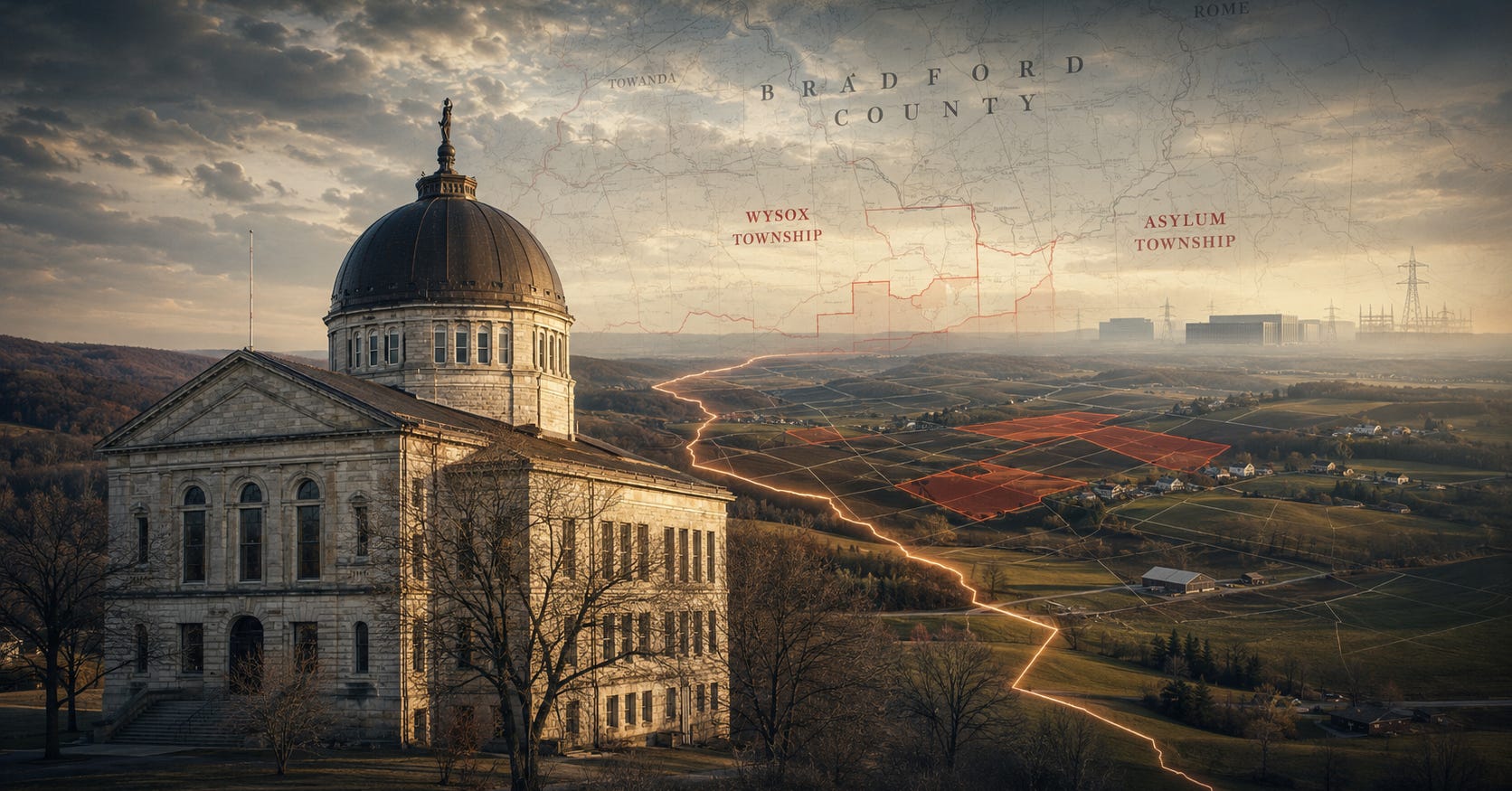
However, residents say consultants are approaching landowners in Wysox and Asylum townships, discussing listing agreements and the possible assembly of hundreds of acres, and proposal trackers show at least one on the map.
To be clear, a listing agreement is not a sale, and a potential site is not an approved project. Landowner outreach does not prove construction will happen. It does show that the public process may not be the first process underway.
Once owners believe the land around them may be sold, pressure can travel from parcel to parcel. A family that never planned to leave may wonder whether it will soon live beside an industrial complex or become the last holdout inside one.
The project may not have an application, but it may already have a map.
Meanwhile, a data center in Wyalusing Township labeled Klondike already appears on The Data Center Proposal Tracker. This project remains in the proposed phase as of July 30th, and is planned on the former site of a proposed natural gas power facility that was previously paused. As such, the land is already owned by private interests and not local residents, and the project includes the previously abandoned power facility being built to fuel the data center. It is unclear as of this reporting where this project is in the proposal process.
This Community Is Powered by You
What started as a small circle has grown into something much bigger, and it’s all because of readers like you.
Every time you forward this email, post it on socials, or bring someone new into the fold, you’re helping build one of the most passionate, independent political communities out there.
Want to keep the momentum going?
Share this newsletter with someone who should be part of this conversation.
Thank you for being here. It means everything.
This Is Bradford County
Bradford County sits along Pennsylvania’s northern border with New York, in the rural Northern Tier. It covers 1,147 square miles of farms, wooded hills, river valleys, and small communities, yet only about 59,600 people live there—roughly 52 residents per square mile.
Nearly one-quarter of residents are 65 or older. More than seven in ten occupied homes are owner-occupied, and the median household income is about $63,700. A home or piece of land may be a family’s largest asset, retirement security, family history, and intended inheritance.
This is not a technology corridor built around industrial campuses, nor is it located in close proximity to a major corridor such as I-81. A project that appears as acreage on a corporate map can become a governing force inside a community this small.
Why This Land May Be Attractive
No publicly identified developer has explained why it may be looking at Bradford County. County officials, however, have identified a possible 200-acre area in Wysox Township and another reaching as much as 400 acres in Asylum Township. Four hundred acres is more than half a square mile. The possible Asylum site is also near the Panda Liberty power plant.
Large sites and proximity to energy infrastructure may help explain the interest. They do not reveal who is interested or what may be proposed.
Rural does not mean empty. Available land does not mean land without consequences.
The Map Is Taking Shape Before the Public Knows the Name
The reported outreach appears to be an early stage of site assembly, not proof that a final project exists. Consultants may secure listing agreements from separate owners and combine them into a footprint large enough to interest a developer. The ultimate company, design, and utility demands remain unknown.
Landowners have every right to sell, refuse, or negotiate, but the consequences do not stop at the property line. Asylum Township resident Sue Corie told WSKG that smaller owners who do not want to sell are “afraid of what the impact is going to be if they remain.” A family that declines may still find itself beside industrial buildings, substations, backup generators, cooling systems and construction traffic.
The choice may no longer be whether to sell, but whether they can continue living beside what everyone else sold. Who is assembling the land, for whom, and how much has already been shaped outside public view?
The County Wrote Rules Before the Developer Filed
Bradford County’s commissioners did not wait for a finished proposal. Before any formal application arrived, they unanimously amended the county’s Subdivision and Land Development Ordinance to establish data-center standards.
The rules require documentation of expected electricity, water, and sewer demands. They establish setbacks and larger buffers near occupied buildings, address noise, lighting, screening and emergency response, and make the property owner responsible for removing abandoned facilities and restoring the site.
Financial security must equal at least 125% of estimated decommissioning costs, with annual proof and reviews at least every five years. While many communities begin writing protections only after land is assembled, utility negotiations advance, and a project is presented as too valuable or too inevitable to resist, Bradford County attempted to act while it still had leverage.
That is public stewardship. However, an early ordinance is not automatically a complete ordinance.
A Rule Is Only as Strong as Its Verbs
The strength of an ordinance is found not only in what it discusses, but in what it requires. Bradford County’s rules contain important protections, but some depend on phrases such as “where feasible,” “to the maximum extent practicable,” “may require,” and “strongly encouraged.”
In the guidelines in question, closed-loop cooling depends on feasibility, burying power lines is encouraged, not mandated, and additional technical studies depend on county officials determining that they are warranted. Most significantly, community-benefit and infrastructure agreements remain voluntary. The ordinance says they cannot be required as a condition of land-development approval.
Some flexibility is reasonable as no ordinance can anticipate every site condition. However, flexibility also moves power from the written rule into later negotiations. Residents should not have to discover during review which protections are firm and which can be waived, bargained down, or replaced by promises. The public must distinguish between a protection the developer must obey and a request the developer may decline.
The Kitchen Table Pays Before the Server Turns On
Before a data center processes its first byte, someone must pay for the physical system that makes it possible. That may include substations, transmission equipment, road improvements, emergency-service training, water infrastructure, and heavy construction traffic. Bradford County must determine which costs belong to the developer and which could reach utilities, taxpayers or local governments. The region has already experienced similar cost analysis due to fracking operations in the area, but is somewhat protected by Pennsylvania’s Act 13 Impact Fees rules.
Could the project affect residential electricity rates, nearby property values, or the ability to sell a home? Would public infrastructure be expanded primarily for one private facility? Who is responsible for heavy equipment damage to roads? Would the county or the company foot the bill for environmental remediation in the event of a spill, leak, or abandonment of the facility? Those outcomes should not be assumed. They should be studied, disclosed, and assigned before approval.
The economic promises require equal discipline. Commissioner Daryl Miller said the county does not know what kind of facility might arrive and that associated jobs could range from roughly six to 36. He also opposed tax abatements that could disrupt county revenue and burden other residents.
Construction jobs are not permanent jobs. Projected tax revenue is not a net public benefit if it comes with subsidies or expenses the community must absorb. For an aging county where many families own their homes, a mistake would not remain on a spreadsheet. It could reach a tax bill, retirement plan or property value.
The company’s first calculation will be whether the project is profitable. The county’s first calculation must be whether the community is protected.
Growth Must Carry Its Own Weight
This is not an argument against technology, private investment, or economic development. A company that builds a useful project, creates jobs, and pays its obligations should be allowed to profit. However, profit does not erase responsibility. A data center should carry the full cost of the roads, electrical infrastructure, emergency capacity, environmental safeguards, and eventual cleanup it requires.
No county should subsidize a global industry through higher household costs, public infrastructure built primarily for a private facility, or tax concessions granted before a complete accounting of the return.
Growth becomes stewardship when the company receiving the benefit also carries the burden. Private companies may own the data center. The people of Bradford County must own the rules governing industry within their borders. Development is not stewardship when the company receives the asset and the community inherits the obligation.
The Public Needs the Names, Numbers and Guarantees
Before Bradford County or any municipal government considers approval, residents deserve more than a project description and a promise of growth. They need details on how it will benefit their community, and at what cost.
They need the names: the land assemblers, developer, operator, parent corporation, and ultimate beneficiaries. Shareholders cannot be hidden behind shell companies and project LLCs.
They need the numbers: acreage, electricity and water demand, cooling methods, transmission requirements, construction work, permanent jobs, and proposed tax concessions. When those numbers change, the public deserves to know why, by how much, and how it will impact their community.
They need guarantees: who pays for roads, emergency preparation, and utility upgrades; who carries decommissioning costs; and which protections are binding. In a perfect world, they also deserve a promise of investment in the future. Instead of relying on the company's potential charity, the people should be involved in selecting meaningful public investment that suits their vision of the future and have a pot of company funding that the public has voting power over.
Those facts should be disclosed before major arrangements are settled, not after the public’s leverage has narrowed to comments at a hearing. A hearing held after the land, power, and tax arrangements are effectively settled is not public participation. That is public notification.
The County Wrote the Gate
The absence of a formal application does not mean nothing is happening. A crypto-mining proposal was formally filed. Soltier LLC submitted a land-development application for a “Crypto Data Mine” in Wysox Township. It remained under county Planning Commission review through June 2026 before being formally withdrawn on June 22nd.
The Planning Commission also reviewed an unidentified sketch plan at its June 16th meeting. The agenda lists “Liberty Power Park, LLC” under “Sketch Plan Review.” However, the public agenda provided no description, so it remains unclear whether that sketch plan involved a data center or the later withdrawn crypto data mine.
In the meantime, private site activity is already occurring. Residents report consultants seeking listing agreements and assembling possible 200-acre and 400-acre footprints in Wysox and Asylum townships. Those activities are not formal county applications, but they are more than abstract speculation.
Land can be assembled, expectations can spread, and neighbors can make decisions based on a project the public has not seen. By the time the first document reaches the county desk, private momentum may already be pressing government toward approval.
Bradford County did something important by writing rules early. Now it must determine whether early was early enough and strengthen protections that depend too heavily on voluntary promises, discretionary studies, or negotiations conducted after public leverage begins to shrink.
The developer may arrive with engineers, attorneys, projections and promises of growth. The people who already live there bring something more fundamental: homes, farms, tax bills, retirement plans, family histories, and the right to decide what their community will be required to carry.
Bradford County wrote the gate. It must keep the key.
Support Independent Media
If this article helped you see what is moving before the application arrives, please share it.
The Coffman Chronicle is reader-supported. If you can afford to become a paid subscriber, your support helps keep this work independent and focused on the people who are expected to carry the cost of decisions made around them.
The project may not have an application, but the public already has a stake.
Sources
Abruzzo, Natalie. “Bradford County Pennsylvania Adds Land Use Regulations for Data Center Construction.” WSKG, July 30, 2026.
Bradford County, Pennsylvania. “Bradford County Subdivision and Land Development Amendment 2026-01: Data Center Development Standards.” Revision 5, May 20, 2026. PDF.
U.S. Census Bureau. “QuickFacts: Bradford County, Pennsylvania.” Accessed July 30, 2026.
Bradford County. Klondike Data Center Project. Data Center Proposal Tracker. Accessed July 30, 2026.
Data Center Proposal Tracker. Accessed July 30, 2026.
This is another excellent article on this subject!!! Every community needs to use these articles to start their discussions and write rules and regulations!!! Thank you guys for all of your work on this important information!!!
Better to be prepared, just in case.