


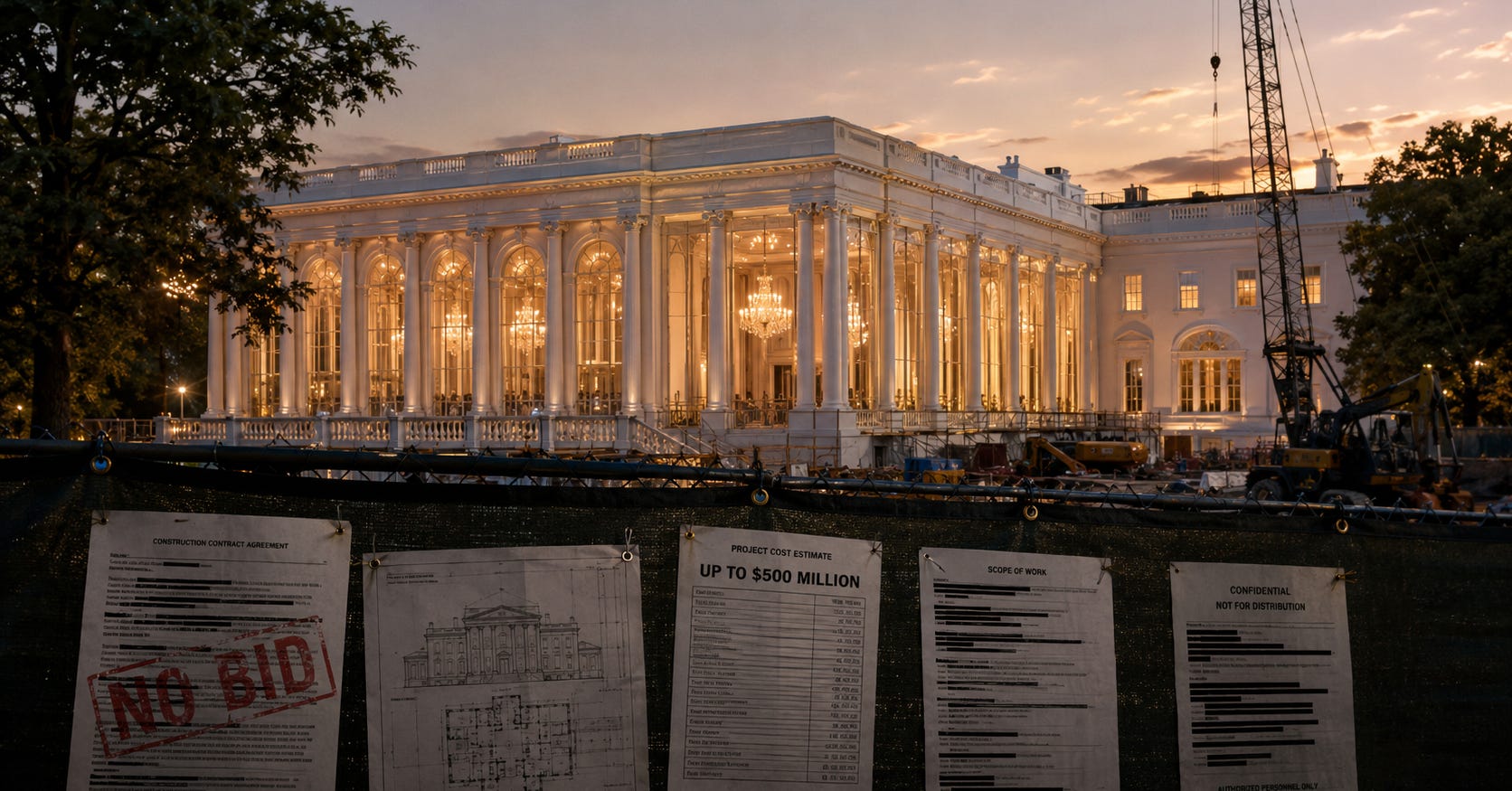
The Fence Hides More Than a Ballroom
When a family discovers that its roof is leaking, it asks for estimates, compares materials, and wants to know who will perform the work. A town replacing a bridge or repairing a school boiler must do even more because the money belongs to the public. Behind the construction fence at the White House in Washington, those ordinary safeguards were pushed aside.
In September 2025, White House officials awarded Clark Construction a confidential, five-year agreement worth up to $500 million to demolish and rebuild the East Wing, including the facility that would house President Donald Trump’s ballroom. The contract was not competitively bid. It was routed through the Executive Residence, an office exempt from many procurement and disclosure rules governing major federal construction. The administration cited national security as its reason for avoiding competition.
Records also indicate that Trump participated in negotiations over some project costs. That does not prove the full $500 million ceiling will be spent or that Clark cannot perform the work competently. It does show how much control was concentrated inside the executive branch.
Trump helped shape the project, raise private money, influence negotiations, and defend the secrecy surrounding a permanent transformation of public property. Congress and the public learned key details after construction had begun.
The ballroom is the spectacle, but the contract is the government story.
Support independent media that follows the power.
The Coffman Chronicle is built to track who holds power, who abuses it, who profits from it, and who pays the price.
Paid supporters get full Tony Michaels Podcast episodes, deeper transcript analysis, paid columns, archives, and the reporting framework behind the show.
If you believe independent media has to survive outside billionaire platforms, corporate media, and party-approved gatekeepers, become a paid supporter today.
What the Contract Actually Says
The agreement was not simply an extension of routine White House maintenance.
Clark had previously won a competitively bid contract during the Biden administration for repairs and alterations across the White House complex. As Trump’s ballroom plan expanded, administration officials negotiated a separate agreement authorizing the company to demolish the East Wing and East Colonnade and construct the replacement facility.
Clark signed the contract on September 22, 2025. It covered five years, carried a ceiling of up to $500 million, and included a nondisclosure agreement. The administration did not solicit competing bids because the White House Office of Administration said revealing the government’s needs could compromise national security. Clark later informed the White House that at least 11 subcontractors would also receive work without competition. Two were Clark subsidiaries.
To be clear, a $500 million ceiling is not a $500 million payment. Clark’s reported 3% profit on early work was described by procurement experts as typical. Trump also reportedly negotiated a concrete package down by $2.3 million from an initial price above $47 million.
None of that answers why competition was rejected across a project of this size and permanence. Clark has not been proven incompetent or corrupt, but the problem is that the public was denied the process that could have shown whether another qualified contractor might have offered a lower price, stronger protections, or better terms.
A project that Trump once suggested Clark might perform for nothing was placed inside a confidential government agreement from which the company expected to earn money.
The contract may contain a spending ceiling, but the arrangement contained too few limits on concentrated power.
An Exemption Is Not a Blank Check
The Executive Residence may be legally exempt from many competitive-bidding rules that bind other federal agencies, and presidents possess broad authority to maintain the White House. Not every no-bid contract is illegal, and not every use of secrecy is improper.
Emergency repairs, specialized security systems, and sensitive construction can justify limited competition. A permanent East Wing reconstruction under a contract with a ceiling of up to $500 million raises a different question. Why was the exemption applied so broadly rather than limited to work that was genuinely sensitive?
A 2024 government memorandum reportedly assigned major East Wing structural and utility work to the General Services Administration and the National Park Service. Those agencies regularly manage large public projects through established systems for bidding, cost review, and contractor oversight.
The Trump administration instead routed the agreement through the Executive Residence, where fewer ordinary procurement protections applied. That may have provided a lawful path, but the administration has not publicly shown why it served the public better, what alternatives were considered, or why classified work could not have been separated from construction that might safely have been opened to competition.
The public should not have to prove corruption before asking why the less transparent route was chosen. The law may provide a doorway. It does not require the president to drive a $500 million project through it with the curtains closed.
National Security Became the Curtain
The White House contains secure communications, protective systems, and facilities that cannot be described publicly without creating real risks. The administration has also said the project includes security upgrades, while Trump has referred to underground military facilities, bulletproof glass, and defensive systems associated with the reconstruction.
That explains why some plans must remain secret, but it does not explain why secrecy should cover the entire contracting process.
A federal judge later allowed below-ground work involving a bunker and other national-security facilities to continue while restricting parts of the above-ground ballroom construction, distinguishing between sensitive security work and ceremonial construction.
The public does not need bunker blueprints, but it does need to know who selected the prime contractor, what cost comparisons were made, how change orders are reviewed, and whether private ballroom expenses are separated from public security obligations.
A government may conceal the location of a secure room, but it should not be allowed to conceal the standards used to spend the public’s money.
Private Money Does Not Privatize the People’s House
When the White House announced the ballroom in July 2025, it estimated the cost at $200 million and said Trump and private donors would pay for it. By spring 2026, the public estimate had reached $400 million. Trump continued to describe the ballroom as taxpayer-free even as his administration sought $1 billion from Congress for security upgrades connected to the White House and ballroom site.
The administration says donors are paying for the ceremonial space, while taxpayers cover legitimate presidential security costs. That may be possible on a ledger, but the ballroom, underground facilities, site preparation, utilities, and protective infrastructure are being built together on the same public property.
In June, the Office of Management and Budget redirected approximately $352 million in Secret Service funding to what it called White House security measures. A person familiar with the agency’s budget told The Washington Post that the money would help pay for the new East Wing facility that includes the ballroom. That does not establish that taxpayers are buying chandeliers or banquet tables, but it does show why the public deserves an exact accounting rather than a slogan about private funding.
Donations create another obligation. Companies and wealthy individuals may give without purchasing a favor, but many operate under federal contracts or regulations controlled by the administration receiving their money. That is not proof of corruption, but it is why donor amounts, conflict reviews, and spending boundaries should be visible before questions become accusations.
A donor can help pay for a room. The donation does not turn public property into a private project. Private money does not privatize the People’s House.
The President Became His Own Project Manager
Trump’s involvement did not stop with announcing the ballroom. According to a project summary reviewed by The Washington Post, he personally negotiated the price of a concrete package on March 4, 2026. The package, supplied by a Clark subsidiary, was initially priced above $47 million. The negotiated reduction was $2.3 million.
There is nothing inherently wrong with pressing a contractor for a lower price. The concern is what happens when one person becomes the project’s political sponsor, chief fundraiser, design authority, public defender, and direct participant in cost negotiations.
That concentration of roles would be unusual in any major public project. It is more troubling at the White House, where a temporary occupant is directing permanent changes to a building that belongs to the public.
The presidency is not a private development company, and the White House is not the president’s personal property portfolio.
This Is Not About Whether You Like the Ballroom
A reader can believe the White House needs more event space, support modern security improvements, and even like Trump’s design. None of that resolves the contracting question.
A useful project can still be procured irresponsibly. A capable contractor can still benefit from too little competition. A lawful exemption can still be stretched beyond responsible stewardship.
The standard must hold across administrations. Had a Democratic president championed a comparable project, raised money from private donors, helped direct negotiations, and placed the construction through a confidential no-bid agreement, Republicans would be right to demand the contract, invoices, and legal justification. The same standard applies here.
The ballroom may become popular and useful, but that does not remove the obligation to explain how the contractor was chosen, how public and private costs were separated, and who protected the public from overpayment or favoritism.
A project does not become accountable simply because some people like the result.
Congress Cannot Stay Outside the Fence
Congress does not need to select the architect or negotiate the concrete. It does need to protect the public’s ownership interest when a president permanently transforms the White House through an unusually secretive agreement.
That responsibility begins with obtaining the Clark contract, work orders, cost estimates, change orders, and records demonstrating how donor funds are separated from public spending. Congress should determine who approved the use of the Executive Residence, what alternatives were considered, and whether independent officials reviewed the arrangement before demolition began.
This is oversight, not micromanagement. Congressional committees possess subpoena power, appropriations authority, and the ability to require public accounting without exposing sensitive security details. Senator Richard Blumenthal has demanded records from Clark Construction and other parties involved in the project, but letters from individual lawmakers are not a substitute for sustained institutional oversight.
The question is larger than one ballroom. It is whether a president may combine personal vision, donor financing, public construction, and national-security exemptions while the branch responsible for federal spending watches from a distance.
Congress does not have to stand inside the construction site, but it does have a duty to look behind the fence.
The People’s House Is Not a Private Development
The construction fence will eventually come down. The cranes will leave, the concrete will set, and the ballroom will become part of the White House complex. By then, the administration may hope that questions about the contract feel old or less important than the finished room. They will not.
The issue was whether a temporary occupant could act with the freedom of a private owner while relying on public authority, public property, security exemptions, and potentially substantial public support.
A private owner may choose a single contractor, keep the price confidential, and redesign a property according to personal preference. A president has no equivalent privilege. The White House is not his asset, and the authority attached to it is not his possession. Both are held in trust for people who may never enter the ballroom but still have every right to know how their government used its power to build it.
Clark may complete excellent work. Donors may believe they are contributing to a lasting public space. Security improvements may be necessary. None of that eliminates the need for competition where possible, independent review, clear accounting, and congressional oversight.
Good intentions do not replace safeguards, and presidential confidence does not replace public consent. The ballroom may be used by future presidents, and the precedent will belong to future administrations.
The People’s House should not be renovated like the president’s private casino, with one man directing the vision, influencing the deal, and leaving the public to discover the real cost after the work is already underway.
Support Independent Accountability Journalism
The ballroom is one project. The larger fight is over whether public power can be exercised behind closed doors, with the public treated as a spectator.
The Coffman Chronicle follows the contracts, court fights, executive claims, and congressional failures that turn public institutions into private instruments of power.
If you can afford to become a paid subscriber, your support helps keep this work independent and accessible.
Sources:
“Trump Is Using a $500M No-Bid Contract to Build His White House Ballroom.” Washington Post, June 30, 2026.
“Trump Said No Taxpayer Money Would Be Spent on the Ballroom. A Contractor’s Invoices Show Otherwise.” Washington Post, June 16, 2026.
“Blumenthal Demands Answers from Trump’s Hand-Picked Construction Firm for Withholding True Cost of White House Ballroom.” Office of U.S. Senator Richard Blumenthal, June 17, 2026.
“Trump Fought to Keep the Ballroom Fundraising Contract Secret. Here’s What’s in It.” Washington Post, April 21, 2026.
Kunzelman, Michael. “Judge Allows ‘National Security’ Work to Proceed at White House Ballroom Construction Site.” PBS News, April 16, 2026.
National Park Service. “The White House and President’s Park.” Last updated March 19, 2026.
O’Connell, Jonathan, Riley Beggin, Jarrell Dillard, and Sarah Blaskey. “Millions in Secret Service Funds Redirected amid Ballroom Construction.” Washington Post, June 18, 2026.
Reuters. “White House Awarded No-Bid Contract for East Wing Ballroom, Washington Post Reports.” June 30, 2026.
Reuters. “White House Ballroom Project to Include ‘Massive’ Military Complex.” March 30, 2026.
Spencer, Saranac Hale. “Who’s Paying for the White House Ballroom?” FactCheck.org, May 14, 2026. Updated June 10, 2026.
The White House. “The White House Announces White House Ballroom Construction to Begin.” July 31, 2025.
Communist nations that are our enemies must be enjoying a very hearty laugh at the Trump spending spectacle. To the retarded voters who chose Trump I suggest you look at the architectural achievements in China and Singapore and compare their efforts. Bid process, oversight, a Congress without corruption might be able to compete with Communist efficiency with good leadership. We are not witnessing capitalism. We are witnessing mismanagement of tax dollars in a once great democracy.
trump is acting as if he's planning to never leave there. He plans to be the King forever