


The booster club had purchased six pop-up tents in nine years and, according to every president who had served during that time, owned none.
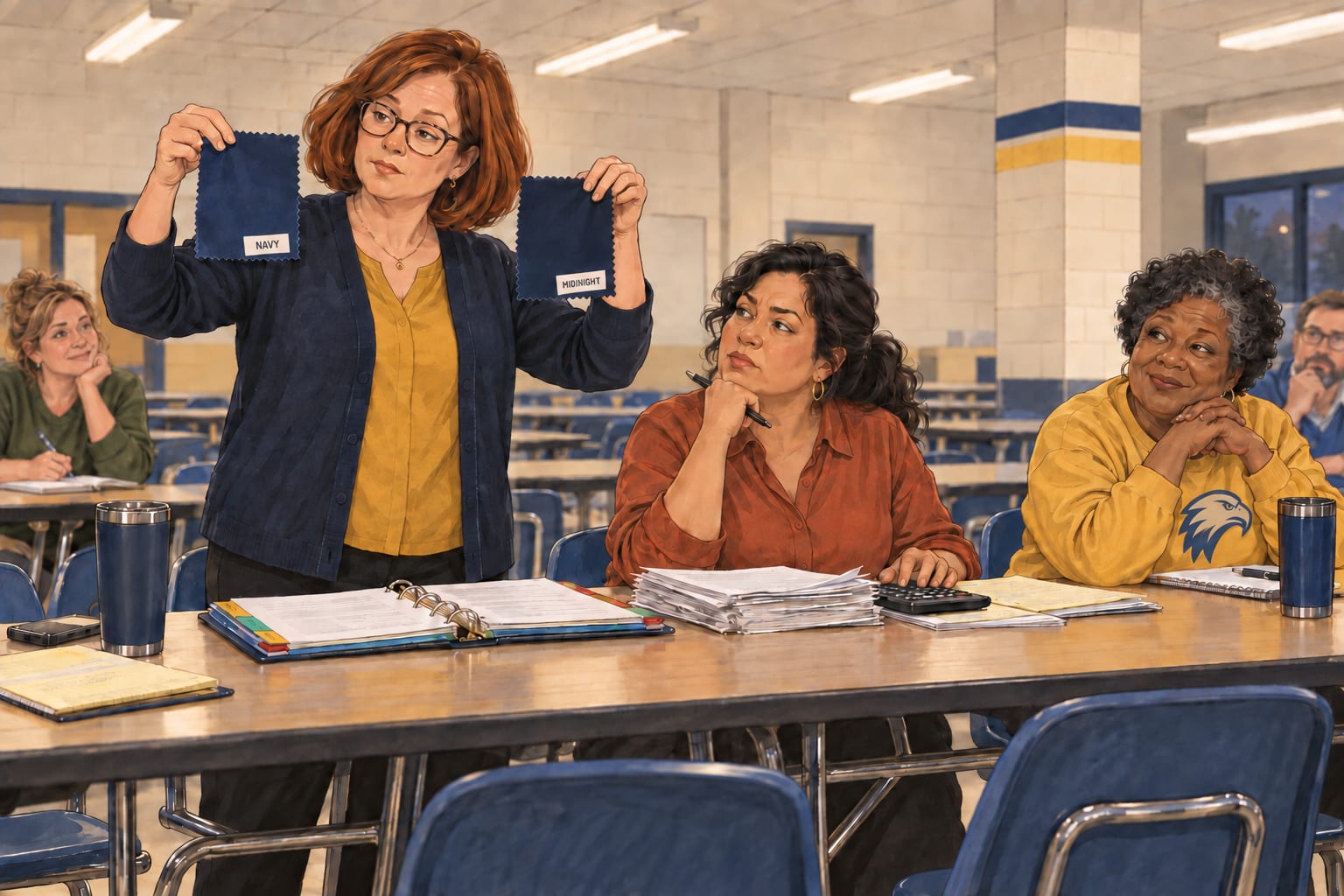
Dana Ortiz knew this because she had spent Tuesday evening reading old treasurer’s reports while the rest of the committee debated whether the tablecloths for the fall sports kickoff should be navy blue or midnight blue. “They’re the same color,” Dana said.
Paula Mercer held two fabric samples beneath the cafeteria’s fluorescent lights. “Midnight has more depth.”
Dana looked back at the reports. “Apparently it also costs four dollars more per table.”
Paula was the newly elected booster club president, a position she had accepted with enthusiasm, a color-coded binder, and the belief that any problem could be overcome by choosing the right committee and giving it a deadline.
The fall sports kickoff was her first major event. Every team would be introduced. The band would play. Parents would buy hamburgers and spirit wear. Children from the elementary school would run across the football field until somebody with a whistle made them stop.
Paula wanted it to look like the community cared.
This Community Is Powered by You
What started as a small circle has grown into something much bigger, and it’s all because of readers like you.
Every time you forward this email, post it on socials, or bring someone new into the fold, you’re helping build one of the most passionate, independent communities out there.
Want to keep the momentum going?
Share this newsletter with someone who should be part of this conversation.
Thank you for being here. It means everything.
The Price of Looking Organized
By the end of the meeting, the committee’s shopping list included a pop-up tent, four folding tables, six tablecloths, two coolers, three extension cords, a balloon arch kit, and a new banner reading EAGLE PRIDE STARTS HERE.
Dana added the numbers. “Two thousand, three hundred and twelve dollars.”
The room became quiet. “That includes the banner?” Paula asked.
“That includes everything.”
“What if we take off the balloon arch?”
“Two thousand, one hundred and ninety-three dollars.”
Paula frowned. “That’s a hundred and nineteen dollars for the balloon arch?”
“Not just the balloons,” Dana said. “The kit, the frame, the pump, and the supplies to keep it from collapsing before the first team is introduced.”
At the other end of the table, Connie McBride lifted one hand. Connie ran the concession stand and had been waiting patiently for the discussion to reach actual food.
“That sounds about right,” Connie said. “My niece made one for a graduation party. By the time they bought the frame, the pump, the balloons, and everything else, they could have just rented a pony.”
Dana checked the estimate. “This one is a hundred and nineteen dollars, and we still have to build it ourselves.”
Paula looked at the list again. “Then we can take it off. If the decorations are going to keep us from repairing the refrigerator, every one of them has to earn its place.”
“Good,” Connie said. “The refrigerator has already earned its place by keeping the hamburgers cold.”
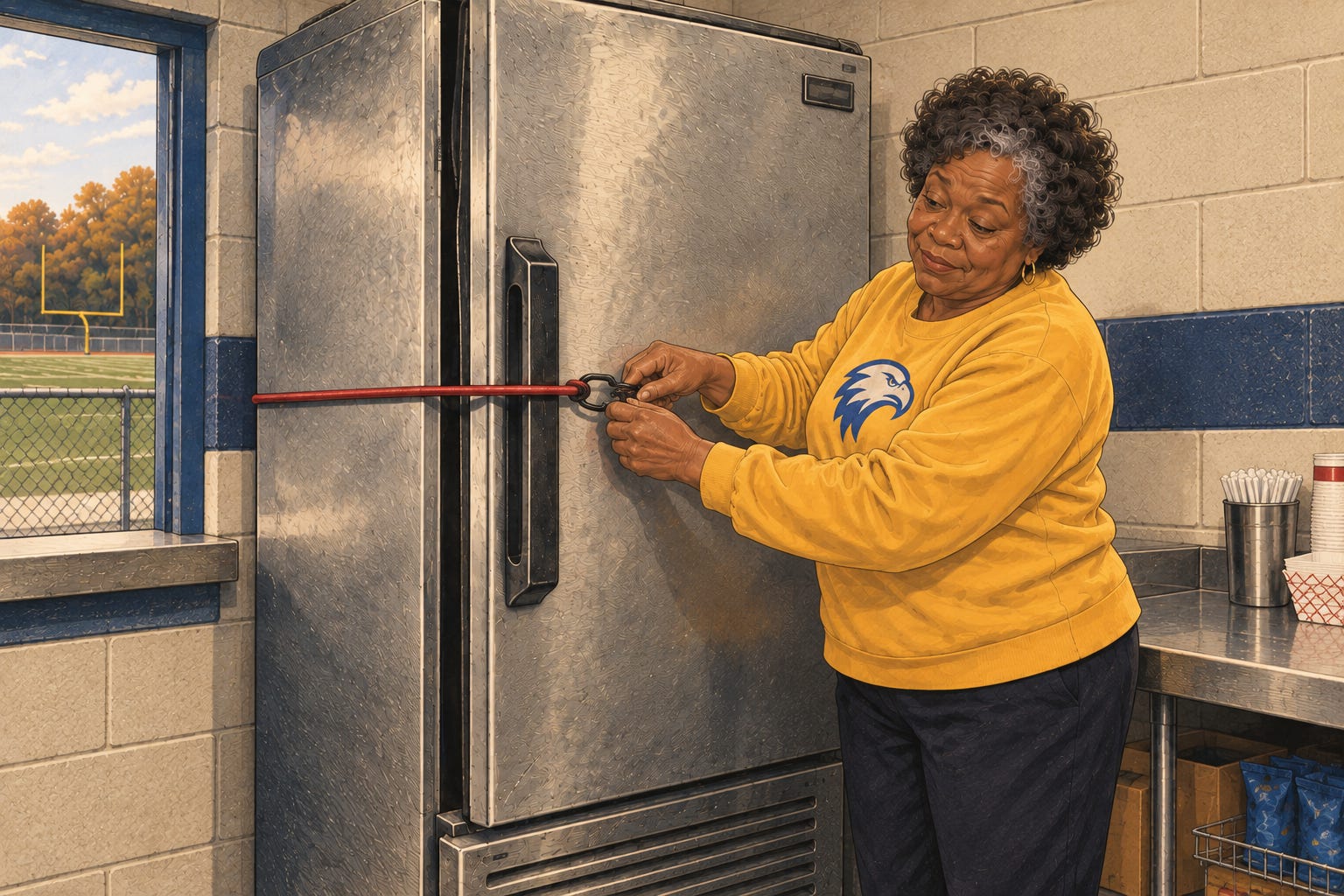
The refrigerator had stopped sealing properly sometime during baseball season. Connie had been holding the door shut with a bungee cord, which worked as long as everyone remembered to replace it. Nobody did. The repair estimate was $900.
Paula tapped her pen against the binder. “We may have to wait until October.”
“We’ll lose that much in spoiled hamburger before October,” Connie said.
Paula looked at the shopping list again. “The kickoff is our biggest event. It needs to look organized.”
“So does the concession stand,” Connie said. “Right now it looks like the refrigerator is trying to escape.”
Dana turned an old treasurer’s report toward Paula. “We bought a pop-up tent three years ago.”
“That one was damaged,” someone said.
“We bought another one the year before that.”
“I think baseball borrowed it.”
“There are four more in these reports.”
Those produced several explanations. One had blown over during a soccer tournament. One might have gone home with a former committee member. Another was believed to be in the band room. Somebody remembered a red tent, although the school colors were blue and gold, so everyone agreed it probably belonged to someone else.
Dana found similar purchases for folding tables, coolers, tablecloths, and extension cords. Each item had been bought because the committee at the time could not find the one purchased by the committee before it.
“Our What?”
Mr. Alvarez, the school custodian, came into the cafeteria to empty the trash. He listened for a moment while two former presidents tried to remember which of them had bought the wheeled cooler.
“Why don’t you use the things in your storage room?” he asked.
Paula stopped tapping her pen. “Our what?”
“Your storage room.”
“The booster club has a storage room?”
Mr. Alvarez looked from Paula to Dana and then around the table. “You have a lot of meetings for people who don’t know what they own.”
The next morning, he led them down a hallway behind the gym to an unmarked cinder-block door. Paula had passed it hundreds of times. She had always assumed it contained volleyball nets or pipes or whatever else schools kept behind doors nobody opened.
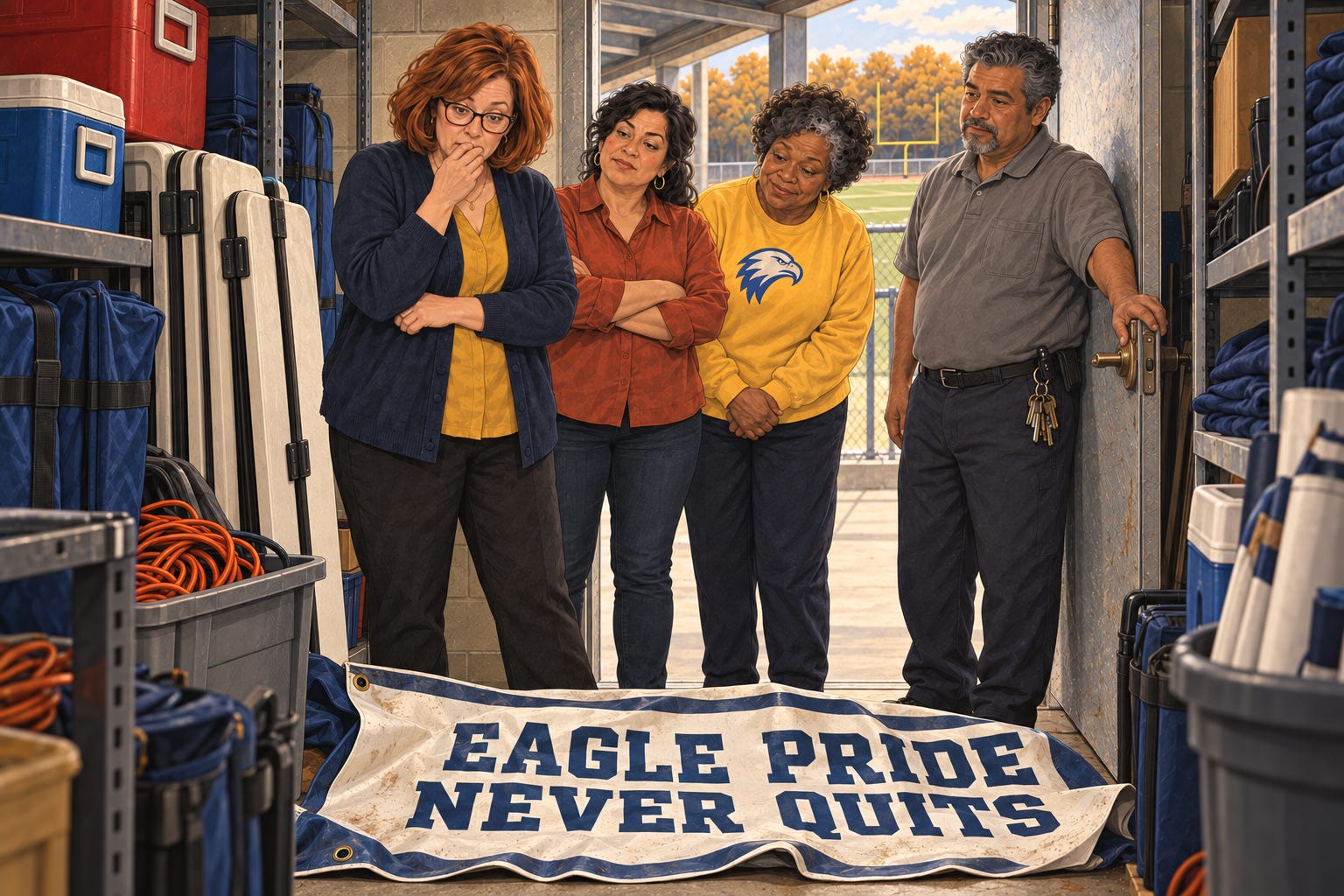
Mr. Alvarez unlocked it and pulled. The door moved about six inches before striking something on the other side. He leaned his shoulder against it and pushed until a cardboard box scraped across the floor. A rolled vinyl banner tipped from a shelf and unfurled at Paula’s feet.
EAGLE PRIDE NEVER QUITS, it announced. Behind it were seven more banners suggesting that Eagle Pride also soared, roared, rose, ruled, started here, lived here, and could not be contained.
Along one wall stood six pop-up tent cases. Four folding tables leaned against the other.
Coolers were stacked on top of larger coolers. Extension cords filled two plastic tubs. An unopened carton contained twenty-four navy tablecloths, although at least three different shades of navy were visible through the plastic.
More boxes held plastic pennants, balloon pumps, raffle tickets, foam fingers, drink dispensers, clipboards, cash boxes, spirit signs, and enough rolls of blue-and-gold ribbon to tie a bow around the gym.
Nobody spoke for several seconds, which was the longest uninterrupted silence the booster club had achieved all year.
Mr. Alvarez switched on the light. “I always wondered when you folks were coming back for this.”
“What do you mean, coming back?” Paula asked.
“Every spring, somebody brings things in here and says the next committee will sort them out.”
Connie pulled a cooler from the stack. Her name was written across the lid in permanent marker. CONNIE McBRIDE—DO NOT LOAN. “I wondered where that went,” she said.
Paula found a plastic tote labeled FALL KICKOFF 2021 in her own handwriting. Inside was a balloon arch kit she remembered ordering during her previous term on the committee. “It was supposed to be used again,” she said.
Dana looked around the room. “I believe that was the theory behind all of this.”
No Archaeological Expedition Required
They spent the next hour opening boxes. The tents had not disappeared, been stolen, or blown into another county. Five of the six still worked. One had a bent frame, but its canopy and stakes could be used as spare parts.
All four folding tables were sturdy. The tablecloths needed washing, and the coolers needed scrubbing. Most of the extension cords worked, although Mr. Alvarez removed two that he said had “made their final contribution to public education.”
The committee canceled nearly the entire supply order.
The following Saturday, Paula organized a storage-room workday. She brought coffee, Connie brought doughnuts, and Dana brought a clipboard with an inventory sheet listing each item, its condition, and the name of anyone who took it from the room.
They washed the tablecloths, tested the tents, untangled the extension cords, and sorted the banners. They offered supplies they could not use to the middle school and the elementary PTO. Broken items were discarded. Everything else was placed on labeled shelves where it could be found without an archaeological expedition.
By noon, the floor was visible. By three o’clock, the committee knew what it owned. The money they saved did not sit in the checking account so the committee could congratulate itself for spending less. It paid for the refrigerator repair.
What Caring Looked Like
At the fall sports kickoff, the tent was several years old, and one tablecloth was a slightly different blue from the others. The banner said WELCOME, EAGLE FANS instead of introducing a new slogan.
Nobody complained.
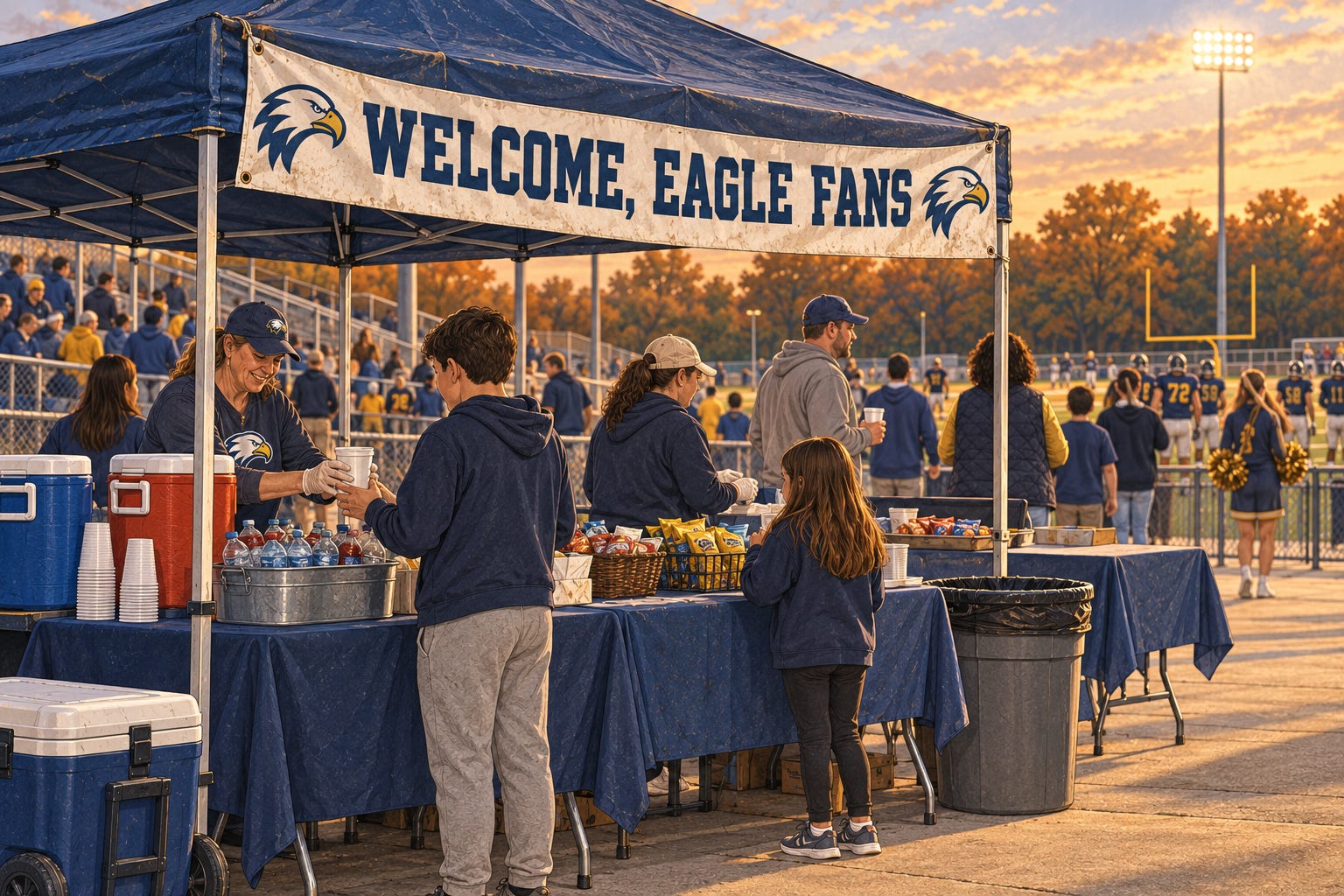
The athletes cared about hearing their names announced. The parents cared about finding seats. The volunteers cared that the drinks were cold and the refrigerator door stayed closed without assistance from a bungee cord.
The event looked like a community that cared, not because everything was new, but because people had taken care of what belonged to everyone.
At the next booster club meeting, Paula reported that the club had spent less on the kickoff than it had in years. The storage-room inventory was taped inside the door, and a sign-out sheet hung from a clipboard beside it. Whoever ran the booster club next year would not have to depend on Paula remembering where anything was.
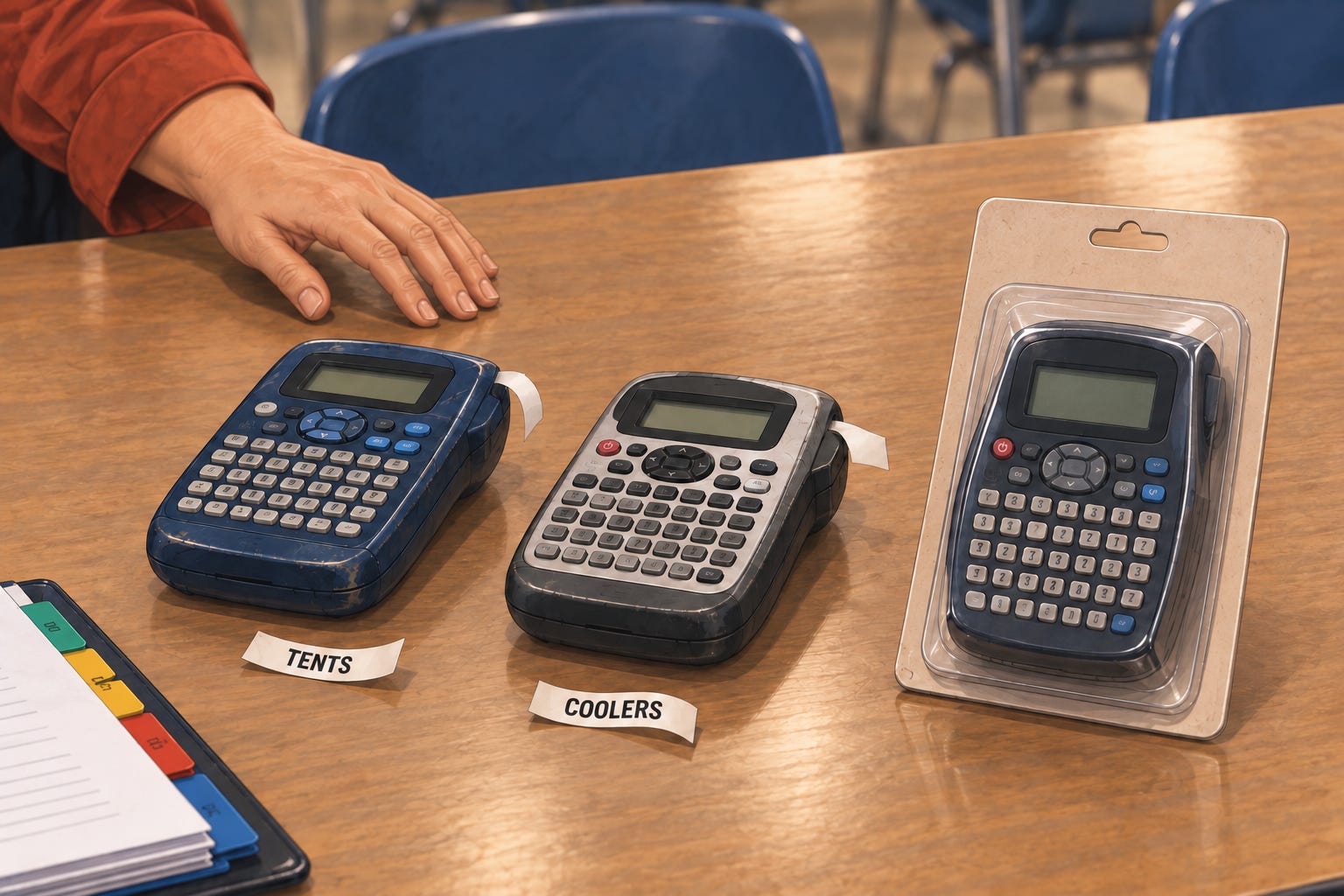
“No more buying things until we check the inventory,” Paula said. “Although we probably should buy a label maker so we can keep everything organized.”
Dana opened the cabinet beneath the counter and silently placed three label makers on the table. One was still in its package.
This made me laugh. I've heard the same thing at other clubs' meetings -- who has the banner? Who has the fall decorations? One club actually has a storage trailer that they periodically go through. Another has a club house yet still can't find things.
Sounds like a matter of keeping things organized.