


A Stamp Is Supposed to Settle the Question
A signature says that someone put his name on a document. A notarial seal is supposed to say something more. It tells the government that the signer was identified, that the required oath or acknowledgment occurred, and that an official authorized by law certified the act. The stamp exists because trust alone is not enough. It is supposed to remove doubt from the page.
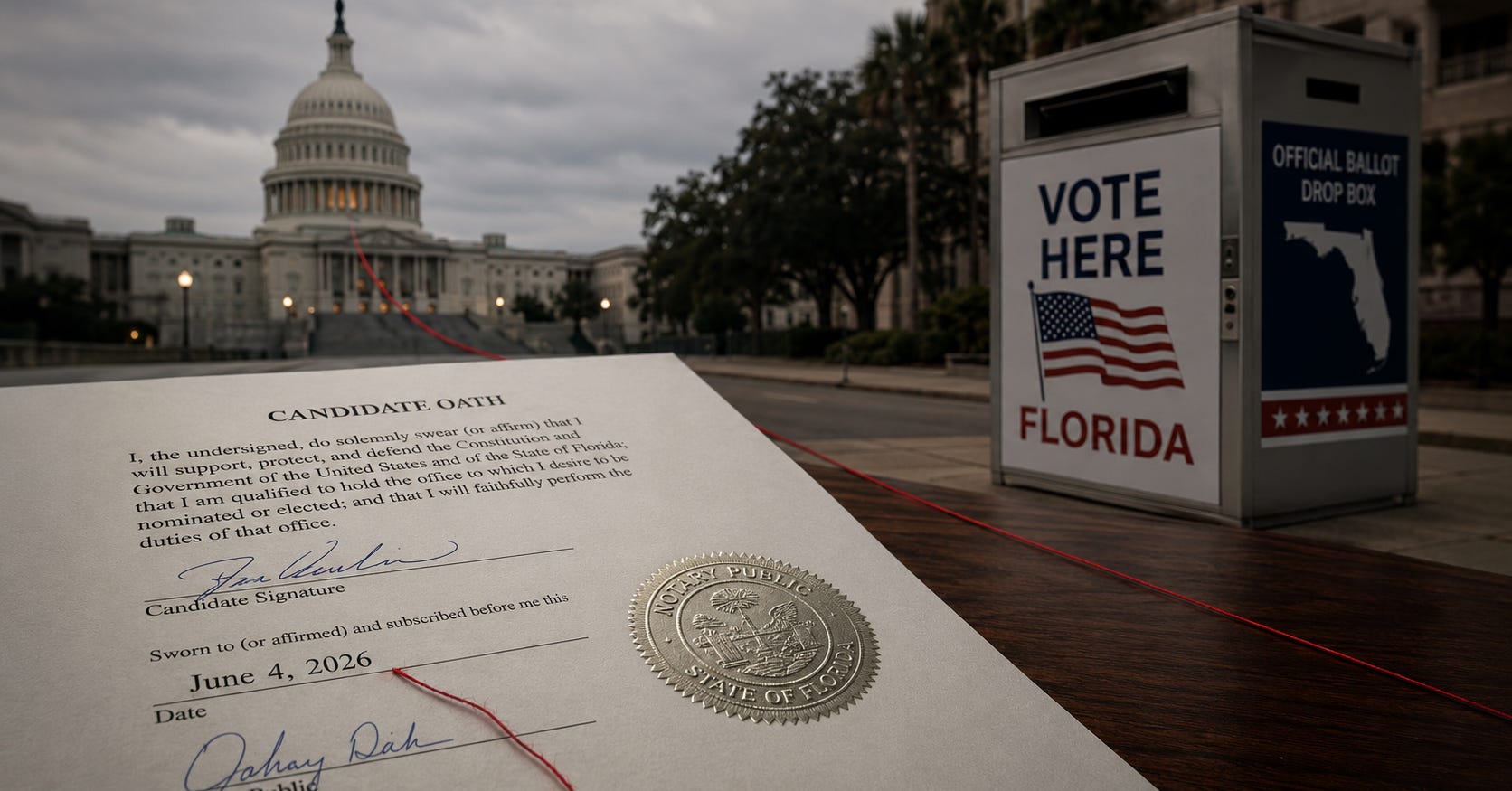
That is why the dispute surrounding Representative Cory Mills’s candidate oath cannot be dismissed as a fight over paperwork. According to the legal challenge, the oath carries a notarization dated June 4, 2026. Mills’s congressional record appears to place him in Washington that day during a lengthy House Armed Services Committee markup.
Those facts may have a lawful explanation. A date does not reveal the precise hour, and a public schedule does not account for every minute. A court, not social media, must determine what happened.
However, the document is not an autograph. Mills is asking Florida voters to return him to the United States House of Representatives, and the oath is part of how his name appears on their ballots.
The public does not yet know whether it was improperly notarized. It knows enough to ask the question the stamp was supposed to settle: Where were the signer and the notary when they certified that this occurred?
Support independent media that follows the power.
The Coffman Chronicle is built to track who holds power, who abuses it, who profits from it, and who pays the price.
Paid supporters get full Tony Michaels Podcast episodes, deeper transcript analysis, paid columns, archives, and the reporting framework behind the show.
If you believe independent media has to survive outside billionaire platforms, corporate media, and party-approved gatekeepers, become a paid supporter today.
What the Documents Say and What They Do Not
Florida’s official candidate records list Mills as a qualified Republican candidate for the state’s 7th Congressional District. His documents were received on June 8, and the state recorded him as qualified the next day. As of July 12th, the state’s candidate system still listed him that way.
The lawsuit challenging that qualification focuses on June 4th. According to the complaint, Mills’s oath was notarized that day by Alejandro “Alex” Blair, a Florida notary and chief of staff to Representative Greg Steube. The challenger alleges that Mills and Blair were in Washington when the document was executed, which would place Blair outside the state in which his Florida commission ordinarily has authority.
The congressional record gives that allegation weight. The House Armed Services Committee scheduled its annual defense-policy markup for 10 a.m. on June 4th in the Rayburn House Office Building in Washington. Its page divided the livestream into one segment that ended at 7 p.m. and another that continued until the markup ended.
The committee’s official record contains 47 recorded votes. Mills appears on the first and continues through the forty-seventh and final vote. Reporting on the complaint says the voting began shortly before 2:10 p.m. and continued until around midnight, although the official vote sheets do not timestamp each vote.
While that is substantial evidence that Mills spent much of June 4th conducting congressional business in Washington, it is not a complete reconstruction of the day.
The oath’s date does not reveal the signing time, and the committee record does not establish where Blair was when he applied the certification or whether an authorized remote process was used. Those are factual questions for records, testimony, and the court.
Florida presently says Mills is qualified. His challenger says the supporting document was not lawfully notarized. For now, the record does not settle the dispute, but it shows why the dispute cannot be waved away.
A contradiction is not a conviction, but it is still a contradiction.
The Notary Is a Witness, Not a Decoration
The seal is small because the promise behind it is supposed to be large. A notary does not guarantee that every statement in a document is true. The office serves a narrower purpose: confirming that the signer was identified and that the required oath, acknowledgment, or other act occurred through a process recognized by law.
Government relies on that certification because it cannot reconstruct every signing. The notary becomes the public’s witness to the legal act.
Florida law is direct about where that authority may be exercised. A Florida notary may use the office only while physically within the state. That limit does not disappear because the signer is familiar, the paperwork is urgent, or the notary works for another member of Congress.
Florida permits remote online notarization, but it is not an informal video call followed by a seal. The notary must be registered and physically in Florida. State law requires two-way audio and video, identity verification, an electronic certificate identifying the online act, and a journal and recording generally preserved for at least 10 years.
Remote notarization should not remain a hypothetical explanation floating above the evidence. If Mills’s oath was lawfully notarized online, Florida law would ordinarily require that records be kept showing what occurred.
The issue is not whether Mills intended to run. His intention is obvious. The question is whether the legally required act occurred in the manner the seal represents.
The stamp either certifies a legally controlled event or it certifies nothing. There is no useful middle ground where the seal matters when the government relies on it, but becomes decorative when the public asks how it was obtained.
Ordinary People Do Not Get “Close Enough”
Most people do not experience government paperwork as ceremonial. They experience it at the closing table, the benefits office, the courthouse, or the permit desk. A missing signature can stop a mortgage, a defective notarization can delay a transfer, and a late form can interrupt the benefits a family needs.
The explanation is usually simple. The document did not comply.
The government does not ordinarily ask whether the applicant meant well. It requires correction because the form is where intention becomes legally enforceable. That does not mean every error deserves the harshest punishment. Some mistakes are clerical. Some can be cured. The law should distinguish an innocent defect from a deliberate falsehood and a harmless omission from one that defeats the requirement.
However, that judgment must come after the facts are established. It cannot begin with the assumption that the rule should bend because the person affected already holds office, has lawyers available, or belongs to a party that needs his name on the ballot. Ordinary people are expected to prove compliance before government accepts the document.
The issue is not whether a congressman deserves less fairness, but rather whether he receives more flexibility than the public would receive under the same rule. Government teaches ordinary people that signatures, dates, locations, and certifications matter because legal systems cannot function on intention alone. It cannot reverse that lesson when the person holding the pen already possesses political power.
The standard should not become harsher in the presence of power. It should not become softer there, either.
The Candidate Oath Is the Doorway to the People’s Branch
The United States House of Representatives was designed to remain close to the public. Its members return to voters every two years and must repeatedly ask permission to continue exercising federal power. That makes the path onto the ballot part of the public trust.
The Constitution establishes the qualifications for serving in the House. Florida cannot invent new ones or use paperwork to rewrite Article I, but the Constitution also gives states authority over the time, place, and manner of congressional elections, including procedural safeguards meant to keep elections orderly, fair, and honest.
The candidate oath is part of that process. It is not a ceremonial statement that everyone understands the candidate intends to run. It is a formal document submitted to seek a seat in the branch created to represent the public most directly.
That is why the Mills dispute is an Article I story even though the lawsuit turns on Florida election and notary law.
Members of Congress understand the power of sworn documents. They hold hearings under oath, demand certifications, require disclosures, and investigate whether officials followed required procedures. They cannot credibly treat the documents governing their own return to office as clerical trivia.
Mills’s incumbency does not prove that anything improper occurred, but it does make a clear explanation more necessary. A person already exercising federal authority should not receive less scrutiny of the process by which he seeks to retain it.
The people’s branch cannot be entered through paperwork that the people are expected not to examine. Power does not make the paperwork less important. Power is what makes the paperwork important.
Due Process Protects the Candidate and the Voter
Cory Mills is entitled to answer the allegations. He may have records that explain the discrepancy. The notary may establish where and how the act occurred. The challenger must prove the case the law requires. A viral post, even one built around persuasive public records, cannot substitute for evidence tested in court.
Removing a candidate from the ballot is not a minor remedy. It changes the choices available to voters. Courts should be careful before disqualifying someone for a defect that may be curable, immaterial, or legally insufficient, but protecting voters cannot mean treating every qualification rule as optional.
Voters have two interests at once: preserving meaningful electoral choice and knowing that every candidate reached the ballot through the same lawful process. Those interests do not cancel each other out.
The court should not ask which result helps Republicans keep an incumbent or helps Democrats remove one. It should ask what happened, whether the oath was lawfully executed, whether the notarization was valid, whether any defect was material, and what remedy Florida law permits. Partisans will be tempted to begin with their preferred outcome and work backward toward the law. The public deserves the reverse: facts first, law second, remedy last.
Fairness does not require anyone to presume Mills committed fraud. It also does not require the public to pretend that two apparently conflicting records fit together without explanation.
The Stamp Must Mean Something
The signature remains on the page. So do the date and the notarial seal. Mills’s congressional record remains public as well.
There may be a lawful explanation. The court may determine that the notarization complied with Florida law, that the challenger failed to prove the claim, that any defect was curable, or that ballot removal is not authorized.
That is what the legal process is supposed to decide, but the answer cannot be that the oath mattered enough to require a notary and then became too insignificant to examine once a sitting congressman’s name was attached to it.
The government asks ordinary people to trust official documents because signatures, dates, locations, and certifications are supposed to mean something. It cannot demand exactness from the public while treating the same formalities as flexible near political power.
Cory Mills is entitled to due process. Florida voters are entitled to meaningful choices. The court must apply the law rather than social-media certainty, partisan pressure, or institutional convenience.
The public is entitled to know whether the oath and notarization were lawful, and whether the rules governing entry into the people’s branch mean what government says they mean
Support Independent Media
If this piece hit home, share it with someone who believes the rules should bind the people seeking power as surely as they bind everyone else.
If you can afford to become a paid subscriber, your support helps keep the Coffman Chronicle independent, reader-powered, and willing to follow the paper trail wherever it leads.
Sources:
Daytona Beach News-Journal. “Court Hearing Scheduled to Determine Cory Mills’ Candidacy,” July 9, 2026. Syndicated by AOL.
Florida Department of State, Division of Elections. “Campaign Documents: Cory Lee Mills.”
Florida Department of State, Division of Elections. “Candidate Tracking System: Cory Lee Mills, United States Representative, District 7.”
Florida Legislature. “Florida Statutes § 117.01: Appointment, Application, Suspension, Revocation, Application Fee, Bond, and Oath.” In The 2025 Florida Statutes.
Florida Legislature. “Florida Statutes § 117.209: Authority to Perform Online Notarizations.” In The 2025 Florida Statutes.
Florida Legislature. “Florida Statutes § 117.225: Registration; Qualifications.” In The 2025 Florida Statutes.
Florida Legislature. “Florida Statutes § 117.245: Electronic Journal of Online Notarizations.” In The 2025 Florida Statutes.
Florida Legislature. “Florida Statutes § 117.265: Online Notarization Procedures.” In The 2025 Florida Statutes.
Library of Congress. “Article I, Section 2.” Constitution Annotated.
Library of Congress. “States and Elections Clause.” Constitution Annotated.
U.S. House Committee on Armed Services. “Full Committee Markup: FY27 NDAA.” June 4, 2026.
U.S. House Committee on Armed Services. “Recorded Votes Nos. 1–47, H.R. 8800.” June 4, 2026.
Cory Mills Is indeed entitled to due process. However, the article describes a prima facie basis for disqualification. Representatives are not above the law and, given their high office, should scrupulously obey the law. If Mills is not 'qualified' to hold the office he has, he should be removed immediately and required to stand for the next election.
If you lie on your oath, why should you be trusted on anything else? Liars lie, and politicians lie far more so than ordinary people.