


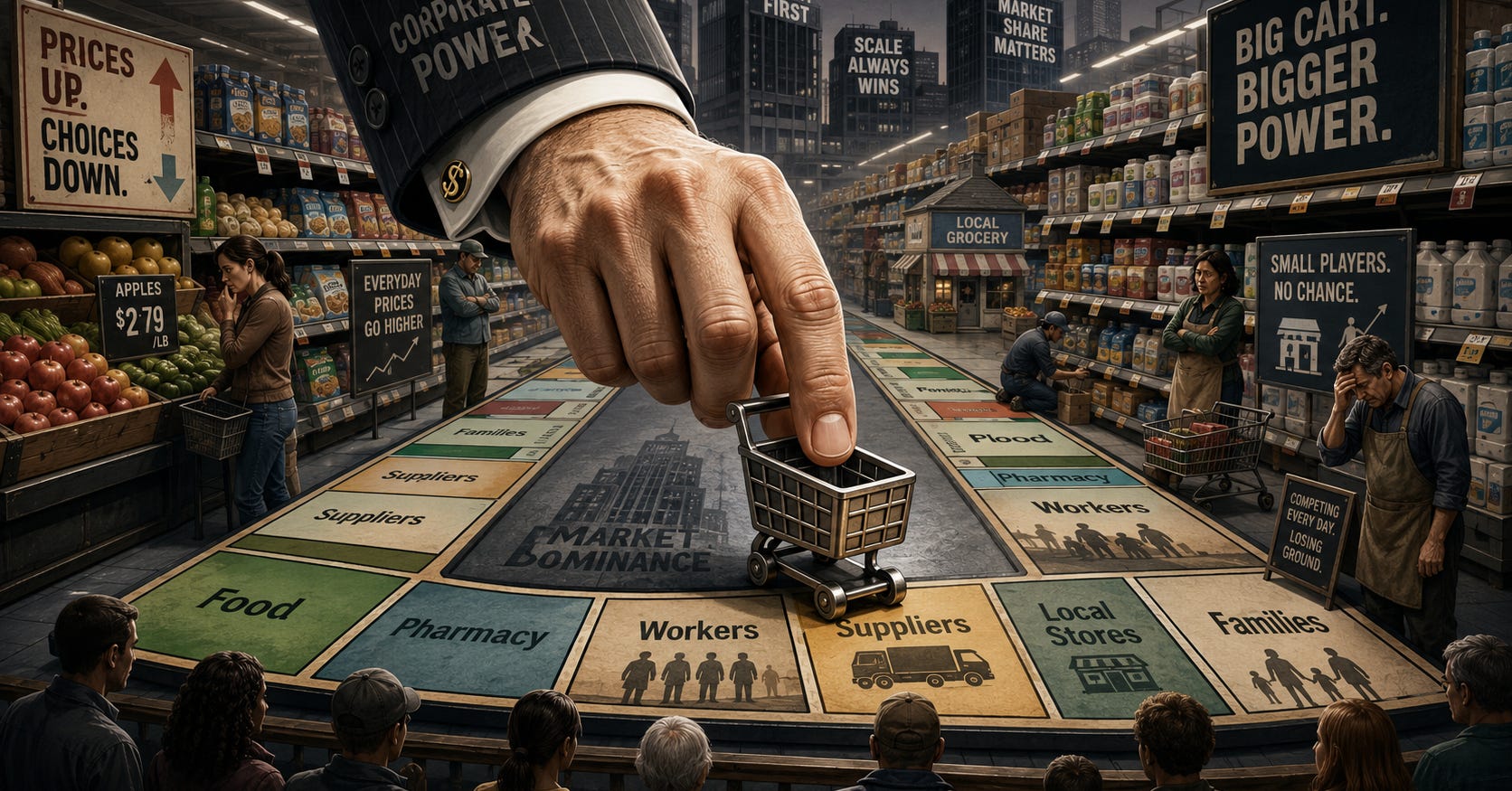
The total appears before the cart is even full. Eggs. Milk. Bread. Cereal. Meat, if there is room in the budget. Medicine from the pharmacy counter. Diapers. Dog food. School snacks. Maybe something quick for dinner because everyone is tired and the day has already taken too much.
The cashier scans. The screen climbs. The family adjusts. That is where antitrust becomes real. Not in a law school seminar. Not in a corporate press release. Not in the careful language of acquisition strategy, operational efficiency, or shareholder value. Antitrust becomes real under fluorescent lights, while a parent watches the number rise and quietly decides what goes back on the shelf.
That is why Kroger’s move to acquire Giant Eagle deserves more than a business-page shrug.
On July 1, 2026, Kroger announced a definitive agreement to acquire Giant Eagle, a regional food and pharmacy retailer with about $9 billion in annual sales, 197 supermarkets, and 11 standalone pharmacies across northern Ohio, western Pennsylvania, West Virginia, Maryland, and Indiana. The purchase price is $1.65 billion, including $1.25 billion in cash and the assumption of about $400 million in liabilities. The transaction is expected to close in 2027 if regulators clear it, and the companies said they anticipate divesting a limited number of Giant Eagle stores as part of that process.
Those are the facts of the deal, but the meaning is bigger. This is not just a grocery merger. It is a question about who gets to control the places where families buy food, fill prescriptions, earn wages, bargain with suppliers, and decide whether their local store still answers to the community around it.
Kroger deserves a hearing. Grocery is a brutal business, and scale may bring real advantages against larger rivals and rising costs. The public deserves a hearing too, because food is not optional, pharmacy access is not optional, worker pay is not abstract, and a local grocery store is not just a logo on a sign.
When grocery power consolidates, ordinary people are asked to trust that bigger will mean better, but the burden should not fall on the family at the register to prove harm after prices rise, stores close, workers lose leverage, suppliers get squeezed, or pharmacy access becomes thinner.
The burden should fall on the corporation seeking more power to prove that the public will not be harmed.
Support independent media that follows the power.
The Coffman Chronicle is built to track who holds power, who abuses it, who profits from it, and who pays the price.
Paid supporters get full Tony Michaels Podcast episodes, deeper transcript analysis, paid columns, archives, and the reporting framework behind the show.
If you believe independent media has to survive outside billionaire platforms, corporate media, and party-approved gatekeepers, become a paid supporter today.
Groceries Are Different
A grocery store is not just another retailer. Families can delay a new television, skip a new phone, wear the same coat another winter, patch the same jeans, drive the same car, and put off what can be put off. Food does not wait.
A grocery store sits close to the center of daily life. It is where families buy dinner, seniors fill prescriptions, workers pick up shifts, suppliers fight for shelf space, and a town measures whether basic needs are still within reach.
When a grocery chain changes hands, the consequences are not limited to shareholders. A store closure can mean a longer drive for an older person. A pharmacy change can mean more friction for a patient. A pricing strategy can decide whether a family buys meat that week.
Kroger has said Giant Eagle would keep its name, and the companies describe the deal as a strategic fit. That may comfort customers, but the deeper question is not only what sign hangs outside. The question is where power goes. A logo can stay local while power leaves town.
Families do not live on spreadsheets. They live near stores. They plan around pharmacy hours. They budget around weekly food prices. They work the shifts. They sell to the buyer. They stand in the checkout line and feel decisions made far above them.
Groceries are different because eating is not optional.
The Laws Were Written for This Moment
America does not lack laws for this.
The country already has antitrust tools designed to address concentrated power. The Sherman Act targets monopolization and restraints of trade. The Federal Trade Commission Act bans unfair methods of competition. The Clayton Act reaches practices that the Sherman Act does not clearly prohibit, including mergers. Section 7 of the Clayton Act prohibits mergers and acquisitions that “may be substantially to lessen competition, or to tend to create a monopoly.” The Robinson-Patman Act, as an amendment to the Clayton Act, addresses certain discriminatory prices, services, and allowances among merchants.
These laws were not written for Washington to admire from a distance. They were written because private power can become public danger when it grows too large to challenge. Competition is not only about the price of milk next Tuesday. It is about whether families have choices, workers have leverage, suppliers have bargaining power, and communities have alternatives.
For too long, antitrust was narrowed to a price-check scanner. If a merger did not immediately raise prices in an obvious way, too many people in power treated it as harmless. However, grocery consolidation does not only show up in one weekly circular or one receipt.
It shows up when fewer employers compete for workers, fewer buyers compete for suppliers, and pharmacy access, store investment, staffing levels, and local relationships are decided farther away by fewer people.
Congress already built the fence. Regulators, courts, lobbyists, and decades of corporate-friendly ideology lowered the gate. Antitrust was never supposed to be only a price-check scanner. It was supposed to be a fence against private power becoming too big for workers, suppliers, communities, and families to challenge.
The Albertsons Warning Is Still Sitting on the Table
Kroger has been here before. Its proposed merger with Albertsons did not collapse because Washington suddenly became hostile to grocery stores. It collapsed because regulators and courts looked at the deal and saw a danger the public already understood: fewer real competitors can mean higher prices, weaker service, fewer choices, and less leverage for workers.
The Federal Trade Commission, or FTC, challenged Kroger’s $24.6 billion Albertsons deal in 2024, arguing that it would eliminate competition, raise grocery prices, reduce quality and service, narrow choice, and harm grocery workers by weakening competition for wages, benefits, and working conditions. In December 2024, a federal court granted the FTC’s request for a preliminary injunction, halting the transaction.
That warning should not disappear just because the next deal is smaller. The Giant Eagle acquisition is not the Albertsons merger, but the lesson should not be that Kroger only needed a cleaner map.
The lesson should be that grocery consolidation deserves a full public test before the deal is done, not a public apology after the damage is visible.
The grocery economy is not only a consumer market. It is also a labor market, a supplier market, a pharmacy access system, and a regional food infrastructure system. A smaller merger can still shift power away from the people it affects.
Monopoly Is Only Half the Story
Most people understand monopoly. One seller gets too much power over customers. Prices rise. Choices shrink. Service weakens. The customer has fewer places to go.
That technically true, but in grocery consolidation, monopoly is only half the story. The other half is monopsony, which occurs when a buyer or employer gains too much power over the people who need access to the market.
That may sound technical, but the kitchen-table version is simple. If fewer grocery chains compete for workers, workers may have less leverage over wages, benefits, schedules, and working conditions. If fewer powerful buyers compete for suppliers, farmers, vendors, and regional producers, they may have less leverage over price, shelf space, contract terms, and survival.
That kind of power can arrive quietly. A worker gets fewer hours. A department runs thinner. A supplier accepts worse terms because losing the account would be fatal. A regional product disappears from the shelf. A pharmacy cuts hours. A store that once had local discretion becomes a line item in a national strategy.
Good Steward Capitalism does not say a company may never grow. It says power creates obligation. A company powerful enough to reshape the grocery map should be powerful enough to answer public questions before the map is redrawn.
Efficiency Is Not a Substitute for Oversight
Every merger arrives dressed in the same respectable clothes: efficiency, scale, investment, modernization, competition, better service, stronger supply chains, lower costs, and more choices for customers.
However, efficiency is not a magic word. Does efficiency mean lower prices for families, or fewer workers on the floor? Does it mean better pharmacy access, or fewer pharmacy hours? Does it mean stronger supply chains, or more pressure on suppliers? Does it mean more investment in local stores, or more decisions made from farther away?
Those questions should not be left to regulators alone. The FTC, the Department of Justice, state attorneys general, and courts all have roles to play. They can study market overlap, labor effects, supplier power, pharmacy access, divestiture plans, pricing behavior, and whether the transaction would substantially lessen competition.
Yet Congress cannot pretend this is only a technical question for lawyers. Congress wrote the antitrust laws, funds enforcement, and holds hearings. Congress can ask whether the food economy has become too concentrated for ordinary people to discipline with choice alone.
That is the Article I problem beneath the grocery story. When Congress treats concentrated grocery power as someone else’s problem, the people lose power in the most ordinary place imaginable: the grocery aisle.
Congress should not run the grocery store, but it does have to defend the people who cannot opt out of eating. Oversight is not micromanagement but stewardship.
The Register Does Not Care About Merger Theory
The public should not have to prove harm after the deal is done.
Let the merger happen. Let the market change. Let stores close, suppliers adjust, workers absorb the pressure, and families discover the new reality one receipt at a time. Then, years later, ask the public to prove exactly which decision caused which harm. By then, the map has already changed.
Kroger should have to answer specific public questions before the Giant Eagle deal is approved. What happens to stores, pharmacy access, workers, wages, schedules, benefits, staffing levels, local suppliers, regional products, and prices after the promises fade? If regulators require divestitures, who buys those stores, and are those buyers strong enough to compete?
That last question is essential. In the Albertsons case, the FTC argued that the proposed divestiture package was inadequate and would not fully replace the lost competition. Reuters reported that the federal judge questioned whether the proposed buyer could become a successful competitor and found Kroger’s promises about lower prices and employee benefits were not enforceable.
Broad promises are not enough. The family at the register should not be handed consequences after executives receive approval. The worker should not be told to trust stability while losing leverage. The supplier should not be told to celebrate an opportunity while facing a more powerful buyer. The community should not be told the logo will stay while meaningful control moves farther away.
The register does not care about merger theory, press releases, acquisition language, market strategy, or polished promises. It only shows the total.
Kroger may be able to make its case. Giant Eagle may survive as a name. Some efficiencies may be real. None of that erases the public question.
When a corporation asks for more power over food, the answer cannot be automatic trust. The answer must be proof, enforcement, and accountability. Food is too essential for faith-based antitrust. Workers are too important for after-the-fact concern. Communities are too real to be treated as dots on a market map.
The checkout line is where antitrust becomes real, and if Washington cannot defend competition there, it should stop pretending concentrated power is only a problem after ordinary people have already paid for it.
Support independent Media
If this piece made sense to you, share it with someone who buys groceries, works in retail, fills prescriptions, or wonders why every essential part of American life keeps ending up in fewer hands.
The Coffman Chronicle is reader-supported. If you can afford it, become a paid subscriber so we can keep following the places where concentrated power reaches the kitchen table, from the grocery aisle to Congress, from corporate mergers to the laws Washington already wrote and too often refuses to enforce.
Food is too essential for faith-based antitrust. And the people paying at the register deserve more than promises.
Sources:
Forbes. “How Kroger And Aldi Are Battling For Grocery Store Dominance.” July 8, 2026.
Grocery Dive. “5 things to know about the Kroger-Giant Eagle deal.” July 8, 2026.
Federal Trade Commission. “FTC Challenges Kroger’s Acquisition of Albertsons.” February 26, 2024.
Federal Trade Commission. “Statement on FTC Victory Securing Halt to Kroger, Albertsons Grocery Merger.” December 10, 2024.
Federal Trade Commission. “The Antitrust Laws.” Guide to Antitrust Laws.
Godoy, Jody. “Kroger’s $25-Billion Deal for Grocery Rival Albertsons Blocked by US Courts.” Reuters. December 11, 2024.
The Kroger Co. “Kroger Announces Agreement to Acquire Giant Eagle.” July 1, 2026.