


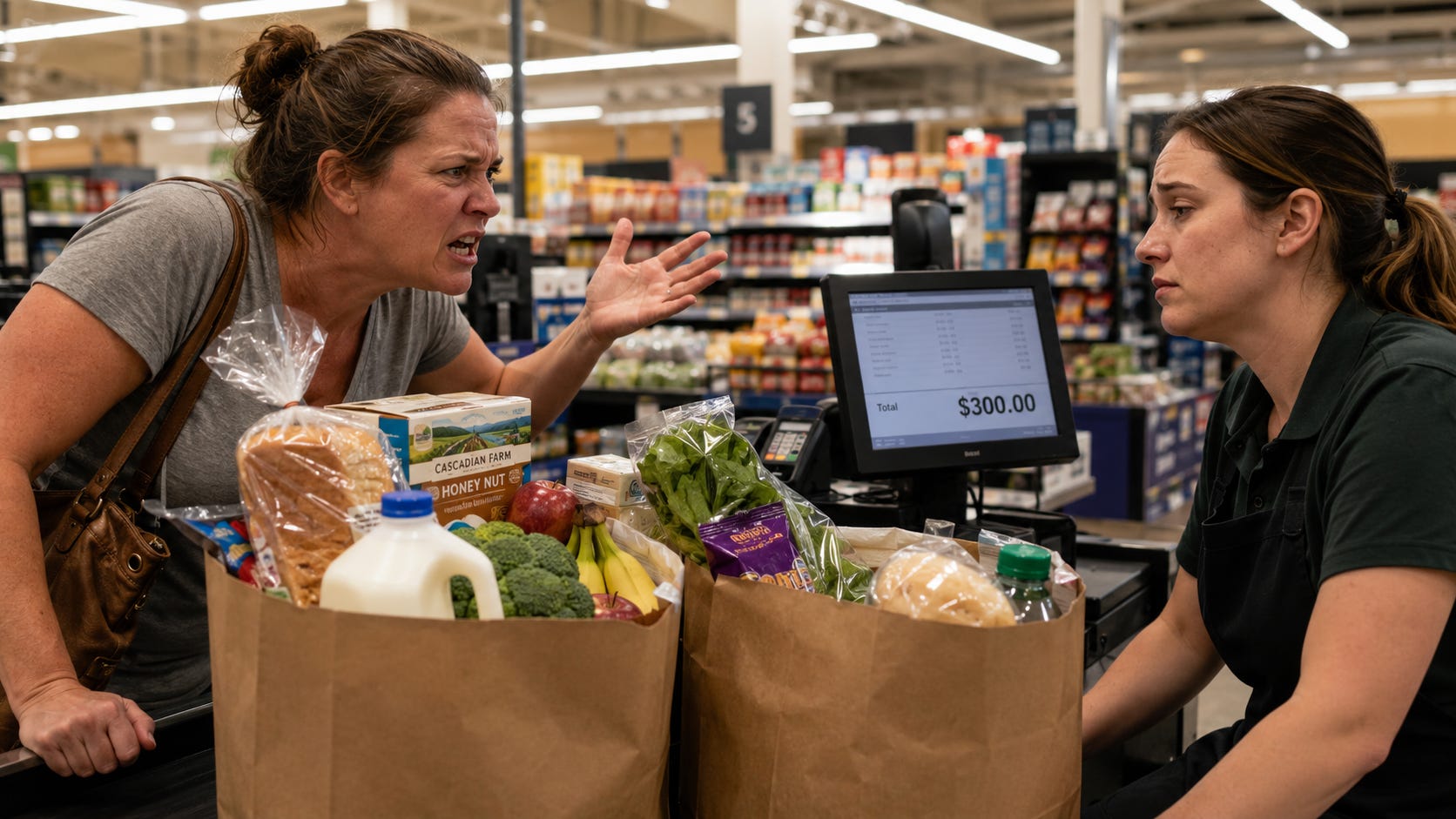
The CEO Gets the Oval Office. The Clerk Gets the Anger.
The grocery store clerk was not in the Oval Office. Neither was the stocker unloading pallets before sunrise, the warehouse worker moving food through the supply chain, the truck driver hauling it across the country, or the customer quietly removing an item from the cart because the total had climbed too high.
The CEO of Kroger was there. President Donald Trump had gathered grocery executives to announce changes to federal refrigerant rules that his administration said would lower costs and eventually reduce grocery prices. The executives stood beside the president as policies affecting their companies were discussed on camera.
Then the meeting revealed something beyond access. Trump asked Kroger CEO Greg Foran whether he had noticed a difference in Washington. After Foran gave the answer Trump wanted, Trump replied, “Boy, you said the right thing. Can you imagine? That would have been the end of Kroger.”
Maybe it was a joke, but the joke only works because everyone understands the imbalance. Even the head of one of America’s largest grocery companies was being reminded that proximity to presidential power comes with expectations.
Meanwhile, the clerk was still at the register. The clerk did not write the rule, change it, decide how much Kroger would save, or determine whether those savings would reach the customer. The clerk simply stood where the consequences arrived.
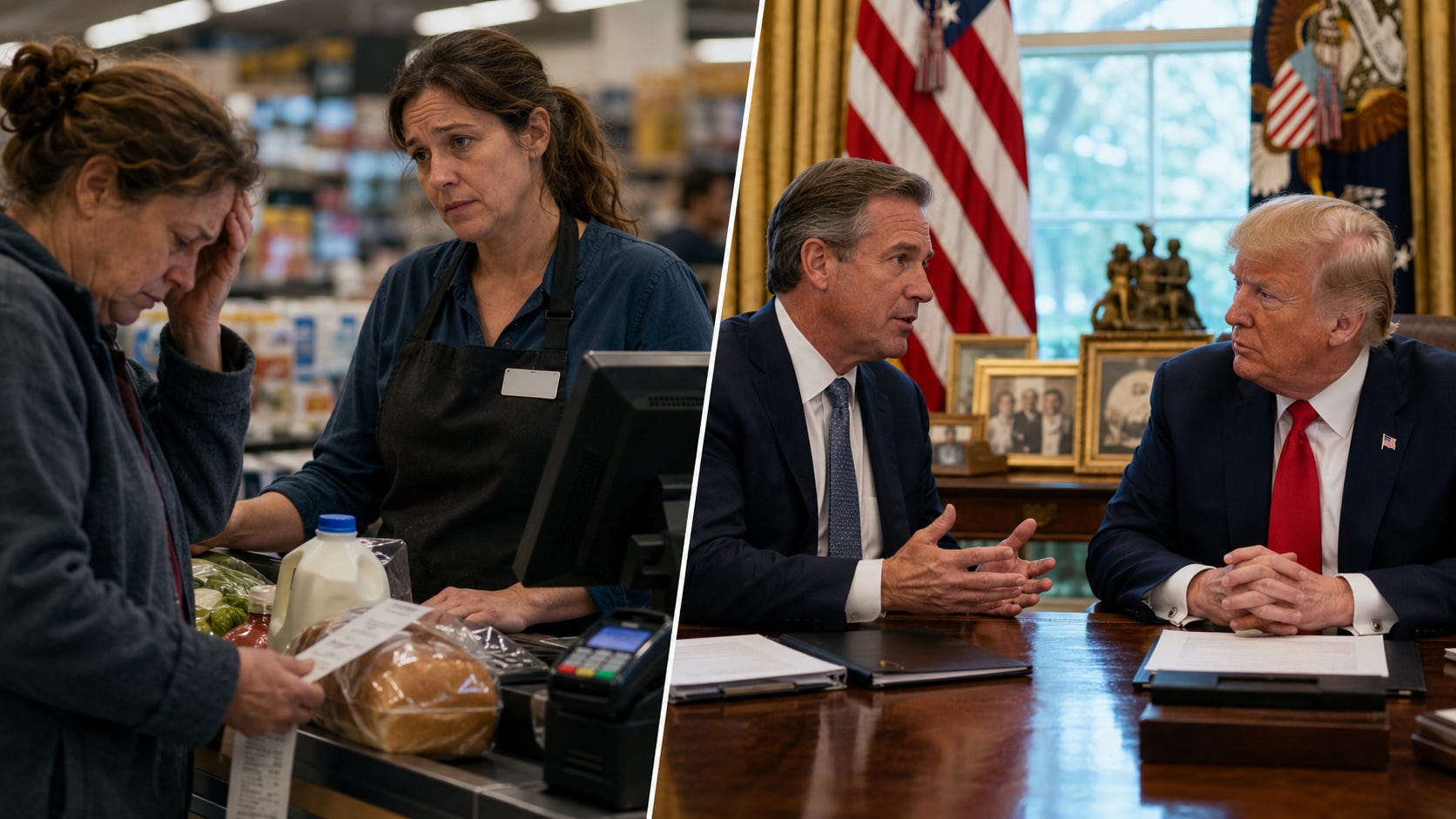
That is the split screen of American power. The CEO gets the Oval Office. The politician gets the camera. The investor gets the earnings report. The customer gets the total. The clerk gets the anger.
The customer and the clerk may stand on opposite sides of the register, but they are on the same side of the power divide.
That is where the Great American Realignment begins.
Support independent media that follows the power.
The Coffman Chronicle is built to track who holds power, who abuses it, who profits from it, and who pays the price.
Paid supporters get full Tony Michaels Podcast episodes, deeper transcript analysis, paid columns, archives, and the reporting framework behind the show.
If you believe independent media has to survive outside billionaire platforms, corporate media, and party-approved gatekeepers, become a paid supporter today.
The Customer and the Clerk Live Inside the Same Squeeze
The customer is not wrong to be angry. Groceries cost more. Gas costs more. Rent, insurance, utilities, childcare, and medical bills keep taking larger bites from the same paycheck. Choices that once felt routine now feel strategic: brand name or store brand, meat or no meat, medicine now or later, fill the tank or put in twenty dollars and hope it lasts.
That is not “consumer sentiment.” It is the daily math of survival.
But the clerk is doing the same math. The person ringing up the groceries may have put items back before starting the shift. The gas station worker may have driven in on fumes. The cashier, who is blamed for a total they cannot control, may be wondering how to cover rent, prescriptions, childcare, or the next car repair.
The customer feels robbed. The clerk feels blamed. The company keeps moving.
Concentrated power turns shared pain into conflict by pitting two struggling people against each other in the same transaction and letting each see the other as the problem.
The checkout counter is not a battlefield between enemies. It is where two people squeezed by the same structure are forced to meet.
The better question is not why the customer is angry or why the clerk is exhausted. It is who benefits when they blame each other.
The Worker in Front of You Is Not the Power Above You
The person closest to the public’s frustration usually has the least power to change the outcome. Cashiers, gas station clerks, teachers, nurses, contractors, delivery drivers, and customer-service workers are visible. They must explain the price, delay, shortage, or rule. The decision-makers remain in executive offices, boardrooms, consulting meetings, and political rooms.
The grocery clerk can scan the food, but not lower the price. The nurse can apologize for the wait, but not hire more staff. The teacher can face the parent, but not rewrite the budget.
Frontline workers receive just enough authority to enforce a decision and not enough to change it. They absorb the complaint while those who set the terms remain distant from the anger they create.
Concentrated power puts a human face at the bottom and keeps the decision-makers out of sight. Visibility is not power. Stop confusing proximity with responsibility.
The CEO and the Clerk Do Not Live in the Same Economy
The distance between the executive suite and the checkout counter is measured in more than access. It is measured in pay.
Kroger reported annualized compensation of about $14.4 million for its interim CEO in fiscal 2025. The company reported $34,552 in annual total compensation for its median associate. That is a ratio of 417 to 1. Divided across a standard 2,080-hour working year, the CEO’s annualized compensation equaled the median Kroger worker’s entire annual compensation in roughly five hours. The clerk works the rest of the year.
Kroger’s current CEO, Greg Foran, has a separate compensation package that includes a $1.5 million salary, a target annual cash incentive of $3 million, a target annual equity award of $12 million, and other benefits.
The point is not that a chief executive and cashier must earn the same amount, but rather that the gulf has become so wide that the person making decisions is insulated from the consequences felt by those carrying them out.
Compensation is not just money. It is insulation.
A higher grocery bill, a lost shift, a rent increase, or a car repair can become a crisis for the clerk. The executive beside the president does not experience those pressures the same way. The CEO receives millions and political access. The clerk receives the schedule, the policy, and the instruction to keep the line moving.
They may work for the same company. They do not live in the same economy.
Corporate Power Sets the Terms, Then Disappears
The price at the register is often treated as if it appeared by accident. Costs rose. Hours were cut. Fees were added. Everyone is told the market did it, inflation did it, the supply chain did it, or some distant force made the outcome unavoidable.
Some of those explanations contain real truth. Fuel prices rise. Shipping becomes more expensive. Wars disrupt markets. Weather damages crops. However, complexity should not become a hiding place for power.
Someone decides how many workers cover a shift, and whether higher costs are absorbed, shared, or passed directly to customers. Someone decides whether executive incentives remain protected while labor hours are cut. Someone decides whether savings from a tax break, subsidy, or deregulation reach the checkout line or remain inside the company.
The Oval Office meeting made that hierarchy visible. The cashier did not get a meeting about grocery prices. The stocker did not get to explain understaffing. The customer choosing what to put back did not sit beside the president while rules affecting the industry were changed. The CEO did.
That does not mean every price increase begins in a boardroom or every business decision is corrupt. It means the people with the greatest influence over the system have access to rooms the public rarely enters, while workers and customers remain closest to the consequences.
Power does not stand behind the register. It sits at the table where the rules are changed.
The Obedience Economy
The Oval Office exchange also showed how access can become tied to deference. A healthy government should question corporations on behalf of the public. Executives should be held accountable for prices, wages, staffing, mergers, market power, and the effects of their decisions on workers and communities.
Instead, the scene looked like court politics. The corporation received access. The president received praise. The public received another promise that relief might eventually reach the checkout line.
The danger is not only that powerful companies get invited into the room. It is that access begins to depend on obedience.
The clerk understands obedience from below: follow the schedule, enforce the policy, take the complaint, and keep smiling. The CEO encounters another version: praise the president, protect the relationship, remain in favor.
The clerk obeys the company. The CEO learns to please the president. Everyone below concentrated power is expected to adjust.
The Powerful Organize. Working People Are Divided.
Corporations join trade associations, hire lobbyists and lawyers, fund campaigns, pressure regulators, shape legislation, and seek access to presidents and Congress. They understand that organized interests multiply power.
Working people are taught the opposite. The customer is told to blame the clerk. The nonunion worker is told to resent the union worker. The private-sector worker is told to resent the public employee. Rural and urban voters dismiss each other. The native-born worker is told to blame the immigrant. Everyone is handed a target close enough to hit.
The corporate class does not need a secret conspiracy when its interests already align around lower labor costs, weaker unions, favorable regulation, tax advantages, subsidies, market concentration, and political access. Corporate America practices solidarity every day. It calls it lobbying.
Culture war becomes useful when real disagreements over religion, immigration, guns, abortion, education, race, gender, and identity keep working people from recognizing the structure they share.
As Tony Michaels puts it, culture is compromise; principle is constitutional. Culture asks whether you like the person beside you. Principle asks whether the person above you is accountable. Culture war asks which tribe should win. Constitutional principle asks who holds power, who checks it, who benefits, and who pays.
When anger moves sideways, the customer leaves furious, the clerk remains exhausted, the company keeps the margin, and the politician gains another grievance to exploit. When anger moves upward, the questions become harder to avoid.
Who set the terms? Who protected the profits? Who weakened the worker’s leverage? Who received the meeting? Who was left outside?
Culture war gives working people a fight. Principle gives them the right target.
War Comes Home Through the Checkout Line
The most terrible cost of Trump’s war with Iran is measured in human life, but war also travels home through the gas pump, the grocery aisle, and the family budget. The fighting disrupted shipping through the Strait of Hormuz, drove up energy costs, squeezed fertilizer supplies, and raised costs across transportation and food production.
The driver did not launch the war, the gas station clerk did not authorize it, and the grocery cashier did not decide that families should absorb higher fuel, shipping, and food costs. Yet they are where the consequences meet.
The public pays through the federal treasury and again through the household budget. Congress never authorized the war. Its war-powers votes came after the strikes, the spending, and the economic consequences were already underway.
This is concentrated power in its most expensive form. The president makes the decision at the top. Working people rearrange their lives around the bill.
The Great Realignment Is a Fight Over Solidarity
The Great American Realignment is not simply voters switching parties. It is a fight over what working people do with their pain.
That pain can be aimed at immigrants, teachers, nurses, public workers, rural communities, cities, unions, or anyone close enough to blame. It can be handed to a strongman who promises punishment, speed, and control while leaving the underlying concentration of power untouched. Or it can become solidarity.
A Republican customer and a Democratic clerk may disagree about almost everything. But both still face rising prices, weak bargaining power, medical costs, rent pressure, and economic insecurity. A rural worker and an urban worker may live in different political worlds while answering to the same corporations, insurers, lenders, and employers.
One path turns pain into scapegoating and asks working people to obey. The other turns pain into organized pressure and asks power to answer.
The realignment will not be decided by which party borrows the working class’s language. It will be decided by whether working people continue mistaking one another for the source of their pain.
Political homelessness can result in either authoritarian surrender or democratic renewal. The difference is solidarity.
The People’s Branch Abandoned the Checkout Counter
Congress is supposed to force power into public view. Article I gives it authority to regulate commerce, write labor law, investigate corporate conduct, control public spending, and decide whether the nation goes to war.
But too often, Congress arrives after the decision. The executive announces the policy. The corporation gets the meeting. The war begins. The costs move through groceries, gas, wages, and public budgets. Then Congress argues, holds hearings, or votes after working people have already received the bill.
That is not representation. It is delayed reaction.
When Congress refuses to use its power, Article II begins to look like the only place where anything can happen. Direct access replaces public oversight, and loyalty replaces debate. But concentrated corporate power cannot be corrected by concentrating even more political power in one person.
The answer to corporate power is not unchecked presidential power. The answer to a broken Congress is not a king.
Congress should ask who sets prices, who benefits from consolidation, who receives public subsidies, who cuts labor while protecting executive pay, and who profits when war drives up the cost of daily life.
The people’s branch cannot keep abandoning people at the point where policy becomes pain. The clerk did not set the price. Congress has the power to ask who did.
Solidarity Must Become Policy
Recognizing the problem is not enough.
Companies should not build extraordinary wealth while paying workers so little that families, taxpayers, and communities end up covering the difference. If a corporation depends on public roads, schools, utilities, transportation systems, workers, customers, and community stability, then the people sustaining that prosperity deserve a return.
That return should include good wages, strong organizing rights, opportunities to build ownership and wealth, and investment in housing, childcare, healthcare, schools, and the communities carrying the cost.
This is not about punishing success. Successful companies can remain successful. Wealthy executives can remain wealthy, but prosperity cannot keep flowing in one direction while the people creating it are told to be grateful for whatever reaches them.
The people who help create prosperity deserve to participate in it. It is not about eating the rich, but building an economy where working people are finally allowed to eat with them.
Aim Higher. Stand Together.
The answer is not to make people less angry. People should be angry when groceries cost too much, gas eats the paycheck, rent keeps climbing, medical bills become threats, and war adds another layer of cost to lives already under pressure. Anger is not the problem.
Misdirection is the problem.
The CEO has lobbyists, lawyers, stock awards, and access to the Oval Office. The clerk has a name tag, a schedule, and the obligation to face the public when the total becomes painful.
The customer and the clerk stand on opposite sides of the register, but they are not on opposite sides of the real divide. The powerful are already organized around their interests. Working people need to organize around ours.
The Great American Realignment will be defined by whether working people recognize one another across the register, the gas pump, the classroom, the hospital floor, and the jobsite.
The corporate class has its solidarity. Working people need ours.
The clerk did not set the price. Aim higher. Stand together.
Support Independent Media - The Coffman Chronicle
If this article spoke to you, share it with someone who has ever been blamed for a decision they did not make—or forced to pay for one made far above them.
If you can afford to become a paid subscriber, your support helps us keep following the money, the power, and the consequences all the way back to the people responsible.
The clerk did not set the price.
Let’s keep aiming higher.
Sources:
Associated Press. “Trump Eases Refrigerant Rule in a Bid to Address Surging Grocery Costs.” May 21, 2026.
Foster, Ken, and Bernhard Dalheimer. “The Iran Conflict, Energy Prices, and U.S. Farm Profitability: A Balanced Assessment.” Purdue University Center for Commercial Agriculture, March 31, 2026.
Kroger Co. “Current Report, Form 8-K.” Filed with the U.S. Securities and Exchange Commission, February 9, 2026.
Kroger Co. “Definitive Proxy Statement, Schedule 14A.” Filed with the U.S. Securities and Exchange Commission, May 13, 2026.
Mascaro, Lisa. “Congress Picks Up the Pieces after the Iran War.” Associated Press, June 20, 2026.
Reuters. “US War in Iran Has Cost $29 Billion So Far, Pentagon Says.” May 12, 2026.
U.S. House of Representatives, Office of the Clerk. “Roll Call 199: H. Con. Res. 86, Directing the President to Remove United States Armed Forces from Hostilities with Iran.” June 3, 2026.
Welsh, Caitlin. “Iran, Fertilizer, and Food Security: Risks, Impacts, and Policy Responses.” Center for Strategic and International Studies, April 1, 2026.
This is how a fascist state controls its citizens!
Neo-feudalism on the rise.