


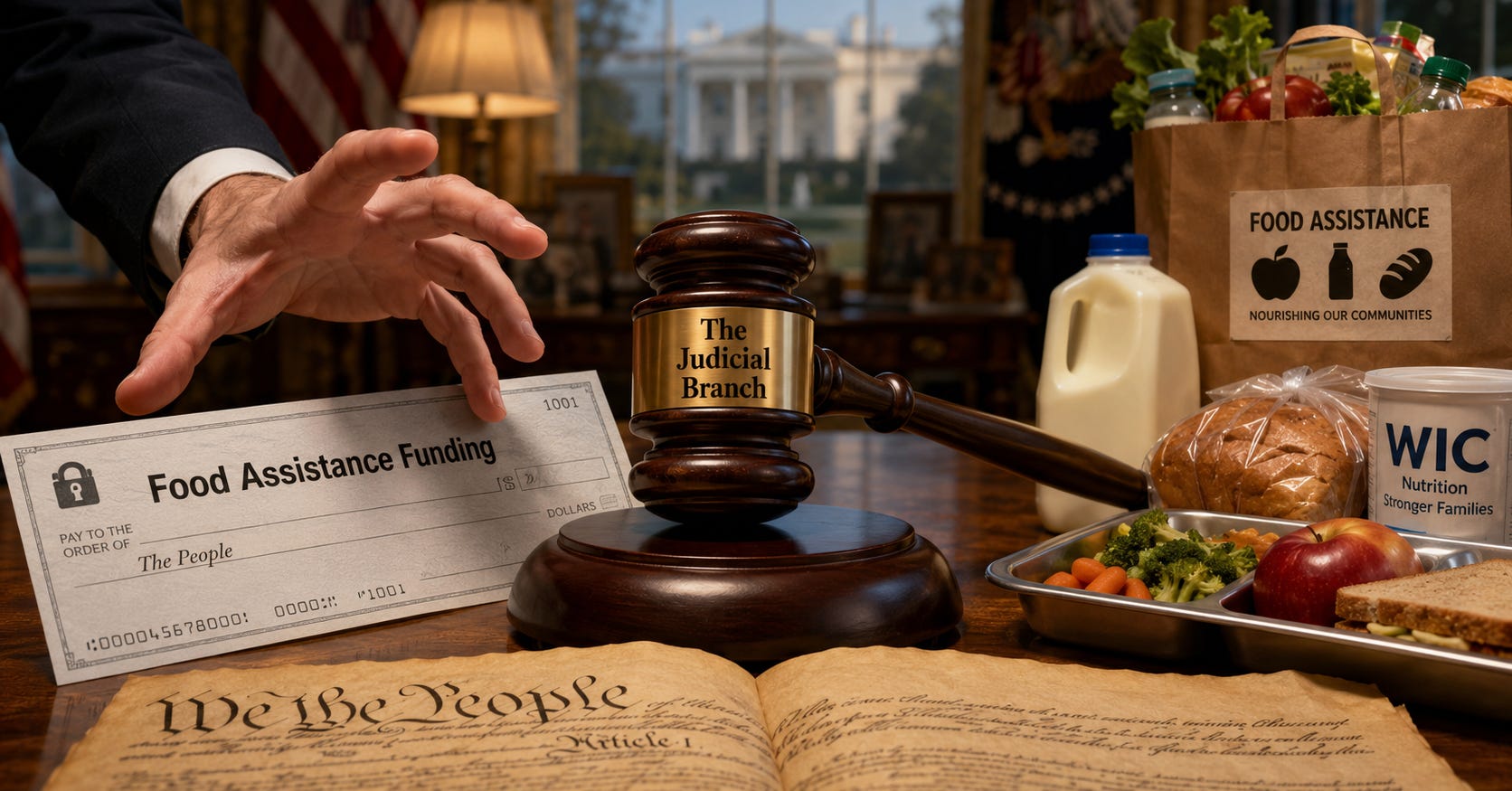
Dinner should never become a bargaining chip in a presidential power fight.
That is the plain truth underneath the latest court ruling blocking the Trump administration’s attempt to attach new political conditions to federal food and agriculture funding. A federal judge did not just pause a policy. He enforced a constitutional boundary. Congress created food-assistance programs to help families eat, schools feed children, and states administer nutrition programs. The executive branch tried to turn that money into leverage for unrelated ideological demands. The states pushed back. The court stepped in.
That is the Constitution working as designed.
However, the fact that it worked this time should not make us comfortable. It should make us pay attention. Food money belongs at the kitchen table, not inside a pressure campaign from the White House. When Washington threatens funding connected to SNAP, school lunches, WIC, farmers, and state nutrition programs, the first people put at risk are not politicians or agency lawyers. It is the parent stretching groceries through the week, the child who depends on school lunch, the senior on a fixed income, and the family already living one bill away from disaster.
The court enforced the boundary, but families should never have been close enough to the cliff for that boundary to matter.
Support independent media that follows the power.
The Coffman Chronicle is built to track who holds power, who abuses it, who profits from it, and who pays the price.
Paid supporters get full Tony Michaels Podcast episodes, deeper transcript analysis, paid columns, archives, and the reporting framework behind the show.
If you believe independent media has to survive outside billionaire platforms, corporate media, and party-approved gatekeepers, become a paid supporter today.
What the Administration Tried to Do
The Trump administration tried to attach new conditions to federal food and agriculture funding that states depend on to serve their residents. Those conditions were tied to broader political fights over immigration enforcement, gender policy, diversity programs, and athletic rules.
Congress did not create food-assistance programs so presidents could use them as leverage in unrelated ideological battles. They were created to help families buy groceries, schools feed children, mothers and infants get nutrition support, and states keep food moving to people who need it.
Twenty Democratic-led states and the District of Columbia challenged the move in court. Their argument was straightforward: the executive branch was putting unlawful roadblocks between congressionally approved funding and the people who rely on the programs that funding supports.
A federal judge agreed, at least for now, and issued a preliminary injunction blocking the administration from enforcing those conditions while the case continues. A preliminary injunction is not the final word, but it says something important right now: the executive branch cannot take money Congress approved for food and nutrition programs, attach unrelated political demands to it, and dare states to comply or lose funding their residents rely on.
This Is the Constitution Working
This story is bigger than one judge, one administration, or one lawsuit.
The Constitution does not depend on every president respecting the line on his own. It was built with the understanding that power will try to expand. Presidents will test boundaries. Agencies will stretch authority. Political movements will use whatever tool is available to get what they want. That is why the system has checks.
Congress controls the purse. The executive branch carries out the law. The courts step in when administration becomes overreach.
That is what happened here. Congress created food and nutrition programs. The executive branch tried to attach conditions that reached beyond the purpose of those programs. States challenged the move because they believed the administration was threatening funding that their residents depend on. A federal court reviewed that challenge and stopped the conditions from being enforced while the case proceeds.
That is not the system failing, but responding. The court did not invent the check on executive power. The Constitution did. The judge simply enforced it.
This should not become another story about waiting for courts to save us. Courts have a role, but they are not the only defense against executive overreach. Congress, states, and citizens have a role. The Constitution works best when every part of the system does its job before ordinary people are put at risk.
In this case, the system responded. Families were not immediately forced to live under the threat that food and nutrition programs could be used as ideological leverage. In a moment when it often feels as though power moves only in one direction, that is worth celebrating.
Food Money Is Not Presidential Leverage
The president does not get to rewrite Congress’s purpose after the money has already been approved.
That is the Article I issue at the center of this fight. Congress has the power to create federal programs, set their purpose, and decide how public money should be spent. The executive branch has the duty to administer those programs within the law Congress passed. This is one of the basic ways the Constitution prevents one person from turning public power into personal power.
Food-assistance funding is not a blank check for the White House. When Congress funds nutrition programs, that money is supposed to help families buy groceries, schools feed children, states run food programs, and communities keep people from going hungry.
The executive branch can enforce lawful program rules and require states to comply with conditions that Congress actually authorized. What it cannot do is take funding meant for food and convert it into a loyalty test on unrelated political disputes.
If a president wants new national rules on immigration enforcement, gender policy, athletic policy, or diversity programs, the Constitution provides a path. Make the argument publicly. Send legislation to Congress. Let the people’s representatives debate it, amend it, vote on it, and answer to the voters.
What the president cannot do is skip that process and use food funding as a shortcut. The kitchen table is not where presidents get to hide fights they could not win in Congress.
The Bigger Pattern: Concentrated Power Through Funding
This is how concentrated power often works in real life. It does not always announce itself with a speech, a rally, or a dramatic order from behind a podium. Sometimes it shows up as a funding condition, a waiver, or a threat buried in agency language most people will never read until their state government is forced to choose between compliance and losing money residents depend on.
This case matters beyond SNAP or USDA funding.
If a president can weaponize food money, that is only the beginning. The same logic can be applied to education funding, transportation funding, disaster aid, healthcare grants, housing support, infrastructure money, and public safety dollars. Every program Congress creates can become another pressure point. Every state can become another target. Every family can become collateral damage in a fight that was never supposed to reach their dinner table. We have already seen this in action since Trump regained the Oval Office.
Congress passes laws and appropriates money because the people are supposed to have a voice in how public power is used. Those debates can be messy, slow, and frustrating, but they are public. They require representatives to take positions, force lawmakers to explain themselves, and give voters someone to hold accountable.
Executive leverage works differently. It moves through pressure, agencies, and threats to withhold funding. It can turn public programs into tools of obedience without forcing Congress to openly debate the issue at all.
When presidents can use congressionally approved money to force unrelated policy outcomes, the people’s power gets pushed further away from the people themselves. The debate leaves Congress, and the decision moves into the executive branch. The consequences land in households that had no seat at the table.
Once that pattern becomes normal, every kitchen table is one executive decision away from becoming a bargaining chip.
The Constitution Worked. Now Congress Has to Act Like It.
The good news is that the constitutional check worked. The states challenged the administration, and the court blocked the funding conditions. The design did what it was supposed to do when executive power tried to stretch beyond its lane, especially in a political moment when many Americans feel like no institution is willing to say no.
However, the fact that the system worked does not mean the system is healthy. A healthy republic should not require states to rush into court to stop food money from becoming political leverage. A healthy Congress should not sit back while presidents test how much authority they can grab before a judge intervenes. A healthy system should not let families, schools, farmers, and state nutrition programs get close enough to cause harm for a preliminary injunction to become the emergency brake.
This is where Article I matters.
Congress is supposed to be the people’s branch. It is supposed to decide how public money is spent, what conditions apply, and what programs are for. When presidents stretch congressionally approved funding for unrelated political leverage, Congress, states, and the people lose power.
The answer cannot be to simply hope courts catch every overreach in time. Courts matter, but they are not supposed to be the first and only defense. Congress has to write clearer laws, defend its own spending power, and stop treating executive overreach like someone else’s problem.
The Constitution worked this time, but the lesson is not that we can relax. It is, instead, that constitutional checks only work when people use them, defend them, and refuse to let presidents turn public programs into political weapons.
Food assistance exists to feed people, not to help presidents win unrelated ideological fights. Dinner should never be put on the bargaining table, and Congress should make sure no president gets this close to doing it again.
Support Independent Media
If you believe the kitchen table should not be held hostage to presidential power, share this piece. Help more people see how these fights connect. And if you can afford to become a paid subscriber, it helps keep independent constitutional accountability journalism alive.
Sources:
“Judge Halts Trump Administration Efforts to Impose Conditions on SNAP.” AP News, June 6, 2026.
Commonwealth of Massachusetts et al. v. U.S. Department of Agriculture et al. “Complaint for Declaratory and Injunctive Relief.” U.S. District Court for the District of Massachusetts, No. 1:26-cv-11396, filed March 23, 2026.
Commonwealth of Massachusetts et al. v. U.S. Department of Agriculture et al. “Plaintiff States’ Motion for Preliminary Injunction.” U.S. District Court for the District of Massachusetts, No. 1:26-cv-11396-MJJ, filed March 30, 2026
“The Federal Government’s Authority to Impose Conditions on Grant Funds.” EveryCRSReport.com, March 23, 2017.
Congressional Research Service. “Litigation Over the Trump Administration’s Grant Terminations.” Legal Sidebar LSB11407, March 19, 2026.
Library of Congress. “ArtI.S8.C1.2.6 Anti-Coercion Requirement and Spending Clause.” Constitution Annotated.
“Judge Blocks Trump Administration’s Attempt to Link USDA Funds to Compliance with Other Policies.” Reuters, June 6, 2026.
U.S. Department of Agriculture. “Current USDA General Terms and Conditions for Federal Financial Assistance.” December 31, 2025.
U.S. Department of Agriculture. “USDA General Terms and Conditions.”
U.S. Department of Agriculture, Food and Nutrition Service. “Supplemental Nutrition Assistance Program (SNAP).” Updated March 12, 2026.
U.S. Department of Agriculture, Food and Nutrition Service. “WIC: USDA’s Special Supplemental Nutrition Program for Women, Infants, and Children.” Updated May 21, 2026.
U.S. Department of Agriculture, Food and Nutrition Service. “National School Lunch Program.” Updated December 11, 2025.
Controlling food is power. Power gets you money. Trump loves money. Therefore controlling food access is part of a dictator’s agenda.
The Fapweasel (Trump) stuffs his face, but God forbid, anybody else have enough to eat!