


Imagine a world where anyone can copy your art, book, or music, and you can do nothing to stop it. No copyright. No ownership. No protection.
That world is no longer science fiction. In March 2025, a federal appeals court ruled that purely AI-generated art cannot be copyrighted, an explosive decision that affects everything from YouTube channels to Etsy storefronts.
The court reaffirmed a core principle of U.S. law: only humans can be authors. Machines, no matter how intelligent, do not get copyrights.
But this legal decision didn’t emerge in a vacuum. It collided with a policy whiplash: the Biden administration tried to prepare for the AI era, and then Trump tore those protections down. At stake isn’t just ownership. It’s the future of authorship, value, and human creativity itself.
To understand what’s really at stake, we need to examine how the courts drew the line and why it changed everything for the people who create.
Independent News. Just $1/Week.
We just hit 12,000 subscribers—thank you! We’re offering full access to The Coffman Chronicle for just $1 a week ($52/year) to celebrate.
Get exclusive analysis and fearless reporting you won’t find in corporate media.
Support truth. Stay informed.
What the Court Decided and Why It Matters
At the center of the case was “A Recent Entrance to Paradise,” an image created by an AI system called DABUS. The developer, Stephen Thaler, applied for copyright, but listed the AI, not a person, as the author.
The U.S. Copyright Office rejected it. A district court agreed, and in March 2025, the D.C. Circuit Court of Appeals did, too.
“The Copyright Act protects ‘original works of authorship’—and authors, in the eyes of the law, must be people,” the ruling stated.
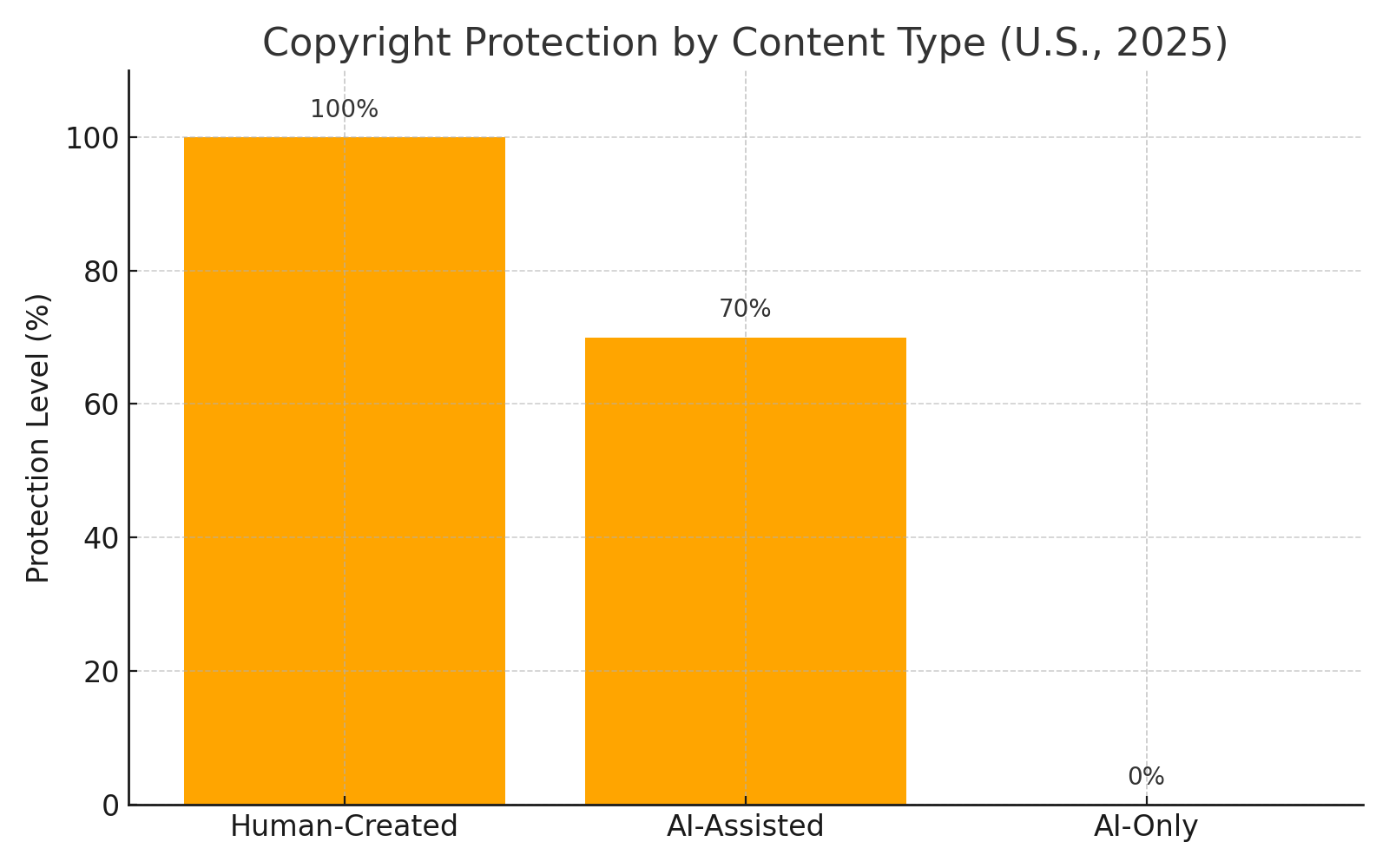
That might sound obvious, but the implications are seismic. Content made solely by AI—without meaningful human edits—is public domain. That means anyone can copy, remix, sell, or exploit it without legal consequences.
Take platforms like Etsy or YouTube: If your song or illustration is made entirely by AI and someone reuploads or resells it, you have no ownership rights to defend it. It's open season.
The consequences aren’t theoretical. They’re already hitting real creators.
The Human Cost: A Real-World Example
Last year, designer Lina Zhou used Midjourney to generate floral greeting cards for her Etsy store. Within weeks, copies appeared on dozens of competitor listings, some selling at half the price. “Since it was AI-generated,” she says, “they told me it wasn’t protected. I felt like someone walked into my studio, took my work, and I couldn’t even call the cops.”
Her story is increasingly common. And under current law, there’s no remedy.
Winners and Losers in the Creative Economy
As this legal reality sets in, it’s already creating two very different futures—one for human creators, and another for those relying solely on machines:
Winners
Human Creators: Writers, musicians, and artists who use AI as a tool—but not a replacement—can still claim copyright.
Traditional Media: Studios and publishers get stronger legal footing to challenge AI mimicry.
Platforms with Human-Centric Models: Substack, Etsy, and YouTube can now prioritize human-authored content without ambiguity.
Losers
AI-Only Creators: No protection. No exclusivity. No recourse.
Dropshippers Using AI Art: Designs generated without human editing are open to copying.
Generative AI Companies: Firms like OpenAI or Stability AI face new limits in marketing their outputs as “original” products.
Automated YouTube Channels: Deepfake interviews and AI-narrated content can't be copyrighted, making them vulnerable to takedown or theft.
Here’s a simple breakdown of what kinds of content are protected and what’s now legally up for grabs:
What the Presidents Did
In October 2023, President Biden signed Executive Order 14110, directing federal agencies to study how copyright and AI should interact. It was the first serious government effort to modernize intellectual property law in the age of generative models.
However, in January 2025, President Trump revoked that order, calling it a threat to “AI innovation” and “free enterprise.” In its place, he signed a new directive removing oversight and labeling requirements, and refocusing policy on corporate freedom and “ideological neutrality.”
“The current copyright framework isn’t equipped for AI’s creative surge,” said Prof. Rebecca Tushnet of Harvard. “When authorship is unclear or denied, it opens the door to exploitation on all sides—by corporations, platforms, and bad actors alike.”
In a single stroke, Trump gutted the nation’s only federal roadmap for dealing with AI and creativity. Now, all that's left is a patchwork of outdated laws and court decisions doing the work Congress refuses to.
The Dangerous Vacuum
Without updated laws or executive guidance, the creative world now faces a high-speed crash:
Unowned Content Becomes Devalued Content: No exclusivity means no marketplace value.
Platforms May Be Overrun with Spam: Algorithm-gaming AI content risks crowding out human voices.
Creators Have No Shield: Especially independent artists relying on AI to supplement their income.
Bad Actors Get a Free Pass: From deepfakes to misinformation, unregulated AI content can be easily weaponized.
Unless something changes soon, the creative economy will not only be disrupted but also rewritten by those least accountable to the people it affects.
To be clear, while the court ruling draws a clear line for now, it does not resolve the deeper legal questions that only Congress can address. Courts interpret existing law, but in an age of machine-generated content, we need new laws that define human authorship, how much AI input is too much, and how to protect creators across a rapidly evolving landscape.
Reclaiming Human Creativity in the Age of AI
Copyright isn’t about code; it’s about people. It’s about protecting the spark of creativity, making something new, personal, and expressive. That’s a profoundly human trait, and it demands protection.
If we want a future that rewards original thought, we need:
Updated laws that recognize AI-assisted work, not just reject AI-generated content.
Platforms should clearly label and disclose AI use.
A renewed commitment to preserving human authorship as a legal and cultural priority.
Because the issue isn’t whether AI can create; it’s whether we value the human mind enough to protect it.
Let’s be clear. AI can be a valuable tool. But like all tools, it is not a replacement for people. See our previous reporting on AI and privatization here:

Call to Action: Don’t Let the Machines Write the Rules
This is your moment to push back:
Artists: Be transparent about your process. Document human input.
Platform users: Demand clear AI labels and protections for creators.
Lawmakers: Pass modern laws for a modern creative economy.
Readers: Share this. Talk about it. Organize.
If we don’t define authorship now, we risk losing it forever.
We just hit 12,000 subscribers—thank you! We’re offering full access to The Coffman Chronicle for just $1 a week ($52/year) to celebrate.
Get exclusive analysis and fearless reporting you won’t find in corporate media.
Bibliography:
Reuters. “U.S. Appeals Court Rejects Copyrights for AI-Generated Art Lacking ‘Human’ Creator.” Reuters, March 18, 2025.
U.S. Copyright Office. “Copyright Registration Guidance: Works Containing Material Generated by Artificial Intelligence.” copyright.gov, March 2023.
Sidley Austin LLP. “President Biden Signs Sweeping Artificial Intelligence Executive Order.” Sidley News & Insights, November 1, 2023.
The Employer Report. “AI Tug-of-War: Trump Pulls Back Biden’s AI Plans.” The Employer Report, January 23, 2025.
Reuters. “Trump Revokes Biden Executive Order Addressing AI Risks.” Reuters, January 21, 2025.
White House. “Executive Order on Removing Barriers to American Leadership in Artificial Intelligence.” whitehouse.gov, January 2025.
AP News. “Trump’s AI Overhaul Sparks Fears of Unchecked Development.” Associated Press, February 2, 2025.
Harvard Law Today. “Rebecca Tushnet on the Future of Copyright and AI.” Harvard Law School, February 2025.