


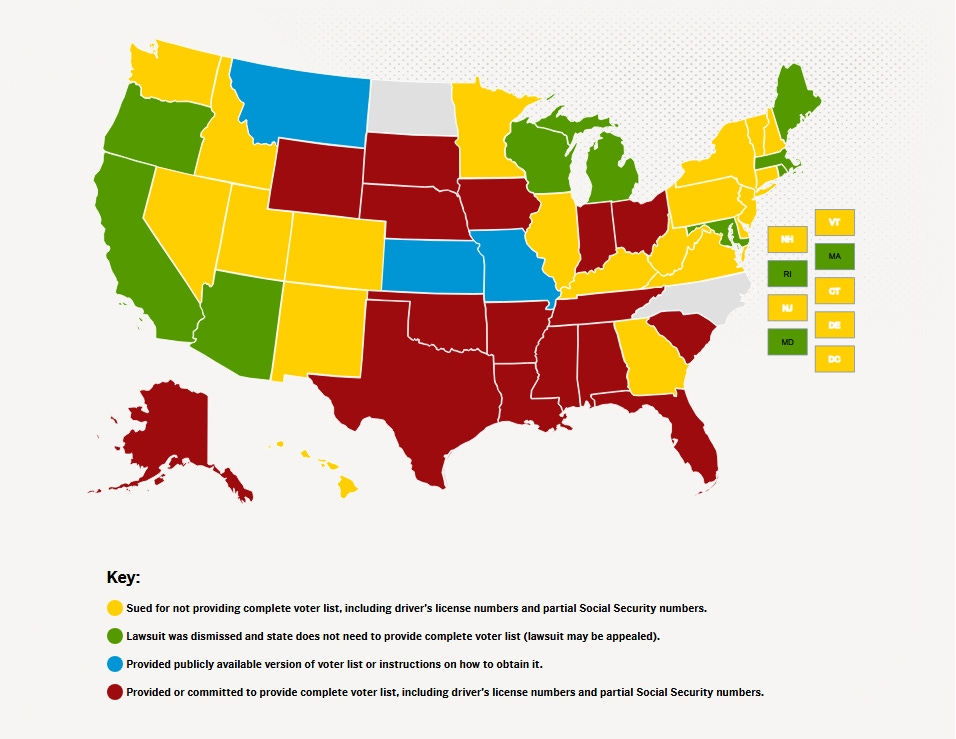
A federal judge in Maryland has dismissed the Department of Justice’s lawsuit seeking access to state voter registration records, handing the administration its ninth loss in a series of cases filed against states and the District of Columbia.
The administration argues that the information is necessary to enforce federal election laws and ensure the accuracy of voter rolls. State officials have countered that the requests exceed federal authority and seek sensitive information that federal law does not require disclosure of. Thus far, courts have consistently sided with the states.
On its own, the ruling is significant. The Justice Department has now filed 31 lawsuits seeking voter registration data and has yet to persuade a court that its legal theory is correct. However, the Maryland case arrives amid a remarkable cluster of election-related disputes unfolding across the country.
Viewed separately, these stories may appear unrelated, involving different agencies, courts, and legal questions. Viewed together, however, a theme begins to emerge.
Support independent media that follows the power.
The Coffman Chronicle is built to track who holds power, who abuses it, who profits from it, and who pays the price.
Paid supporters get full Tony Michaels Podcast episodes, deeper transcript analysis, paid columns, archives, and the reporting framework behind the show.
If you believe independent media has to survive outside billionaire platforms, corporate media, and party-approved gatekeepers, become a paid supporter today.
The Headline
The Maryland ruling is the most recent development, so it is where we begin. Of the cases heard thus far, none have resulted in a ruling in favor of the Trump administration.
Some states have argued that the federal government is demanding information beyond what federal law requires, while others have raised concerns about voter privacy and the security of sensitive registration data.
The Maryland ruling is now the ninth decision rejecting the administration’s position. To date, the Department of Justice has not indicated a willingness to withdraw any of the cases yet heard on the same grounds, perhaps testing the consistency of the courts.
Brenna Center Tracker
This raises an obvious question. What exactly is the administration trying to accomplish?
Supporters argue that election laws cannot be enforced if federal authorities lack access to the information necessary to identify potential violations. If voter rolls contain ineligible registrations, they say, the federal government has a legitimate interest in knowing about it.
Critics, meanwhile, note that states have traditionally maintained voter-registration systems, verified voter eligibility, and administered elections. They also point out that Congress has repeatedly declined to enact legislation that would create a national voter-verification framework.
Before evaluating either argument, it may help to ask a more fundamental question. How serious is the threat used to justify such extensive action?
To Find a Cure, We Must Understand The Disease… and The System
That question brings us to a headline that has received surprisingly little attention outside election-law circles. Earlier this month, Reuters reported that a long-awaited election security review initiated under former Director of National Intelligence Tulsi Gabbard had identified vulnerabilities in certain voting systems. According to Reuters, the report recommended security improvements and highlighted areas of concern.
Based on that review result, it would seem logical that there are notable election security risks. However, Reuters further reported that sources familiar with the review said investigators found no evidence that votes had been altered and no evidence that election outcomes had been changed.
Notably, the article relies upon sources rather than the report itself. That is because the report has not been released publicly, and its publication has reportedly been delayed. So far, the reason for the delay has not been given.
To be clear, a vulnerability is not the same as a breach, just as a weakness in a system is not the same as evidence that it was exploited. A faulty door lock should also be repaired even if no one has broken into the house, but the discovery of a faulty lock still does not prove a burglary occurred.
Americans are now being asked to accept a growing list of federal interventions in the name of election security. Before deciding whether those interventions are justified, it seems reasonable to ask whether the evidence supports them. Based on what we know from the DNI report, potential vulnerabilities did not yield evidence of fraud, and certainly not enough to justify overhauling voting machines.
Registration Is Not The Same Thing As Eligibility
At this point, we find ourselves asking a question that rarely receives much attention in election debates. What problem is the administration actually trying to solve?
There is a tendency in modern political arguments to collapse several distinct issues into a single conversation. Eligibility is treated as if it were the same as registration. Registration is treated as if it were verification. Verification is treated as if it were enforcement. However, they are not the same thing, but rather steps in the process.
Congress already settled one part of the debate. Federal law prohibits noncitizens from voting in federal elections. Whatever disagreements Americans may have about election administration, that particular question has already been answered.
The dispute concerns something else entirely, namely, how states should determine who is eligible to vote. The answer varies considerably across the country. Some states rely heavily on information already collected through their Departments of Motor Vehicles. Others require identification at different stages of the registration process. Some states have automatic voter registration systems. Others place more responsibility on the voter to initiate registration and provide information. Nearly all require applicants to attest, under penalty of perjury, that they are citizens and otherwise eligible to vote.
While the details differ, the principle does not. This isn’t an accident. States administer voter registration. It is how the system was designed to operate.
Election administration is often discussed as though it occurs in federal offices and courtrooms. In reality, it occurs in county election bureaus, township buildings, school cafeterias, churches, libraries, fire halls, and municipal offices. The people maintaining voter rolls are usually not federal officials. They are county clerks, election directors, and local poll workers operating under state law. That local character is easy to overlook from Washington.
It is also one of the reasons many Americans are surprised to learn how decentralized election administration remains. A voter in Pennsylvania may encounter a very different registration process from that of a voter in Arizona or Georgia. The Constitution allows for that variation. States have primary responsibility for administering elections, while Congress retains authority to establish federal rules through legislation.
The SAVE Act
Over the last several years, the administration and its allies have repeatedly pressed Congress to enact the Safeguard American Voter Eligibility Act (SAVE Act). The legislation would require documentary proof of citizenship to register to vote in federal elections and would significantly expand verification requirements. This publication has covered it extensively.
Despite sustained pressure, Congress has not passed the SAVE Act, not even when the Administration threatened to refuse to sign any legislation passed before it.
Legislation fails for many reasons. Sometimes lawmakers disagree with the policy, sometimes with the details. Often, they simply cannot assemble the votes necessary to move a proposal across the finish line. Whatever the reason, Congress has thus far declined to create the national verification framework envisioned by the SAVE Act.
Despite this, many of the administration’s current initiatives appear aimed at reaching similar destinations through different routes. The lawsuits seeking voter-registration data are one example. Efforts to expand the use of federal databases for eligibility verification are another. Together, they point toward a larger federal role in determining how voter eligibility is verified.
Executive Orders
Despite Congress’s refusal to enact the SAVE Act or similar legislation, the Administration did not end the effort.
On March 25, 2025, President Trump signed Executive Order 14248, “Preserving and Protecting the Integrity of American Elections.” Among other provisions, the order directed the Election Assistance Commission to require documentary proof of citizenship on the federal voter-registration form, one of the central goals of the SAVE Act itself. The order also addressed mail ballots, voting-system standards, voter-roll maintenance, and the use of federal funding as leverage to encourage compliance with the administration’s election priorities.
The move immediately raised constitutional questions. The Election Assistance Commission was created by Congress, and the federal voter-registration form exists because Congress established it through the National Voter Registration Act. Critics argued that the President was attempting to alter election procedures that only Congress had the authority to change. Several provisions of the order were subsequently blocked by federal courts.
Almost exactly one year later, the administration returned to the issue. On March 31, 2026, Trump signed a second executive order focused specifically on citizenship verification and voter eligibility. The order expanded the administration’s efforts to use federal databases and agencies to review voter eligibility, despite Congress having never enacted legislation expressly authorizing such a system.
Together, the two orders reveal that the debate is no longer limited to whether Congress should establish national verification standards. The administration appears to be operating from the premise that existing executive authority permits it to play a much larger role in determining how states verify voter eligibility. That is where the constitutional questions begin.
Congress has already prohibited noncitizens from voting in federal elections. The issue is not whether that prohibition exists. The issue is who determines the mechanisms used to enforce it before a ballot is ever cast. According to the Constitution, that power lies with the states in the absence of Congress.
The Fraud Question
This begs the question. If Congress has already prohibited noncitizen voting, and if states have spent decades administering voter registration under that framework, what evidence demonstrates that the existing system is failing?
The Administration and its allies have claimed that American elections are rife with fraud. The evidence available today paints a different picture. Study after study has found noncitizen voting to be rare, vanishingly so. Election fraud more broadly remains uncommon. The data have consistently failed to support claims of widespread unlawful voting capable of altering election outcomes.
The question of election integrity and voter fraud becomes even more interesting when we move beyond registration and follow the voter to the next stage of the process. After all, registering to vote is only the beginning. The ballot still has to arrive.
The Ballot Still Has To Arrive
Registration is only the first step in the voting process. Once a voter has established eligibility and successfully registered, a ballot still has to be cast and counted. For millions of Americans, that process involves the United States Postal Service.
Mail voting has become one of the most contentious subjects in modern election politics, often generating far more heat than light. Depending on who is speaking, it is either an indispensable tool that allows millions of eligible citizens to participate in elections or an invitation to widespread fraud.
The reality is far less dramatic. Mail-ballot fraud exists, as do fraudulent absentee-ballot requests, forged signatures, ballot harvesting schemes that violate state law, and isolated attempts to cast ballots on behalf of deceased individuals. Election crimes occur because people occasionally commit crimes.
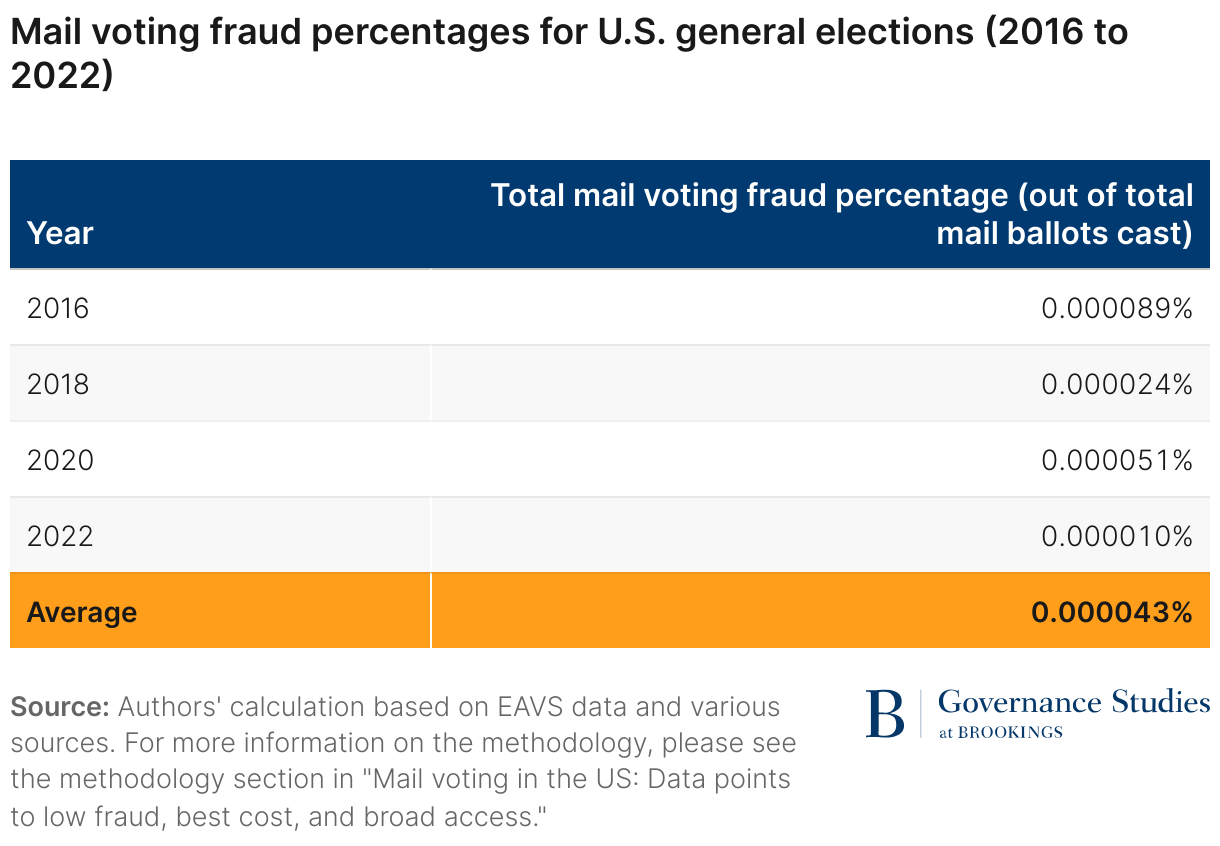
The question, as with noncitizen voting, is one of scale. The answer is also the same. Despite years of investigation, litigation, audits, recounts, and criminal prosecutions, evidence of widespread mail-ballot fraud remains elusive. Individual cases are periodically uncovered, and organized schemes occasionally emerge at the local level. Yet the kind of systemic fraud capable of altering election outcomes on a broad scale has proven remarkably difficult to find.
Brookings
That has not stopped efforts to impose additional federal involvement in the administration of mail voting. Marc Elias and other voting-rights attorneys are currently challenging administration actions affecting how mail ballots are processed and transmitted through the postal system. The details of the litigation are complex, involving questions of postal regulations, election deadlines, and administrative authority, yet the underlying dispute is surprisingly familiar. Who gets to decide how ballots move through the system?
Historically, states have answered that question. State legislatures establish election rules, state election officials administer them, and Congress may impose federal requirements when it chooses to do so.
Whether the issue involves voter-registration records, citizenship verification, or mail ballots, the destination seems remarkably consistent. Authority that has traditionally been exercised by states is increasingly being subject to federal executive action.
The next story pushed that pattern in a different direction. Until now, the focus had largely been on preventing unlawful votes. The Arkansas case concerns lawful voters.
When A Right Exists On Paper
The right to vote means little if a voter cannot practically exercise it. Congress understood that when it enacted Section 208 of the Voting Rights Act. The provision guarantees that voters who require assistance because of a disability or because they cannot read or write may receive help from a person of their choice, subject to limited exceptions.
The history behind the provision is important. Federal voting-rights laws did not emerge from a vacuum. Congress enacted many of them because states had, at various points in American history, imposed barriers that prevented otherwise eligible citizens from voting through poll taxes, literacy tests, understanding clauses, and other restrictions.
Section 208 addresses a similar concern. A citizen who cannot read, a voter with a disability, or an elderly person who requires assistance remains eligible to vote. The inability to complete a ballot without help does not eliminate that right.
That brings us to Arkansas. The Supreme Court recently declined to hear a challenge involving Arkansas’s restrictions on voter assistance. The practical effect of that decision is significant. In the seven states within the Eighth Circuit, voters and private organizations may face substantial obstacles in enforcing Section 208 protections through litigation because the legal question SCOTUS denied certiorari concerns who may sue. The practical question concerns who can obtain help.
Supporters of the ruling note that Section 208 remains federal law and that the Department of Justice retains authority to enforce it. Critics respond that rights are most meaningful when the people who possess them can defend them directly. While that may seem like a minor distinction, the impact is significant.
Imagine a voter who believes their Section 208 rights have been violated shortly before an election. If private lawsuits are unavailable, that voter may be forced to rely on federal officials to investigate, intervene, and potentially litigate the matter. Elections, however, do not wait for investigations to conclude. A right vindicated years later may do little good for a voter who was unable to cast a ballot when it mattered.
There is another concern as well. Access to government power is not evenly distributed. Large organizations, well-connected individuals, and politically influential constituencies often have easier access to decision-makers than ordinary citizens. The voters most likely to need Section 208 protections are often those least likely to possess those advantages. A system that depends entirely on executive discretion risks creating an uncomfortable reality in which the practical availability of a right depends, at least in part, on a person’s ability to attract the attention of those in power.
That brings us back to the same question. Who is responsible, in this case, for protecting the franchise? The answer increasingly appeared to involve the Executive Branch.
What Problem Are We Solving?
Across each of these stories, the justification is broadly similar. The administration argues that stronger federal involvement is necessary to protect election integrity, prevent unlawful voting, secure election systems, and maintain public confidence in election outcomes.
One question is whether the evidence supports the proposed scale of the intervention. The administration’s own election-security review reportedly identified vulnerabilities while finding no evidence that votes had been changed. Noncitizen voting remains exceptionally rare according to the available research. Election fraud remains uncommon. Mail-ballot fraud exists, yet documented cases remain a tiny fraction of the millions of ballots cast through the mail. The Arkansas dispute concerns not allegations of widespread fraud, but the ability of lawful voters to enforce protections Congress already enacted.
One fact remains difficult to ignore. The evidence repeatedly points to limited and isolated problems. The proposed solutions, meanwhile, point toward expanded federal executive involvement.
The Pattern We Kept Running Into
All of these headlines involve different agencies, laws, and courts, yet it is nearly impossible to ignore the recurring pattern: the federal Executive Branch is increasingly attempting to play a role at each stage of the election process.
The administration would likely reject that characterization, arguing it is enforcing existing law, protecting election integrity, and addressing vulnerabilities before they become crises. However, that explanation never fully resolves the question we kept encountering as we moved from story to story. What exactly distinguishes enforcement from administration?
When a noncitizen illegally casts a ballot in a federal election, investigating and prosecuting that violation falls squarely within the Executive Branch’s traditional role. When election fraud occurs, the Executive Branch investigates and prosecutes the crime. When federal voting-rights laws are violated, the Executive Branch may bring enforcement actions against those responsible.
Those powers are not controversial. They are fundamental components of executive authority.
The controversies discussed throughout this article involve something different. In each case, the focus is preventative. The Constitution establishes a system in which different institutions exercise different powers. States administer elections. Congress may establish federal election rules. The Executive Branch enforces the laws that Congress enacts.
Those responsibilities inevitably overlap at the margins, yet the distinction between creating preventative systems and enforcing existing laws remains important because those activities involve different kinds of authority.
A police officer may enforce a speed limit, but he does not have the authority to establish the limit itself. A prosecutor may prosecute election fraud, but that does not automatically grant the prosecutor authority to redesign election-administration systems simply because doing so might prevent future violations.
The administration is not merely prosecuting election violations after they occur. It is increasingly asserting a role in shaping the systems intended to prevent those violations from occurring at all.
Regardless of whether you view that as good or bad policy, consider this question. Who possesses that authority under our constitutional system?
Where We Landed
The administration presents these initiatives as election-integrity measures without considering, or perhaps caring, who possesses the authority to decide how those goals are achieved.
Congress has already prohibited noncitizen voting in federal elections. If Congress believes existing verification procedures are inadequate, it possesses the authority to establish minimum standards. Congress may amend existing election laws, pass new legislation, create additional safeguards, and direct states to implement them to address mail-in ballot concerns. Congress can also address reasonable accommodation. The Constitution provides a mechanism for doing precisely that. That is how we got the Voting Rights Act, including Section 208.
States possess authority as well. They administer elections, maintain voter rolls, and establish registration procedures consistent with federal law. If evidence emerges that a state’s systems are failing, that state’s voters and elected officials possess both the responsibility and the authority to address the problem. States routinely learn from one another, adopting practices that have proven successful elsewhere and abandoning those that have not.
The Constitution assigns a different role to the Executive Branch. The Executive enforces laws. It investigates violations, prosecutes crimes, and carries out the statutes Congress enacts. It is one of the central safeguards built into our constitutional system. The power to create rules and the power to enforce them were deliberately separated because concentrated power tends to expand beyond its original boundaries.
Throughout this debate, Americans are often presented with a false choice. We are told that we must either support expanded executive action or accept vulnerabilities in our election system. The Constitution offers another path. If election-administration reforms are necessary, Congress can debate them openly and enact them through legislation. If states are failing to prevent unlawful voting, states can strengthen their procedures, and Congress can establish national standards. If crimes occur, the Executive Branch can investigate and prosecute them.
That framework may be slower than executive action. It may be messier, produce compromises that leave no one entirely satisfied, and be far less sexy or dramatic. However, that is the system the Constitution created. With intention and consideration, the framers chose deliberation and separation of powers over speed and unilateral action.
Now, why oh why is the Executive Branch so focused on subverting that?
Politics is rarely about a single headline.
More often, it is about the pattern hiding beneath a dozen of them.
If you enjoy thoughtful progressive analysis that connects the dots, explores the constitutional questions, and digs deeper than the daily outrage cycle, subscribe below and join us for the next investigation.
Sources:
“DOJ now 0-9 in voter roll cases after Trump-appointed judge tosses its Maryland demand,” Democracy Docket, June 22, 2026.
“Federal judge dismisses Justice Department lawsuit seeking detailed voter data from Maryland,” Associated Press, June 23, 2026.
“Tracker: DOJ Lawsuits Seeking States’ Sensitive Voter Data,” State Democracy Research Initiative, University of Wisconsin Law School, updated June 2026.
“Tracker of Justice Department Requests for Voter Information,” Brennan Center for Justice, updated June 2026.
“White House delays release of US voting machine study as midterms near,” Reuters, June 19, 2026.
“Preserving and Protecting the Integrity of American Elections,” The White House, March 25, 2025.
“Ensuring Citizenship Verification and Integrity in Federal Elections,” The White House, March 31, 2026.
“Judge blocks Trump’s use of revamped immigration database for voter checks,” Reuters, June 22, 2026.
“US judge allows challenges to Trump’s mail-in voting order ahead of November elections,” Reuters, June 18, 2026.
“Supreme Court declines to hear Arkansas case, further weakening Voting Rights Act,” Democracy Docket, June 22, 2026.
“Voting by aliens,” U.S. Code, 18 U.S.C. § 611, current federal statute.
“Noncitizen Voting Is Already Illegal — and Vanishingly Rare,” Brennan Center for Justice, April 17, 2024.
“Trump’s Claims About Noncitizens Voting Are False. We Can Prove It,” Cato Institute, February 5, 2026.
“Mail voting fraud: Data points to low risk and high benefits to voters,” Brookings Institution, November 6, 2025.
“Mail Voting Accuracy,” Brennan Center for Justice, April 23, 2024.
Little donnie dementia knows his days are numbered if the Democrats take both Houses in Congress. So he is relying on cheating to prevent his third impeachment.
If Democrats were actually rigging elections, we'd probably already have universal health care, stronger gun safety laws, a Supreme Court with a liberal majority, high-speed rail, AI regulations, and affordable college. The fact that we don't is a pretty good indication that elections are competitive—not predetermined.