


Editor’s Note: This article was updated to correct a misspelling at 5:30pm EST on November 3, 2025.
This Tuesday, all eyes are on New York City. The mayor’s race is loud, messy, and expensive — exactly what national media loves. Mamdani’s campaign has sparked outrage, praise, record-breaking fundraising, and bitter infighting within the Democratic party.
It’s got everything: high stakes, identity clashes, donor drama, and coast-to-coast coverage.
But while pundits are dissecting every poll from Brooklyn to the Bronx, voters in more than 30 states are heading to the polls too, deciding everything from school board control to tax increases to congressional replacements.
These elections aren’t on cable news. They’re not trending on X. However, they’re shaping your daily life more than most people realize, and far more than any mayoral election in a city (much less a state) that you do not live in.
Because democracy doesn’t defend itself, and neither does your sanity. Subscribe here to keep your eyes open and your sarcasm sharp.
Local Elections, Big Consequences
This isn’t an offhand cliche. Local elections determine:
How your property taxes are spent
What your kids learn in school
Whether your water is clean or your road gets fixed
How accessible healthcare is in your county
Whether your neighbor can open a gun range, a dispensary, or a gas station
And yet, turnout for these elections is abysmal.
Presidential elections barely crack 60% turnout. Off-cycle local elections, meanwhile, often fall closer to 10%. In some rural areas, it dips into the single digits.
That means decisions affecting thousands are made by a handful of people. Worse, it means organized interest groups, often with extreme agendas, can sweep into positions of power unchallenged. Just ask the school districts now dominated by “parental rights” candidates aligned with national PACs.
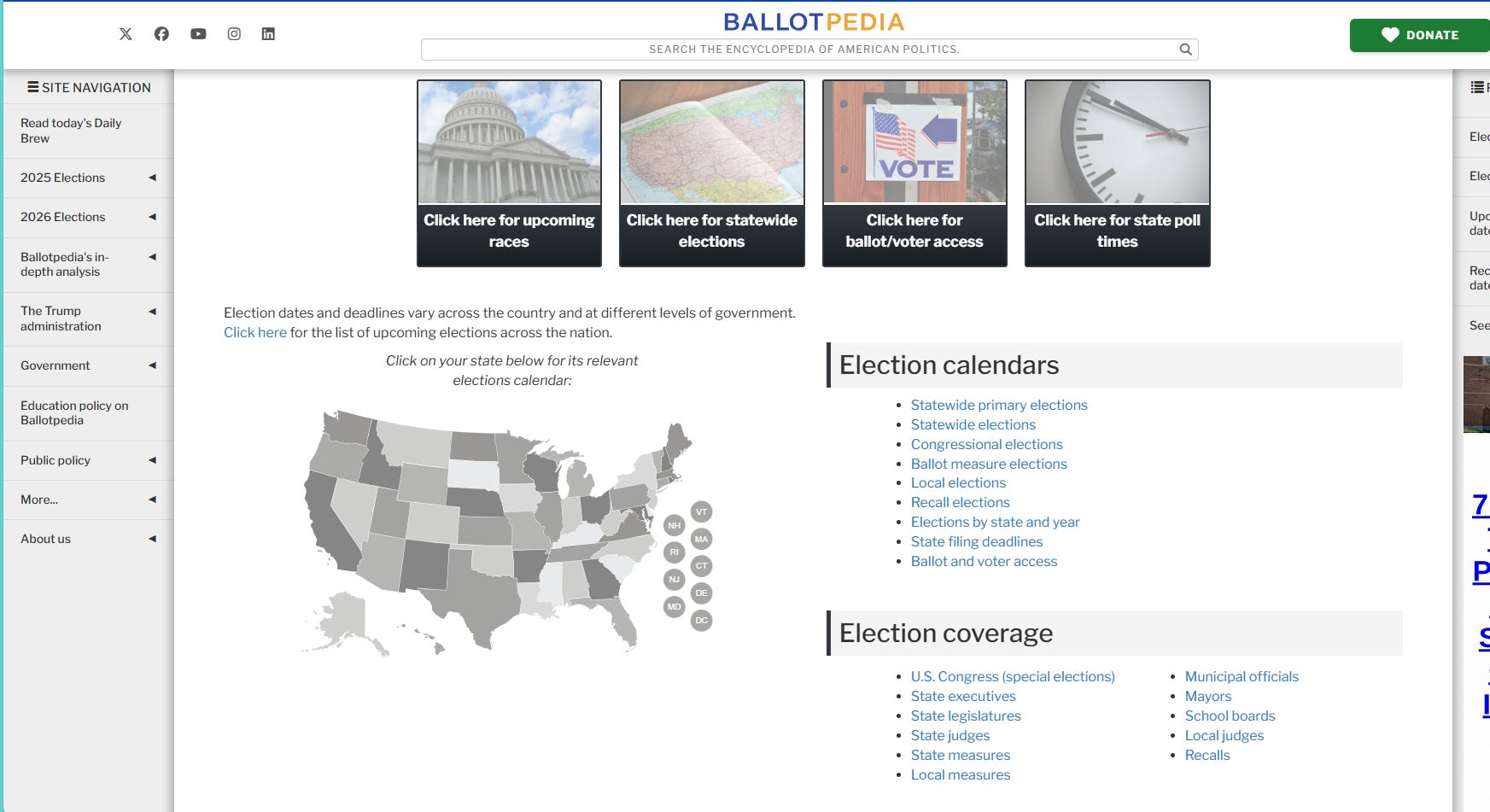
See what elections are happening in your area on the Ballotpedia calendar.
Ballot Language Is a Labyrinth. On Purpose
You’d think the hardest part of voting would be deciding how you feel about an issue. However, in local elections, sometimes the hardest part is just figuring out what the question is asking.
Even well-meaning voters walk into the booth and stare at a paragraph that reads like it was written by a contract attorney — which, often, it was.
Written for Lawyers, Not Voters
According to Ballotpedia, the average readability of state ballot measures is the equivalent of 18 years of education. For reference, that’s a master’s degree. Meanwhile, the average American adult reads at a 7th or 8th grade level. According to research, only about 1 in 10 adults is considered “proficient” in complex reading, meaning that 9 out of 10 voters who bother to show up must rely upon someone else telling them how to understand the proposition.
Only 23 states require ballot questions to be written in “plain language”, and even then, the rules are vague or unenforced. So, while you’re being asked to approve or reject changes that might affect your taxes, schools, or public services, the language you’re reading might as well be Latin.
This isn’t just bad communication. It’s voter suppression through obfuscation.
Ballot Candy: When a Sweetener Hides the Sting
Another tactic used is adding something nice and broadly appealing to the beginning of the question, then burying the controversial or costly stuff in the back half. Think of it as the Mary Poppins “Spoonful of Sugar” method.
It’s called “ballot candy.” A measure might start with “Do you support raising teacher pay” but also includes a provision to lower business taxes, increase local taxes, or cut funding elsewhere, all in one vote. Occasionally the framing is so obtuse that the sweetener is actually undone by the sting, such as requiring cutting teaching or support staff to fund teacher raises.
Some voters will only read the first part of the question, miss the implications of the second part, or feel torn by their dedication to the former and confusion about the latter.
Misleading Framing and Double-Negatives
Sometimes, the entire structure of a question is a trap. Measures that read like: “Shall the City Charter be amended to retain the repeal provision of Ordinance 187-B, thereby disallowing further reversals of zoning reclassifications under Article IX?”
It’s a double negative within a procedural clause about something most voters have never heard of. What is Ordinance 187-B? Many voters are unlikely to know, and those who do might be further confused by “disallowing further reversals”. What reversals have already occurred? Do we need more?
In many cases, those voting “no” and “yes” may actually want the same outcome, but they’re just confused about which button delivers it. And honestly, for many voters, the issue is so technical that they are ill-equipped to have an opinion one way or another. Who is getting worked up over zoning reclassifications when property taxes are high, schools are underfunded, and the local roads are shot?
Voting Rules Are Changing, Too
Adding to the confusion, voting rules themselves are shifting under our feet.
In some states, new laws require documentary proof of citizenship, often without fully explaining what counts or how to provide it. In others, early voting windows have been cut back, ID rules have changed, or mail ballot deadlines are tightening.
Even the timing of elections is shifting. Louisiana just moved its 2026 primaries in anticipation of a Supreme Court ruling that could redraw the state’s congressional map. Texas continues to wait months to fill a vacant House seat after a member’s death in March, leaving constituents unrepresented, and critics wondering if politics influenced the delay.
And then there are the multiple redistricting efforts that have taken place in the last nine months. For many voters, who they are even eligible to vote for (or against) has recently tilted entirely.
All of this makes voting harder and less transparent just when local stakes are growing.
The Quiet Crisis: Nobody’s Running
Then there is the problem we rarely talk about: no one’s running.
Thousands of local elections across the country have just one name on the ballot or none at all. That’s school board seats, city council positions, tax collectors, and judgeships uncontested, year after year. The same people, no matter how much they are hated by the voters, remain in power.
And when no one files to run? That depends on the local or state rules. That seat can stay empty. Worse, it can be filled by appointment, often by the same insiders voters are tired of. In some places, the remaining members of a board get to handpick a replacement. In others, the seat might sit vacant until a special election is called. Sometimes, the current officeholder just stays in place, even after their term technically ends.
None of these outcomes involve your vote. None increase accountability.
This is how local power calcifies— not through dramatic takeovers or partisan warfare — but through silence, vacancy, and voter fatigue. The gears of local government keep turning, but fewer and fewer people are at the wheel.
If your town feels like it’s being run by the same people year after year, it probably is, not because they are the best choice, and certainly not because it is inevitable, but because no one is challenging them.
Stop Complaining. Start Campaigning.
I live in a rural area. I’m definitely in the political minority, yet I often hear the majority voters say that the current leadership is corrupt or not doing anything, that it is always the same people in charge of everything.
However, when the candidate filing deadline hits, no one challenges the incumbents. If you’re tired of seeing the same names on the ballot, maybe it’s time to add yours. Even a small campaign can rattle a complacent incumbent, a write-in race can change the conversation, and in a low-turnout local election, a few dozen votes can win. Goodparty.org is a great resource to build a grassroots campaign.
So, if you’re frustrated, good. That means you still care. Now ask yourself: What could you do with a clipboard, a few friends, and a weekend?
Tools to Help You Cut Through the Fog
If this all feels overwhelming, that’s by design. However, you’re not powerless. There are tools that can help:
Ballotpedia: Find out what’s on your ballot, what the measures mean, and who’s running. This is a great tool for understanding the confusing language and mixed messages. Ballotpedia’s Sample Ballot Lookup tool allows you to enter your address and see local candidates, ballot measures, and elections in your area.
ActiVote: A personalized voting app that aligns you with candidates based on issues. Try the Plot Your Politics quiz and prepare to be surprised. Useful for readers who prefer mobile access or want personalized alerts for their zip code/area.
Vote.org and your state’s election portal: Check registration, polling locations, mail ballot deadlines
League of Women Voters: Nonpartisan voter guides written in plain English
Use them. Share them. Bookmark them.
For a straightforward way to check who’s on your local ballot and what the measures mean, check Ballotpedia’s lookup tools. For a mobile‑friendly way to track upcoming local, state, and federal elections, including personalized candidate match‑ups and local‑race alerts, use ActiVote. Or if you are a political junkie like me, use both.
Don’t Let Silence Win
This Tuesday and in the weeks to come, decisions will be made in your name whether you show up or not. While many states are holding general elections this Tuesday, some have upcoming dates later this month, next month, or early next year.
If you want change, it starts here— not next year, not in some far-off presidential race, and not after it’s too late. Right now, where you live.
The next big fight isn’t in Washington or even NYC. It’s in your school board, your zoning board, your county office, and it’s probably happening this week.
Don’t let the bastards sneak anything past you. Subscribe and get your daily dose of rage and receipts delivered fresh, before the spin doctors can scrub it.
Sources:
U.S. Census Bureau — Voting and Registration in the Election of November 2020
United States Elections Project — Voter Turnout Rates Presented by State, 1980–2024
Nonprofit VOTE — America Goes to the Polls 2022
Ballotpedia — Readability of Ballot Language, 2017–2023
NCES (National Center for Education Statistics) — National Assessment of Adult Literacy (NAAL)
Ballot Initiative Strategy Center — The Hot Sheet: Ballot Candy and Voter Confusion
Very informative with links to essential information…some of which I knew about, but others not so much. Downloading Activote now. It looks very promising and most useful to me. 💯🫶
Thank you for your work, it is critical to help retake our local government and Commissions.
Great piece.