


Congress is once again working to pass a new Farm Bill, the sweeping piece of legislation that shapes American agriculture, food assistance, conservation, and rural development for years at a time. Lawmakers have spent months debating everything from crop insurance to the Supplemental Nutrition Assistance Program (SNAP). More recently, attention has turned to controversial proposals involving pesticide liability and animal welfare standards.
When Americans hear the words “Farm Bill”, most understandably assume the legislation is primarily about farms and food. However, like many previous versions, this edition of the Farm Bill raises the question of what problem it is actually trying to solve.
Support independent media that follows the power.
The Coffman Chronicle is built to track who holds power, who abuses it, who profits from it, and who pays the price.
Paid supporters get full Tony Michaels Podcast episodes, deeper transcript analysis, paid columns, archives, and the reporting framework behind the show.
If you believe independent media has to survive outside billionaire platforms, corporate media, and party-approved gatekeepers, become a paid supporter today.
Where the Farm Bill Stands
Before examining the legislation's broader implications, it is worth stepping back to review its key elements and current status.
The House approved the bill on April 30 in a largely party-line vote, with 14 Democrats crossing the aisle to support final passage and 3 Republicans opposing it. The Farm Bill is typically reauthorized every five years. However, Congress has not enacted a new comprehensive bill since 2018, relying instead on a series of temporary extensions while lawmakers struggled to reach an agreement on a replacement. The recent House passage marks the first time in years that either chamber had approved a full Farm Bill, setting the stage for negotiations with the Senate, whose Agriculture Committee released its version on June 23rd.
Although the two versions differ in several important respects, they also share significant similarities. Both continue the traditional structure of the Farm Bill, combining agricultural programs with nutrition assistance, conservation initiatives, research funding, and rural development.
Farm Supports Would Increase
Both chambers generally move in the same direction on traditional farm programs. The proposals increase support for commodity producers through higher reference prices, strengthen crop insurance, expand disaster assistance, and continue programs intended to help farmers weather volatile markets, drought, and other disruptions. These provisions are often described as the farm safety net because they are designed to stabilize agricultural production when circumstances beyond a producer’s control threaten financial viability.
Supporters say that these programs are overdue, given years of rising production costs and volatile markets. Critics generally do not dispute that many producers need assistance, but worry that the structure of many commodity programs disproportionately benefits larger operations capable of producing the greatest volume of eligible crops.
SNAP Remains One of the Most Contested Issues
Nutrition assistance remains one of the most politically contentious portions of the legislation. Regardless of how you feel about the inclusion of the program in the Farm Bill, it continues to be a significant aspect of it.
The House bill largely preserves the tighter SNAP framework established through earlier legislation rather than restoring previous policies. The current Senate proposal likewise does not appear to substantially reverse those earlier changes.
At the same time, the debate surrounding SNAP extends well beyond the Farm Bill itself. Some policymakers have also proposed restricting which foods may be purchased with benefits, arguing that taxpayer dollars should encourage healthier diets. Many states have already placed restrictions on sugary drinks and other processed foods.
The Pesticide Liability Debate
One of the most closely watched provisions never made it into the House-passed bill. An earlier House Agriculture Committee draft included language that opponents argued would make it significantly more difficult to bring certain state-law failure-to-warn lawsuits against pesticide manufacturers. Agricultural organizations supported the proposal, arguing that federal pesticide labeling should remain nationally uniform rather than subject to fifty different legal standards.
An interesting coalition of consumer advocates, environmental organizations, trial lawyers, and many members of the Make America Healthy Again (MAHA) movement strongly opposed the language, arguing that it would effectively shield manufacturers from accountability.
Before final House passage, lawmakers removed the provision. The Senate committee’s current proposal also does not include it. Public pressure is partly credited with the exclusion.
The Save Our Bacon Act
Another controversial provision remains unresolved. The House bill includes language commonly referred to as the Save Our Bacon Act, which would limit states’ ability to enforce certain livestock production standards on products originating outside their borders. Supporters say the measure protects interstate commerce and prevents individual states from imposing their own agricultural regulations on producers nationwide.
Opponents, meanwhile, argue that the proposal would override voter-approved state animal welfare laws, undermine state authority, and primarily benefit large industrial producers.
Unlike the pesticide liability provision, the SOBA passed the House while the Senate committee’s draft does not currently include it. Its future may hinge on reconciliation.
Conservation and Rural Development
Both chambers continue funding for conservation programs aimed at improving soil health, water quality, wildlife habitat, and long-term agricultural sustainability. Both also include rural development provisions addressing broadband, rural health, childcare, water infrastructure, small-business assistance, and other community priorities, though the details vary by chamber.
Those programs are significant for many communities. However, questions remain about whether they are funded at levels sufficient to match the scale of the challenges many rural areas now face.
The Food System Congress Is Legislating
Legislation does not exist in a vacuum. A bill can only be judged against the conditions it is meant to address, and the Farm Bill is no exception. So, what does America’s food system look like today?
Cost
For most Americans, the answer begins at the grocery store. Food prices have remained stubbornly high even as inflation has cooled in other parts of the economy. This is in part due to transportation costs impacted by fuel volatility related to the Iran War. Other factors are also at play, however.
Families have spent over a year adjusting household budgets, buying less, switching brands, delaying purchases, or simply accepting that a trip to the supermarket costs considerably more than it did just a few years ago. Due to inflation, wage stagnation, rising costs in other key sectors such as housing, transportation, and healthcare, and various austerity economic policies, strain has been building, often finding an uncomfortable outlet at the checkout line.
Specific factors related to individual food industries have also impacted cost. Beef prices have climbed to record levels as ranchers continue rebuilding herds after years of drought, higher feed costs, and other supply pressures. Despite two agreements that reduced Argentinian beef import restrictions to increase supply, the market continues to experience pressure on both supply. Eggs have experienced dramatic swings as highly pathogenic avian influenza, more commonly known as H5N1 or bird flu, has affected poultry flocks across the country. Dairy products, poultry, and many pantry staples have additionally become noticeably more expensive for many households.
Safety
Price, however, is only one measure of a healthy food system. Americans also expect the food they purchase to be safe, that livestock diseases will be detected before they become widespread, that processing plants will maintain rigorous sanitation standards, that contaminated products will be identified quickly, and that government inspectors will have the resources necessary to keep pace with an increasingly complex food supply. Those expectations are so fundamental that most of us rarely think about them until something goes wrong.
Recently, several warning signs and pressures have begun to emerge simultaneously.
Highly pathogenic avian influenza continues to circulate among wild birds and commercial poultry, and is also affecting dairy cattle in multiple states. Federal and state officials have intensified their response to the northward spread of New World screwworm, a parasitic fly capable of devastating livestock populations if it becomes established in the United States. Consumers have also watched a steady stream of recalls involving meat, dairy products, eggs, produce, and processed foods, many of which are tied to pathogens such as Salmonella, Listeria, and Escherichia coli (E. coli). Other recalls have involved foreign materials, including metal, glass, and plastic fragments introduced during processing.
Taken individually, none of these developments necessarily suggests a food system in crisis. Agriculture has always faced disease outbreaks, equipment failures, weather extremes, and supply disruptions. Food safety recalls are an unavoidable part of maintaining a modern food supply, and in many cases, they demonstrate that oversight systems are functioning as intended.
Together, however, they tell a different story. The American food system is operating under a growing number of simultaneous pressures. Biological threats, supply chain disruptions, rising consumer prices, workforce challenges, and ongoing questions about inspection capacity are all occurring against the backdrop of a food economy that has become increasingly concentrated over the past several decades.
That context changes how we should evaluate the Farm Bill. If the food system is already under stress, the question is no longer simply whether Congress is supporting agriculture, but also whether the legislation strengthens its resilience.
What Does a Resilient Food System Actually Require?
The word “resilience” frequently appears as a buzzword across industries, including discussions about agriculture. Farmers need resilient crops. Ranchers need resilient livestock. Supply chains need resilience against drought, floods, disease outbreaks, and market disruptions. Consumers need confidence that grocery store shelves will remain stocked even when conditions become difficult.
Resilience is one of those words that sounds reassuring and vague until we stop to consider what it actually means. At its core, resilience means the ability to bounce back from setbacks, adversity, or roadblocks. It relies upon systems that can adapt and continue under pressure, strain, and disaster.
A resilient food system is not simply one that produces a great deal of food. It is one that continues to produce safe, affordable, and accessible food even when something goes wrong. History suggests that something will always go wrong. The question is rarely whether the next disruption will arrive, but whether the system is prepared when it does.
Preparation takes many forms. It begins on farms, where healthy soil, water availability, crop diversity, and disease prevention determine how well producers can withstand changing conditions. It extends into laboratories where scientists monitor emerging livestock diseases and foodborne pathogens. It depends on veterinarians, inspectors, epidemiologists, and other public servants whose work is largely invisible until an outbreak occurs. It reaches processing facilities where sanitation procedures, equipment maintenance, and food safety protocols help prevent contamination before products ever reach consumers. Finally, it includes the transportation networks, warehouses, grocery stores, and local markets that connect farms to dinner tables across the country.
Every link in that chain contributes to resilience. Weakening any one of them increases pressure on the others. Food policy cannot be measured only by production. Producing record harvests or processing record volumes of meat is only part of the equation. Americans also care whether food remains affordable, whether recalls are rare rather than routine, whether fresh products reach communities before they spoil, whether disease outbreaks are contained quickly, and whether families can reliably purchase nutritious food regardless of where they live.
Those expectations reveal something important about the Farm Bill. If the legislation is fundamentally a food bill, then its success should be measured not only by the financial stability of agricultural producers, but also by the resilience of the entire food system. It should strengthen our ability to prevent disease, protect food safety, maintain healthy soil and clean water, reduce waste, support local and regional food access, and ensure that the food Americans produce ultimately reaches American families safely and affordably.
It is a high standard, but it is also the standard most Americans assume the Farm Bill is designed to meet.
The challenge is that resilience depends on institutions as much as infrastructure. Strong farms require strong public systems alongside strong private ones. Disease surveillance, food inspection, laboratory testing, emergency response, and scientific research are not separate from agriculture, but rather part of the foundation that allows modern agriculture to function with the level of confidence consumers have come to expect.
Those institutions rarely receive much public attention. However, they become indispensable the moment they begin to struggle.
The Invisible Infrastructure of Food
Most Americans rarely think about the people responsible for keeping the food system functioning safely. That is understandable because the best food safety systems are largely invisible. They do their work quietly, day after day, allowing consumers to assume that the milk in the refrigerator, the beef in the grocery case, and the eggs on the breakfast table have passed through multiple layers of oversight before reaching their homes.
However, that confidence does not happen by accident. Behind every shipment of meat, poultry, and many other food products is an extensive network of inspectors, veterinarians, laboratory scientists, epidemiologists, researchers, and emergency response personnel. Within the U.S. Department of Agriculture (USDA), agencies such as the Food Safety and Inspection Service (FSIS) oversee meat, poultry, and processed egg products, while the Animal and Plant Health Inspection Service (APHIS) monitors livestock diseases and works to prevent devastating animal pests from becoming established in the United States. Other federal, state, and local agencies contribute their own pieces of that system, creating overlapping layers of surveillance, testing, inspection, and response.
Most of the time, Americans never notice this work because success is measured by the absence of headlines. When diseases are contained quickly, recalls remain limited, and outbreaks are prevented altogether, there is little reason for the public to think about the infrastructure that made those outcomes possible.
That invisibility creates a political challenge. Investments in preparedness are often difficult to appreciate because their greatest successes are the crises that never occur. Laboratory capacity, disease surveillance, food inspectors, emergency response planning, and scientific research all require sustained funding, whether or not the public is paying attention. During periods of relative stability, those investments can appear expensive or even unnecessary. Their value becomes much easier to understand when conditions begin to change. Think of a bridge. Once it is installed, the average person doesn’t think about how, when, or how often it is being tested, maintained, or reinforced until the first crack appears, the first visible failure becomes impossible to ignore.
As is so much of our infrastructure, today’s food system is asking more of its invisible infrastructure than it has in years.
Highly pathogenic avian influenza continues to demand significant federal and state resources as officials monitor poultry flocks, dairy herds, wildlife, and occasional human infections. The northward movement of the New World screwworm has required an aggressive response to prevent the parasite from becoming established in the United States, where it could inflict enormous damage on livestock production. At the same time, routine responsibilities have not disappeared. Inspectors continue examining processing facilities. Laboratories continue testing samples. Investigators continue tracing foodborne illness outbreaks. Researchers continue monitoring pathogens that most Americans will never hear about unless something goes wrong.
Those responsibilities have unfolded alongside ongoing questions about staffing levels, laboratory capacity, program funding, and USDA’s ability to recruit and retain the specialized workforce needed to carry out those missions. Some programs have experienced reductions or restructuring in recent years, while other personnel and resources have been restored after concerns emerged about the potential consequences.
Preparedness should not be judged solely by whether it prevents every crisis, but rather by whether it improves the nation’s ability to detect problems early, respond effectively, and reduce the human and economic costs when disruptions inevitably occur.
The question, then, is not whether every dollar spent on preparedness produces an immediate return. Have we consistently done the maintenance, monitoring, updating, and reinforcement necessary to best support continued and evolving success?
Two Kinds of Resilience
Resilience is not a single idea. A food system can be resilient in different ways, depending on what policymakers choose to strengthen. One approach focuses primarily on maintaining agricultural production and market stability. Another focuses on ensuring that communities can reliably access safe, affordable, nutritious food regardless of changing conditions. In practice, the two often overlap, but they are not always the same.
Much of the current Farm Bill is designed around the first kind of resilience. Commodity programs help stabilize income for producers when markets fluctuate. Crop insurance reduces financial risk after droughts, floods, and other disasters. Conservation programs seek to preserve the long-term productivity of agricultural land. Rural development initiatives support infrastructure that many communities genuinely need. Those are all legitimate policy goals, and many farmers, ranchers, and rural communities depend on them.
Yet there is another side to the equation. Consumers rarely experience the food system through commodity markets or reference prices. They feel it while standing in grocery aisles, when the nearest full-service grocery store is an hour away, when a food recall reaches the evening news, and when rising prices force difficult choices about what stays in the shopping cart and what goes back on the shelf. That is community resilience.
Community resilience asks different questions than industrial resilience. Those questions do not diminish the importance of supporting agricultural producers. In fact, healthy farms are an essential part of healthy communities. However, the reverse is also true. A food system cannot be considered fully resilient if it reliably produces abundant food while leaving growing numbers of families struggling to purchase it.
Those two types of resilience are especially important when examining where the Farm Bill directs its attention. The legislation devotes considerable energy to stabilizing agricultural production and reducing financial uncertainty for producers. It continues important investments in conservation and rural development while maintaining the traditional framework that has defined Farm Bills for decades. Yet it is less ambitious when it comes to the challenges ordinary Americans experience most directly: food affordability, food access, concentrated processing capacity, transportation barriers, and the everyday resilience of the communities that depend on the food system rather than simply participate in producing it.
This is not to suggest that Congress should abandon support for agriculture. The United States benefits enormously from a productive agricultural sector, and farmers deserve policies that help them manage risks beyond their control. The more difficult question is whether the current balance reflects the realities of today’s food system.
If food insecurity is rising in many communities, if grocery prices remain elevated, if consumers are increasingly concerned about food safety, and if disease preparedness has become more important rather than less, should the nation’s signature food and agriculture legislation devote more of its attention to strengthening the resilience of the people who ultimately depend on that system?
And if the Farm Bill is intended to strengthen American agriculture, who benefits most from the way American agriculture is currently organized?
Following the Structure of American Agriculture
For many Americans, the words “Farm Bill” evoke a familiar image of a family farm passed down from one generation to the next, producing food that eventually reaches local grocery stores and dinner tables. While that image is real, it is also incomplete.
American agriculture has undergone profound changes over the past several decades. Farms have become increasingly specialized. Supply chains have grown longer and more complex, and processing has become more centralized. Many agricultural markets are now dominated by a relatively small number of companies with enormous purchasing power, processing capacity, and influence over the broader food system.
None of those developments happened overnight, and none are entirely negative. Large-scale agriculture has helped make food production remarkably efficient. Modern equipment, improved genetics, advanced logistics, and sophisticated processing have enabled American farmers and ranchers to feed hundreds of millions of people while exporting agricultural products worldwide. Consumers have benefited from reliable supplies and, for many years, relatively inexpensive food by historical standards.
Every system, however, involves tradeoffs. As agriculture has become more efficient, it has also become more concentrated. Small and midsized farmers often occupy the same position in the system as consumers.
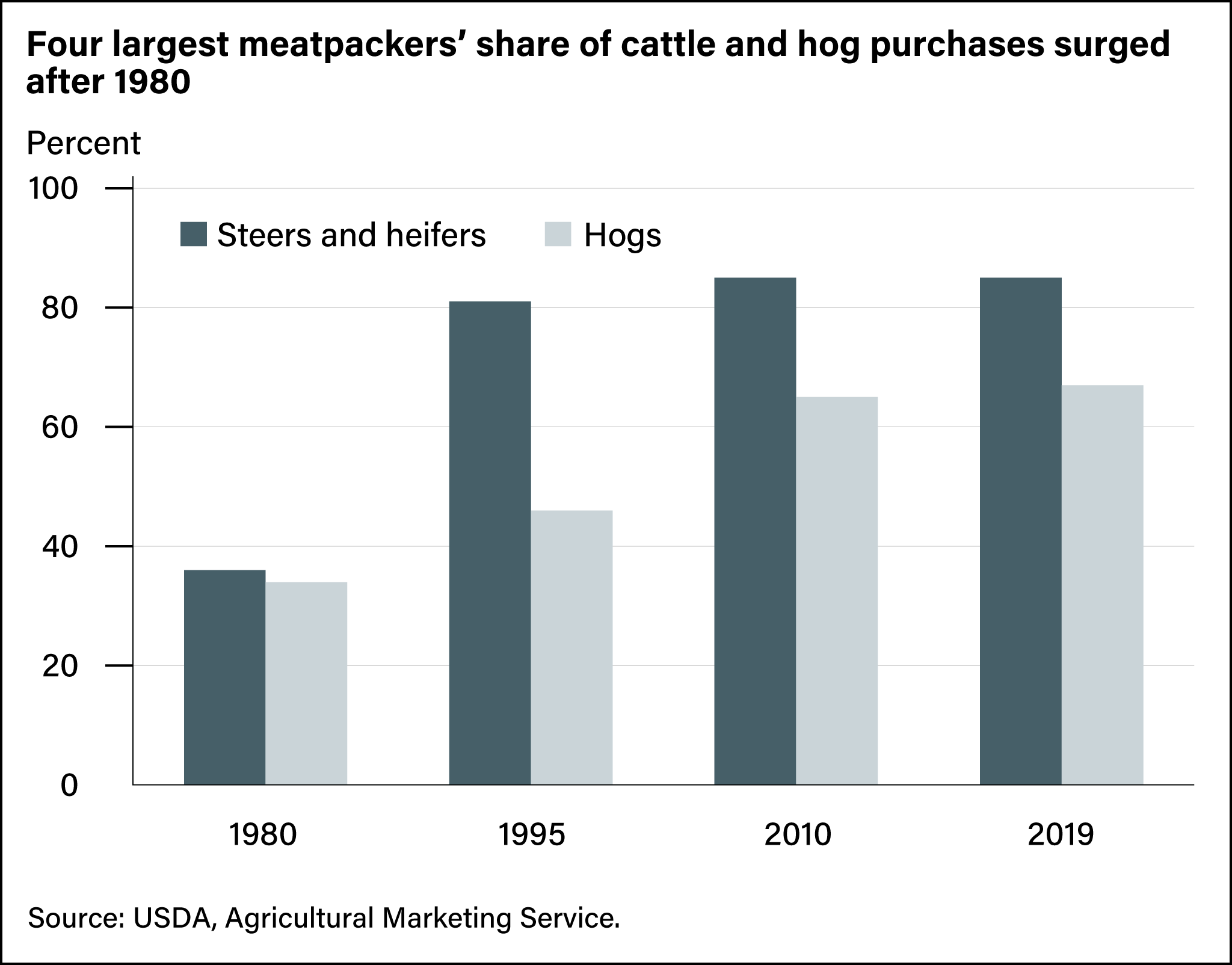
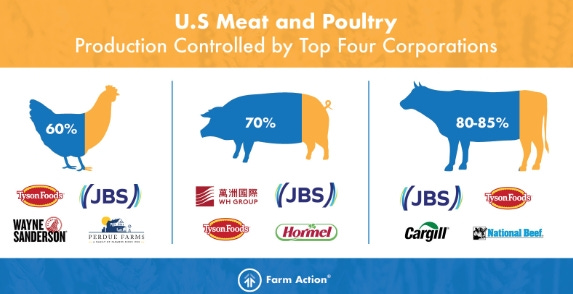
In the beef industry, the 4 largest meatpackers account for roughly 85% of steer and heifer purchases, according to the U.S. Department of Agriculture’s Economic Research Service. In the pork industry, the 4 largest firms account for approximately 67% of hog purchases. Poultry processing is similarly concentrated among a relatively small number of companies. That concentration can create efficiencies, but it also means that disruptions affecting a small number of facilities can ripple across the entire food system.
AmberWaves
Farm Action
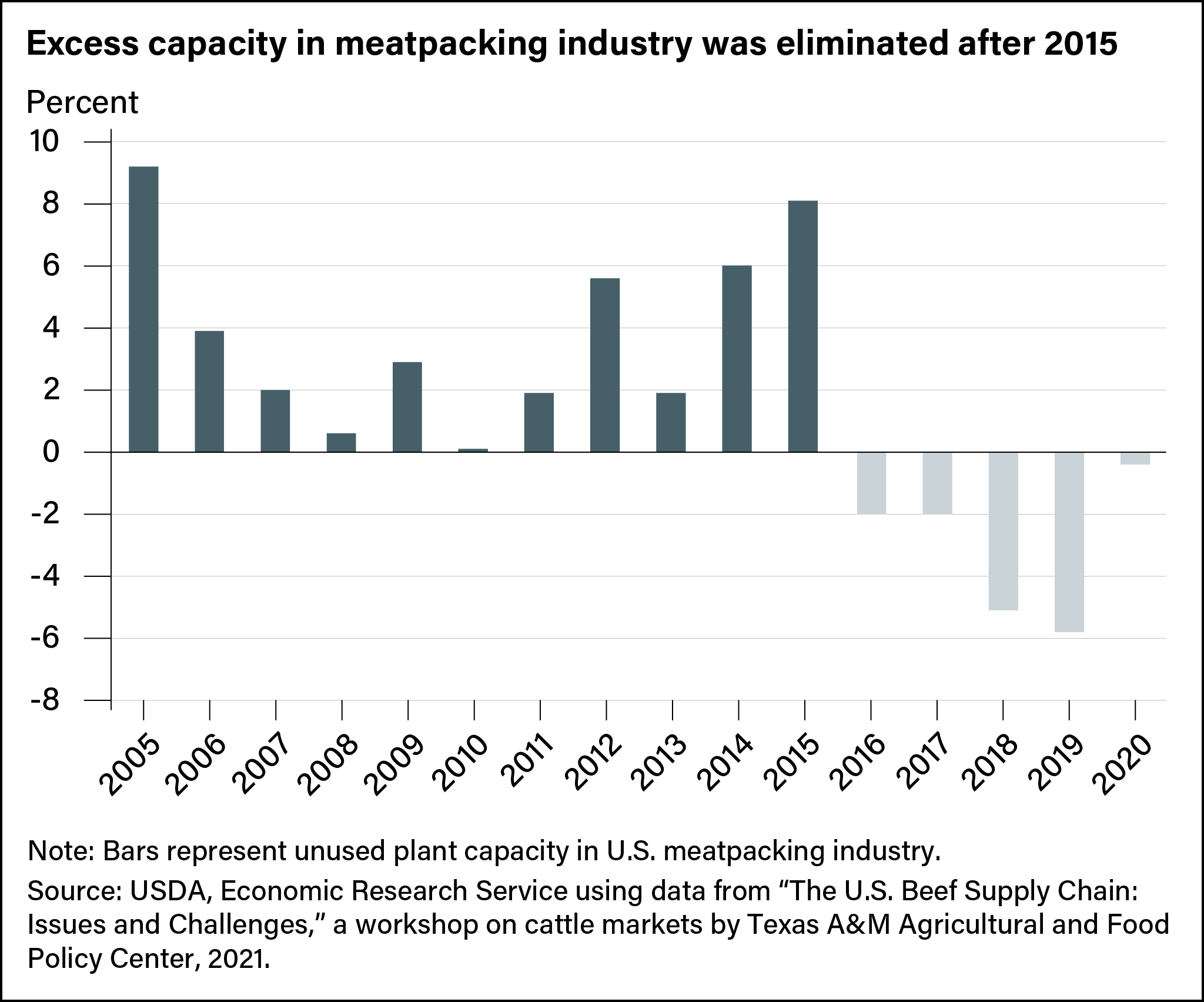
Concentration changes more than market competition. It also alters how risk moves through the system. When processing capacity is spread across hundreds of facilities, a disruption at one plant is more likely to remain a local problem. When a large share of production flows through a relatively small number of companies and facilities, a disease outbreak, equipment failure, labor disruption, cyberattack, or major food recall can affect far larger portions of the national supply chain.
Concentration also influences the balance of economic power. Farmers may have fewer buyers competing for their livestock, and smaller processors can struggle to compete with firms operating on an enormous scale. Independent grocery stores often lack the purchasing power to negotiate prices comparable to those available to national retail chains. Consumers may ultimately feel those dynamics through higher prices, fewer choices, or greater volatility when disruptions occur.
Excess Capacity: AmberWaves
Those dynamics help explain one of the more persistent paradoxes of rural America. Many rural communities produce extraordinary amounts of food while offering surprisingly limited access to affordable groceries. Residents may live among thousands of acres of farmland yet drive thirty minutes or more to reach a full-service supermarket. The crops surrounding those communities are frequently commodities destined for feed, fuel, export markets, or industrial processing rather than direct local consumption. Local stores often purchase smaller quantities than national chains and cannot negotiate comparable wholesale prices. Transportation costs, limited competition, and lower sales volume further increase the prices consumers ultimately pay. The result is a food system in which proximity to agriculture does not necessarily translate into food security.
This challenges one of the assumptions underlying much of the Farm Bill debate. Supporting agricultural production and strengthening community food security are related goals, but they are not identical.
Many of the Farm Bill’s largest and most durable investments are designed to strengthen the productive capacity of American agriculture, but fail to address whether communities living alongside that productive capacity receive comparable attention or are expected to adapt to the consequences of a food system optimized primarily for production and scale.
Power Shapes Policy
Every major industry participates in the political process. Agricultural organizations advocate for farmers, environmental organizations for conservation, and so on. Congress depends on outside expertise, and stakeholders often understand the practical consequences of legislation better than anyone else.
The challenge arises when influence becomes uneven. Large organizations generally possess advantages that smaller ones do not. They have dedicated government affairs offices, legal teams, economists, lobbyists, and the financial resources necessary to maintain a constant presence in Washington. Small farmers, independent grocers, rural communities, and working families rarely possess comparable capacity. Their experiences are no less important, yet they are often represented indirectly rather than speaking with the same institutional voice.
That imbalance does not guarantee bad policy. It does, however, shape which problems receive the greatest attention. The current Farm Bill offers several examples.
Earlier versions of the legislation included language that many critics believed would have made it significantly more difficult to pursue certain pesticide-related lawsuits under state law. Agricultural organizations supported the proposal, arguing that federal labeling requirements should provide consistent national standards. Consumer advocates, environmental organizations, and many within the Make America Healthy Again movement argued that the language would instead reduce corporate accountability. Following substantial public opposition, the provision was removed before the House passed its bill and does not appear in the Senate Agriculture Committee’s discussion draft.
The debate surrounding the Save Our Bacon Act reflects a similar tension. Supporters view the proposal as a necessary safeguard against a patchwork of state regulations that affect interstate commerce. Opponents argue that it would prevent states from enforcing standards adopted by their own voters and would primarily benefit large-scale livestock operations. The House retained the language. The Senate draft did not.
Each reflects competing ideas about regulation, commerce, federalism, and agricultural policy. Taken together, they reveal something worth considering.
Much of the political energy surrounding the Farm Bill has focused on reducing legal uncertainty for industries, preserving market stability, and protecting existing business models. Businesses make long-term investments and seek predictable rules under which to operate.
However, consumers also seek predictability. Families want confidence that groceries will remain affordable. Parents want confidence that the food reaching their children is safe. Rural communities want confidence that they will not lose their last grocery store. Farmers want confidence that they can remain economically viable without becoming increasingly dependent on consolidation. Workers want confidence that producing America’s food will allow them to afford it.
Those interests are not mutually exclusive. In a healthy system, they reinforce one another, but they are not always weighted equally.
That may help explain why so many debates surrounding the Farm Bill become arguments about agriculture while relatively little attention is devoted to the lived experience of the people who ultimately depend on the food system every day.
The View From the Grocery Store
Rural communities often struggle with long travel distances, limited retail competition, and a lack of public transportation. Many urban neighborhoods face various obstacles, including food deserts, lower household incomes, and fewer stores that offer affordable fresh food. Suburban families may enjoy greater physical access to grocery stores while still finding themselves squeezed by the combined costs of housing, childcare, transportation, and food.
The circumstances differ. The underlying challenge is remarkably similar. Access to food is shaped by far more than agricultural production.
For families already living close to the edge, those realities magnify the importance of nutrition assistance. The Supplemental Nutrition Assistance Program is often discussed as though it benefits only those who receive it directly. In reality, SNAP dollars also flow through neighborhood grocery stores, rural markets, and local retailers that rely on consistent customer demand to remain open. In many communities, food assistance helps support the very stores that serve households, regardless of whether they participate in the program.
Debates over SNAP frequently focus on eligibility requirements or on restrictions on which foods recipients are permitted to purchase. They often assume that healthier alternatives are equally available and equally affordable everywhere.
For millions of Americans, they are not. Fresh foods generally require reliable transportation, nearby grocery stores, refrigeration, and enough disposable income to absorb the higher cost of products that spoil more quickly than shelf-stable alternatives. Those conditions cannot simply be legislated into existence by changing the list of foods eligible for purchase.
Improving nutrition is an important goal, yet it is not a competing priority with improving access. In fact, they are complementary. A family cannot consistently purchase healthier food if healthier food remains physically or financially out of reach.
Viewed through that lens, food security is less about calories or benefits and more about whether the systems surrounding the food supply are designed to ensure that ordinary Americans can reliably obtain safe, nutritious food regardless of where they live.
The success of a food system is not measured by how much it produces, but by whether the people who grow, process, transport, sell, and buy it can reliably put safe, nutritious food on their own tables.
The People in the Middle
One of the enduring myths surrounding debates over agriculture is that every disagreement can be reduced to a choice between supporting farmers or supporting consumers. Reality is rarely that simple.
Many independent farmers and ranchers are navigating the same economic pressures affecting the communities around them. Production costs have risen, weather has become less predictable, disease outbreaks can erase years of work almost overnight, and markets have become more concentrated. For many producers, there are fewer processors, fewer buyers, and fewer opportunities to negotiate favorable prices than there were a generation ago. The result is a system in which farmers themselves often have limited control over the conditions shaping their businesses.
The challenge is not that American agriculture has become more productive. The challenge is that efficiency and resilience are not always measured the same way. A system optimized for production may also become more dependent on consolidation. A system optimized for economies of scale may leave fewer competitors at every stage of the supply chain. A system designed to maximize output may unintentionally reduce flexibility when disruptions occur. Those are not failures of agriculture. They are tradeoffs that deserve honest discussion.
The same is true of public policy. Commodity supports, crop insurance, conservation programs, and disaster assistance all serve legitimate purposes. They help producers manage risks that no individual farmer can control. The question is whether those investments have kept pace with the changing realities of the broader food system, or whether public policy has continued to evolve around agricultural production while giving comparatively less attention to the communities that ultimately depend upon it.
Farmers and consumers are not opposing interests. Most farmers are consumers, and most consumers depend upon farmers. Farmworkers, truck drivers, veterinarians, food processors, grocery clerks, restaurant workers, and families all participate in the same system. When one part becomes less resilient, pressure eventually spreads to the others.
Perhaps that is the most important lesson hidden within the current Farm Bill debate. The question is not whether America should support agriculture. The question is what kind of agriculture we are trying to support, and whether the systems surrounding it remain accountable to the people whose lives they shape every day.
Looking Beyond This Farm Bill
The Farm Bill currently before Congress will almost certainly become law in some form. The challenge before us is ensuring that the reconciliation process shapes it into something that serves all of us.
What should success look like for America’s food system? Should it be measured primarily by production, exports, and market stability? Or should it also be measured by whether families can consistently afford healthy food, whether rural communities can sustain local grocery stores, whether public institutions remain capable of preventing disease before it spreads, and whether the people who produce America’s food can build stable lives within the system they help sustain?
Those are civic questions, not partisan ones.
The Constitution begins with three words that are easy to overlook because they are so familiar: We the People. Those words establish a simple but profound principle. Institutions derive their legitimacy from the people, not the other way around. Markets are among the most powerful engines of prosperity ever created, yet they remain tools rather than ends in themselves. Government exists to secure the conditions under which people can exercise liberty, pursue opportunity, and contribute to the common good. Businesses create jobs, innovation, and wealth. Public institutions provide the infrastructure, rules, and public goods that allow those businesses to thrive. Each depends upon the other, and neither exists apart from the people they ultimately serve.
Over time, every society reshapes its institutions. The enduring responsibility of self-government is to ensure that those changes continue moving the republic toward its founding ideal rather than quietly away from it.
Viewed through that lens, the current Farm Bill raises a larger question than whether Congress has struck the right balance between subsidies, conservation, and nutrition assistance. It asks whether we have begun confusing the health of the system with the well-being of the people the system was created to serve.
America has built one of the most productive agricultural economies in history. The next challenge is ensuring that our measure of success extends beyond production alone. A truly resilient food system is not defined only by the abundance it creates, but also by whether the people who grow our food, process it, transport it, sell it, and place it on their own dinner tables can share in the security that abundance was meant to provide.
If Farm Bills begin with that question instead of ending with it, they may finally become as much about the food system as they are about business.
The headlines change every day. The systems behind them change much more slowly.
We look beyond the daily political fight to understand how institutions, incentives, and public policy shape the lives of ordinary Americans. We don’t claim certainty. We believe understanding begins with curiosity, evidence, and a willingness to question our own assumptions.
If that sounds like a conversation worth having, we’d be honored to have you with us.
Sources:
“US House passes farm bill after scrapping pesticide language opposed by MAHA,” Reuters, April 30, 2026.
“Roll Call 154 | Bill Number: H.R. 7567,” Office of the Clerk, U.S. House of Representatives, April 30, 2026.
“Chairman Boozman Releases Farm Bill 2.0 Text,” U.S. Senate Committee on Agriculture, Nutrition, and Forestry, June 23, 2026.
“Agricultural Act of 2026: Farm Bill 2.0,” U.S. Senate Committee on Agriculture, Nutrition, and Forestry, June 2026.
“H.R. 7567 – Farm, Food, and National Security Act of 2026,” House Committee on Rules, 2026.
“House passes the 2026 Farm Bill with key county priorities,” National Association of Counties, June 25, 2026.
“Concentration in U.S. Meatpacking Industry and How It Affects Competition and Cattle Prices,” USDA Economic Research Service, January 25, 2024.
“Food Price Outlook — Summary Findings,” USDA Economic Research Service, May 22, 2026.
“A(H5) Bird Flu: Current Situation,” Centers for Disease Control and Prevention, accessed June 25, 2026.
“Staff exodus at US farm agency leaves fewer experts to battle bird flu,” Reuters, May 12, 2025.
“USDA works to rehire bird flu officials it fired, NBC news reports,” Reuters, February 18, 2025.
“USDA Confirms Presence of New World Screwworm in the United States,” USDA APHIS, June 3, 2026.
“USDA reports three new cases of screwworm, bringing total to 15,” Reuters, June 22, 2026.
“Supplemental Nutrition Assistance Program (SNAP),” USDA Economic Research Service, July 24, 2025.
“SNAP Boosts Retailers and Local Economies,” Center on Budget and Policy Priorities, May 28, 2020.
This is an extensive, detailed analysis of our whole agricultural system-the farmers who grow the food, the workers (before this time, they were often workers from Mexico, South America, Haiti, but I did not see much about them), the machinery (purchase and maintenance), the regulators, the veterinarians, the vast # of trucks and truckers, the regulators, the legislative bodies etc. It is more extensive than I had even imagined. And then also, the significance of this process in providing SNAP benefits. Overwhelming!
Mr Michaels (I'm assuming this post was written by Mr Michaels, since it was he who "liked" Mary Kay Ness' comment), the Coffman Chronicle has two disadvantages, and one advantage. One disadvantage is that the posts are probably the longest on Substack. The second disadvantage is that paid subscription to the Coffman Chronicle is $80 per year. Some others charge $80 per year, too, and a few charge more, but a number charge less. The advantage is that the Coffman Chronicle is SOOO worth the time and money. These posts are clearly very carefully researched, and magnificently well written. And that goes for the ones you write, the ones Marie Riverton writes, and the ones General Azmundus writes. You join very few accounts at the very top of the heap. Thank you.
As for this particular post, I am reminded of Ronald Reagan's wisecrack that "government is the problem." The clown who lives in the White House now is clearly in full agreement. You have made exquisitely clear how critical government is to public safety and functioning. And if government was the problem, there wouldn't be any governments. Except every country on earth has one. Some are very different from others, and some are at odds with others, but each has as an important goal to act in what it believes is the benefit of its public. We wouldn't always agree with them, and they wouldn't always agree with us. But governments have essential public interests, and you have extremely clearly described the preferred public interest of the United States' government. And its lapses and failings.
Again, thank you for these posts. And for all the work, devotion, and intellect you put into them.