


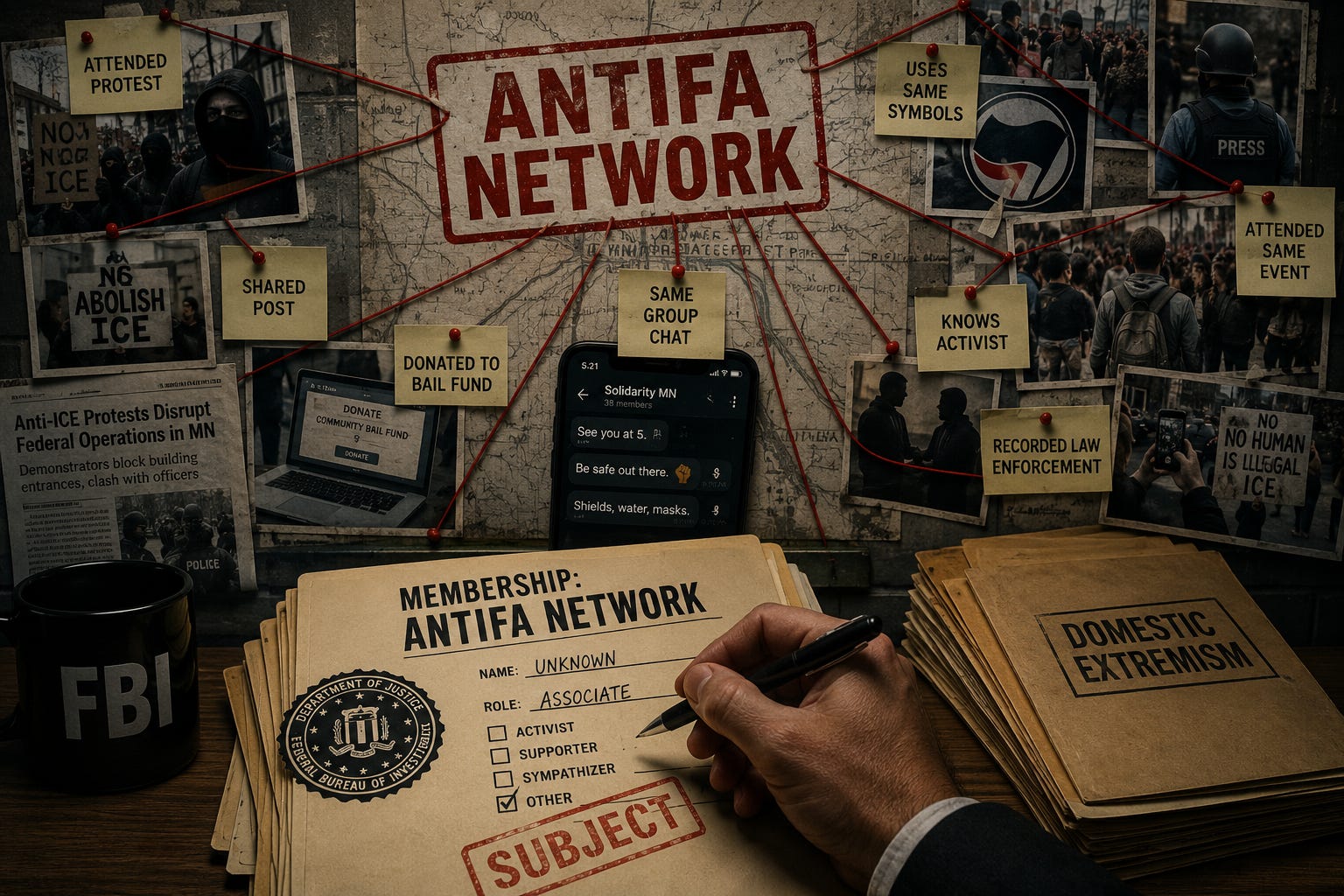
The Arrest Comes Before the Verdict
An arrest is not a verdict, yet when federal agents arrive, handcuffs come out, and the Justice Department announces that it has struck an “antifa-linked” network, the government’s accusation begins doing its work before any jury hears the evidence.
Fifteen people connected to Direct Action Minnesota now face federal charges stemming from protests against immigration enforcement. Prosecutors allege that some defendants went beyond speech and protest into threats, obstruction, assault, and property damage. If the government proves those allegations, it has every right to prosecute the crimes.
However, the administration is not presenting this as a narrow case against particular people for particular acts. It is, rather, describing the arrests as part of a broader campaign against a political enemy.
The question in Minnesota is not whether crimes may be prosecuted. The question is whether the Trump administration is using alleged crimes as a doorway to criminalize the movement around them.
An allegation of violence is not a license to criminalize the First Amendment.
Support independent media that follows the power.
The Coffman Chronicle is built to track who holds power, who abuses it, who profits from it, and who pays the price.
Paid supporters get full Tony Michaels Podcast episodes, deeper transcript analysis, paid columns, archives, and the reporting framework behind the show.
If you believe independent media has to survive outside billionaire platforms, corporate media, and party-approved gatekeepers, become a paid supporter today.
What the Government Says Happened
Federal prosecutors claim Direct Action Minnesota coordinated efforts to interfere with immigration enforcement rather than merely protesting it. According to the indictment, participants organized blockades around the Bishop Henry Whipple Federal Building, tracked government vehicles, shared identifying information through encrypted Signal chats, and dispatched people to locations where federal agents were operating.
Prosecutors also allege the use of vehicles, trailers, homemade shields, and metal obstacles to block entrances, along with confrontations, vehicle damage, and efforts to follow agents away from federal facilities.
If proved beyond a reasonable doubt, those accusations describe punishable conduct. Interestingly, the charges are not evenly distributed among the 15 defendants.
Every defendant is charged with conspiring to impede or injure a federal officer under 18 U.S.C. § 372. Only four face additional charges tied to specific alleged acts such as stalking, threats, solicitation, assault, or destruction of government property. Eleven are charged only through the broader conspiracy count.
Conspiracy allows prosecutors to reach beyond the person accused of carrying out a particular act. The government must prove that each defendant knowingly joined the alleged agreement. Shared politics, common meetings, and opposition to immigration enforcement are not enough.
The indictment remains an accusation, and every defendant is presumed innocent. For the other eleven, the case depends on proving that their words, relationships, and participation amounted to a criminal agreement.
When Speech Becomes the Evidence
Words can be evidence of a crime. A message coordinating an assault can help prove a conspiracy. A true threat is not protected simply because it was made during a political protest. Instructions to damage property or physically interfere with officers may show criminal intent.
However, context cuts both ways. People have the right to say they hate ICE. They may demand that the agency be abolished, condemn immigration raids, attend organizing meetings, join political groups, and argue that ordinary protest tactics have failed. They may use angry, radical, or offensive language without entering a criminal agreement.
Prosecutors must show that each person knowingly agreed to unlawful conduct. Shared anger is not shared criminal intent, and presence in a group chat is not agreement with every message.
The danger is that protected speech may begin doing more work than the alleged conduct. A political statement becomes a motive, a meeting coordination. Association with other activists becomes membership in a network. Placed beside allegations of violence, the politics may encourage a jury to assume that everyone involved shared the same purpose.
The Supreme Court has rejected guilt-by-association alone and protected abstract advocacy unless it is intended and likely to produce imminent lawless action. That does not erase genuine evidence of a crime; it prevents fear of a defendant’s politics from replacing it.
How much protected speech can the government place inside a conspiracy charge before dissent itself becomes the evidence?
The Terrorist Organization Without an Organization
The Trump administration describes antifa as though it were a national organization with identifiable members, leaders, and a command structure.
That description does not match the movement the Congressional Research Service has described as decentralized, composed of loosely affiliated individuals and local groups. There is no established national headquarters, recognized leader, membership registry, or unified chain of command connecting everyone the government may call antifa.
That determines who gets to decide where the supposed organization begins and ends. When the organization is a broad political label, affiliation may be inferred from protest attendance, symbols, chats, relationships, or political views. The government is no longer discovering a membership list, but writing one.
Officials can draw lines among scattered people and announce that they have uncovered a network. The network then becomes evidence of connection, while the connections become evidence that the network exists.
The government does not need a terrorist label to prosecute assault, stalking, threats, vandalism, or obstruction. Those offenses already exist in law. The label becomes useful when officials want to cast suspicion more broadly over the people, organizations, and beliefs surrounding an alleged act.
Readers do not have to support antifa or excuse unlawful tactics to recognize the problem. A movement without defined boundaries can become whatever the president needs it to be.
The vaguer the enemy, the greater the government’s power to define it.
A President Cannot Invent Domestic Terrorism Law
Congress created a legal process for designating foreign terrorist organizations. That designation carries defined consequences, including criminal penalties for knowingly providing material support.
Congress did not create an equivalent statutory process allowing a president to designate a domestic political movement as a terrorist organization. The federal definition of domestic terrorism does not create a stand-alone charge or give the president the designation power that federal law provides for foreign organizations.
The president, therefore, cannot create a new federal crime by proclamation. He cannot make association with a domestic movement illegal merely by attaching the word “terrorist” to it.
However, an executive label can still exercise enormous power. It can shape investigations, prosecutorial priorities, and which political activities officials interpret as security threats, while branding defendants before trial.
The administration may say that it is using existing criminal statutes. The question is how those statutes are being aimed. When a president first defines a domestic political enemy, and agencies then search that movement for conspiracies, the label becomes part of the machinery surrounding the prosecution.
If the country is going to create such a system, Congress must define it, establish standards, and protect constitutional rights. An executive order cannot substitute for that legislative process.
A presidential label is not legislation, nor can it be allowed to become evidence.
The White House Defined the Enemy First
Law enforcement should begin with conducting an investigation of a suspected crime, following the evidence, and testing the case in court. The Trump administration has begun from the other direction.
In September 2025, the White House issued National Security Presidential Memorandum 7, directing a nationwide effort against what it called organized political violence. The memorandum says the government should protect First Amendment rights while targeting threats, intimidation, and violence.
However, it did not stop at conduct. It identified supposed ideological “common threads” behind political violence, including anti-Americanism, anti-capitalism, anti-Christianity, extremism concerning migration, race and gender, and hostility toward what the administration calls traditional American views on family, religion and morality.
Those are not crimes. Beginning there allows the government to map people and organizations by political category, then search their speech and relationships for signs of criminality.
A government investigating an assault asks who committed it. A government investigating anti-capitalism asks who believes it.
The Justice Department says the Minnesota prosecution is part of the nationwide NSPM-7 initiative. That does not prove the charges are false or politically motivated, but it does show that the case sits inside a White House-directed program whose founding document identifies protected beliefs as threads connecting suspected threats.
The constitutional problem is the list itself. When the government begins with ideology rather than conduct, dissent ceases to be a right and becomes a lead.
A Government Label Is Not Proof
Call someone antifa, and a ,political association begins to sound like membership in a criminal organization. Call that supposed organization terrorist, and protest activity begins to resemble participation in a national threat. Repeat the description often enough, and the public may stop asking what each person actually did.
A person may hold antifascist beliefs without accepting violence, just as someone may attend a gun-rights rally without joining a militia.
The Constitution requires more than guilt by category.
We have seen the pattern elsewhere. The executive calls someone an illegal immigrant, a gang member, or an invader and treats the classification as though it has already been proved. Here, the words are antifa, extremist, and terrorist. In each case, the label is used to demand more power for the government and less doubt for the accused.
Courts exist because executive accusations are not self-proving. Juries exist because a press release is not a verdict. “Antifa-linked” cannot substitute for proving who agreed to what, who committed which act, and what each person intended.
A government label is an accusation. It is not proof.
The Process Can Become the Punishment
A criminal case does not have to end in conviction to change a person’s life.
An arrest can mean detention, lost work, legal bills, family disruption, and public humiliation. The damage spreads beyond the accused.
A person who might have attended the next protest stays home. Someone who would have recorded an immigration raid puts the phone away. A volunteer leaves the group chat. A journalist wonders whether covering a demonstration will later be described as participation.
They do not know whether a meeting will be called coordination, a friendship will become association, or their words will be placed beside someone else’s alleged crime. That uncertainty is where the chilling effect lives.
Crimes should be charged when evidence supports them, but ideological labels and expansive network claims extend the pressure to anyone who might stand near the accused.
The government does not have to outlaw dissent when it can make dissent feel too dangerous to practice.
Minnesota Is the Test Case, Not the Limit
The indictment of Direct Action Minnesota did not arrive in a vacuum. In separate litigation, Minnesota residents have alleged that federal immigration agents arrested, threatened, or used force against people who were watching, recording, and protesting enforcement operations. The government disputes those claims, and the litigation remains unresolved.
Federal agents also arrested independent journalists Don Lemon and Georgia Fort after a protest disrupted a service at a St. Paul church. Prosecutors allege that they participated in a coordinated effort that interfered with worshippers’ rights. Lemon and Fort say they were covering the event as journalists and have pleaded not guilty.
Those cases are not identical: journalism is not protest organizing, and observation is not physical interference.
However, the recurring question is where the administration draws the line between protected activity and criminal participation. An observer becomes an obstructor. A journalist becomes a participant. An activist network becomes a terrorist network. Political speech becomes evidence of criminal intent.
Each case must be decided on its evidence, but each also helps establish the boundary the government may claim next.
Minnesota is not merely where these cases are happening. It is where the administration is testing how far it can move the line between dissent and crime.
A power does not become constitutional because its first target is someone you dislike.
The Government May Prosecute Conduct, Not Opposition
Political motivation does not erase criminal law. A person cannot turn an assault into protected expression by shouting a slogan while committing it. A conspiracy does not become lawful because the people involved believe their cause is just.
Yet the government must prove what each defendant did, intended, and knowingly agreed to. It cannot substitute political identity for evidence.
Attendance, harsh rhetoric, friendship, proximity, and shared beliefs are not interchangeable with criminal intent. Words and relationships may be evidence, but the government must prove the connection.
The line is straightforward: prosecute proven assaults, threats, and unlawful agreements, present the evidence, and let a jury decide.
However, do not turn an ideology into an organization, an organization into a conspiracy, and a conspiracy into a reason to distrust everyone the government places nearby.
The government must prosecute what a person did, not what political movement the government says they belong to.
Congress Cannot Be a Comment Section
Congress should not wait for these cases to work through the courts and pretend the outcomes will settle the larger problem.
Courts can decide individual charges, but they will not answer every question about how NSPM-7 was designed, how groups were selected, or how protected beliefs are used inside investigations. That responsibility belongs to Congress.
Lawmakers should demand the internal memoranda, charging guidance, and investigative standards connected to NSPM-7. They should ask who decided which movements would be treated as potential extremist networks, what evidence is required before an organization is mapped, and whether protected speech has been used to open investigations.
They should determine whether journalists, observers, donors, or peaceful protesters have been entered into federal databases due to their proximity to a targeted movement.
Republicans should not excuse unchecked federal power because the people being investigated oppose ICE or hold political views they despise. Democrats should not confuse posting outrage with exercising power. They should force hearings, demand testimony, seek records, and place specific protections into legislation and appropriations bills.
Congress can restrict funding for investigations based solely on protected speech or association, require reporting, protect journalists and observers, and deny presidents unilateral power to create domestic terrorist designations.
Most importantly, Congress can demand public answers: Who counts as antifa? How are lawful beliefs separated from criminal intent? What prevents the same framework from being aimed elsewhere?
Congress has the power to investigate now. If it chooses not to, that silence will not be neutrality. It will be permission.
A Congress that will not examine how dissent becomes a federal target is surrendering the people’s freedom along with its own power.
The Precedent Will Outlive the Target
Readers do not have to support antifa, approve of every tactic, or assume every defendant is innocent. They only have to understand that executive power rarely remains confined to its first target.
Today, the government may describe antifascist activists as a threat. A future administration could point to gun-rights organizations, anti-abortion networks, churches, labor organizers, antiwar coalitions, or protesters who reject federal authority.
It could map their rhetoric, donors, relationships, and communications, then treat the crimes of some as evidence against many. The political justification would change. The structure would not.
The easiest precedents are aimed at people the public already fears or despises. Once the power becomes normal, officials need only name the next enemy.
The Constitution does not ask whether we like the accused before protecting them from guilt by association. It restrains government precisely when fear, anger, and political convenience make restraint least popular.
The question is not whether antifa deserves special protection. The question is whether any president should be allowed to define a vague political enemy, decide who belongs to it, and use that classification to widen federal suspicion.
The machinery does not become constitutional because the first people caught inside it are people you dislike.
The First Amendment Is Not a Conspiracy
The government may prove that some defendants in Minnesota committed crimes. If the evidence supports those charges, courts and juries can hold them accountable.
However, the government must prove each case without placing the burden on a political label. It cannot turn antifa into a national organization by declaration, decide who belongs through association, and treat protected speech and relationships as proof of conspiracy.
That is not a defense of violence. It is a defense of the line between what a person believes and what the government can prove that person did. That line protects the observer holding a phone, the journalist covering a protest, and the ordinary person deciding whether it is still safe to speak against the government.
The First Amendment does not promise that dissent will be polite, popular, or comfortable. It promises that opposition will not become a crime merely because the president gives it a frightening name.
The administration may prosecute a crime. It may not manufacture an organization around its political opponents and call their proximity to it guilt.
The First Amendment is not a conspiracy, and a president’s accusation is not a verdict.
Support Independent Media
If you believe the government should have to prove crimes instead of criminalizing political labels, please share this article.
And if you can afford to become a paid subscriber, your support helps Coffman Chronicle keep following the indictments, the court fights, and the congressional silence that too often lets executive power grow unchecked.
Sources:
American Civil Liberties Union. Tincher v. Noem et al.: Amended Complaint. U.S. District Court for the District of Minnesota, filed February 2, 2026.
Brandenburg v. Ohio, 395 U.S. 444 (1969). Legal Information Institute, Cornell Law School.
Judicial Committee on Model Jury Instructions for the Eighth Circuit. Manual of Model Criminal Jury Instructions for the District Courts of the Eighth Circuit.
Legal Information Institute. “18 U.S. Code § 2331—Definitions.” Cornell Law School.
Legal Information Institute. “8 U.S. Code § 1189—Designation of Foreign Terrorist Organizations.” Cornell Law School.
NAACP v. Claiborne Hardware Co., 458 U.S. 886 (1982). Legal Information Institute, Cornell Law School.
Nesterak, Max. “Journalist Georgia Fort Pleads Not Guilty to Felony Charges Stemming from Church Protest.” Minnesota Reformer, February 17, 2026.
PBS NewsHour. “Don Lemon Pleads Not Guilty to Civil Rights Charges in Anti-ICE Minnesota Church Protest.” February 13, 2026.
Sacco, Lisa N. Are Antifa Members Domestic Terrorists? Background on Antifa and Federal Classification of Their Actions. Congressional Research Service, June 9, 2020.
United States Department of Justice. “15 Members of Direct Action Minnesota, a Minneapolis-Based Direct Action Group with Antifa Ties, Indicted.” June 16, 2026.
United States Department of Justice. United States v. Sant et al., Indictment. No. 0:26-cr-00115-KMM-DTS, U.S. District Court for the District of Minnesota, filed June 11, 2026.
White House. “Countering Domestic Terrorism and Organized Political Violence.” National Security Presidential Memorandum 7, September 25, 2025.
White House. “Designating Antifa as a Domestic Terrorist Organization.” Executive order, September 22, 2025.
This is frickin’ scary. How far is this evil man going to take this? He is rewriting the Constitution to suit himself. His oath to it means nothing, any promise he makes means nothing unless it is of great benefit to him. Next thing you know he’ll be calling groups like the League of Women Voters subversive, the ACLU members will be jailed just for disagreeing with him. I know that seems extreme, but he’s already taken extreme means by ignoring the Constitution. Congress needs to wake up, get off their butts, stop making excuse for him, and DO something.
People who create violence at protests should be arrested, peaceful protestors should be allowed to have their say, and be protected from others who violently disagree with them,