


The law does not usually arrive as mercy. For most Americans, it arrives as a bill, a notice, a fine, a court date, a suspended license, a failed inspection, a late fee, a tax penalty, or a balance that keeps growing while the paycheck does not. Nobody calls that persecution. Nobody turns it into a national symbol. Nobody says the rule should disappear because it landed too hard on the wrong person.
Most people are simply expected to obey.
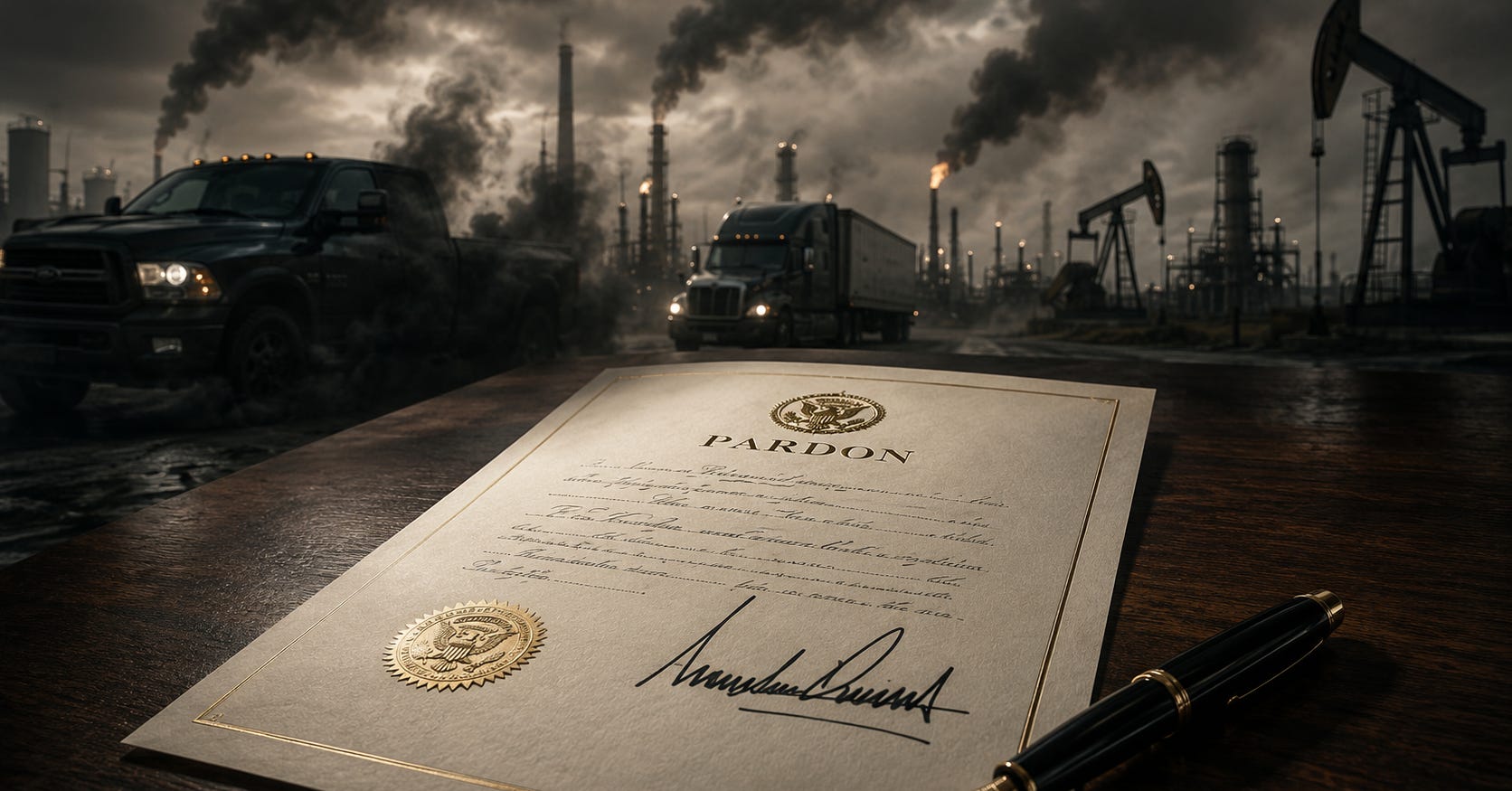
That is what made Donald Trump’s Fourth of July pardons worth more than a passing headline. On July 3rd, Trump pardoned 11 people. Reuters reported that all but two had been convicted of violating the Clean Air Act by modifying or disabling emissions controls on trucks. AP reported that nine of the pardons involved people convicted of disabling or helping others bypass vehicle emissions-control systems.
A pardon is not only forgiveness. It is also judgment from the top of the government. It tells the country which punishments the president believes should end, which defendants deserve rescue, and which laws can be recast as overreach after the fact.
That does not make every prosecution perfect or every sentence fair. Mercy can correct excess or recognize when the law has hit too hard. However, mercy also reveals priorities.
When presidential mercy moves toward violations of clean-air law while ordinary people remain trapped under every fine, fee, penalty, and consequence in their own lives, the question is no longer only who was pardoned. The question is what kind of law bends, and for whom.
Support independent media that follows the power.
The Coffman Chronicle is built to track who holds power, who abuses it, who profits from it, and who pays the price.
Paid supporters get full Tony Michaels Podcast episodes, deeper transcript analysis, paid columns, archives, and the reporting framework behind the show.
If you believe independent media has to survive outside billionaire platforms, corporate media, and party-approved gatekeepers, become a paid supporter today.
The Pardon Was the Message
Most of the pardons were tied to Clean Air Act vehicle-emissions cases. The reported conduct was not ordinary repair by people trying to keep an old vehicle alive. Instead, it involved emissions-control systems, the equipment and monitoring rules meant to limit what vehicles release into the air.
The pardons also reached beyond the Clean Air Act cases. Trump pardoned Adam Kidan, a former business partner of Jack Abramoff who pleaded guilty in 2005 to fraud and conspiracy connected to the purchase of gambling boats. Trump additionally pardoned Jack Harvard, a Texas ranch owner with an old bank-fraud conviction.
While those facts do not prove that every person on the list lacked any claim for mercy, they do establish something more important for the public record. The president used one of the Constitution’s most personal powers to erase consequences for a selected group of people, most of them tied to clean-air violations, while his administration has been moving aggressively against climate and emissions regulation.
A pardon not only ends punishment. It speaks with the authority of the presidency behind it. It tells prosecutors, agencies, industries, and political supporters which cases the president believes should be remembered as injustice rather than enforcement. It can recognize rehabilitation and correct excess, but it can also turn a conviction into a symbol.
The White House did not simply announce individual clemency. It presented the Clean Air Act cases as examples of regulatory burden and overreach, even though the reported conduct involved disabling, modifying, or bypassing emissions-control systems.
Trump was not merely saying those sentenced had served enough time, paid enough of a price, or earned a second chance. He was telling the country that these prosecutions belonged inside a larger political story: government versus freedom, regulation versus ordinary people, clean-air enforcement versus common sense.
However, the law was not changed for everyone. Congress did not vote, nor was the Clean Air Act rewritten. Penalty standards were not reformed. Small businesses did not receive a clearer compliance process. Workers did not receive a fairer system. Individuals modifying their vehicles to keep them running were not spared.
Instead, selected people were lifted out after the fact, after making a business of knowingly violating the law.
That is the difference between reform and rescue. Reform changes the rules in public. Rescue changes the outcome for the few people close enough, useful enough, or symbolic enough to receive mercy from the top.
The pardon was not only an act of forgiveness. It was an act of interpretation: the president telling the country which laws should count, and for whom.
The Fossil-Fuel Exception
The pardons did not land in a vacuum. They landed inside a governing project.
From the first day of Trump’s return to office, the administration described energy regulation as a barrier to be broken. Trump’s “Unleashing American Energy” order declared that federal policy would encourage energy exploration and production on federal lands and waters. It also targeted electric-vehicle policy and state emissions waivers that limited gasoline-powered automobiles. The direction was not subtle.
The administration later went further. In February, Trump’s EPA announced what it called the “single largest deregulatory action in U.S. history,” eliminating the 2009 greenhouse-gas endangerment finding and federal greenhouse-gas emission standards for vehicles and engines from model years 2012 through 2027 and beyond.
The administration also made clear that its energy agenda protected traditional fuel sources. An April executive order said the administration was committed to removing impediments to domestic energy resources, “particularly oil, natural gas, coal,” and other sources, while attacking state climate policies as threats to “American energy dominance.”
When Trump used the pardon power in cases mostly tied to Clean Air Act emissions violations, the move fit a larger pattern. That does not mean every person pardoned was an oil executive, but that the administration’s mercy moved in the same direction as its policy: away from clean-air enforcement, away from climate regulation, away from public limits on pollution, and toward a politics that treats fossil-fuel-aligned conduct as freedom whenever the law gets in the way.
When clean-air laws burden the pollution side of the economy, it becomes overreach. When emissions standards push industry toward cleaner technology, they become mandates. When states try to hold energy producers accountable for climate costs, they become enemies of national prosperity. When people are convicted of disabling or bypassing emissions controls, they can be recast as victims of the government.
Yet when ordinary people face the rules in their own lives, mercy does not flow so easily. They are told the bill is due, the deadline passed, the fine stands, and the system is the system.
The pardons did not create Trump’s fossil-fuel politics. They just revealed how far politics can reach, not only into permits, leases, regulations, and agency enforcement, but into mercy itself.
Deregulation by Pardon
If a law is outdated, Congress can change it. If penalties are excessive, Congress can reform them. If enforcement is uneven, Congress can investigate it. If small shops, workers, farmers, truckers, or independent contractors are being crushed by rules written for larger players, lawmakers can write a better standard in public and put their names on the vote. That is how a republic is supposed to work.
The pardon power does something different. It does not change the law for everyone, clarify the rule for the next person, or create a fairer compliance system. It does not lower penalties across the board or ask the public to weigh the tradeoffs between affordability, public health, industry power, and clean air. It removes consequences from selected people after the fact.
That can be legitimate when a pardon corrects injustice, but it can also become a political workaround. It can let a president send a message that a law is illegitimate without forcing Congress to repeal it. It can signal to agencies which enforcement priorities are disfavored without rewriting their statutes. It can tell industries which violations will be treated sympathetically if they fit the administration’s story.
That is deregulation by pardon. It does not repeal the Clean Air Act nor amend it. It does not replace emissions standards with a better system. Instead, it creates an exception from the top. The law stays in place for everyone else, but the consequences move for the selected few.
The president has the constitutional power to pardon. The Constitution gives the president authority to grant reprieves and pardons for federal offenses, except in cases of impeachment. Congress cannot undo a valid pardon.
However, Congress is not powerless. It can ask why mercy moved where it moved. It can ask whether the ordinary clemency process was followed. It can ask who recommended these cases, what criteria were used, whose voices were heard, and whose were ignored. It can ask whether the White House used clemency to send an enforcement message that Congress itself never voted on.
The pardon cannot be undone, but the pattern can still be exposed.
Working People Do Not Need Dirty Air or Unequal Law
The trap is pretending there are only two sides. On one side, the story goes, there are workers, drivers, truckers, mechanics, farmers, contractors, small shops, rural families, and people trying to keep vehicles running in a country where life often requires a car or truck. On the other side, there is clean air.
That choice is false.
Working people need affordable transportation. They need vehicles that they can repair, rules that make sense outside of a conference room, and regulators who understand that not every person dealing with a vehicle is a corporation with lawyers, lobbyists, and compliance departments.
However, working people also breathe. Clean air is not an elite preference or a luxury item for people who can afford to talk about the environment after every other bill is paid. It is a public condition of ordinary life.
Freedom for the company that sells a bypass device is not the same as freedom for the child whose asthma worsens near traffic. Freedom for a polluting industry is not equal to freedom for the worker whose body absorbs the cost. Freedom from enforcement for one politically useful defendant is not the same thing as freedom under equal law.
The country does not have to choose between working people and clean air. That is the lie fossil-fuel politics keeps selling. Working people need affordable vehicles, fair rules, and clean air. What they do not need is a government that treats corporate-aligned pollution as freedom while treating ordinary survival as personal responsibility.
The Law Should Not Depend on Which Side of Power You Stand On
The person at the kitchen table is still under the law. The bill still comes due. The notice still arrives. The deadline still passes. The fine still grows. The court date still requires time off work. The suspended license still threatens the job. The inspection failure must still be fixed before the vehicle can legally return to the road.
No one calls those burdens tyranny. They are told to comply, pay, appeal, wait, explain, borrow, sacrifice, or fall behind.
That does not mean every rule is good or every penalty is fair. Ordinary people are often right when they say government can be confusing, expensive, slow, and unforgiving. However, that is exactly why selective mercy is so revealing.
When the powerful decide a certain kind of violation fits their politics, the story changes. The defendant becomes a victim. The prosecution becomes overreach. The law becomes suspect. The punishment becomes proof that the government went too far.
Then mercy appears. It does not appear for every family trapped under fines, every worker who lost a license because one penalty became three, every small business owner buried under confusing rules, or every parent choosing which bill gets paid late. Mercy appears where power sees itself.
That is why these pardons are significant beyond the 11 names on the list. They show how differently the government can speak when the violation fits the politics of power. Clean-air enforcement becomes oppression. Emissions rules become the enemy. Convictions become symbols. Mercy becomes a message.
The problem is not mercy. The problem is mercy that knows which direction to travel.
If the clean-air law is wrong, change it in public. If enforcement is unfair, expose it openly. If penalties are too harsh, reform them in an open debate. If small businesses need clearer rules, write them in public. But do not turn the pardon power into a quiet side door where favored violations are forgiven while the rest of the country is told the rules are the rules.
The law should not get softer on the pollution side or near power. It should not depend on whether a president can fold your conviction into his larger political story.
It should belong to the public, and if it must change, the people’s representatives should have to place their names on the vote.
Support Independent Media
If you believe the law should not bend for the powerful while ordinary people are told to absorb every consequence, support independent media that keeps following the pattern.
If you can afford to become a paid subscriber, it helps keep this work going.
Sources:
“Trump Pardons Former Abramoff Partner, 9 People Convicted of Violating Vehicle Emissions Controls.” AP News. July 4, 2026.
“Article II, Section 2, Clause 1: Military, Administrative, and Clemency.” Constitution Annotated.
“Trump Pardons 11, Most for Violating Clean Air Act.” Reuters. July 4, 2026.
United States Environmental Protection Agency. “President Trump and Administrator Zeldin Deliver Single Largest Deregulatory Action in U.S. History.” February 12, 2026.
Volcovici, Valerie, and David Shepardson. “Trump Revokes Basis of US Climate Regulation, Ends Vehicle Emission Standards.” Reuters. February 12, 2026.
White House. “Protecting American Energy from State Overreach.” Executive Order 14260. April 8, 2025.
White House. “Unleashing American Energy.” Executive Order 14154. January 20, 2025.
While these recent pardons changed a sentence everyone needs to be reminded that accepting a pardon is an admission of guilt. Whether it's before a judgment happens or after one. So an employer or anyone else involved with one of Trump's pardoned criminals should consider them guilty of the crimes they committed.
The Fapweasel (Trump) always has a hidden agenda, although most of the time, it isn’t hidden very well.