


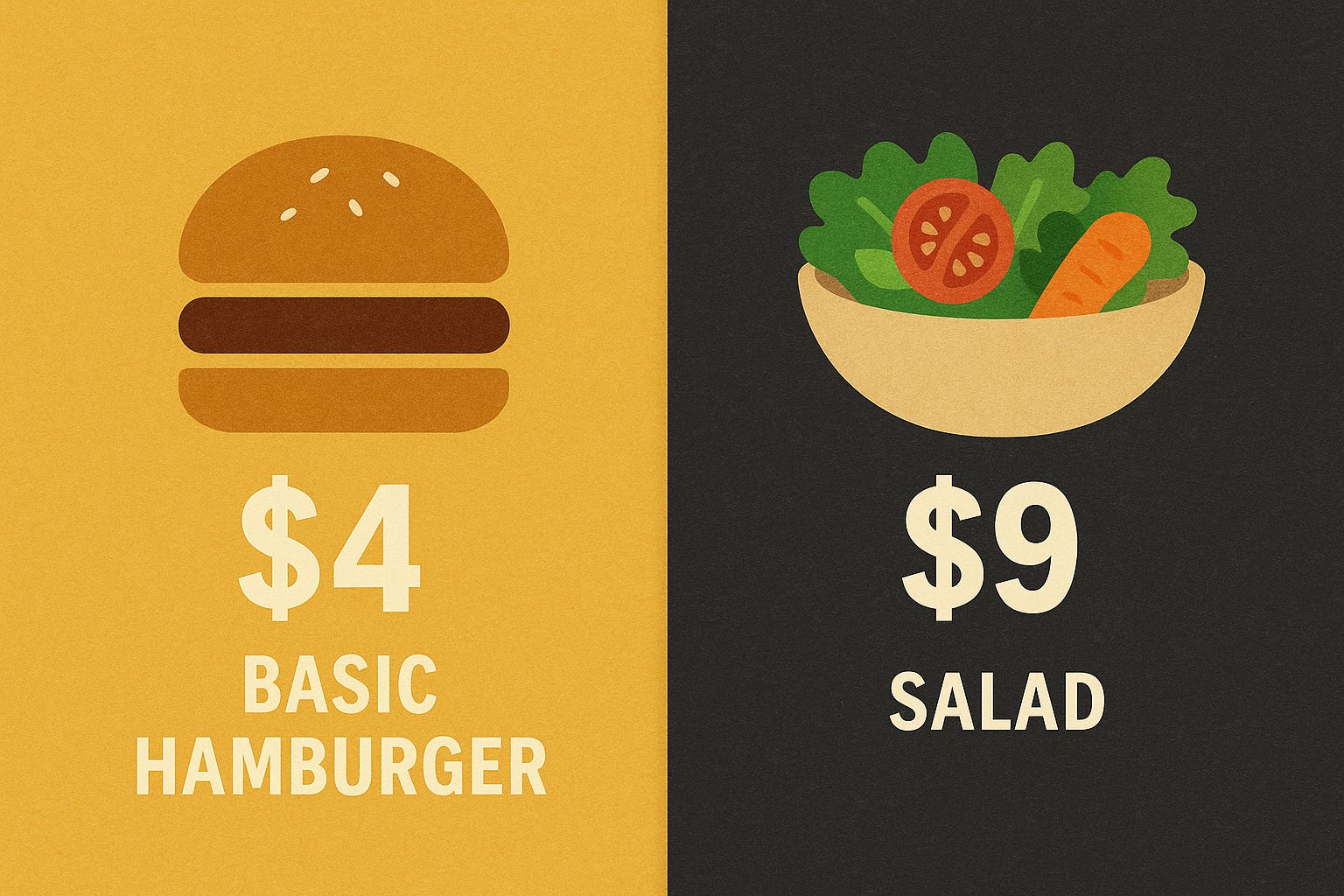
A basic cheeseburger now costs nearly $4. A fast-food combo meal? Over $11 on average. A salad—if it’s even on the menu—might run you $9 or more. That’s the new math of hunger in America. At home, the fridge hums next to a broken stove. The pantry holds rice and possibly some canned beans. You’re just home from your second job, exhausted, kids asking what’s for dinner, and your energy bill is past due. The choice? Microwave noodles or the drive-thru. That’s not freedom. It’s survival.
We’ve been sold the lie that eating healthy is simply a matter of personal responsibility. That if you’re sick, overweight, diabetic, or tired, it’s because you made bad choices. However, that framing ignores the truth that there is no real “choice” when every option is structured by scarcity, fatigue, and corporate manipulation.
You can’t cook a healthy meal when you:
Don’t have the time
Don’t have working appliances
Don’t have the ingredients or the money to buy them
Don’t have the energy, knowledge, or support system
And yet, politicians, pundits, and industry execs keep shaming families for not doing more, while doing nothing to dismantle the systems profiting from their exhaustion.
Healthy eating isn’t a lifestyle decision. In this economy, it’s a political impossibility.
Stay Informed. Stay Loud.
Subscribe to The Coffman Chronicle for no-BS political analysis, action guides, and daily truth bombs you won’t get from corporate media.
The True Barriers to Healthy Eating
We hear it constantly: “Just cook at home.” “Plan better.” “Shop smarter.” But what if the problem isn’t your planning but rather the system?
The reality for millions of families is that cooking a healthy meal requires far more than groceries. It demands time, energy, appliances, space, skills, and stability, all luxuries many don’t have.
Time Poverty
When you're working multiple jobs, commuting on unreliable transit, helping kids with homework, or caring for elders, even 30 minutes in the kitchen feels impossible. Often, that’s the only time in the day you might get to sit, breathe, or simply be still.
Energy Poverty
Even if you could cook, are you physically and mentally able to? When you're running on fumes, making dinner from scratch is not a matter of discipline. It’s an emotional and logistical mountain.
Broken or Missing Tools
Many households, especially in low-income housing, have broken or missing appliances. Ovens don’t work. Stovetops flicker. Cookware is minimal or nonexistent. You can’t roast veggies with a hot plate and a dented pot.
Empty or Fragile Pantries
Healthy cooking assumes a base: oil, garlic, flour, spices, vinegar, broth, and fresh ingredients. For families living paycheck to paycheck, even these “staples” are out of reach. They can’t “stock up”. They buy what they can, when they can.
Generational Skill Gaps
Decades of fast-food reliance and the elimination of home economics programs mean many adults never learned how to cook real meals. It’s not their fault. It’s a systemic loss of knowledge passed down from stressed-out parents to survival-focused children.
This isn’t a failure of will. It’s a failure of infrastructure, education, and policy.
“Just cook at home” is the new “Let them eat cake.” It’s not advice. It’s condescension.
The Corporate Grip on Our Plates
If you want to understand why healthy food is so hard to access, follow the money.
Big Food corporations, such as processors, distributors, and brand giants, have spent decades engineering a system that rewards cheap, addictive, highly profitable products while sabotaging anything that resembles local, fresh, and community-powered food.
Subsidize Junk, Starve the Rest
The U.S. doesn’t have a “free market” when it comes to food. It has a rigged one, a market where taxpayer money props up cheap ingredients for processed food, while real, nutritious food is priced as a luxury.
The government spends billions annually to subsidize a handful of commodity crops, mainly corn, soybeans, wheat, rice, and cotton. These aren’t grown to feed people directly. They’re grown to feed livestock, biofuels, and processed food factories.
Corn becomes high-fructose corn syrup.
Soy becomes hydrogenated oil and feed for factory-farmed meat.
Wheat becomes ultra-refined flour used in packaged snack foods.
Meanwhile, fruits, vegetables, legumes, nuts, and whole grains—the building blocks of a healthy diet—receive almost no federal support. In fact, these foods are considered “specialty crops” under federal policy, as if they're optional or elite.
We don’t subsidize broccoli. We subsidize soda.
This is why a 2-liter of cola can cost less than a gallon of milk, why fast-food fries are cheaper than a baked potato, and why a bag of chips is more accessible than an apple.
This distorted system artificially inflates the cost of eating healthy and lowers the price of ultra-processed, nutrient-poor food, creating the illusion that junk food is the economical choice.
But that “choice” is bought and paid for with public money.
Monopolized Supply Chains
The food on your plate doesn’t just reflect what farmers grow. It reflects what corporations allow to move.
Today, a handful of powerful agribusinesses and food conglomerates control the entire supply chain, from the seeds in the soil to the products on grocery store shelves. Companies like Cargill, ADM, Tyson, JBS, PepsiCo, Nestlé, and Kraft Heinz dominate processing, distribution, marketing, and retail shelf space.
This consolidation gives them enormous leverage:
They dictate prices to farmers and squeeze them out of fair markets
They set the terms for school, hospital, and military food contracts
They lobby against labeling laws, anti-monopoly regulations, and sustainability standards
If a small or mid-size farm wants to sell produce to a local school district or grocery store, it often can’t because the distributor is locked into exclusive contracts with a national supplier. If a local co-op wants to open, it faces impossible costs for warehouse space, cold storage, or insurance.
Fresh food doesn’t “fail” because it’s inefficient. It fails because the system is built to favor shelf-stable, packaged goods moved by giant firms.
The result is a supply chain that rewards food engineered for profit, not nutrition:
Food that’s made to travel thousands of miles, not feed communities
Food optimized for shelf life, not human health
Food that’s cheap to produce but expensive in health costs
This isn't consolidation. It's control. It's why attempts to build farm-to-school, farm-to-table, or cooperative distribution networks are often labeled “unscalable” or “unreliable”—even when they work.
See our recent reporting on the rising cost of beef here:

Corporate Capture of School Meals
Nowhere is this more obvious than in what we feed our kids. In March 2025, the USDA quietly eliminated over $1 billion in support for farm-to-school pipelines, cutting off funding for programs that allowed schools to buy fresh, local produce from nearby farmers.
These weren’t pilot projects. They were proven, effective, and popular.
They improved children’s diets, strengthened local economies, and brought food education back to classrooms.
There’s just one big problem. There was nothing in it for Big Food.
So, the funding vanished with no Congressional debate, no public hearings, and no emergency replacements.
Meanwhile, the contracts for shelf-stable chicken nuggets and vacuum-packed fruit cups roll on.
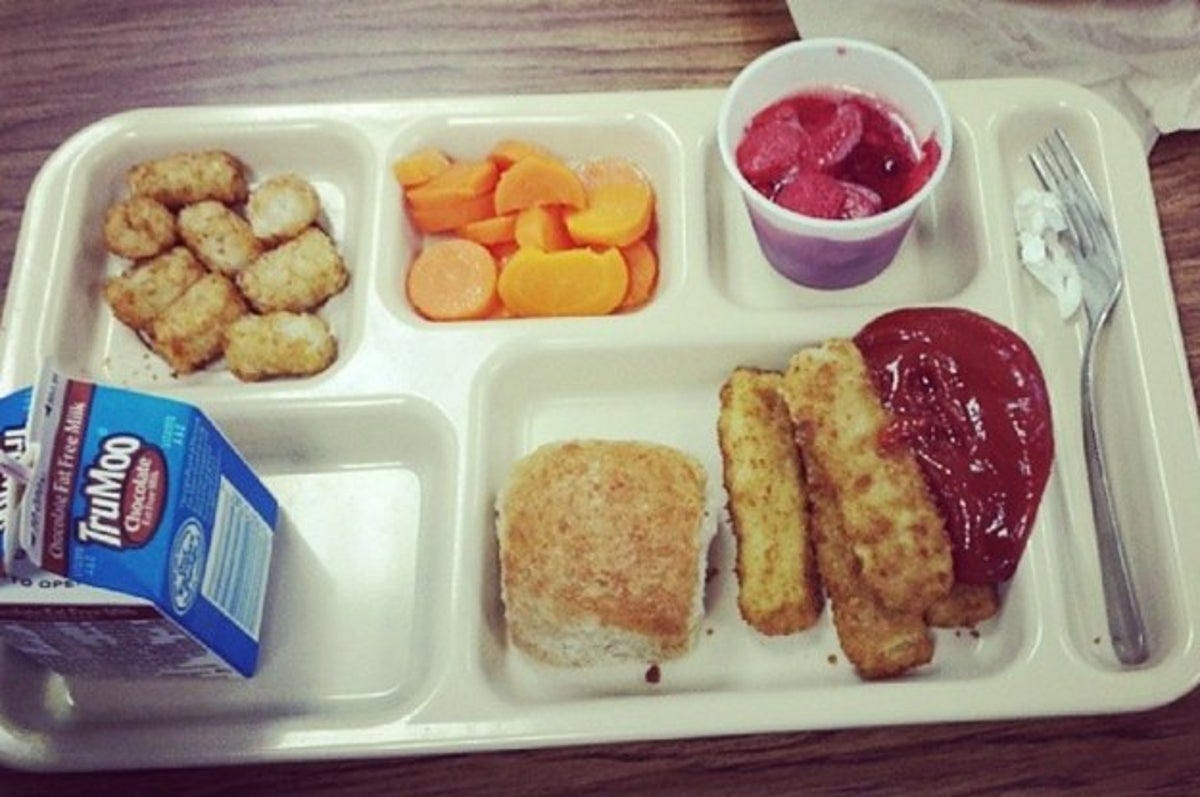
Industrial Control of School Meals
When you hear that schools "choose" to serve low-quality food, understand that they’re not really choosing. The vast majority of public-school districts are locked into long-term contracts with multinational food service providers like Sodexo, Aramark, and Compass Group (via Chartwells K12).
These companies don’t just supply meals. They dominate institutional food policy.
Centralize meal production in mass facilities
Rely heavily on USDA commodity subsidies
Offer cheap, shelf-stable, highly processed options with long storage lives
This isn’t just inefficient. It’s intentional. Their business model depends on scale, not quality. And when schools source fresh, local food through farm-to-school programs, these corporations lose revenue.
So, when over $1 billion in local food funding vanished in March 2025, that wasn’t just a bureaucratic decision. It was a win for the corporations already embedded in school cafeterias.
Fresh food programs weren’t failing. They were winning, and that made them a threat.
Project 2025: Deregulate Nutrition for Corporate Gain
While the public debates how to fix the broken food system, corporate-aligned think tanks have already written a blueprint to make it worse on purpose.
Project 2025, authored by the Heritage Foundation and backed by conservative industry donors, lays out a sweeping plan to dismantle federal public health infrastructure, including food and nutrition policy. When enacted, it will:
Eliminate or radically shrink the USDA’s role in public nutrition guidance
Undermine federal dietary guidelines by framing them as “woke” or “anti-business”
Roll back SNAP flexibility, especially incentives that prioritize healthy or local food purchasing
Abolish Obama-era school nutrition standards, reverting to highly processed, high-sugar cafeteria fare
The goal is not efficiency. It’s removing obstacles to profit, gutting the few remaining protections that prioritize human health over corporate margins.
This isn’t speculation. It’s happening now:
In 2024, Project 2025 strategists pushed state-level bills that blocked SNAP users from buying fresh produce at double-value programs, claiming it was unfair to retailers.
They’ve argued that dietary guidelines limit “freedom of choice,” while supporting policies that steer schools toward shelf-stable processed meals from industrial vendors.
Meanwhile, fast food, soda, and processed meat lobbyists have direct input into shaping this policy framework, funding campaigns and PACs that align with the deregulatory agenda.
Project 2025 isn’t just an attack on the government. It’s a gift to Big Food at the cost of public health.
When implemented, it would lock in ultra-processed food as the American default, slash support for community-based nutrition programs, and all but guarantee another generation raised on nutrient-poor, corporate-controlled meals.
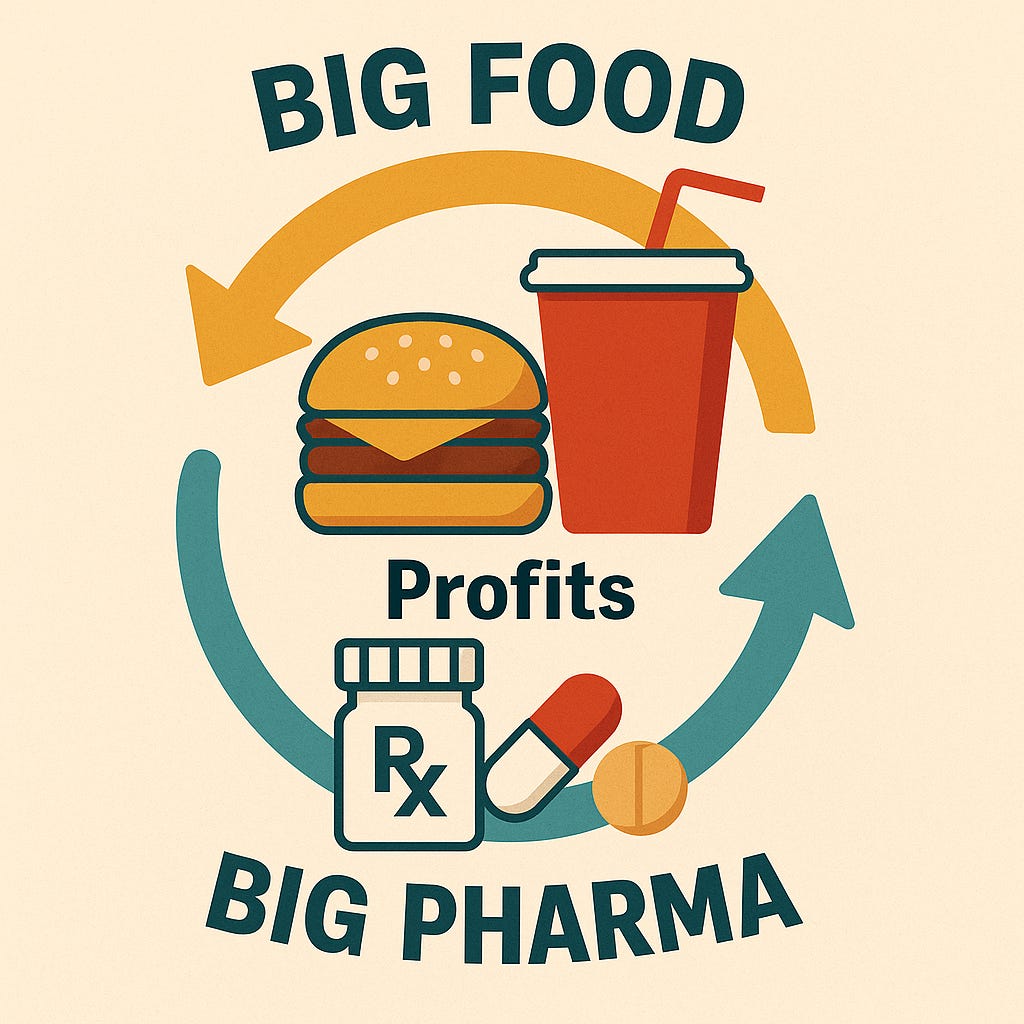
Big Pharma Profits from the Fallout
If Big Food profits from feeding us poorly, Big Pharma profits from keeping us barely functional afterward.
Diet-related diseases are no longer rare or tragic outliers. Nearly 1 in 2 American adults now live with at least one chronic condition tied directly to food: type 2 diabetes, hypertension, cardiovascular disease, obesity, and fatty liver disease. These conditions aren't just widespread. They're profitable.
The U.S. spends over $4.5 trillion annually on healthcare, 90% of that on chronic and preventable conditions.
The market for diabetes drugs alone exceeds $60 billion annually, with new GLP-1 drugs like Ozempic and Wegovy exploding in value.
Statins, blood pressure meds, acid reducers, antidepressants—entire product lines depend on a steady stream of diet-related illness.
The same companies investing in food tech or fast-food supply chains often have arms in healthcare and pharmaceuticals. The same institutional shareholders profit from both ends of the problem.
This isn’t a conspiracy. It’s a perfectly legal, highly efficient business ecosystem:
Step 1: Undermine access to real food
Step 2: Normalize ultra-processed diets
Step 3: Treat the fallout as a medical opportunity
What they fear most is prevention, because a well-fed, well-supported population isn’t profitable.
Healthy people don’t generate quarterly returns. Sick ones do.
The Hollow Promise of MAHA
In a nation battling epidemic levels of obesity, diabetes, and diet-related illness, a slogan like “Make America Healthy Again” should be a rallying cry for bold, structural reform.
In reality, MAHA is long on rhetoric, short on action, and silent where it matters most.
The initiative, spearheaded by Robert F. Kennedy Jr., has promoted ideas like:
Reworking school lunches
Encouraging healthier habits
Investigating ties between food and chronic disease
Yet while families still struggle to access fresh produce, and diet-related disease continues to rise, federal support for local food systems is being actively dismantled.
In March 2025, the USDA eliminated over $1 billion in funding for farm-to-school and food bank procurement programs. These cuts didn’t just affect contracts. They ended real food access for millions of students and families. No replacement was offered. MAHA didn’t push back.
At the same time, corporate food giants continue to dominate school cafeterias, SNAP debates focus on punishment over empowerment, and proposed reforms sidestep the deeper issue: a food system designed for profit, not people.
You can’t call for health while cutting off the supply lines to real food.
What’s marketed as a health revolution often amounts to surface-level gestures, unbacked by the funding, access, or infrastructure real reform requires. While families ration produce, schools cut garden programs, and working parents microwave dinner at 10 PM, the political class congratulates itself on slogans.
A “healthy nation” isn’t made with hashtags. It’s built with policy, investment, and courage.
In February, you reported on how the MAHA iniative was a fraud. See that here:
Note: This article is more than 45 days old and now lives in our archive. Become a paid subscriber for exclusive perks including full access to over 850 articles.

What Real Reform Looks Like
If we want to make America healthy again, we have to stop pretending that health is a product of individual virtue. It's not. It’s a product of policy, of the systems we build, fund, and protect.
The food system doesn’t need tweaks. It needs a fundamental reorientation toward people, not profits.
Start With Affordability
Healthy food cannot be a luxury. If we want people to eat better, we need to make good food cheaper than bad food, not the other way around.
That means doubling down on SNAP incentive programs that reward purchases of fruits, vegetables, legumes, and whole grains. It means federal funding that amplifies—not replaces—local produce pricing, so that farmers' markets and grocery stores alike can offer fresh food at accessible prices. It means ending subsidies for junk calories and redirecting that money toward nutrition-forward agriculture.
We need to stop punishing poor families for being priced out of a rigged system and start building a new one in its place.
Fix the Farm-to-Table Pipeline
Real reform means making it easier—not harder—for local farmers to feed their neighbors.
When the USDA axed funding for farm-to-school programs in 2025, it didn’t just cut a grant. It severed a lifeline. Those programs worked. They helped children discover new foods, improved school nutrition outcomes, and created stable markets for small and mid-size farmers. That should have been a model, not a memory.
We need to restore and expand these pipelines. Let SNAP dollars stretch further when used at farms and farmers’ markets. Let small farmers redeem those benefits at more than face value. Make the local food economy not just possible but profitable.
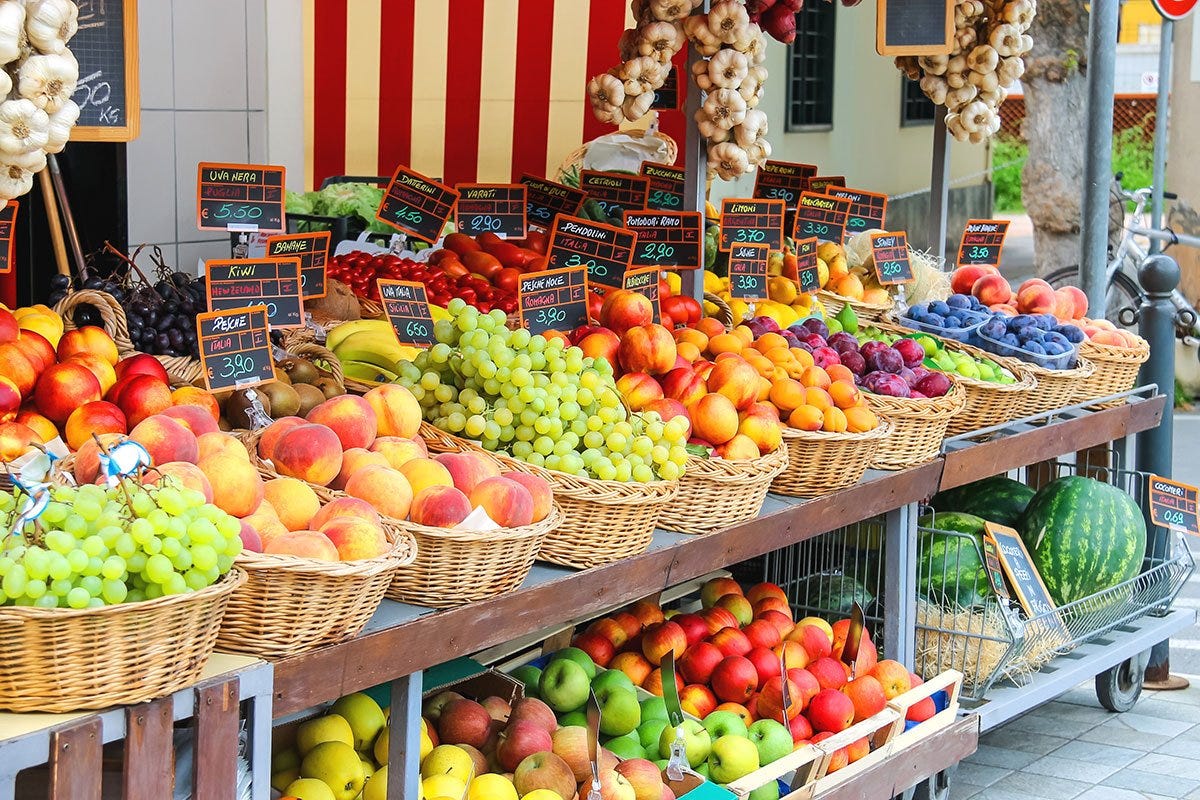
Not everyone has access to a farmers’ market. Incentivize local grocers and shops to offer regionally grown produce at an affordable price. Extend SNAP double bucks programs for fresh products to the store.
And while we're at it, let's rebuild public infrastructure to support it: community cold storage, mobile markets, local aggregation hubs. Make it easier for communities to feed themselves, and they will.
See our recent reporting on how the administration has abandoned farmers here:

Reinvest in Food Education
Many families don’t just lack access to food. They’ve been cut off from the knowledge of what to do with it.
We need to bring back home economics for the 21st century, not as a nostalgic return, but as a radical act of empowerment. Teach kids how to grow, cook, preserve, and share food. Support schools with on-site gardens, kitchen classrooms, and curriculum-integrated meals. It works. The research proves it. And more importantly, the children who eat better, feel better, and learn better every day.
In communities, fund public cooking spaces and training hubs, especially for those transitioning from generational poverty. Food should not be a test of survival. It should be a source of resilience.
Build Community Resilience
Not every solution needs to be high-tech or top-down. Community gardens, orchards, co-ops, and shared kitchens are low-cost, high-impact ways to make food sovereignty real. They feed people. They build skills. They create connection and pride.
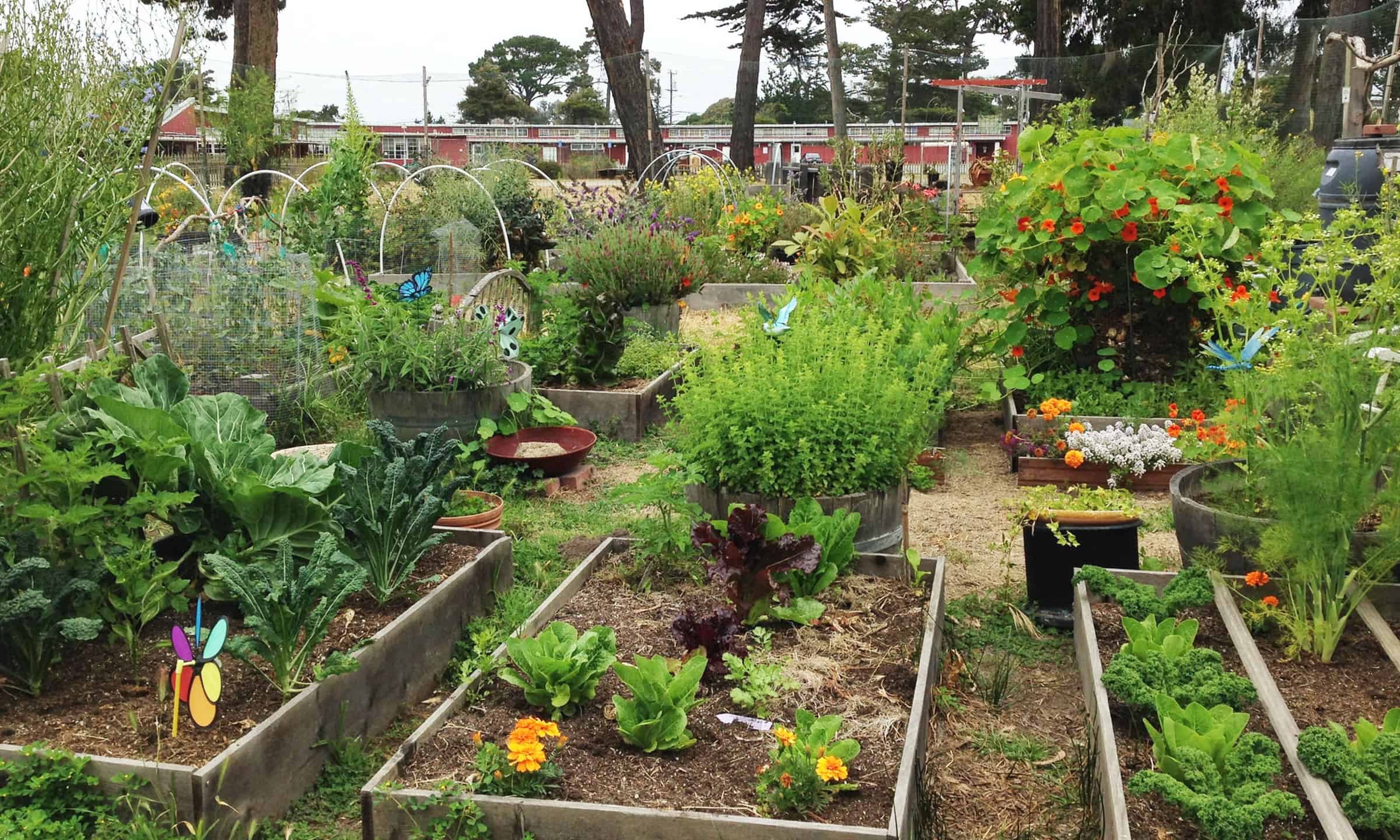
Most food deserts exist in inner cities and rural areas, where available land is often underutilized. Let communities turn these spaces into food hubs where they can grow, harvest, cook, and preserve together. An empty lot or abandoned field is better used to support the people, regardless of its potential economic value, if “one day” someone might want to purchase it.
Right now, those efforts are underfunded, underrecognized, and under constant pressure from zoning laws, developer buyouts, and a lack of support.
If we want healthy communities, we need to support the people already doing the work. Fund them. Protect them. Let them grow.
A Healthy Nation Is a Fed Nation
We don’t have a food crisis because Americans are lazy. We have a food crisis because corporate profits depend on scarcity, sickness, and shame.
They want you to believe this is your fault, that your diet is a failure of willpower, that your child’s school lunch is cheap because that’s all you deserve, and that if you just budgeted better, planned harder, and cooked longer, you wouldn’t be here—exhausted, stretched thin, feeding your family on a hope and a drive-thru menu.
But you are not the failure. The system is.
And slogans won’t save us.
To actually make America healthy again, we need more than marketing. We need:
A food system rooted in justice, not volume
Policies that make healthy choices accessible by default
Public investments that value local resilience over industrial scale
The political courage to say food is not a commodity. It is a human right.
This isn’t just about what’s on our plates. It’s about who we are and whether we still believe in a country where people should not be punished for being poor, tired, or hungry.
A healthy nation is not one with strong branding. It’s one with strong communities. It’s one where everyone eats.
Stay Informed. Stay Loud.
Subscribe to The Coffman Chronicle for no-BS political analysis, action guides, and daily truth bombs you won’t get from corporate media.
Bibliography:
“Average Cost of a Fast Food Meal Now Tops $10 in Major U.S. Cities.” Fox13 News, May 22, 2025.
“June Burger Prices Rise to $14.39, up 3.0% Compared to June 2024.” Toasttab Blog, July 15, 2025.
“Menu Prices.” Restaurant.org, July 15, 2025.
“The Average Price of a Quarter Pounder with Cheese Is Now $5.39…” Bloomberg.com, September 26, 2024.
Schneider, Meredith. '“I ordered salads from Wendy's, Culver's, Chick-fil-A, and Zaxby's. My old go-to chain didn't come close to first place.” Business Insider, August 25, 2024.
“5 Facts About Food Costs in America.” Pew Research Center, May 15, 2025.
U.S. Bureau of Labor Statistics. “Consumer Price Index Summary for June 2025.” Monthly CPI Release, July 15, 2025.
“USDA Cancels Local Food Purchasing for Schools, Food Banks.” Politico, March 10, 2025.
“USDA Ends Program That Helped Schools Serve Food from Local Farmers.” AP News, March 12, 2025.
“Ending USDA Programs for School Meals Will Impact Learning, Experts Warn.” EdSurge, April 28, 2025.
“Our Response to the USDA Cutting Over $1 Billion in Local Food Funding.” Chef Ann Foundation, March 12, 2025.
“US Farmers Raise Lobbying Spending after Trump Immigration Crackdown.” Financial Times.
“Local Food for Schools Helps Farmers and Kids. So Why Is Trump Cutting Funding?” The Guardian, March 19, 2025.

The addictive quality of any form of sugar is astounding. It produces dopamine in the brain. That is so hard to overcome with education about nutrition.
SNAP needs to be run exactly like WIC. Healthy, whole foods, fruits and vegetables, beans, rice, whole wheat bread, no junk food, soda, processed foods, and preservative-laden, high sodium foods. SNAP recipients should also be offered nutrition and cooking classes. Your point is well taken about today's younger generation having no knowledge of food preparation. Why learn to cut up a whole chicken (the least expensive) when you can just heat up frozen chicken nuggets? Today's young people can find almost any nonsense on social media to their detriment, but there are millions of cooking and food preparation videos that could actually prove beneficial to their health and their budget that they wouldn't give the time of day. Municipalities also need to step up and provide free, reliable public transit to a reasonably priced supermarket for their citizens living in food deserts. Instead, they allow the proliferation of convenient and 'dollar' stores where fresh produce, meat and dairy are unavailable. In my Midwest community of 100,000+, there is one entire section of the city that is no longer served by any grocery store or pharmacy. The only chain grocery with a pharmacy closed several months ago due to 'poor performance' at that location. The population of this area tends to be elderly, low-income families, persons lacking transportation, and disabled individuals. The city looked the other way and the building has sat vacant since.