


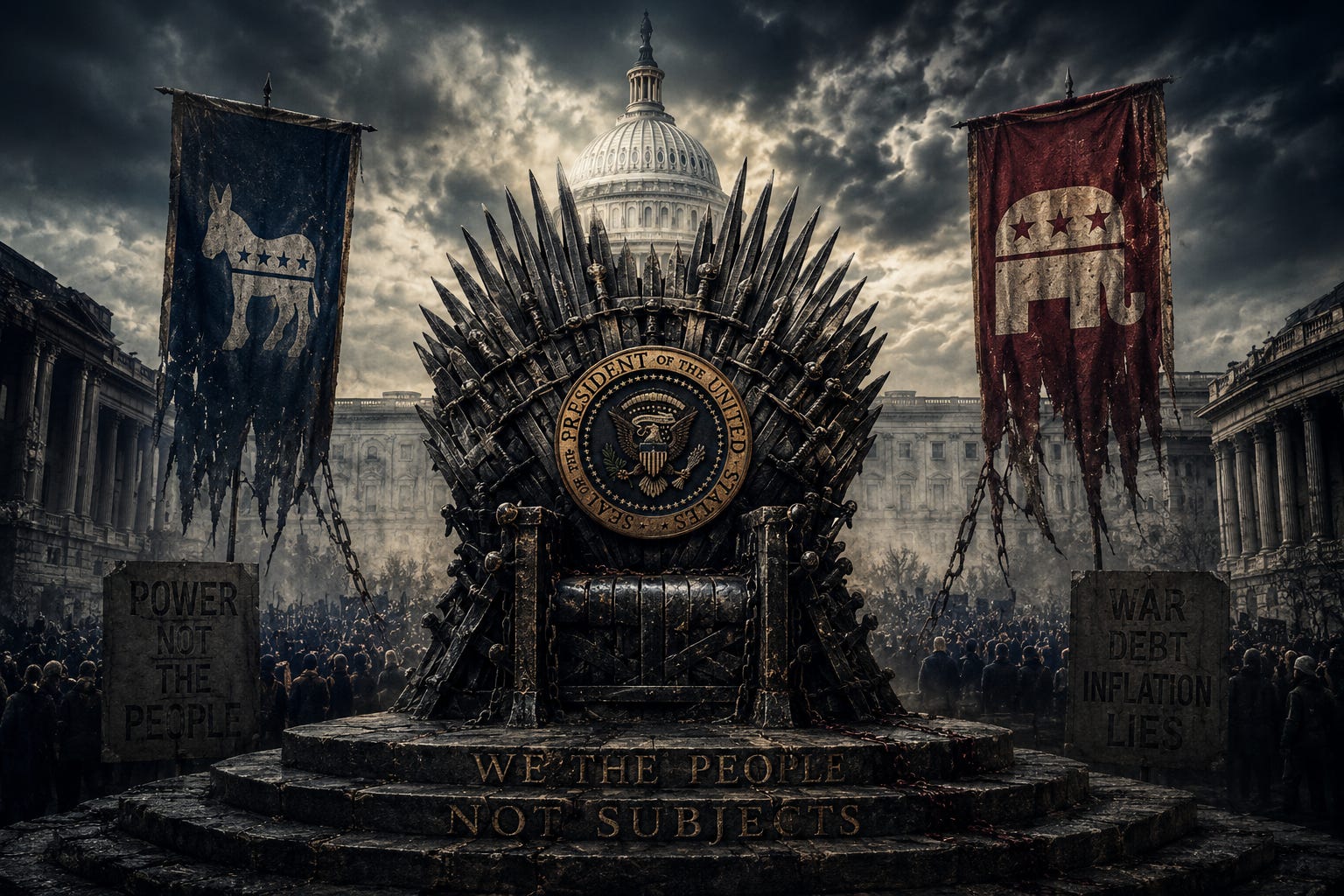
The Throne Fight Never Ends
At the kitchen table, the television is talking about power again. A president is threatening someone. A senator is defending him. Strategists are explaining which faction won the day and who may control the White House next. The names change. The banners change. The fight does not.
Meanwhile, the person watching is calculating whether the grocery bill can stay under $200. The credit card is still carrying last month’s emergency. The rent is due. Somewhere overseas, another military commitment is expanding before Congress has clearly explained the mission or how it ends.
Washington calls this politics. For millions of Americans, it feels more like living beneath a war between powerful houses.
That is why Game of Thrones still offers a useful picture of the American political system, not because the United States has become a medieval kingdom, but because rival houses keep demanding loyalty while ordinary people absorb the consequences.
Democrats and Republicans are not identical. Their values, coalitions, policies, and conduct can differ sharply, but both operate within a system in which control of the presidency exerts too much influence.
Congress was supposed to debate war, write laws, control spending, and investigate abuse. Instead, it too often behaves like a Small Council surrounding the ruler—defending, excusing, interpreting, and waiting.
America’s political crisis is not merely that the wrong person might capture the presidency. It is that both parties have helped turn the presidency into an Iron Throne while Congress surrenders the people’s constitutional power.
We keep fighting over who should sit on the throne. Almost no one asks why the throne has been allowed to become this powerful.
Support independent media that follows the power.
The Coffman Chronicle is built to track who holds power, who abuses it, who profits from it, and who pays the price.
Paid supporters get full Tony Michaels Podcast episodes, deeper transcript analysis, paid columns, archives, and the reporting framework behind the show.
If you believe independent media has to survive outside billionaire platforms, corporate media, and party-approved gatekeepers, become a paid supporter today.
The Iron Throne Is the Presidency
The presidency has become more than an office. It has become the prize around which the political system is organized.
Every four years, voters are told that the next election may determine whether the country survives. Presidents appoint judges, command the military, direct the executive branch, and shape the daily lives of millions. However, that does not explain why Americans have come to expect one person to solve nearly every national problem.
When prices rise, people ask what the president will do. When Congress refuses to legislate, activists demand an executive order. When war threatens, attention turns first to the commander in chief rather than to the legislature responsible for deciding whether the country should enter or sustain the war.
That is the appeal of the Iron Throne: it promises speed. Congress requires debate, recorded votes, compromise, and public accountability. Executive power offers something cleaner—a signature, an order, a command.
The frustration behind that appeal is understandable. People watch Congress stall while wars expand, industries consolidate, and public problems worsen. Presidential action can look like the only proof that the government is still capable of moving.
However, speed is not legitimacy, and action is not self-government. Every shortcut around Congress makes the next one easier. Every emergency power accepted for a trusted president becomes an inherited weapon. Every decision removed from public debate teaches lawmakers to avoid responsibility and citizens to look toward one person for choices that belong to the republic.
A presidency strong enough to save the country by decree is also strong enough to govern it against the public’s will. A republic that depends on repeatedly finding the right person to wield extraordinary power has already surrendered something essential.
The Great Houses Need Your Loyalty
Political parties are not inherently illegitimate. Representative government requires coalitions. The problem begins when a coalition stops acting as a vehicle for citizens and starts expecting citizens to serve the coalition.
American parties increasingly ask for that allegiance. They have colors, slogans, heroes, enemies, donors, punishments, and stories about why their continued power is necessary for national survival. Membership becomes identity, and disagreement becomes betrayal.
The opposing house is presented not merely as wrong but as an existential threat. That fear may reflect real stakes. Parties can differ sharply over rights, war, labor, healthcare, and the courts. However, fear also gives party institutions enormous power over their own voters.
When the rival house must be defeated at any cost, your house can ask you to overlook corruption, defend executive power, remain silent when promises disappear, and treat accountability as assistance to the enemy.
The two-party system does not require Americans to trust either house. It only requires them to believe they cannot survive unless they belong to one. That is the dependency trap. The parties do not need to earn permanent loyalty if they can manufacture permanent fear. This is how democratic participation begins to resemble political feudalism.
People are encouraged to wear the colors, defend the leader, and bend their principles to suit whoever holds power. An executive order is necessary when our president signs it, and tyrannical when theirs does. A congressional investigation is accountability when aimed outward and persecution when aimed inward.
The moment a party believes it is entitled to loyalty regardless of performance, it has stopped asking for democratic support and started demanding obedience.
The Houses Are Different. The Throne Is the Same.
This is not an argument that Democrats and Republicans are identical. They are not. House Stark was not House Lannister. Their values, conduct, and treatment of others were not interchangeable. Those differences mattered to the people beneath them.
The same is true in American politics. One party may pose a more immediate threat on a particular question. One administration may abuse power more aggressively, but neither party establishment has challenged the structure deeply enough to make possession of the presidency less decisive.
When their party holds the White House, lawmakers discover reasons the president needs flexibility. Congress is too slow. The opposition is acting in bad faith. The emergency is too urgent.
When the other party takes power, executive flexibility becomes authoritarianism, agency discretion becomes lawlessness, and military initiative becomes undeclared war. Some of those criticisms may be justified. Hypocrisy does not render every accusation false, but the pattern remains: constitutional principles are too often used as weapons against the opposing house rather than as rules binding every house.
Each party condemns the dragon when the other side controls it and imagines it can ride the same creature responsibly after the next election. The banners behind the throne change, but the powers surrounding it remain. The houses are different. Their dependence on capturing the throne is the same.
Congress Chose to Become the Small Council
The presidency did not become an Iron Throne by taking power from a helpless Congress. Congress helped build it.
It surrendered authority gradually. A difficult vote could be avoided. An emergency could be handled faster. A president from the same party could be trusted. A military commitment could continue without forcing every member to answer publicly for it.
Congress controls spending, writes federal law, conducts oversight, and possesses the constitutional authority to decide whether the country goes to war. Those powers are not ceremonial privileges. They are the mechanisms through which the public is supposed to govern.
When Congress uses them, decisions pass through representatives who can be questioned and removed. When Congress avoids them, power shifts to places harder for the public to reach. When Congress gives up power, the people lose power.
Yet Congress increasingly behaves like the Small Council. Members interpret the president’s latest statement, shape investigations around party needs, defend actions they did not authorize, and criticize decisions they have made no serious effort to restrain.
The institution still has power. Too many members have decided that using it is politically dangerous. A recorded vote creates accountability. It can anger donors, party leaders, presidents, and primary voters. Avoiding that vote is safer.
A member can condemn a war without voting to end or limit it. Congress can complain about an emergency declaration without rewriting the law that made it possible. Lawmakers can denounce presidential overreach while preserving the same authority for the day their party returns to power.
Congress can appear powerless while protecting the tools that make it powerless. The people’s branch becomes the president’s personal staff because it is easier to denounce one ruler than to weaken the throne.
Congress did not lose its constitutional power. It stopped using it.
Every House Wants a Dragon
Executive power is attractive for the same reason a dragon is attractive. It is fast. It can break through resistance and accomplish in moments what representative institutions might debate for months.
Supporters celebrate because the dragon is moving in the direction they want. A unilateral action is bold when it advances a favored policy. An emergency is legitimate when the threat feels urgent. The machinery appears dangerous only when it turns around.
Then the same people who cheered presidential strength rediscover constitutional restraint. Every faction imagines it will remain the dragon’s rider. It will not.
Every power created for one administration becomes part of the next president’s inheritance. Legal theories are cited by successors. Databases remain. Surveillance tools are redirected. Military precedents justify the next escalation.
The president changes. The dragon stays. Benevolence does not neutralize precedent. A constitutional system cannot depend on personal self-control. It must depend on enforceable limits.
Presidents must be capable of enforcing law, administering government, conducting diplomacy, and responding to genuine threats, but capacity is not supremacy.
The duty to execute law cannot become a license to write it. The power to respond to an attack cannot become indefinite authority to choose the scope and duration of war. An emergency cannot become a permanent constitutional condition.
The dragon offers spectacle. The republic offers accountability.
The Wall Comes Down One Breach at a Time
A wall is rarely destroyed all at once. It weakens through exceptions granted to trusted actors, urgent threats, and breaches tolerated because the first people affected are easy to abandon.
The Constitution is America’s wall against concentrated power. It divides authority and protects due process, habeas corpus, speech, association, elections, judicial review, and public accountability.
Those safeguards are sometimes described as obstacles. They are supposed to be. They were built because the country could not assume that every president would be honorable, every Congress courageous, or every emergency genuine.
Every political house is tempted to weaken the Wall when the rules protect someone it dislikes or delay something it wants.
The argument usually begins with the target. This person is dangerous. That group is extreme. These migrants are an invasion. Those protesters are subversive. Congress is too slow. The courts are interfering.
Sometimes the danger is real. Constitutional restraint does not require denying it. It requires proving the danger, identifying lawful authority, defining limits, and keeping government answerable.
The first target is always the easiest to abandon, but government labels are not proof. Due process does not prevent punishment; it requires lawful punishment. Habeas corpus forces the jailer to explain a detention. The First Amendment does not protect threats or violence; it prevents political belief from replacing evidence.
The machinery survives the story used to create it.
A constitution cannot defend itself through ceremony. Its barriers have meaning only when institutions and citizens insist that they hold. The Wall falls when too many people decide that one more breach will help their side.
The People Pay for the Wars of the Houses
The people who suffer most from political conflict are rarely the people whose names dominate the story. In Game of Thrones, the great houses speak of succession, alliances, betrayal, and victory. Farmers experience the same war as burned fields, emptied villages, hunger, and fear.
American politics has its own version of that distance. The national story is told through presidents, party leaders, donors, and cable-news personalities. Which side won? Who gained leverage? Who humiliated whom?
The public is trained to watch politics from above. Most Americans live it from below.
They live it at the grocery checkout. They live it when a credit card covers medicine, food, or a car repair because the paycheck ran out before the month did. They live it when rent rises faster than wages, an insurer denies a claim, a factory closes, or work hours disappear. They live it when a military deployment expands without a clear mission, or when a publicly supported corporation eliminates jobs and distributes the gains upward.
The ruling houses call it strategy. The people living beneath them call it rent, debt, layoffs, war, and survival. The houses experience politics as movement on a board. The public experiences it as consequences.
The houses benefit when people fight sideways. The customer blames the cashier for prices she did not set. One struggling family is encouraged to resent another while the institutions profiting from both remain protected.
Political feudalism does not survive through loyalty alone. It survives by redirecting pain. However, the people beneath the banners are not background characters in somebody else’s struggle for power. They are the country.
Winter Is Already Here
In Game of Thrones, the great houses keep fighting over succession even as a larger danger approaches. America has its own version of winter.
It is the accumulation of problems the political system can see but refuses to confront: household debt, unaffordable housing, healthcare insecurity, artificial-intelligence displacement, corporate concentration, aging infrastructure, energy pressure, widening wars, and collapsing public trust. None of these crises is hidden.
Congress holds hearings. Agencies publish reports. Candidates give speeches. Parties promise action after the next election. Then the throne fight resumes.
A system built to reverse direction every four years cannot prepare a country for problems that require twenty years of sustained governing. The country’s long-term needs are filtered through the houses’ short-term fortunes. Will action help the president, embarrass the opposition, anger donors, or survive the next election?
Washington produces constant motion while avoiding durable action. Statements and executive orders arrive, followed by lawsuits and fundraising messages. The houses keep campaigning as though the next ruler will solve everything. Winter keeps advancing because the institutions that should prepare the country have abandoned their work.
The crisis is not always one dramatic collapse. Sometimes it is the normalization of less: less accountability, less security, less public control, and less faith that government can act without being captured. The future becomes the place where every serious promise is stored. Winter does not wait there.
America is not doomed. Fatalism is another form of surrender. The country still possesses enormous wealth, civic energy, institutional knowledge, and constitutional tools, but unused tools do not become stronger.
No single victory repairs a political culture that has mistaken succession for government. Winter is not coming. For millions of Americans, it is already here.
Break the Throne
A political system this frustrating can make destruction feel like honesty, but America does not need political arson. It needs republican reconstruction. A leader who promises to smash institutions and ignore old rules may sound like a rebel. He often asks for permission to concentrate power in himself.
Burning the kingdom rarely leaves ordinary people standing as equals. It leaves the strongest faction standing in the ashes.
We can break the throne without breaking the republic. Breaking the throne does not mean eliminating the presidency. It means ending the country’s dependence on presidential power as the answer to every national problem.
That requires three things.
First, Congress must vote. A country should not enter or widen a war while legislators avoid responsibility. Major questions of spending, trade, surveillance, labor, and technology should not be left indefinitely to executive improvisation. Members must place their names beside decisions made in the public’s name.
Second, extraordinary executive power must expire unless Congress renews it. Emergency declarations, military authorities, and temporary exceptions should not become permanent because lawmakers are afraid to revisit them. If Congress will not affirm that a power remains necessary, it should end.
Third, representatives must answer to constituents before presidents, party leaders, and donors. That means giving members greater freedom to force debates and recorded votes while confronting campaign money, leadership control, gerrymandering, and the punishment of independent lawmakers. A representative who fears the party more than the district does not fully represent it.
Representation without political risk is not representation. It is career maintenance. Representatives must be judged as representatives. Did they vote and explain the decision? Did they defend constitutional limits when their party held power? Did they challenge concentrated private power as seriously as they challenged the opposing house?
Breaking the throne means making national power answerable to more than one person, election, party, or political house. It means rebuilding a government in which no president must save the country alone because no president is permitted to own it.
Citizens, Not Subjects
At the kitchen table, the television is still talking about the throne. Another leader is demanding loyalty. Another panel is explaining which house gained ground. The next election is already being described as the final chance to save the country. The grocery bill is still sitting beside the remote.
For parties, politics is control. For donors, it is access. For consultants, it is business.
For citizens, it is supposed to be self-government. A subject asks who the ruler will be. A citizen asks what authority the ruler is permitted to possess. A subject waits for protection. A citizen demands representation. A subject owes loyalty to the house. A citizen owes loyalty to the republic and to the equal rights of the people within it.
The American experiment was not built on the assumption that every leader would be good. It was built on the recognition that no constitutional system should depend on every leader being good.
Power was divided because people are fallible, and Congress exists to turn public disagreement into law rather than leave national decisions to one ruler. That structure has never worked perfectly. Many Americans were excluded from its original promises, but the answer to an incomplete republic is not a completed throne. It is a republic made more democratic, accountable, and faithful to the principle that public power belongs to the public.
Citizenship asks harder questions than party loyalty: Who authorized the power? What limits remain? Who benefits? Who pays? Would the same authority still look acceptable in the other side’s hands?
A republic is not maintained by admiration for its symbols. It is maintained by people who insist that its institutions perform their duties. No political house should own the public. No president should embody it.
The presidency is not an Iron Throne. Congress is not a Small Council. Political parties are not noble houses entitled to permanent allegiance. The Constitution is not scenery arranged behind whichever ruler occupies the room.
America does not need a kinder king, a wiser dynasty, or a more honorable rider for the dragon. It needs a republic strong enough that no ruler, party, or political house can own the country.
We do not need to win the Game of Thrones. We need to remember that Americans were never meant to be subjects in it.
Rebellion from Home - Support Independent Media
The throne grows stronger when citizens are reduced to spectators.
The Coffman Chronicle exists to do the opposite: follow the power, defend the people’s branch, and insist that government belongs to citizens—not presidents, parties, donors, or political houses.
If this work matters to you, share this article with someone who is tired of being told that choosing the right ruler is the same thing as self-government.
And if you can afford to become a paid subscriber, your support helps keep this work independent and makes more articles like this possible.
We do not need a better king. We need our republic back.
Sources:
Goitein, Elizabeth. “Testimony on Reforming the National Emergencies Act before the Senate Committee on Homeland Security and Governmental Affairs.” Brennan Center for Justice, May 22, 2024.
Pew Research Center. “Public Trust in Government: 1958–2025.” December 4, 2025.
United States Congress. “Article I, Section 1: Legislative Vesting Clause.” Constitution Annotated. Library of Congress.
United States Congress. “Article I, Section 8: Enumerated Powers.” Constitution Annotated. Library of Congress.
United States Congress. “Separation of Powers Under the Constitution.” Constitution Annotated.
United States Government Accountability Office. Legislative Branch: Options for Enhancing Congressional Oversight of Rulemaking and Establishing an Office of Legal Counsel. GAO-24-105870. Reissued January 9, 2024.
The public needs to know that nothing will change until the public forcibly removed hi from office