


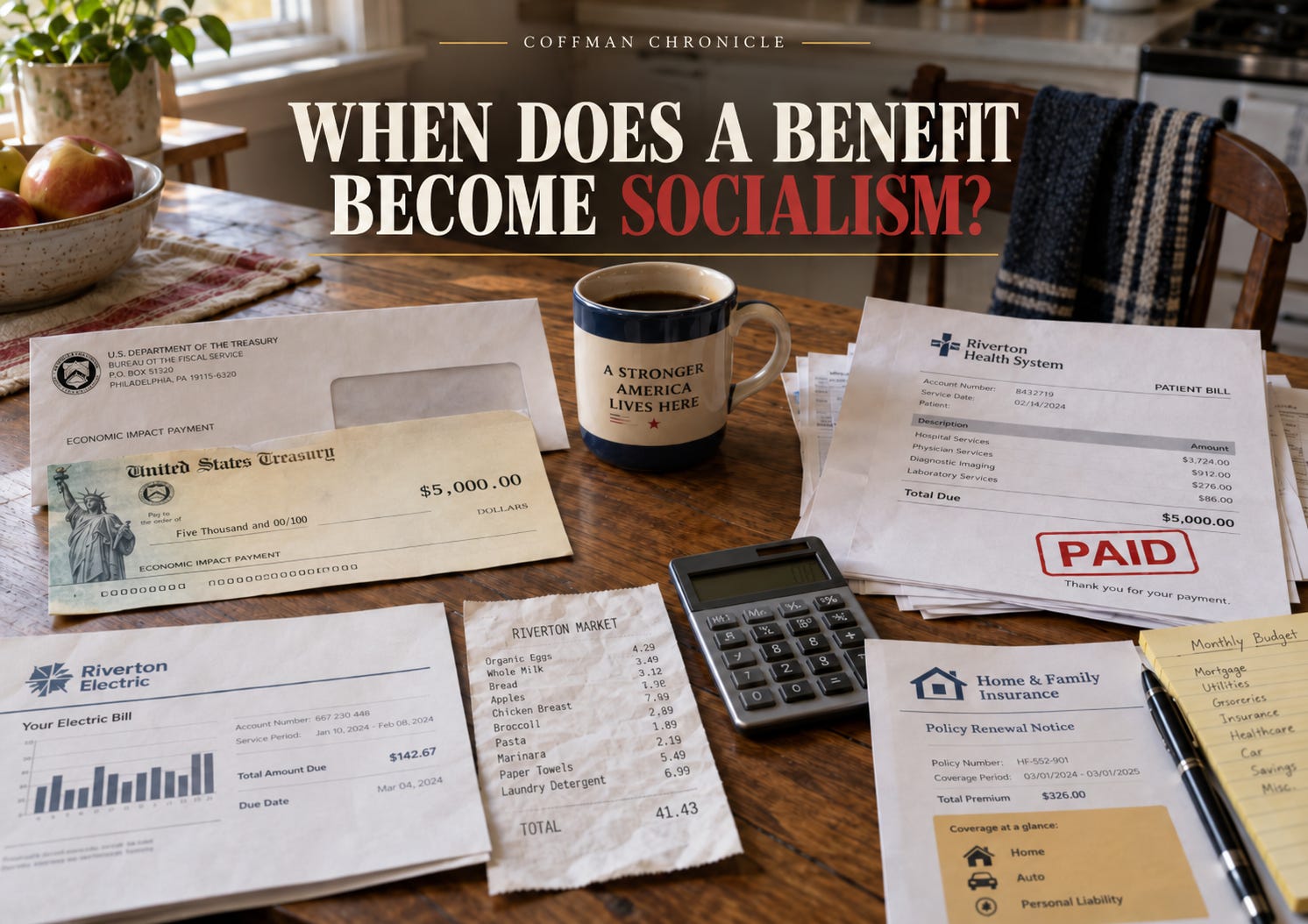
The Check on the Kitchen Table
Imagine a household with two adults sitting at the kitchen table trying to make the numbers work. The mortgage is due. Groceries cost more than they used to. The electric bill is sitting beside a stack of unopened mail, and somewhere in that pile is a medical bill neither person is particularly eager to look at.
Now imagine the federal government makes that household two different offers.
The first is simple: We are going to send you $10,000. No restrictions. The money goes into your account, and you decide whether it pays the mortgage, catches up the credit cards, replaces the transmission, covers groceries, or sits in savings.
The second offer looks different: We will cover $10,000 of your healthcare costs that otherwise would have come out of your household budget. The money never lands in your checking account. It goes toward insurance, doctors, hospitals, prescriptions, or some other part of the healthcare system. You cannot use it to fix the car or pay the electric bill. But you are still $10,000 better off than you would have been if you had paid those medical expenses yourself.
These are not the same policy. One is a direct cash transfer. The other is government financing of a specific service. They can have different costs, incentives, administrative burdens, and economic effects, but in both cases, the government uses public resources to improve a private household's financial position.
Which one is socialism? And would your answer change if you knew which political party made the offer?
This Community Is Powered by You
What started as a small circle has grown into something much bigger, and it’s all because of readers like you.
Every time you forward this email, post it on socials, or bring someone new into the fold, you’re helping build one of the most passionate, independent communities out there.
Want to keep the momentum going?
Share this newsletter with someone who should be part of this conversation.
Thank you for being here. It means everything.
Now Put the Party Labels Back On
On September 9th, Donald Trump promised a $5,000 “Trump dividend” to every adult U.S. citizen if Republicans retain both chambers of Congress in the 2026 midterm elections. Reuters estimated the proposal would cost about $1.2 trillion, and the spending would require congressional approval.
The offer did not appear by itself. Trump had previously proposed a $2,000 tariff dividend, and his administration distributed a $1,776 payment to military personnel. More recently, the administration announced $500 refunds for nearly one million people who paid full price for insurance through HealthCare.gov and one-time $90 payments for more than 20 million eligible Medicare Part B beneficiaries.
Those examples have different legal structures and purposes. The $500 payments are being described as refunds of excess federal marketplace user fees, not a new healthcare subsidy. The $90 Medicare payments use money from the Medicare Improvement Fund, which Congress funded. Neither is the same as creating a new $1.2 trillion cash program.
However, together they establish something useful for this discussion: government putting money into the hands of individual Americans is not an idea confined neatly to one political side.
Now consider healthcare. Senate Democrats are developing proposals to lower premiums and deductibles, simplify insurance, and expand coverage options, including Medicare-like choices. Some Democrats want government to go considerably further than others.
American politics routinely describes government-financed healthcare as socialism. That makes the kitchen-table question harder. If government spending thousands of dollars to help pay someone’s healthcare costs is socialism, what should we call government putting thousands of dollars directly into that person’s hands?
Before choosing a side, we should probably choose a definition.
Use the Same Definition Twice
In its traditional economic sense, socialism involves public or collective ownership or control of the means of production. In a basic explanation contrasting capitalism and socialism, the International Monetary Fund describes socialism as a system in which the state owns the means of production.
Under that definition, government spending money on someone does not automatically make an economy socialist. A $5,000 government check does not mean Washington owns the grocery store where the recipient spends it. A Medicare payment does not mean the government owns every doctor’s office, hospital, pharmaceutical company, or medical-device manufacturer involved in providing care. Government can tax, spend, regulate, subsidize, insure, and redistribute money inside an economy that remains overwhelmingly based on private ownership.
However, that is not always how the word socialism is used in American political debate. The definition often becomes much broader: government collects money from taxpayers and uses it to provide something of economic value to an individual. When the benefit is healthcare, that arrangement is frequently called socialism.
If that is the definition, consistency requires us to use it more than once.
If government spending $5,000 to help pay someone’s healthcare costs is socialism because public money is being used for that person’s benefit, then putting $5,000 directly into the same person’s bank account cannot escape examination under the same definition merely because politicians call it a dividend.
Conversely, if a $5,000 government payment is not socialism because redistribution alone does not amount to government ownership of the economy, then publicly financed healthcare cannot automatically become socialism merely because government helps pay the medical bill.
That does not make the policies economically equivalent. One may cost more, require higher taxes, increase borrowing, distort markets, replace expenses households already pay, or produce greater public benefit. Those are arguments worth having. Calling one socialism and the other a dividend does not settle them.
Choose the definition. Then use it twice.
The Vocabulary Changes Before the Money Does
Political language often decides an argument before the numbers arrive. Money sent to a household can be called a dividend, refund, benefit, incentive, investment, tax credit, or relief. Money going somewhere we disapprove of can become a handout, welfare, or socialism. Sometimes those words identify real differences. A refund is different from a subsidy. Insurance is different from unrestricted cash.
However, language can also pre-frame the policy before anyone asks what it costs or accomplishes. Call something a dividend, and it can sound like money that was always yours. Call it a handout, and it sounds like money someone else did not earn. Call it socialism, and the argument can end before anyone examines the policy.
A useful test is to remove the politician’s name while leaving the policy untouched: same amount, same eligibility, same funding source, same budget effect, and same economic consequences. Would you describe it differently after learning who proposed it?
That is not a Republican problem or a Democratic problem. It is a political habit, and it makes serious policy analysis much harder.
Healthcare Makes the Comparison Harder
Healthcare makes the boundary particularly difficult to maintain. Legitimate disagreements remain over how far government should go in financing medical care, what expanded coverage would cost, how it should be financed, and how greater public involvement would affect patients, providers, insurers, and taxpayers.
However, the mere act of government using public money to reduce someone’s healthcare costs cannot, by itself, settle the socialism question. The Trump administration’s new Medicare payment makes that unusually concrete.
More than 20 million eligible Medicare Part B beneficiaries are slated to receive a one-time $90 payment to help offset premiums, funded by the $2 billion Medicare Improvement Fund. Strip away the party labels and look at the mechanism: Congress funded a federal healthcare account, and the executive branch is directing money from that account to individual beneficiaries to reduce what they pay for government health insurance.
That does not make the Trump administration socialist. It does show why defining socialism simply as government helping someone pay a healthcare bill does not take us very far.
Suppose the contribution were $900 instead of $90, or $9,000. The economic principle would not suddenly change because the number got larger. What would change are the cost, scope, consequences, and degree of government involvement. Those are the things worth debating.
Put Both Policies Through the Stewardship Test
Set the socialism label aside and examine the policies themselves.
Start with Trump’s proposed $5,000 payment. Government should be able to explain what problem it is trying to solve, whether the goal is to ease household costs, stimulate consumer spending, return revenue to taxpayers, or simply provide additional income. It should also explain where roughly $1.2 trillion would come from. If existing revenue pays for it, what else will that revenue no longer support? If government borrows, what happens to the debt and future interest costs? If more than a trillion dollars of purchasing power reaches households, what effect might that have on demand and prices? Most importantly, what result should taxpayers expect after the money is spent?
Now apply the same test to government-financed healthcare. Government should identify whether the goal is reducing the uninsured population, lowering premiums and deductibles, protecting households from catastrophic bills, or providing another insurance option. It should explain the cost, the financing, who qualifies, and what happens to spending households and employers already make privately.
Higher federal healthcare spending can replace costs families or employers are already paying through premiums or out-of-pocket expenses, so looking only at the government’s new expense can exaggerate the net economic cost, but calling healthcare a public benefit does not make the underlying cost disappear either. Doctors, hospitals, nurses, drug manufacturers, and everyone else providing care still have to be paid.
The useful questions are therefore the same for both proposals: What is the purpose, what does it cost, who pays, who benefits, and what happens afterward? That is where Stewardism begins.
Stewardism Asks a Better Question
Stewardism asks what government is doing with the power and resources entrusted to it. It asks whether a legitimate public purpose is being served, what alternatives were available, what opportunity costs follow from the choice, whether the commitment is sustainable, whether citizens can see where the money went, and whether success can be measured.
Those questions apply whether government is sending someone $5,000, helping pay a Medicare premium, supporting a farm, financing a weapons system, or offering a tax preference to a corporation. The program changes, but the obligation to justify it does not.
This also has a citizen side. It is easy to demand fiscal responsibility when the other party is spending the money. The harder test is demanding the same explanation when the spending benefits us, our community, our industry, or a cause we support. That is citizen stewardship.
A useful test is simple: Would you accept the same justification if the other party controlled the government? If the answer changes with the party, the problem may not be the policy. It may be the standard.
The President Can Promise the Check. Congress Controls the Purse.
The $5,000 proposal also raises a constitutional question. Article I places federal spending authority in Congress, and the Appropriations Clause says money cannot be drawn from the Treasury except through appropriations made by law. A president can propose spending and campaign on it, but cannot create a new $1.2 trillion payout simply by announcing one.
Congress would have to provide the legal authority, establish eligibility, determine the funding, and accept responsibility for the consequences. That is not a technical inconvenience. It is part of the constitutional design.
If lawmakers decide every adult citizen should receive $5,000, they should defend the price and explain where the money comes from. If they decide government should assume a larger share of healthcare costs, they should do the same. If either proposal requires borrowing, new revenue, or cuts elsewhere, citizens should know.
The purpose may differ. The constitutional responsibility does not. A president can promise the check. Congress has to own the decision to write it.
The People’s Money Does Not Change Parties
Public money does not become Republican money when a Republican president wants to spend it, and it does not become Democratic money when Democrats want to spend it. It remains public money.
A dollar spent on a cash payment is a public dollar. So is a dollar spent on Medicare, farm support, military procurement, disaster relief, childcare assistance, or a corporate tax incentive. Those expenditures serve different purposes and can produce very different results, but every one creates an opportunity cost. Money used for one purpose cannot be used for another. Money borrowed today becomes a claim on future revenue. A permanent benefit becomes an obligation future taxpayers inherit.
Stewardship therefore requires government to make the case: Why this program, this amount, these recipients, this funding source, and why now? What evidence will tell us whether it worked?
If citizens demand those answers only when the other party is spending, then we are not really defending fiscal responsibility. We are defending our team. The people’s money deserves a better standard than that.
Stop Asking for the Label. Ask for the Receipt.
Go back to the household at the kitchen table. The bills are still there. So are the healthcare costs, mortgage, groceries, electric bill, insurance premium, and everything else due this month.
Washington can call the money a dividend, refund, subsidy, tax credit, benefit, or healthcare guarantee. Those words may describe important differences in policy design, but they do not tell that household whether the policy was responsible.
For that, citizens need the receipt: what it cost, where the money came from, who qualified, whether government borrowed, whether another program lost funding, and whether the policy accomplished what its supporters promised.
If publicly financed healthcare is called socialism because government collects and redistributes money for an individual’s benefit, then intellectual consistency requires us to examine direct government cash payments under the same definition. If a $5,000 government check is not socialism because redistribution alone does not amount to government ownership of the economy, then government helping pay a healthcare bill cannot automatically become socialism simply because the benefit arrives through Medicare, Medicaid, an insurance subsidy, or another public program.
Choose the definition. Then use it twice.
After that, the real debate can begin. One program may be worth the cost, while another is not. Maybe one solves a legitimate public problem while another merely moves money around. Maybe one belongs in government, and another does not. Those disagreements are worth having because they force us to talk about what government is actually doing.
If you demand an explanation when the other party writes the check, demand the same explanation when your party does. That is citizen stewardship.
Maybe the first question should not be whether government spending is socialist. Maybe it should be whether it is responsible. Stop asking for the label. Ask for the receipt.
Support Independent Media - The Coffman Chronicle
If this article gave you something useful to think about, please share it with someone who may not agree with you.
The Coffman Chronicle is built around a simple idea: the republic works better when citizens ask harder questions, demand clearer answers, and hold every branch of government to the same standard.
If you can afford to support this work, a paid subscription helps me keep doing the research, writing the long-form pieces, and building the Square New Deal and Stewardism arguments without putting them behind a partisan wall.
And whether you subscribe or not, keep asking for the receipt.
The people’s money deserves nothing less.
Sources
Aboulenein, Ahmed, and Yasmeen Abutaleb. “White House Says It Will Send $500 Obamacare Refunds to Nearly a Million Americans.” Reuters, September 10, 2026. Reuters article
International Monetary Fund. “Back to Basics: What Is Capitalism?” Finance & Development 52, no. 2 (June 2015). International Monetary Fund article
Singh, Kanishka. “Trump Says US to Send One-Time $90 Payment to 20 Million Seniors Enrolled in Medicare.” Reuters, October 3, 2026. Reuters article
Sullivan, Andy, Jonathan Stempel, and Saqib Iqbal Ahmed. “Is Trump’s $5,000 ‘Dividend’ Legal and How Would It Work?” Reuters, September 10, 2026. Updated September 11, 2026. Reuters article
U.S. Congress. “Historical Background on Appropriations Clause.” Constitution Annotated, Article I, Section 9, Clause 7. Accessed October 4, 2026. Congress.gov Constitution Annotated
U.S. Senate Committee on Finance. “Wyden Seeks Input on Major Reforms to Health Coverage in America.” July 30, 2026. Senate Finance Committee source
this is thought-provoking, but it needed to be reduced by a third in length , at least