


The Proposal That Isn’t Really About a Monument
A Monument Proposal That Tests Who Gets to Redefine Civic Space
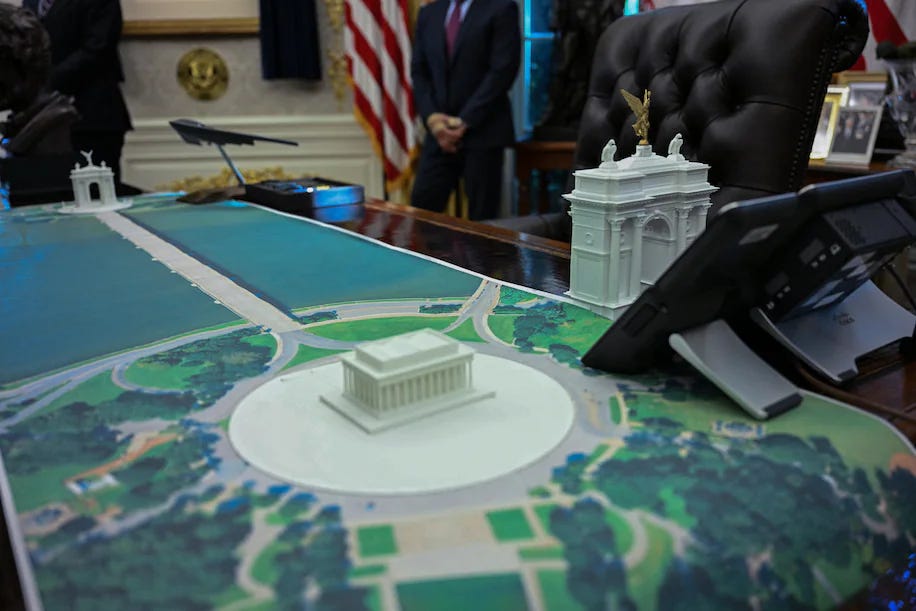
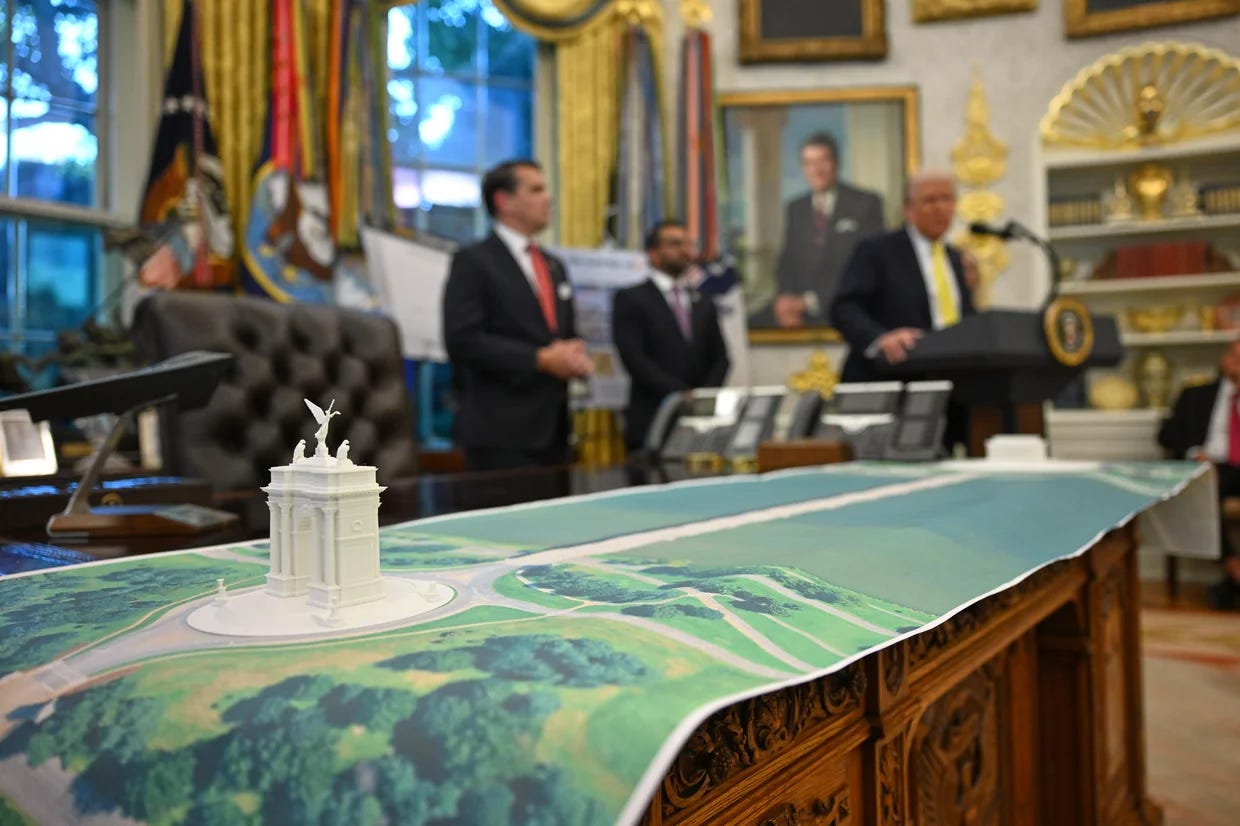
A proposal backed by President Donald Trump would construct a 250-foot “Independence Arch” near the Lincoln Memorial, inserting a towering new structure into one of the most symbolically protected spaces in the United States. Architects and historians have raised concerns about scale, sightlines, and disruption. Those criticisms are valid but incomplete.
This story is not ultimately about architecture.
The National Mall was designed to resist dominance. Its openness, its long horizontal lines, and its carefully spaced monuments are not aesthetic accidents. They are physical expressions of restraint, an intentional refusal to allow any single figure, ideology, or moment to overwhelm the nation’s shared civic memory. Altering that balance is not a neutral act. It is a statement about who has the authority to redefine what the country honors, how it remembers, and where power is allowed to leave permanent marks.
A 250-foot monument placed near the Lincoln Memorial would do more than add a new landmark. It would reorder the visual and symbolic hierarchy of the Mall itself. Once built, such changes are irreversible. Stone does not retreat. Steel does not apologize. Monuments do not evolve with public opinion.
Even if the Independence Arch is never constructed, the proposal alone matters. It tests whether the guardrails surrounding America’s most important civic space still function or can be pressured, reframed, and bypassed in the name of patriotism. History shows that the reshaping of democratic institutions rarely begins with laws alone. It often starts with symbols, quietly introduced, before anyone is asked whether they consent.
This Community Is Powered by You
What started as a small circle has grown into something much bigger, and it’s all because of readers like you.
Every time you forward this email, post it on socials, or bring someone new into the fold, you’re helping build one of the most passionate, independent political communities out there.
Want to keep the momentum going?
Share this newsletter with someone who should be part of this conversation.
Thank you for being here. It means everything.
Why the National Mall Was Designed to Resist Dominance
The Mall’s design was meant to prevent any one idea from looming too large
The design of the National Mall was never meant to impress in the way modern megastructures do. It was meant to restrain.
From its earliest planning, the Mall was conceived as an open civic commons—long, horizontal, and deliberately uncluttered. The distance between monuments, the preservation of sightlines, and the emphasis on open space were not aesthetic preferences but democratic ones. Power, in this landscape, was not supposed to loom. It was supposed to be contemplated.
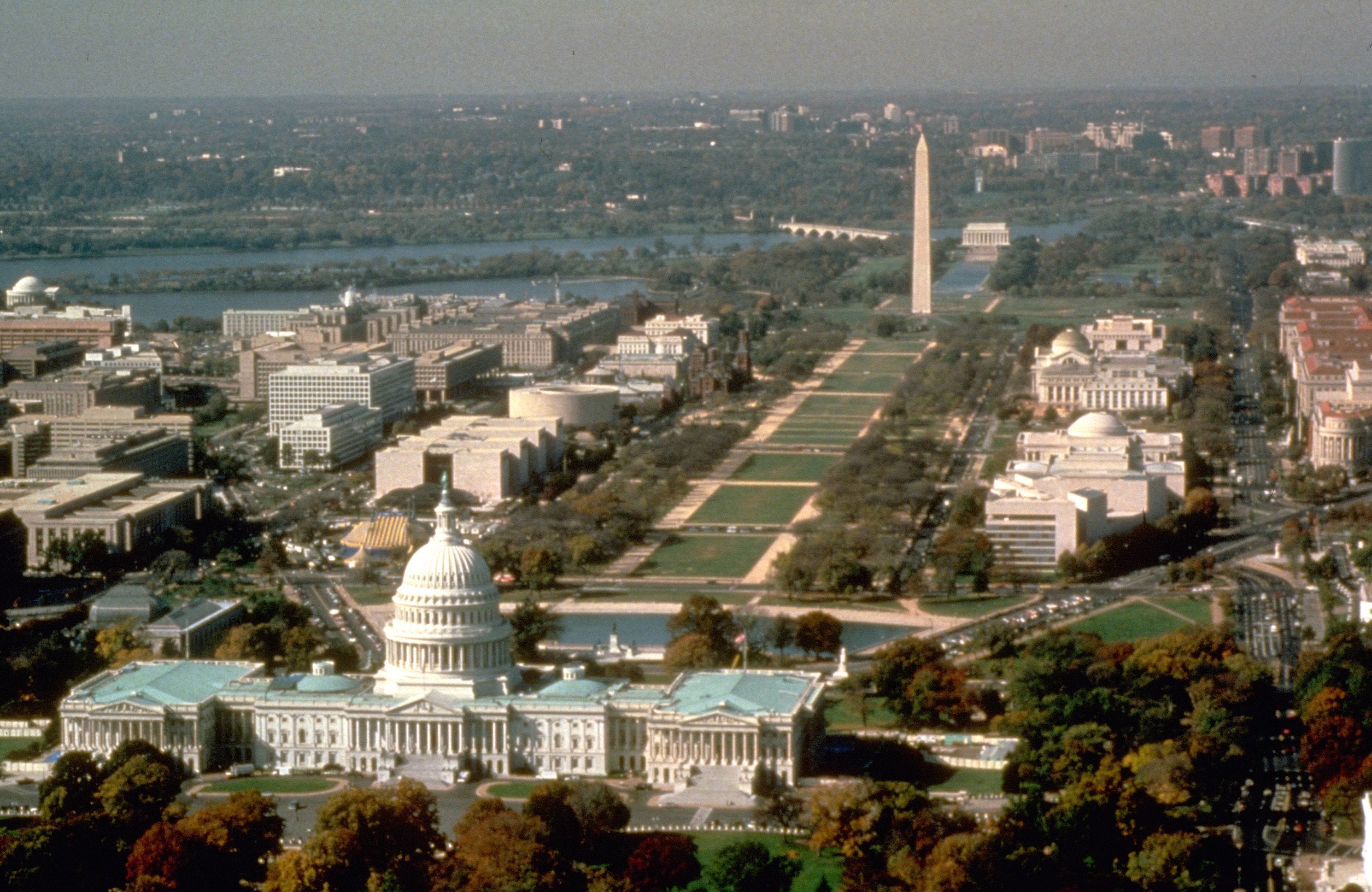
The placement of the Lincoln Memorial at the western edge of the Mall is central to that philosophy. Lincoln sits low, seated rather than standing, his memorial approached gradually across the Reflecting Pool. The experience is intentionally humbling. Visitors walk toward history rather than being confronted by it. The space invites reflection, not awe.
This restraint is echoed throughout the Mall. Even the Washington Monument, the tallest structure in the area, was set back and isolated by open ground. Its dominance is tempered by separation. Its symbolism is national, not personal.
Urban planners and historians often describe the Mall as a conversation rather than a competition. Each monument speaks, but none is meant to shout. That balance has been fiercely protected for decades precisely because it is fragile. Once a new vertical element is introduced near an existing memorial, the conversation changes permanently.
This is why proposals that disrupt scale or proximity have historically faced intense scrutiny or quiet burial. The Mall does not easily absorb additions. It was designed not to. Its power lies in what it refuses to become—a space where authority asserts itself through size alone.
What a 250-Foot Structure Actually Does to Civic Space
Scale is not neutral when memory is permanent
In abstract terms, 250 feet can sound modest. In civic space, it is not.
A structure of that height near the Lincoln Memorial would immediately assert itself as a visual authority. It would not sit alongside existing monuments so much as reorder them. Human perception is not neutral. The tallest object in a shared space becomes the reference point, whether intended or not.
The National Mall was designed so that movement through it unfolds horizontally. Visitors progress across open ground, their attention guided gradually rather than commanded. A vertical intrusion interrupts that experience. It pulls the eye upward and anchors the space around itself, changing how every surrounding memorial is seen and felt.
Architects understand that monuments do not exist independently. They create fields of influence. A 250-foot arch placed near Lincoln would visually compete not only with the memorial itself, but with the Reflecting Pool, the Washington Monument sightline, and the broader western Mall. The result is not addition, but displacement.
There is also the question of permanence. Unlike temporary installations or symbolic gestures, monuments resolve debates by ending them. Once constructed, they establish facts on the ground that cannot be meaningfully reversed. Future generations inherit the decision without having participated in it.
A monument of this scale does not ask to be noticed. It requires it. And in a space deliberately constructed to prevent any single symbol from overwhelming the rest, that requirement alone marks a fundamental departure from the Mall’s original civic purpose.
The Guardrails: How New Monuments Are Supposed to Be Approved
Why delay, review, and rejection are signs that the system is working
The United States does not add monuments to the National Mall casually. That restraint is intentional.
Any proposal to introduce a new permanent structure into the Mall must pass through multiple layers of review. Congress must authorize it. Federal planning bodies evaluate placement, scale, and environmental impact. Design commissions assess historical and aesthetic compatibility. The process is slow by design, not because it is hostile to commemoration, but because permanence demands caution.
These guardrails exist to separate national memory from momentary power. They are meant to ensure that no single administration or movement can imprint itself onto the country’s most symbolic ground without sustained consensus.
Historically, many proposals never make it through this process. Some are delayed for decades. Others are quietly abandoned once scrutiny reveals conflicts with sightlines or scale. Rejection, in this context, is not failure. It is the system working as intended.
What makes the Independence Arch proposal notable is not that it exists, but how it is framed. Oversight is subtly recast as obstruction. Delay is portrayed as disrespect. Review bodies become barriers rather than stewards.
This is how guardrails erode, not through open defiance, but through reframing. The rules remain on paper. The expectations around enforcing them quietly change.
Monumental Power as Political Signaling
When permanence becomes a message to institutions, not the public
Monuments do not merely commemorate the past. They announce who believes they have the authority to define it.
Large-scale civic structures have long been used to project permanence and authority. Height, mass, and visibility communicate durability. They imply that what is being honored is settled and beyond debate.
In democratic societies, this impulse has traditionally been restrained. Monumental architecture is treated cautiously because it risks converting political moments into physical facts. Once cast in stone, debate ends.
The proposed Independence Arch fits squarely within this tradition of signaling. Its scale does not merely mark an anniversary; it asserts interpretive dominance over it. By inserting a new vertical focal point into the Mall, the proposal claims the right to reorder how national identity is visually understood.
Even if rejected, such attempts leave residue. They shift the boundaries of what is considered reasonable to propose. What is debatable becomes conceivable. What is conceivable becomes repeatable.
This is how symbolic control precedes institutional control, not through rupture, but through accumulation.
The Pattern, and the Kitchen-Table Consequences of Symbolic Control
How abstract symbols quietly become real costs, lost access, and lost consent
For most Americans, a monument proposal feels distant. No rent bill changes. No grocery receipt spikes.
That is precisely why symbolic power is tested first.
Authority does not begin by changing laws. It begins by changing expectations. Symbols quietly move boundaries, while daily life appears unchanged.
But symbols do not stay symbolic.
A monument of this scale does not fund itself. Even when private donors are involved, public money follows—security, maintenance, policing, infrastructure. Those costs persist long after debate fades.
Access changes, too. Security footprints expand. Public space becomes regulated terrain. What was once common ground becomes conditional.
Then comes precedent. If one political movement can credibly attempt to dominate shared civic space, the argument against future attempts to do so weakens. Restraint erodes not because it is defeated, but because it is exhausted.
At the kitchen table, democracy is not lost all at once. It is traded away in increments, one symbol at a time.
Even Unbuilt Monuments Leave Scars
Why democratic space must be defended before it’s altered
The Independence Arch may never be built. That would be easy to mistake for reassurance.
Democratic systems are not weakened only by what is constructed. They are weakened by what is normalized. Each proposal recalibrates expectations. Each reframing narrows resistance.
The National Mall endures because it has been deliberately protected from dominance. Its restraint reflects an understanding that democracy requires spaces where power does not announce itself solely through size.
Once altered, civic memory does not revert. Stone settles. Narratives harden.
The only moment when shared space can truly be protected is before it is changed.
That moment is now.
Coffman Chronicle — Support Independent Media
If this piece helped you see how power reshapes institutions before most people notice, that’s not accidental.
The Coffman Chronicle exists to trace patterns others miss, to follow decisions that don’t look dangerous until they become permanent. This work is fully reader-supported. If you value journalism that treats democratic guardrails as something worth defending before they erode, consider becoming a paid subscriber.
Support independent media. Become a paid subscriber.
Sources:
“Trump wants to build 250ft Washington DC arch that dwarfs Lincoln Memorial – report.” Guardian US, January 31, 2026.
“Trump wants to build a 250-foot-tall arch, dwarfing the Lincoln Memorial.” Washington Post, January 31, 2026.
“Trump plans to leave his mark on Washington by building a Paris-like arch near the Lincoln Memorial.” AP News, October 16, 2025.
“Trump says building DC triumphal arch is domestic policy chief’s ‘primary thing’.” Guardian US, December 14, 2025.
“Trump eyes a triumphal arch to mark America’s 250th anniversary.” Washington Post, October 10, 2025.
“Memorial Circle arch.” Wikipedia.
“Fact Sheet: President Donald J. Trump Celebrates American Greatness with the Freedom 250 Grand Prix of Washington, D.C.” WhiteHouse.gov, January 30, 2026.
This is beyond disgusting, another monument trump doesn't need or deserve, his ego is already out of control!
The Arch, much like the man, would be a disturbing and destabilizing intrusion into civic space.