


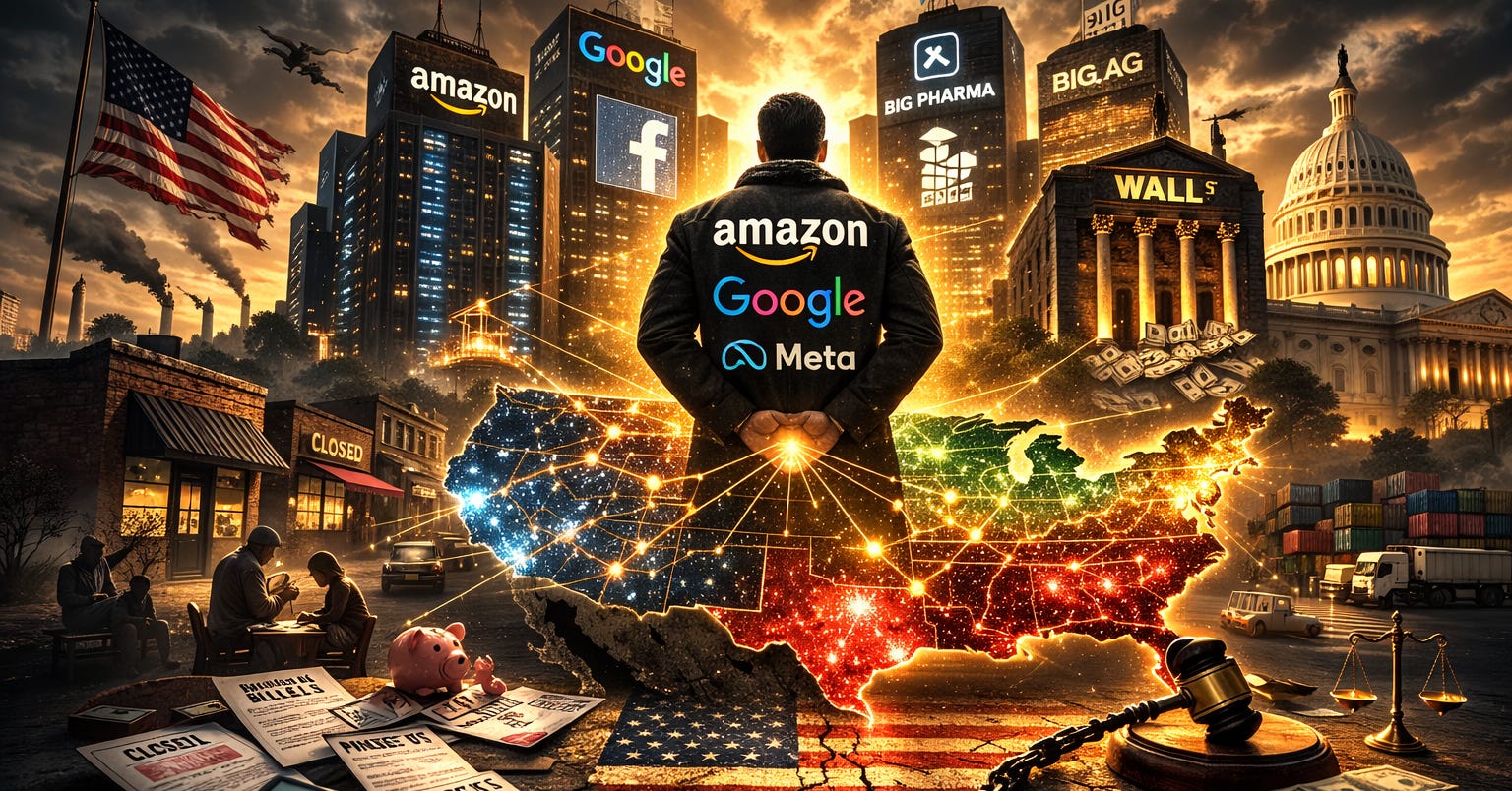
The Quiet Return of the Barons
If America feels harder to afford, navigate, and influence, it’s not your imagination. It’s the architecture. Over the past thirty years, we’ve quietly rebuilt something this country once fought to dismantle: a system where a handful of private empires decide what we pay, what we see, and how far our voices carry. This isn’t capitalism as advertised. It’s a 21st-century Gilded Age, run not by railroad tycoons and oil trusts, but by digital platforms, food giants, drug middlemen, and global logisticians whose power reaches deeper into daily life than anything the original barons could have dreamed.
The most telling part is how effortlessly it happened.
While Washington sank into gridlock, corporate consolidation marched forward with almost no resistance. Antitrust laws stayed on the books, but the government stopped enforcing them with any seriousness. Courts reinterpreted them into irrelevance. Regulators were hollowed out. Congress, captured by the very industries it’s supposed to oversee, looked the other way. The result is the kind of invisible governance Americans can feel but rarely see: higher prices, fewer choices, weaker local economies, and a political system that increasingly answers to consolidated wealth instead of the public.
We’ve been here before. The end of the 19th century was defined by industrial monopolies that grew so powerful they began dictating national policy. Today’s barons wield different tools — cloud computing instead of coal, vertical integration instead of railroads, data pipelines instead of oil — but the pattern is unmistakable. Concentrated power is once again functioning as a shadow government, and this time, it reaches straight into the kitchen drawer where you keep your bills.
The only question now is whether we recognize the pattern early enough to stop the sequel.
This Community Is Powered by You
What started as a small circle has grown into something much bigger, and it’s all because of readers like you.
Every time you forward this email, post it on socials, or bring someone new into the fold, you’re helping build one of the most passionate, independent political communities out there.
Want to keep the momentum going?
Share this newsletter with someone who should be part of this conversation.
Thank you for being here. It means everything.
How Government Stopped Fighting Monopolies and Why
America did not wake up one morning and decide monopolies were acceptable. There was no national vote, no sweeping repeal of antitrust law, no dramatic congressional declaration that market concentration was suddenly harmless. Instead, the shift happened quietly, through a slow-moving change in legal philosophy, regulatory posture, and political incentives that collectively rewired how power operates in the American economy.
For most of the 20th century, U.S. antitrust enforcement operated on a structural understanding of competition. Excessive concentration itself was considered dangerous. Lawmakers, regulators, and courts recognized that monopolies distort markets long before price effects become visible. Competition policy was designed not merely to prevent higher prices but to preserve economic liberty, prevent political capture, and stop private actors from accumulating state-like power.
That framework began to erode in the late 1970s.
A new school of thought, heavily influenced by the Chicago School of economics, reframed how courts and regulators interpreted the risk of monopoly. The central idea was deceptively simple. Market dominance was not inherently harmful unless it could be proven to raise consumer prices. Efficiency and scale became virtues. Bigness was no longer suspicious. Mergers, once viewed as dangerous, were now seen as a rational business strategy.
This intellectual shift had profound consequences.
Under the new logic, entire categories of anti-competitive behavior became far harder to challenge. Regulators now carried a heavier evidentiary burden. It was no longer sufficient to argue that consolidation reduced competition or increased systemic risk. Agencies increasingly had to demonstrate near-term, measurable consumer harm, typically defined through price effects, even when history suggested that monopoly damage often emerges slowly and indirectly.
Corporate America adapted quickly.
Industries consolidated at accelerating speed. Airlines merged. Telecommunications giants absorbed rivals. Media companies fused into sprawling conglomerates. Pharmaceutical intermediaries vertically integrated. Technology platforms scaled into gatekeepers. Each merger, viewed narrowly, could be defended as efficient. Collectively, they produced an economy where meaningful competition steadily declined.
Meanwhile, enforcement capacity weakened.
Antitrust litigation is among the most complex and resource-intensive forms of legal conflict. Major corporations deploy vast legal teams, armies of economists, and years of procedural delay. Federal regulators, by contrast, operate within fixed budgets and political constraints. Over time, agencies found themselves structurally outmatched, forced to pick fewer battles, stretch thinner resources, and accept settlements that rarely altered underlying market structures.
The imbalance became self-reinforcing.
As industries consolidated, the political influence of dominant firms expanded. Larger corporations command larger lobbying operations. Campaign finance incentives align with concentrated wealth. Regulatory agencies face persistent funding pressures. The revolving door between government and industry deepens institutional familiarity. None of this requires conspiracy. It emerges naturally from scale.
By the early 21st century, the posture of antitrust enforcement had fundamentally changed.
Government intervention became reactive rather than preventative. Cases often emerged only after markets were already captured. Remedies skewed behavioral instead of structural. Legal challenges stretched across years, sometimes decades. By the time regulators prevailed, competitive damage was frequently irreversible.
What appears from the outside as indidence is better understood as a systemic realignment of incentives, doctrines, and institutional capacity.
Washington did not formally abandon antitrust law. It gradually redefined what counted as harm, narrowed the circumstances in which intervention was justified, and allowed consolidation to reshape the terrain faster than enforcement mechanisms could respond.
Monopoly power did not break the system. It learned how to operate comfortably within it.
Mapping the Modern Barons: Who Actually Runs America Now
Monopolies rarely announce themselves as monopolies. They emerge gradually, often disguised as innovation, efficiency, convenience, or growth. No company campaigns on a promise to eliminate competition. No merger is marketed as a step toward concentrated power. Yet when entire sectors fall under the control of a handful of firms, the practical effect is indistinguishable from monopoly rule, regardless of what the market technically calls it.
Modern American dominance operates through something more sophisticated than the monopolies of the past. Instead of single-company control across obvious industries, power now concentrates through platform control, vertical integration, network effects, and infrastructure dependency. The result is a landscape where competition exists in theory but becomes increasingly fragile in practice.
To understand the scale of this shift, it helps to map where concentrated power actually lives.
The Platforms: Gatekeepers of Attention and Commerce
Digital platforms now function as economic and informational infrastructure. A small number of firms mediate how Americans search for information, communicate, shop, advertise, and distribute products.
Companies like Google, Meta, and Amazon do not merely compete within markets. They define the markets themselves. Their dominance rests on scale advantages that become nearly impossible for challengers to replicate: global data accumulation, advertising ecosystems, algorithmic optimization, cloud infrastructure, and deeply entrenched user networks.
This creates a structural asymmetry. New entrants are not simply competing against better products. They are competing against platforms that control discovery, visibility, distribution, and monetization.
Market power becomes self-reinforcing.
The more users a platform captures, the more valuable it becomes. The more valuable it becomes, the harder it is for alternatives to gain traction. Over time, entire economic activities — from retail logistics to digital advertising — begin orbiting a few dominant nodes.
The Pipelines: Control Over Connectivity
In theory, telecommunications markets are competitive. In practice, most Americans experience something closer to regional duopolies. Broadband access, mobile service, and data infrastructure are frequently dominated by two or three major providers whose pricing power is constrained only by limited competition.
Unlike traditional consumer markets, connectivity is not optional. It is a prerequisite for economic participation, education, access to healthcare, and social engagement. When infrastructure markets consolidate, consumers cannot meaningfully “shop around” as classical market theory assumes.
The market behaves less like competition and more like managed access.
The Pharmacies Without Walls: Vertical Integration in Healthcare
Few sectors better illustrate modern consolidation than healthcare. What once appeared as separate industries — insurers, PBMs, retail pharmacies, and drug distribution networks — have fused into vertically integrated ecosystems.
In this structure, the same parent corporation may influence:
which drugs are covered,
how prices are negotiated,
where prescriptions are filled,
and how reimbursement flows.
This is not a monopoly in the traditional single-firm sense. It is something arguably more powerful: systemic leverage across multiple layers of the same market.
Competition fragments. Control centralizes.
The Food Chain: Agricultural and Processing Concentration
American agriculture presents another paradox. Thousands of farmers operate across the country, yet processing, distribution, and commodity trading increasingly sit in the hands of a few dominant firms.
Farmers do not sell into fully competitive markets; they often negotiate with limited buyers possessing significant pricing leverage. Local processors disappear. Regional competition erodes. Supply chains centralize. When disruptions occur, the effects cascade nationally.
The Logistics Spine: When Scale Becomes Gravity
Retail, shipping, and fulfillment networks now exhibit similar dynamics. Scale advantages in warehousing, transportation optimization, and supply chain integration allow dominant players to operate at margins that smaller competitors cannot survive.
Smaller firms either disappear, become acquisition targets, or depend on the infrastructure of larger rivals. What remains is not a competitive field, but a hierarchy of dependency.
The New Barons Don’t Look Like the Old Ones, But the Math Is Familiar
The original Gilded Age monopolies controlled railroads, oil pipelines, steel, and banking. Today’s equivalents control search algorithms, digital marketplaces, drug pricing channels, food processing capacity, and cloud infrastructure.
The mechanisms differ. The outcome is strikingly similar.
Not through the absence of competitors, but through the concentration of control.
The Gilded Age Echo: How We’ve Seen This Pattern Before
America’s first Gilded Age did not begin with public outrage. It began with admiration.
Industrialists were celebrated as innovators. Consolidation was framed as progress. Vast fortunes were treated as evidence of genius rather than warning signs of imbalance. Railroads stitched the continent together. Oil barons fueled an industrial revolution. Steel empires reshaped skylines. Efficiency, scale, and modernization became the language of inevitability.
Beneath that optimism, however, the structure of power was quietly transforming.
By the late 19th century, a small circle of corporate titans had accumulated extraordinary control over the arteries of American life. Railroad monopolies dictated shipping rates. Oil trusts controlled distribution. Financial syndicates steered capital flows. Competition did not disappear overnight. It was gradually suffocated by entities whose size granted them pricing leverage, political influence, and the ability to neutralize rivals.
The parallels to today are difficult to ignore.
Then: Control Over Physical Infrastructure
Now: Control Over Digital and Economic Infrastructure
The barons of the 1800s dominated rail lines, pipelines, and industrial production. Control of transportation meant control of commerce itself. Modern dominance operates through digital platforms, cloud infrastructure, telecommunications networks, logistics giants, and pharmaceutical middlemen.
Then: Trusts and Combinations
Now: Vertical Integration and Platform Ecosystems
Standard Oil absorbed competitors and shaped entire markets. Today, companies achieve similar dominance through ecosystem control: platform + marketplace + logistics, or insurer + PBM + pharmacy.
Then: Political Capture Was Obvious
Now: Political Capture Is Systemic
Early industrial monopolies openly bought influence. Modern monopolies operate through sophisticated lobbying networks, revolving doors, and regulatory asymmetries.
The system does not look captured. It behaves captured.
Then: The Damage Became Visible Slowly
Now: The Damage Feels Personal
The first Gilded Age ended only when the consequences became unavoidable. Today’s warning signs — higher costs, fewer choices, brittle supply chains — are already visible.
History’s Most Important Lesson: Concentration Compounds
Modern monopolies reappear with new tools, new markets, and new mechanisms. The names changed. The mathematics did not.
The difference today is scale.
The Hidden Costs: How Monopoly Power Hits the Kitchen Table
The most dangerous thing about modern monopolies is how normal they feel. Americans don’t see a monopoly when their grocery bills jump 12%. They don’t call it consolidation when their internet bill rises. They don’t think about market power when flights disappear from regional airports.
Yet every one of these experiences traces back to concentration.
The Monopoly Tax: The Bill You Never Agreed to Pay
When dominant firms face limited competition, they quietly increase margins. Tiny increases add up to billions extracted from households, not by law, but by leverage.
It is the most regressive tax in America. The poorer you are, the more it hurts.
The Choices That Disappeared While No One Was Looking
Local stores vanish. Independent pharmacies close. Small news outlets die. Broadband and airline options shrink. When choices disappear, so does accountability.
Why Your Bills Keep Rising Even When the Economy Doesn’t
In concentrated markets, companies can raise prices without fear of losing customers. This isn’t inflation. It’s pricing power.
Workers Feel the Squeeze, Too, Often First
When employers consolidate, worker mobility collapses. Wage competition weakens. Bargaining power evaporates.
Brittle Systems, Local Pain
Consolidated supply chains break easily. Baby formula shortages, meatpacking shutdowns, and shipping delays are all symptoms of a system optimized for profit rather than resilience.
Life gets more expensive, less flexible, and more fragile.
It is not because people failed, but because systems concentrated.
Why Government Doesn’t Intervene: The Real Mechanics, Not the Myths
If monopoly power is so damaging, why doesn’t the government stop it?
The Revolving Door: Where Enforcement Goes to Die
Regulators know their most lucrative future jobs are in the industries they oversee. Aggressive enforcement becomes career-risky.
The Legal Choke Point: Courts Rewrote the Rules
Judges transformed antitrust from structural protection into price-centric analysis. Proving harm became nearly impossible.
The Lobbying Flood: Concentrated Wealth Buys Concentrated Influence
Dominant firms speak with unified, well-funded voices. They shape legislation, hearings, and policy narratives.
The Structural Reality: Congress Benefits from Concentration
Fewer, richer firms mean easier fundraising and fewer stakeholders to keep happy.
The Bureaucratic Constraint: Agencies Were Designed for Yesterday
The FTC and DOJ cannot regulate digital-era monopolies with 1970s staffing and statutes from the telegraph age.
The Political Payoff: Inaction Has Become the Default Setting
The system rewards accommodation, not enforcement.
The government doesn’t fail to stop monopolies. It is built not to.
The Breaking Point: When a Monopolized Nation Starts to Fail
Every era of concentrated power reaches a moment when the system stops bending.
Fragile Systems: When Efficiency Becomes a Liability
Centralized systems break dramatically: formula shortages, meatpacking shutdowns, ransomware attacks, shipping crises.
National Security Risks: When Corporate Consolidation Becomes Strategic Vulnerability
Concentration in cloud hosting, pharmaceuticals, logistics, and telecommunications creates single points of national failure.
The Democracy Connection: When Economic Power Becomes Political Power
When corporations control information, pricing, visibility, and supply chains, they wield governmental power without democratic accountability.
A democracy cannot remain healthy when the economy is governed by the few.
The Pattern Is Clear, And It Is Accelerating
Either the country reins in monopoly power,
or private empires continue replacing public authority.
The Real Question: What Do We Do Now?
The first Gilded Age ended only when the public demanded structural change. The same is required now.
Rebuild Structural Antitrust, Not Case-by-Case Symbolism
Shift legal standards back toward preventing concentration. Restore the idea that bigness itself can threaten the public.
Break Up Vertical Integration That Creates Systemic Leverage
Platform ecosystems and healthcare conglomerates must be structurally separated to restore bargaining power and competition.
Restore Agency Funding and Modernize Capacity
Increase budgets, hire technologists, update statutes, and shorten litigation timelines.
Introduce Public Alternatives Where Competition Is Impossible
Public broadband, postal banking, and generic drug manufacturing — fill the gaps left by private monopolies that threaten the public good.
Rein in Corporate Political Influence
Strengthen transparency, limit the revolving door, reform campaign finance, and restore conflict-of-interest rules.
Learn the Lesson of 1911: Reform or Rupture
Structural change arrives only when the public insists.
The New Gilded Age Only Ends If We End It
America has once again allowed private power to grow into public authority. Modern monopolies control platforms, pipelines, prices, and visibility. They influence politics, shape markets, and define choices. The danger is not theoretical. It is already reshaping daily life.
We rebuilt a Gilded Age without realizing it. Now we must decide whether to live in one.
Concentrated power is never invincible, but it is always entrenched until the public forces a reckoning.
The first Gilded Age ended because Americans demanded a new social contract. The second will end the same way if enough people choose it.
In the end, every era of concentrated power leaves the public with a choice:
Accept the system as it is or demand the country it was supposed to be.
If This Hit You in the Gut, Here’s How You Help Us Keep Going
Independent journalism doesn’t survive in a monopolized media landscape unless people like you keep it alive. The Coffman Chronicle runs on a simple idea: tell the truth plainly, follow the power, and put the kitchen table back at the center of American politics.
If you learned something today or if you felt that spark of “why isn’t anyone else talking about this?”, consider becoming a free or paid subscriber.
Every new subscriber helps us stay ad-free, algorithm-proof, and answerable only to readers, not corporate sponsors or political machines.
Subscribe → Share → Support independent media.
It’s how we build the country we’re owed, one kitchen-table story at a time.
Join The Coffman Chronicle and be part of the resistance to America’s new barons.
Sources:
“The FTC’s Role in Competition and Consumer Protection.” Federal Trade Commission, 2023.
“Are U.S. Industries Becoming More Concentrated?” Review of Finance 23, no. 4 (2019): 697–743.
“Amazon’s Antitrust Paradox.” Yale Law Journal 126, no. 3 (2017): 710–805.
Radical Markets: Uprooting Capitalism and Democracy for a Just Society. Princeton, NJ: Princeton University Press, 2018.
“Competition and Monopoly: Single-Firm Conduct Under Section 2 of the Sherman Act.” U.S. DOJ, 2008.
“Towards a Political Theory of the Firm.” Journal of Economic Perspectives 31, no. 3 (2017): 113–130.
U MUST GO AFTER trump NOW FOR ALL THE WAYS HE VIOLATED OUR CONSTITUTION!!!!!!!!!!!!!
Perhaps we're approaching another historic time of reckoning with the concentration of power in the U.S.
Senator Chris Murphy (D-CT) has just been quoted saying, "Paramount should enjoy its growing news monopoly while they have it because when Democrats win back power, we are going to break up these anti-democratic information conglomerates. All of them."
Vertical integration is a particularly insidious gambit that must also be addressed.