


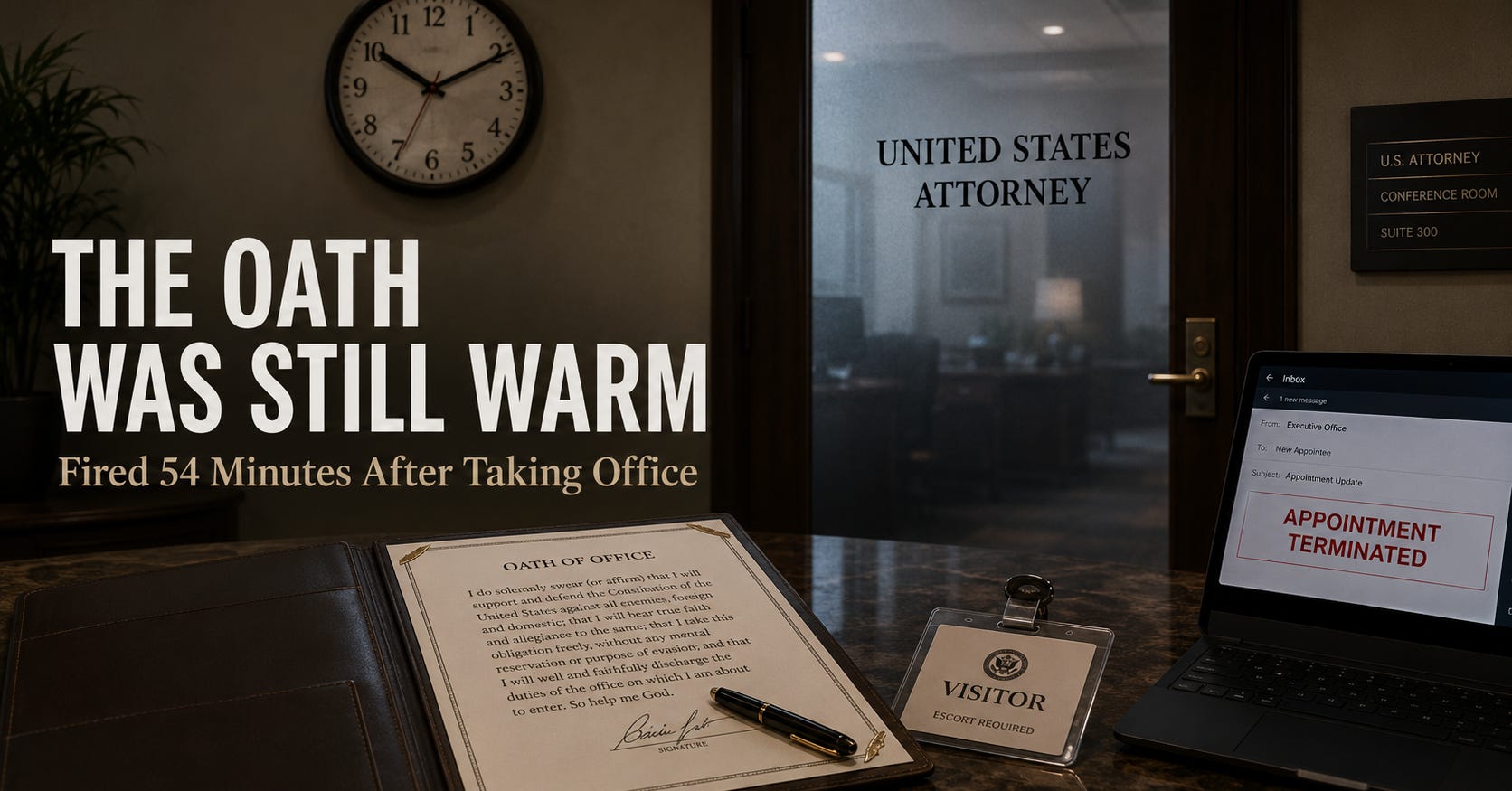
Roger Scott Rogoff had taken the oath. The federal judges of the Western District of Washington had unanimously appointed him United States attorney. The order carried the authority Congress had given them, and the oath carried the obligations of the office.
Then Rogoff crossed downtown Seattle to report for work.
He entered the U.S. Attorney’s Office and asked to meet Charles Neil Floyd, the official who had continued leading the office during the vacancy. Rogoff waited in the lobby. Before that meeting happened, an email arrived from the presidential personnel office. President Donald Trump had fired him. Less than an hour had passed since the oath.
Rogoff had not selected a prosecution, changed an enforcement priority, dismissed an attorney, or challenged a presidential directive. He had barely reached the office he had been appointed to lead.
The judges had followed the process Congress created. They accepted applications, used a merit-selection panel to screen candidates, and unanimously selected Rogoff to serve until the president nominated a permanent United States attorney and the Senate confirmed that choice.
The president did not answer the appointment by sending a nominee to the Senate. Instead, he answered by removing the prosecutor that the process produced.
Trump may have possessed the legal authority to do it. Federal law gives presidents broad power to remove United States attorneys, and Rogoff’s dismissal may eventually be tested in court, but another question was already waiting in the lobby with him.
What remains of Senate confirmation when a president can leave an office vacant, preserve his preferred official through temporary authority, and erase Congress’s backup process before it can function?
Roger Rogoff’s tenure lasted less than an hour. The vacancy had lasted more than three years.
Support independent media that follows the power.
The Coffman Chronicle is built to track who holds power, who abuses it, who profits from it, and who pays the price.
Paid supporters get full Tony Michaels Podcast episodes, deeper transcript analysis, paid columns, archives, and the reporting framework behind the show.
If you believe independent media has to survive outside billionaire platforms, corporate media, and party-approved gatekeepers, become a paid supporter today.
The Vacancy Was on Paper. The Power Was Not.
The title can make the dispute sound smaller than it is. A United States attorney is not simply another government lawyer. The office directs federal prosecutions, works with federal, state, and local investigators, and helps determine how the enforcement power of the United States will be used across an entire district.
Those choices reach the parent whose child died from a counterfeit pill, the worker whose employer may have defrauded the government, and the defendant facing prosecutors backed by the investigative and financial power of the United States.
A United States attorney does not make every decision alone. Career prosecutors, investigators, Justice Department officials, grand juries, and judges all play important roles. Laws, evidence, and professional obligations also limit what the office can do.
The person directing the office helps establish priorities, allocate limited resources, and decide which categories of cases receive institutional attention. That power can protect a community. It can also destroy a life when used carelessly, selectively, or for political purposes.
Citizens do not elect their United States attorney, and they cannot remove that official at the next local election. Their protection is structural.
The president selects a nominee. The Senate examines that person’s qualifications, independence, and potential conflicts. It may approve or reject the nominee, but either result identifies who has been chosen and places responsibility on elected officials whose judgment can be evaluated by the public.
Yet the Justice Department identifies Charles Neil Floyd, whose formal title is first assistant United States attorney, as the official leading the Western District of Washington. The position of United States attorney remains vacant, and Floyd has not been confirmed by the Senate to occupy it.
That does not prove he has abused his authority. It proves something more basic. The prosecutions continued, the investigations continued, and decisions continued being made in the name of the United States. The vacancy existed on paper.
The power did not.
Three Years Without a Confirmed Prosecutor
The vacancy began in June 2023, when Nicholas Brown resigned as United States attorney for the Western District of Washington. Brown had traveled the ordinary constitutional route. President Joe Biden nominated him, and the Senate confirmed him.
When Brown left, First Assistant United States Attorney Tessa Gorman became acting United States attorney. Attorney General Merrick Garland later appointed her interim United States attorney. When that appointment approached its statutory limit, the federal district court appointed her to continue serving.
The office remained open, and federal prosecutions continued. What did not happen was the step that the temporary system was supposed to support. Biden did not nominate a permanent successor, so the Senate never received a nominee to examine, approve, or reject.
In February 2025, the Trump administration removed Gorman. Months later, Attorney General Pam Bondi appointed Floyd as interim United States attorney under authority that generally lasts 120 days. That limit is supposed to preserve continuity while the president prepares a nomination and the Senate considers it. It is not supposed to create an indefinite alternative to confirmation.
As Floyd’s 120-day interim period approached its end, the Justice Department appointed him first assistant United States attorney on February 2, 2026. When the interim appointment expired, his practical role did not disappear. He continued leading the office.
By July 2026, the district had gone more than three years without a confirmed United States attorney. The federal judges then used the process Congress authorized for the period after an attorney general’s temporary appointment expires. A merit-selection panel screened the applicants. The active and senior judges considered the candidates and unanimously selected Rogoff.
His appointment contained its own ending. Rogoff would serve only until the president nominated someone and the Senate confirmed that person. The judicial appointment was not the destination. It was another bridge toward the ordinary constitutional process.
Trump demolished it almost immediately.
The government had repeatedly found ways to keep the office functioning without placing a permanent nominee before the Senate. That history prevents this from becoming a simple accusation that Trump alone created the problem.
The Biden administration allowed the vacancy to persist. The Senate never received a nominee, and Congress did not force the extended vacancy into sustained public scrutiny. The Trump administration inherited that institutional failure and pushed it further, preserving its preferred official through temporary authority while removing the court-appointed prosecutor before he could meaningfully serve.
This is how constitutional processes weaken. One administration leaves a responsibility unfinished. Another discovers that the unfinished arrangement creates room for greater control. The temporary solution becomes familiar because the work continues anyway. Then a prosecutor takes an oath, walks across downtown Seattle, and is fired before he can begin.
The district had not gone without federal prosecutorial power for three years. It had gone without the public confirmation process meant to place that power inside constitutional accountability.
Congress Built a Bridge, Not a Bypass
Congress did not expect every vacancy to be filled immediately. Presidents need time to identify nominees. Background investigations take time. Senate committees request records, schedule hearings, and examine qualifications. Meanwhile, federal prosecutions cannot stop whenever an office becomes vacant.
Congress, therefore, created a temporary system. The attorney general may appoint an interim United States attorney. That official may serve until a presidentially appointed prosecutor qualifies or until 120 days have passed. If the 120-day appointment expires first, the federal district court may appoint someone to serve until the vacancy is filled.
Every part of that structure points toward the same destination: presidential nomination followed by Senate advice and consent. Congress built a bridge across a vacancy. It did not build a bypass around the Senate.
Temporary appointment authority is easier to use than permanent appointment authority because it does not require the same public examination. That difference is tolerable only when the temporary arrangement remains a limited means of preserving continuity.
The temporary system assumes delay, but it should not assume abandonment. Trump could have ended the judges’ role through the ordinary process. He could have selected a nominee, sent that name to the Senate, and demanded a vote. A confirmed nominee would have displaced Rogoff without creating a confrontation over the court’s appointment power.
Instead, the administration preserved Floyd’s operational role, rejected the court’s selection, and continued without presenting a permanent nominee for public examination.
That sequence exposes the danger of evaluating each step in isolation. An interim appointment may be lawful. A first-assistant designation may be lawful. A presidential removal may be lawful. A prolonged vacancy may occur without violating a clear statutory deadline. Yet those actions can assemble into a structure that gives the executive branch continuing control without requiring the consent the permanent appointment process demands.
Every title can be explained. Every deadline can be said to have been observed. Every statutory provision remains printed on the page. The executive branch keeps control.
At some point, Congress must decide whether the system it created still serves the purpose for which it was written. A bridge is supposed to carry the government across a temporary gap. It is not supposed to make the other side unnecessary.
The President May Have Had the Power
Donald Trump may have possessed the legal authority to fire Roger Rogoff. Federal law states that each United States attorney is subject to removal by the president. It does not expressly limit that language to prosecutors whom the president nominated or the Senate confirmed. A Justice Department legal opinion has also concluded that the president possesses the power to remove a court-appointed United States attorney.
There is, however, a competing structural concern. Congress gave district courts appointment authority after the attorney general’s 120-day period ends. If the president may immediately remove every person the judges select, the backup authority can become impossible to exercise whenever the executive branch opposes the court’s choice.
The court appoints someone, the president removes that person, and nothing in the cycle produces the permanent nominee the statute expects. That tension may eventually require a court to decide how the appointment and removal provisions fit together.
Calling Rogoff’s firing clearly illegal would allow the administration to reduce the entire dispute to a matter of statutory interpretation. It could point to the removal language, the older legal opinion, and the executive character of federal prosecution. The larger constitutional failure would be obscured by the legal argument.
The more important fact is not that Trump necessarily violated a removal law. It is that he may have used a lawful removal power to defeat the purpose of another lawful process. Those are not the same accusation.
Trump did not remove a prosecutor whose judgment he had tested and rejected. Rogoff had not refused an administration priority, challenged a directive, or demonstrated insubordination. His disqualification appears to have existed before he took the oath. He was the person the judges selected rather than the person the administration wanted to keep in control.
The judges could exercise the authority Congress had given them, but the president could make their decision disappear before it had any practical effect.
That may be lawful, but that does not make it harmless. A court may eventually conclude that Trump had the authority to remove Rogoff. Such a ruling would settle an important legal question, but it would not place Floyd before the Senate, restore the confirmation hearing that never occurred, require the president to submit a nominee, or prevent the same sequence from happening again.
Trump may have possessed the power to fire Roger Rogoff. The question Congress must answer is whether any president should be able to use that power to make Senate confirmation optional.
The Government Got the Prosecutor. The Public Did Not Get the Process.
No single step tells the whole story.
Bondi appointed Floyd interim United States attorney. As his 120-day term approached its end, the Justice Department appointed him first assistant, allowing him to continue leading the office after the formal position became vacant again.
The judges appointed Rogoff under the authority Congress had given them. Trump removed him, Floyd remained in operational control, and no nomination went to the Senate.
That is how one power can empty another without formally abolishing it.
The statute says the judges may appoint. The president replies that he may remove. If removal follows immediately, the court’s authority still exists as text but no longer functions as an effective safeguard.
The Senate’s authority can be weakened in the same way. It technically retains the power to confirm a nominee, but it cannot examine a nomination the president never submits. Without a nominee, there is no public hearing about political loyalty, conflicts of interest, or prosecutorial independence. There is no recorded vote by which citizens may judge their senators.
There is only an internal staffing arrangement inside the executive branch. The government gets the prosecutor. The public does not get the process. Advice and consent is not a ceremonial approval attached to the end of a presidential personnel decision. It is an independent constitutional judgment assigned to a separate branch.
In the permanent appointment process, the president chooses, and the Senate examines. Neither branch is supposed to complete that process alone. That friction is not evidence that government has failed. It is the safeguard.
The Senate cannot excuse its absence by pointing out that no nomination has arrived. Congress writes the statutes governing temporary appointments. It conducts oversight of the Justice Department, controls appropriations, and can define how long temporary arrangements may continue.
The Senate is not powerless because the president refuses to invite it into the process. It is powerless only if it accepts the refusal.
This is the heart of Article I populism. When Congress gives up power, the people lose power. The loss does not primarily belong to the senators whose committee hearing never takes place. It belongs to the citizen who never hears the nominee answer questions, the community whose concerns are never raised, and the voter who never receives a confirmation vote by which to judge the people sent to Washington.
Seattle Is Not the Whole Story
Rogoff’s tenure was extraordinary. The conflict that produced it was not.
Across several federal districts, the Trump administration has tested how long preferred prosecutors may exercise authority without Senate confirmation and what personnel arrangements may preserve that authority after temporary terms expire. The legal details differ, but the institutional pattern is becoming familiar.
In New Jersey, the administration attempted to preserve Alina Habba’s authority after her interim term ended. A federal judge rejected the arrangement, and the United States Court of Appeals for the Third Circuit upheld that conclusion. The appeals court ruled that Habba could not become acting United States attorney merely because the attorney general designated her first assistant after the vacancy arose, and it rejected the attempt to give her the full powers of the office through delegation.
Federal judges later appointed career prosecutor Robert Frazer with the agreement of the Justice Department, ending the confrontation without pretending the statutory limits did not matter. That resolution showed that conflict was not inevitable.
In Virginia, a federal judge concluded that Lindsey Halligan had been unlawfully appointed and that the indictments she had brought against former FBI Director James Comey and New York Attorney General Letitia James had been dismissed without prejudice.
The ruling did not establish that either defendant could never be prosecuted. It established that the government must use a lawfully authorized prosecutor when exercising the immense power to seek an indictment.
New York produced another confrontation. After a federal court disqualified John Sarcone from continuing as the top federal prosecutor in the Northern District of New York, the district’s judges appointed Donald Kinsella. The Justice Department moved to fire Kinsella the same day.
Seattle did not create this pattern. It displayed it with unusual clarity. The administration’s preferred official remained available to direct the office. The judges appointed someone under federal law, and the president removed him before the welcome was over.
What took months of litigation to expose elsewhere became visible in less than an hour. The pattern does not prove that every administration decision was unlawful. Nor does it prove that every court-appointed prosecutor was the best available choice. It does show repeated efforts to preserve executive control without completing the ordinary nomination-and-confirmation process.
Investigations continue. Grand juries meet. Indictments are sought. Defendants appear in court and spend money on their defense.
The country should not have to rely on individual defendants to enforce appointment law one prosecution at a time. By the time a court concludes that an official lacked authority, the government may already have searched homes, issued subpoenas, damaged reputations, and set the machinery of prosecution in motion.
Appointment rules exist before those consequences occur for a reason.
Seattle is not the whole story. It is simply the cleanest picture of the story.
The Prosecutor at the Kitchen Table
Federal appointment law can sound distant from ordinary life. Terms such as acting official, first assistant, judicial appointment, and removal authority belong to statutes, court orders, and Senate committees.
The power governed by those terms does not remain there. It arrives when federal agents knock on a door, when a business receives a subpoena, when a public official learns that a grand jury is investigating, or when a defendant stands in court facing the full authority of the United States. Someone helps decide whether that machinery moves.
The question is whether people living under federal prosecutorial power should have to trust an arrangement they were never given a meaningful opportunity to examine through their representatives.
Senate confirmation does not give citizens direct control over a prosecutor, but it does give them visibility. A nominee’s record becomes public. Senators may ask about conflicts, judgment, and independence. Local concerns may be raised. The nominee may have to explain how the office will distinguish lawful enforcement priorities from political retaliation. The hearing may be partisan, the answers may be incomplete, and the senators may still fail. The process nevertheless creates a public record.
Most citizens will never know the name of the United States attorney in their district until something has gone wrong. A loved one dies from fentanyl. A business is raided. A mayor is indicted. A police department faces a civil rights investigation. Only then does the structure become visible.
By that point, the appointment question may already have influenced how the office used its power.
Constitutional safeguards are supposed to operate before federal authority reaches the front door. That is why divided responsibility matters even when it slows government down.
The person who may direct the power to investigate your employer, your mayor, your neighbor—or you—should not remain in control merely because the executive branch found the right sequence of temporary titles.
That person should be identified, examined, and placed before the Senate. The senators should then be required to place their own names beside the decision.
The kitchen table does not need another promise that the government has everything under control. It needs proof that no one controls too much of it.
Congress Must Make Temporary Mean Temporary
The answer is not to make Rogoff permanent, nor to give federal judges lasting control over prosecutors, or to prevent presidents from removing executive officials whose judgment they no longer trust. The answer is to make the ordinary constitutional process unavoidable again.
The president must nominate. The Senate must examine. Temporary officials should preserve continuity only until those steps occur.
Congress should begin with a complete national accounting. The Justice Department should be required to identify every United States Attorney’s Office led by an acting, interim, court-appointed, or first-assistant official. It should disclose when each vacancy began, which authority supports the current arrangement, and how long the person directing the office has exercised its highest responsibilities without Senate confirmation. The public should not have to reconstruct that information from scattered press releases, personnel pages, and criminal challenges. The department knows who is exercising the power. Congress should require it to say.
Lawmakers must also close the title-change loophole. An interim appointment should not expire on paper while the same individual continues exercising substantially the same authority under another title. A 120-day limit means little if the calendar runs out, but the control remains. Someone must keep the office operational. Career officials must supervise employees, protect evidence, meet court deadlines, and keep ongoing cases from collapsing.
However, continuity is not the same thing as indefinite control. After an interim period expires, Congress should limit how long the same person may continue functioning as the head of the office unless a permanent nomination is moving through the Senate.
Congress should also require immediate notice when a president removes a court-appointed United States attorney. The notice should explain who will direct the office afterward, which authority supports that arrangement, and whether the president intends to submit a permanent nominee.
That would not require the president to obtain permission before exercising removal authority, but rather require the executive branch to own the consequence publicly.
Extended vacancies should trigger automatic oversight. Once a district has gone a defined period without a confirmed United States attorney, the Senate Judiciary Committee should require formal testimony from the Justice Department.
Lawmakers should ask why no nominee has been submitted, whether home-state senators are blocking consideration, whether the White House is preserving temporary control, and when the administration expects the vacancy to end.
The answers may place responsibility in different places. That is the point. A public deadline would make it harder for every branch to hide inside the vacancy.
Congress should also provide expedited judicial review when the legality of a prosecutor’s appointment threatens pending cases. The government should not direct investigations and seek indictments for months before anyone resolves whether the prosecutor possessed lawful authority.
None of these reforms would guarantee virtue. A president could submit an unqualified loyalist. Senators could protect that nominee. The opposition could obstruct a qualified candidate. Confirmation could still become partisan theater, but constitutional government does not avoid failure by eliminating the public process through which failure can be seen and judged.
It creates responsibility. The president must defend the nominee. Senators must defend their votes. The public must judge both.
That obligation does not belong to one party. Democrats should not defend the workaround because a future Democratic president may find it convenient. Republicans should not defend it because Trump is using it now. Senators who surrender confirmation for partisan advantage will not control which president inherits the stronger executive authority.
The office will remain. The precedent will remain. The weakened Senate will remain. Congress does not need to decide that Trump acted illegally before it responds. It needs to recognize that the law may permit exactly the result its constitutional structure was meant to prevent: the executive branch controls the office, the temporary deadline expires, the court appoints someone, the president removes that person, and the same unconfirmed official continues leading the office.
If that sequence is lawful, then the law is incomplete. Congress built the bridge. Congress must now make sure it reaches the other side.
An Oath Should Last Longer Than the Welcome
Rogoff had crossed downtown after taking the oath. The judges had signed the appointment order, and the office he was supposed to lead was on the other side of the doors. Then the email arrived. The welcome had not finished before the president ended his tenure.
Trump may ultimately persuade a court that nothing unlawful happened. The statute may be read to give the president authority to remove a United States attorney regardless of whether the appointment came from the White House, the attorney general, or the federal judges.
That conclusion would matter. It would not explain why Western Washington had gone more than three years without a nominated and confirmed prosecutor. It would not explain why the administration’s preferred official could remain in operational control after his interim appointment expired.
It would not explain why the judges’ lawful appointment was answered with removal rather than a nomination, and it would not place anyone before the Senate.
Rogoff did not own the office. The judges who appointed him did not own it either. Floyd does not own it because the Justice Department placed him in leadership, and Trump does not own it because the president directs the executive branch.
The office belongs inside a constitutional structure designed to prevent any one of them from controlling the entire process.
A president may understandably want prosecutors who will carry out the administration’s lawful priorities. Elections have consequences, and no president should be forced to accept permanent control of an executive office by judges whose choice the administration opposes, but the constitutional answer is not indefinite temporary government.
It is nomination, examination, and either consent or rejection. It is a public record showing who was chosen, what that person said, and which senators agreed to place federal prosecutorial power in that person’s hands.
That process may be slower than a personnel email. It may expose a weak nominee or force senators to take a vote they would rather avoid. That is why it matters. The Constitution did not divide power because divided government would always be efficient. It divided power because efficiency becomes dangerous when the same branch chooses the officer, preserves the officer’s authority, and avoids outside consent.
Temporary appointments are necessary because the government cannot stop whenever an office becomes vacant. They become dangerous when necessity erases the destination.
The Western District of Washington did not lack federal power. It lacked confirmed accountability. The doors remained open, the lights remained on, and the prosecutions continued. Only the public process remained vacant.
Fifty-four minutes revealed what more than three years had hidden.
The executive branch could retain practical control. The judges could follow the statute. The president could erase their result, and the Senate could remain absent.
Congress must decide whether that arrangement is acceptable.
It can leave the law untouched and allow future presidents to use the same sequence. It can wait for criminal defendants to challenge appointments after indictments have been issued while senators release statements about a power they have declined to defend, or it can make temporary mean temporary. That would not guarantee virtue, but it would restore responsibility. The president would own the nomination, the Senate would own the decision, and the public would own the judgment.
Roger Rogoff’s oath lasted 54 minutes. The vacancy lasted more than three years. Between them sits a warning. A lawful appointment can be made meaningless. A lawful removal can concentrate power. A temporary arrangement can become permanent without anyone admitting that the permanent process has been abandoned.
The country should not need another 54-minute prosecutor to understand what is happening. An oath should last longer than the welcome. A statutory safeguard should last longer than the president’s patience, and the Senate’s constitutional authority should not disappear simply because the executive branch has learned how to govern without it.
Support Independent Media - The Coffman Chronicle
The Coffman Chronicle exists to follow power, expose the pattern, and defend the constitutional safeguards that protect ordinary people before government power reaches their front door.
If that kind of independent journalism matters to you, please share this article. And if you can afford to support the work, please consider becoming a paid subscriber to the Coffman Chronicle.
Sources:
“28 U.S.C. § 541: United States Attorneys,” Office of the Law Revision Counsel, U.S. House of Representatives, accessed July 16, 2026.
“28 U.S.C. § 546: Vacancies,” Office of the Law Revision Counsel, U.S. House of Representatives, accessed July 16, 2026.
“Article II, Section 2, Clause 2: Advice and Consent,” Constitution Annotated, Library of Congress, accessed July 16, 2026.
“Charles Neil Floyd Appointed Interim U.S. Attorney for the Western District of Washington,” U.S. Attorney’s Office for the Western District of Washington, October 6, 2025.
“Court Names New Jersey Federal Prosecutor, Ending Standoff with Trump Administration,” Reuters, March 23, 2026.
“In re: Appointment of Roger Scott Rogoff as United States Attorney Pursuant to 28 U.S.C. § 546(d), General Order 09-26,” U.S. District Court for the Western District of Washington, July 15, 2026.
“Meet the First Assistant U.S. Attorney,” U.S. Attorney’s Office for the Western District of Washington, February 3, 2026.
“Power to Remove Court-Appointed U.S. Attorneys,” Office of Legal Counsel, U.S. Department of Justice, November 26, 1979.
“Trump Administration Moves to Fire New U.S. Attorney Appointed by Judges,” Reuters, February 12, 2026.
“Trump Fires Judges’ Pick for Top Federal Prosecutor in Seattle,” Reuters, July 15, 2026.
“United States of America v. Julien Giraud, Jr., et al., Nos. 25-2635 and 25-2636,” U.S. Court of Appeals for the Third Circuit, December 1, 2025.
“U.S. Judge Tosses Cases Against Ex-FBI Chief Comey, New York Attorney General James,” Reuters, November 24, 2025.
“54 Minutes,” Governing, July 16, 2026.
At a minimum, everyone in any public office who continues to support him needs to be removed from office. Ideally.