


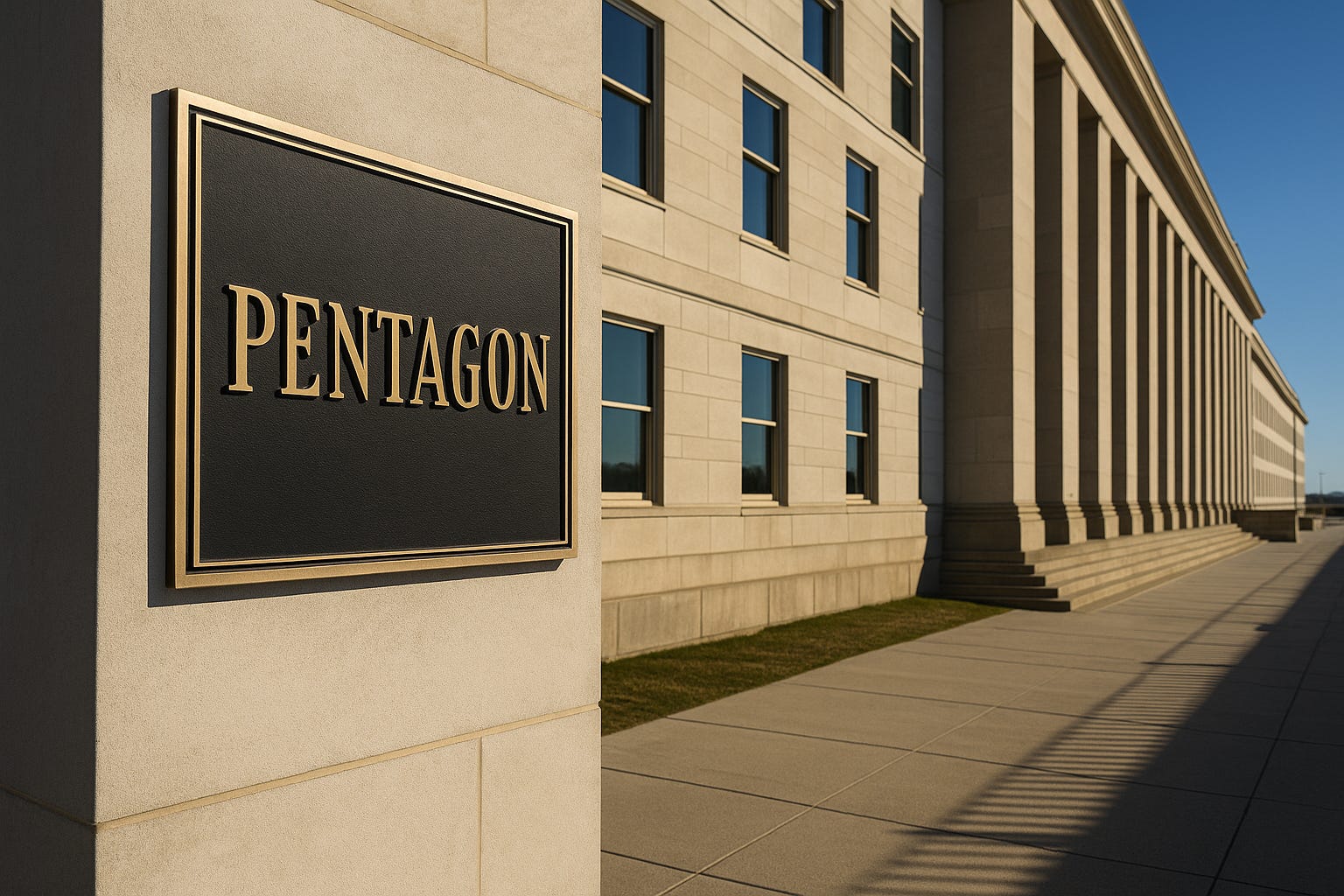
On September 19, 2025, the Pentagon issued a 17‑page memo that demands credentialed journalists covering the military—now being styled the “Department of War”—sign a pledge. The memo requires that even unclassified information cannot be published unless it has been approved in advance by an “appropriate authorizing official.” Refuse to sign or violate the agreement, and your Pentagon credentials can be revoked. Journalists will have restricted movement in the building and limited access to areas they once roamed freely.
This is the headline, but what it suggests about intention is far darker.
Stay Informed. Stay Loud.
Subscribe to The Coffman Chronicle for no-BS political analysis, action guides, and daily truth bombs you won’t get from corporate media.
What We Know: Terms of the Memo and Key Dates
The document, which circulated on September 19, tightened earlier restrictions. It doesn’t only target classified secrets. It explicitly reaches into unclassified territory. According to the memo, journalists must pledge not to collect or report information without official authorization; failure to do so will result in loss of access. Secretary of Defense Pete Hegseth reinforced the policy in a post on X (formerly Twitter): “The ‘press’ does not run the Pentagon—the people do. The press is no longer allowed to roam the halls of a secure facility. Wear a badge and follow the rules—or go home.” Journalists now require a government escort to access many parts of the building, areas that were previously accessible.
Press groups immediately sounded alarms. Mike Balsamo, president of the National Press Club, called the demand “a direct assault on independent journalism at the very place where independent scrutiny matters most: the U.S. military.” Seth Stern of the Freedom of the Press Foundation warned that this is textbook prior restraint—“the most serious” kind of First Amendment violation.
Why Now? Two Fronts of Militarization
Foreign: Venezuela and Unverified Strikes
In recent weeks, the U.S. has conducted strikes on vessels allegedly tied to drug trafficking out of Venezuela. Roughly three such strikes have killed about fifteen people. The government claims cartel involvement, while public evidence remains thin. Eyewitnesses report that at least one of the boats appeared to be a typical fishing vessel. No independent verification has been published confirming cargo with drugs or confirming criminal affiliation. If civilian lives were lost under false pretenses, those casualties could inflame public outrage.
The memo limiting what journalists may report, even about unclassified information, functions in this context not as a safeguard against true operational compromise but as a shield against exposure. Exposure of civilian deaths, misuse of force, mistaken identity—those are the kinds of revelations that could delegitimize an administration’s justification for foreign strikes.
Domestic: The National Guard—Memphis and Beyond
On September 12, 2025, President Trump announced the deployment of the National Guard to Memphis, Tennessee, under the banner of combating crime. This follows prior deployments to Washington, D.C., and Los Angeles. In Memphis, like in LA, local leaders note violent crime is down in many categories. The Legal Defense Fund issued a statement stating that the claimed crime emergency is false and that the deployment represents the misuse of federal resources to occupy a city “against the will of its local leaders and its residents.”
Memphis City Council members are considering legal action over the deployment. Critics question under what lawful authority the Guard is being federalized, whether civil liberties are being overridden, and whether the press will be allowed to report fully on what the troops are doing, who they are engaging, whether rules of engagement are clear, and what oversight exists.
Constitutional Boundaries: What the Courts Have Said
American jurisprudence sets a high bar for government suppression of speech and the press, particularly regarding prior restraint. In New York Times Co. v. United States (1971), the Supreme Court rejected an attempt by the government to block publication of the Pentagon Papers, even though many of the documents were classified. The Court insisted that to stop publication in advance, the government must show direct, immediate, and irreparable harm. Embarrassment, political fallout, or criticism do not qualify.
After 9/11, many feared that journalism was revealing too much (“maps,” locations, vulnerabilities). In those cases, courts listened, but the government rarely succeeded in obtaining broad prior restraints. Now, by contrast, unclassified information is being made contingent on Pentagon approval, regardless of whether it meets the legal standard of harm.
The Pattern: Testing the Limits
Look at the timing and cumulative changes:
The administration formally rebranded “Defense” as “War,” shifting language and culture.
Press facilities and offices have been reshuffled: major media organizations have been removed from their longtime Pentagon offices, and new outlets have been rotated in.
Movement restrictions inside the Pentagon, paired with the removal of access and demands for non‑disclosure, even of unclassified information.
National Guard deployments in blue, Democratic-led cities under broad claims of crime and immigration threats.
These are not isolated events. Each step loosens constraints, tests reaction, and normalizes expanded military and executive power. Each step is small enough that many Americans don’t immediately connect them, but together they form a strategy.
What Experts Are Saying
Kevin Baron, former vice president of the Pentagon Press Association, covered the Pentagon beat for 15 years. He told TIME this move is “100% an intimidation tactic… an attempt to kill transparency and funnel all public information through the government.” Seth Stern said the order is “fundamentally un‑American.”
Media organizations, including the Society of Professional Journalists and the National Press Club, are warning that the agreement undermines democracy.
Why It Matters for You
If you accept this kind of censorship now, saying, “Well, it’s just for Memphis, or just for Venezuelan boats”, you may not notice when it’s your zip code next.
If reporting must be filtered through government approval, the stories that Americans need to see—mistakes, abuses, civilian deaths—can be buried. The justification of “order,” “security,” and “crime” becomes a cover. The guard troops you cheered for elsewhere may one day appear in your neighborhood.
This is not hypothetical. It is happening, and the degree to which people believe the threat is always external determines how long until they feel it personally.
What the Judiciary Could Do (if We Let Them)
Courts have previously struck down broad executive actions that violate constitutional guarantees, under the prior restraint doctrine, under Posse Comitatus (which limits the military's role in domestic law enforcement), and under Tenth Amendment constraints. If journalists or civil rights groups challenge this Pentagon memo, there's substantial precedent for court rulings in favor of press freedom and state rights.
Conclusion
The Pentagon’s new memo isn’t merely about protecting sensitive military operations. It is a test of what people will tolerate: unaccountable foreign strikes, quietly deployed troops in American cities, press censorship, and the removal of transparency.
Timely activism, journalism, and legal challenges are the roadblocks in this moment. If Americans remain quiet, these aren’t temporary measures. They are the blueprint for further erosion of freedoms, ones that will not stay confined to other people’s neighborhoods.
Stay Informed. Stay Loud.
Subscribe to The Coffman Chronicle for no-BS political analysis, action guides, and daily truth bombs you won’t get from corporate media.
Sources:
“Pentagon steps up media restrictions, now requiring approval before reporting even unclassified info,” Military.com, 21 September 2025.
“Pentagon demands journalists sign pledge not to gather certain information,” The Guardian, 20 September 2025.
“Trump’s Pentagon says press must agree not to disclose sensitive information,” Reuters, 21 September 2025.
“LDF Condemns Memoranda Targeting Memphis,” Legal Defense Fund, 16 September 2025.
“It’s a band‑aid: Tennessee lawmakers react to Trump sending National Guard to Memphis crime,” Fox Chattanooga, 12 September 2025.
“News outlets criticize Pentagon's new restrictions on media coverage,” Reuters, 21 September 2025.
“‘Nothing stops reporters’: Trump talks down Pentagon restrictions on journalists,” The Guardian, 21 September 2025.

Wake up America, Trump is trying to grab control of the press!!!
Hey at least department of war is more honest. Probably signals they're about to push forward with aggressive action